Location Code
In global logistics and maritime transport, location code associated with shipping container is a multifaceted concept that encompasses several standardized yet interconnected coding systems. Each of these systems answers key questions: What type of container is it? Where is it located? What is it used for? And what condition is it in?
A location code is essentially a standardized alphanumeric sequence that provides essential information about a container throughout its entire movement in the supply chain – from shipping companies and ports to customs authorities and cargo owners. These codes are the backbone of safe, efficient, and automated handling of millions of containers worldwide.
The term “Location Code” can refer to:
- Identification codes (ISO 6346): Unique “license plate” of the container.
- Position codes on ship (Bay-Row-Tier): Coordinates of position on deck/cargo space.
- Geographic codes (UN/LOCODE): Standardized designation of ports, terminals and other logistics nodes.
- Size and type codes: Description of container dimensions and construction.
- Damage codes (CEDEX/IICL): Systematic network of points for precise localization of damage.
Understanding these codes is essential for anyone operating in the world of international trade and logistics.
Primary Identification Code: Container Number (ISO 6346)
Structure and Standardization
ISO 6346 standard (currently ISO 6346:2022) represents the international standard for identification, coding and marking of intermodal containers. It is managed by the Bureau International des Containers (BIC) in Paris. It ensures that each container is uniquely identifiable and traceable on a global scale throughout its lifetime.
Container number always has 11 characters and consists of these parts:
| Part | Description | Example |
|---|---|---|
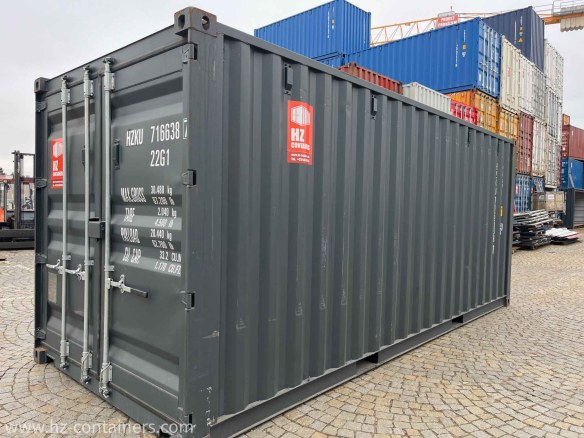
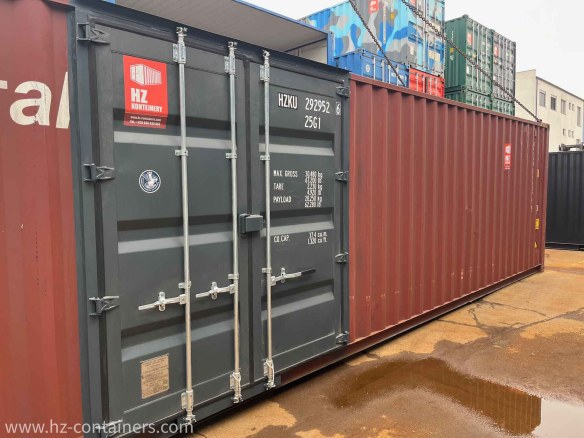
| Prefix (owner) | 3 capital letters registered with BIC, identifying the owner or main operator | HZK |
| Category identifier | 1 letter: U (freight container), J (equipment), Z (chassis) | U |
| Serial number | 6 digits, unique within the owner’s fleet | 123456 |
| Check digit | 1 digit calculated by mathematical algorithm for verification | 7 |
For example, HZKU1234567
- HZK = owner HZ CONTAINERS Ltd.
- U = freight container
- 123456 = unique serial number
- 7 = check digit (verifies entry, minimizes errors)
Number validation:
The check digit is calculated by an algorithm that assigns a value to each character and creates a checksum. A mismatch indicates an error in entering the container number.
Official prefix registry:
BIC maintains a publicly available prefix registry at: bic-code.org
Container Description: Size and Type Codes (ISO 6346)
Size and type code is a four-character alphanumeric code located below the container number. It allows quick identification of container dimensions and construction, which is key for planning transport, stacking and handling at ports.
Code Structure
| Position | Meaning | Examples |
|---|---|---|
| 1st character | Length (in ISO code) | 2 = 20 feet, 4 = 40 feet, L = 45 feet |
| 2nd character | Height/width | 2 = 8’6″ (standard), 5 = 9’6″ (High Cube) |
| 3rd–4th character | Type/purpose | G1 = basic closed, R1 = refrigerated, U1 = open-top, P1 = platform, T1 = tank |
Table of Most Common Size/Type Codes:
| Code | Meaning |
|---|---|
| 22G1 | 20′, standard height, closed container with ventilation |
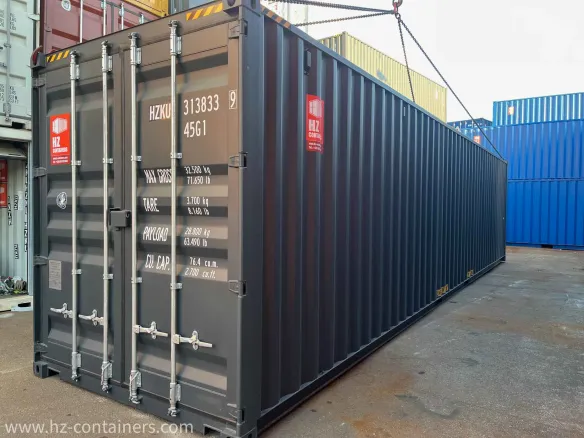
| 45G1 | 40′, High Cube, closed container |
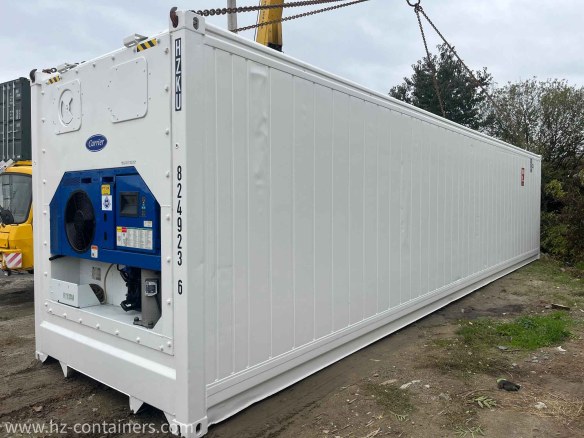
| 22R1 | 20′, refrigerated (reefer) |
| 42U1 | 40′, open-top (open roof) |
| 20P1 | 20′, platform (flat rack) |
| 22T1 | 20′, tank container |
Standardization:
ISO 6346 defines hundreds of combinations of size and type codes.
Precise Position Determination: Stowage Codes (Bay-Row-Tier)
When stacking containers on a container ship, a three-dimensional Bay-Row-Tier system is used, which precisely determines the position of each container.
System Structure
- Bay (transverse position):
- Even numbers for 40′ containers (e.g., 02, 04, 06 – from bow to stern)
- Odd numbers for 20′ containers (01, 03, 05…)
- One 40′ container occupies the space of two 20′ bays.
- Row (longitudinal row):
- Numbers from the centerline:
- Even on the left (port side): 02, 04, 06…
- Odd on the right (starboard): 01, 03, 05…
- Center row (with odd number): 00
- Numbers from the centerline:
- Tier (layer – height):
- Below deck: 02 (bottom), 04, 06…
- Deck: 82, 84, 86… (often starts with 80 or 82, depending on the ship)
- Example: Code 080384 means Bay 08 (40′), Row 03 (starboard), Tier 84 (second level on deck).
Practical Significance
- Precise records allow planning ship balance, quick unloading and minimizing errors.
- The system is always recorded in ship documents and port planning software.
Identification of World Locations: UN/LOCODE for Ports and Terminals
UN/LOCODE (United Nations Code for Trade and Transport Locations) is a worldwide standard for designating ports, airports, terminals and other key logistics locations.
Code Structure
- 5 characters (letters, possibly digits 2–9)
- First 2 characters: country code according to ISO 3166-1 alpha-2 (e.g., CZ, DE, CN)
- Next 3 characters: unique location code (e.g., PRG – Prague, HAM – Hamburg)
- Each location has a defined set of functions (port, airport, rail terminal, etc.)
Examples:
| Code | Name | Function |
|---|---|---|
| CZPRG | Prague | Airport, inland terminal |
| DEHAM | Hamburg | Port |
| NLRTM | Rotterdam | Port |
| SGSIN | Singapore | Port, airport |
| USLGB | Long Beach | Port |
- UN/LOCODE is used in transport documents (e.g., bill of lading, customs declaration) as a clear, machine-readable identifier.
Damage Localization: Damage and Repair Codes (CEDEX, IICL)
Significance and Standardization
Container damage is a common occurrence and its precise localization is essential for efficient repairs, insurance and record-keeping. For this purpose, CEDEX (ISO 9897) and IICL (Institute of International Container Lessors) standards were created.
Damage Location Code Structure
A typical code consists of four parts:
| Position | Meaning | Examples |
|---|---|---|
| 1st character (face) | Side of container (R = right, L = left, T = roof, U = chassis, F = front wall, D = door wall) | L |
| 2nd character (segment) | Upper/lower half (T = top, B = bottom, X = both) | B |
| 3rd character (section) | Section number (e.g., 1–5 for 20′, 1–10 for 40′) | 4 |
| 4th character (specification) | Additional info, often N (or other letter) | N |
Example:
Code LB4N means:
- L = left wall
- B = lower half
- 4 = fourth segment
- N = location/type of damage
According to CEDEX, damage type codes are further used (e.g., D = dent, C = crack, R = rust, H = hole), material (S = steel, W = wood) and extent.
Why is this important?
- Standardization enables global communication between shipping companies, repair shops, depots and insurance companies.
- Automated systems, inspection drones and IoT devices today use these codes for digital records and quick repair assessment.
Other Operational and Safety Markings
Weight and Volume Data
Each container must have basic technical data permanently and legibly marked:
- MAX. GROSS (maximum gross weight): Total maximum weight of container including cargo (e.g., 30,480 kg).
- TARE: Weight of empty container (e.g., 2,200 kg).
- NET (PAYLOAD): Maximum cargo weight (MAX. GROSS – TARE).
- CU. CAP. (volume): Internal volume in m³ and ft³.
CSC Plate (Convention for Safe Containers)
CSC plate is a mandatory safety plate that confirms the container meets the requirements of the International Convention for Safe Containers (CSC). It contains:
- Date of manufacture
- Manufacturer identification
- Maximum permissible load
- Permissible load when stacking
- Racking test value
- Date of last/intended safety inspection
A container without a valid CSC plate must not be used in international transport.
Digital Future: From Physical Codes to Digital Twins
With the development of digitalization, containers are increasingly connected with digital twins – online records containing complete history, location, specifications and condition.
Technologies:
- GS1 Digital Link: QR code enabling instant access to complete container information.
- IoT & GPS: Sensors report location, temperature, humidity, door opening, etc. in real time.
- Inspection automation: Drones and AI recognize and encode damage according to CEDEX/IICL standards.
These technologies do not replace classic codes, but complement them and increase transparency and efficiency of the entire process.
 Beroun, Czech Republic
  FREE SHIPPING