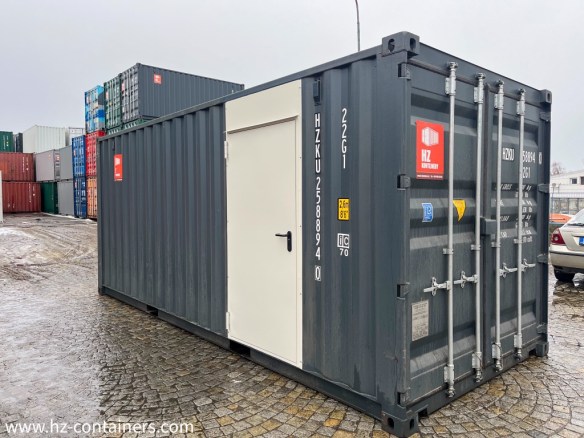
CEDEX (ISO 9897)
CEDEX (Container Equipment Data Exchange) is an international standard defined by the norm ISO 9897, designed for electronic data exchange on container equipment in global logistics. This standard enables efficient and unambiguous communication between all entities involved in the management of shipping containers — owners, leasing companies, depots, repair facilities, and carriers. CEDEX standardizes the language for describing the condition, damage, repairs, materials, and components of containers using precisely defined alphanumeric codes.
Without CEDEX implementation, the exchange of information about container repairs and condition was often inefficient, time-consuming, and prone to errors caused by language barriers or different terminology. CEDEX enables automated data processing, reduces management costs, and significantly accelerates the entire process.
Principle and Structure of CEDEX
Operating Principle: From Words to Codes
CEDEX/ISO 9897 is built on a system of unique codes that assign meanings to individual “data elements” commonly used throughout the entire lifecycle of a container:
- Components (e.g., door gaskets, floor cross members)
- Damage location
- Type of damage
- Material used
- Proposed repair type
- Condition classification
Instead of descriptive text (“Right bottom corner post dented, requires replacement”), inspectors record a series of precisely defined codes. The result is a structured, machine- and human-readable report that can be automatically processed and archived.
Main Benefits of CEDEX:
| Advantage | Description |
|---|---|
| Clarity | Unambiguous coding eliminates various interpretations across languages and companies. |
| Automation | Enables machine processing of estimates, repair approvals, invoicing, etc. |
| Speed and Efficiency | Reduces information transfer time and lowers costs. |
| Transparency and Audit | All repairs and interventions are precisely documented. |
Structure of ISO 9897 Standard
Since 2014, the ISO 9897 standard is divided into several parts:
| Standard Part | Focus |
|---|---|
| 9897-1 | General purpose containers (dry) – basic set of codes and data |
| 9897-2 | Refrigerated containers (Reefer) |
| 9897-3 | Tank containers (Tank) |
| 9897-4 | Special containers (open-top, flat rack, etc.) |
| 9897-5 | Container chassis |
| 9897-6 | Definition of messages for transmission between partners (message sets, e.g., WESTIM) |
Each part of the standard contains detailed lists of codes, rules for their use, and message examples.
Key Data Elements and Code Sets in CEDEX
The standard defines hundreds of codes in several basic categories that cover all aspects of container inspection and repair.
1. Damage Location Codes
CEDEX uses a numeric grid to designate the precise location of damage on a container. Each wall (left, right, front, door, roof, floor) is divided into squares (typically 1200 x 1200 mm). The location is determined by a four-character code:
| Character | Meaning | Example |
|---|---|---|
| 1 | Wall (L, R, F, D, T, B) | L (left), R (right), D (door), T (roof) |
| 2 | Half (T, B, L, R, X) | B (bottom), T (top), X (entire) |
| 3-4 | Grid coordinates | 12 (first row, second column) |
Example: Code LT12 = Left wall, top half, grid 1-2.
Overview of Side Coding
| Code | Location on Container |
|---|---|
| L | Left side |
| R | Right side |
| F | Front wall |
| D | Rear (door) wall |
| T | Roof |
| B | Floor |
2. Condition Codes
For quick classification of container condition, its parts, and coatings, a five-level scale is used:
| Code | Condition | Meaning |
|---|---|---|
| X | Excellent | Excellent condition |
| G | Good | Good condition |
| M | Medium | Medium condition |
| P | Poor | Poor condition |
| B | Bad | Very poor, non-compliant condition |
This categorization is crucial when deciding on rental, return, or retirement from service of a container.
3. Component Codes
Each structural part of a container has its own unique code. The table below provides examples:
| Code | Component (EN) | Component (CZ) |
|---|---|---|
| CPR | Corner Post, Right | Right corner post |
| CPL | Corner Post, Left | Left corner post |
| DGA | Door Gasket | Door gasket |
| FCM | Floor Cross Member | Floor cross member |
| LPN | Left Panel | Left side panel |
| RPN | Roof Panel | Roof panel |
| DRH | Door Hinge | Door hinge |
The complete list contains hundreds of items, including detailed components such as ventilation opening screens, internal reinforcements, door locks, etc.
4. Damage Type Codes
CEDEX distinguishes in detail the type and severity of damage:
| Code | Meaning (EN) | Meaning (CZ) |
|---|---|---|
| BT | Bent | Bent |
| BR | Broken | Broken |
| HO | Hole | Hole |
| CR | Corroded | Corroded |
| DE | Dent | Dented |
| WR | Worn | Worn |
| SC | Scratched | Scratched |
Each type can be extended with a number to determine severity, e.g., DE1 small dent, DE2 large dent.
5. Repair Type Codes
The description of proposed repairs is again standardized:
| Code | Meaning (EN) | Meaning (CZ) |
|---|---|---|
| ST | Straighten | Straighten |
| WE | Weld | Weld |
| RE | Replace | Replace |
| PT | Paint | Paint |
| CL | Clean | Clean |
| SP | Splice | Splice |
| CT | Cut | Cut |
6. Material Codes
The standard also contains codes for materials from which container parts are made:
| Code | Material |
|---|---|
| CO | Corten steel |
| AL | Aluminum |
| WD | Wood (plywood) |
| ST | Standard steel |
| GL | Glass |
| PL | Plastic |
7. Other Key Data Elements
- Measure Codes: mm, cm, inches, feet, etc.
- Repair Responsibility Codes: e.g., M (owner), L (leasing company), C (cargo owner).
Practical Use: Container Repair Cycle
Typical Repair Process in a Depot
- Arrival and Visual Inspection: Inspector identifies all damage.
- Creating an Estimate: Components, locations, damage types , proposed repairs — all coded according to CEDEX.
- Example line:
- Component:
LPN(Left side panel) - Location:
LB23(Left, bottom, grid 2-3) - Damage:
DE2(dent >50 mm) - Repair:
STP(straighten and paint) - Dimensions: 300×400 mm
- Labor time: 1.5 h
- Component:
- Example line:
- Electronic Submission: Estimates are sent in a structured message (e.g., WESTIM, DESTIM).
- Automated Approval: Container owner compares estimate with rules and limits in their IT system, approves/rejects items.
- Repair and Invoicing: Repairs proceed according to approved items, invoicing follows CEDEX codes for transparency.
Result: A process that previously took days or weeks is now a matter of minutes to hours thanks to CEDEX and minimizes the risk of errors.
Broader Context: Shipping Containers and Standardization
What is an ISO Container?
A shipping container is a highly standardized transport unit with clearly defined dimensions, strength, and handling elements according to ISO standards (particularly ISO 668, ISO 1496). This allows containers to be transferred between ships, trains, and trucks worldwide without the need to unload cargo.
Container Types:
| Type | Description |
|---|---|
| Dry Van (DV) | Standard dry container for general cargo |
| High Cube (HC) | Elevated container (+30 cm height) |
| Reefer (RF) | Refrigerated container with temperature control |
| Open Top (OT) | Open roof, suitable for oversized cargo |
| Flat Rack (FR) | Platform without side walls, for heavy/oversized cargo |
| Tank Container | Tank container for liquids and gases |
Each type has its specific data and inspection codes within CEDEX.
Safety and Certification (CSC)
Every ISO container in international transport must have a valid CSC plate (Convention for Safe Containers), which certifies technical fitness and safety. Records of maintenance and repairs — kept precisely using CEDEX — are key to maintaining CSC validity.
Role of Registration Authority: BIC
BIC (Bureau International des Containers) is the official administrator of the CEDEX system:
- Issues new codes for components, materials, repairs, etc.
- Maintains and publishes current lists of codes
- Ensures consistency and global uniformity of the system
- Also manages the Party Identification and Location Code system (unique codes for companies and depot locations)
Overview of Main Messages and Formats (Message Sets)
ISO 9897-6 standard defines message sets for electronic data exchange:
| Abbreviation | Name | Description |
|---|---|---|
| WESTIM | Work Estimate | Message with repair proposal |
| DESTIM | Damage/Repair Estimate | Damage and repair estimate |
| REPAIR | Repair Status | Status of completed repairs |
| APPROV | Approval Message | Approval/rejection of proposed repairs |
Messages are designed for use in EDI (Electronic Data Interchange), often in EDIFACT format.
Practical Examples of Use
- Global leasing companies: Management of fleets of tens of thousands of containers in hundreds of depots.
- Reefer containers: Specific codes for machinery and refrigeration units, repair monitoring.
- Tank containers: Detailed record of valves, fittings, internal coatings.
CEDEX in Digital Logistics and Automation
CEDEX is a cornerstone of container management digitalization, enabling:
- Creation of digital “health records” for containers
- Automatic evaluation of damage trends and planning of preventive maintenance
- Easy sharing of information across different IT systems and even between competitors
Conclusion
CEDEX (ISO 9897) is a fundamental pillar of standardized management and communication in container logistics. By introducing precise and universal codes, it enables fast, efficient, and transparent exchange of information about container condition, damage, and repairs, which is crucial for safety, economy, and traceability in the global supply chain.

 Czech Republic
  WITHOUT SHIPPING