
What is transported in tank containers?
Tank containers, also known as ISO tanks, simply tanks or tanktainers, represent a key element of modern logistics and transportation of liquids, gases and bulk materials. These specially designed containers meet international ISO standards, making them universal and suitable for various types of transportation, including road, rail and maritime. In this article, we will take a detailed look at what can be transported in tank containers, their construction, types and advantages.
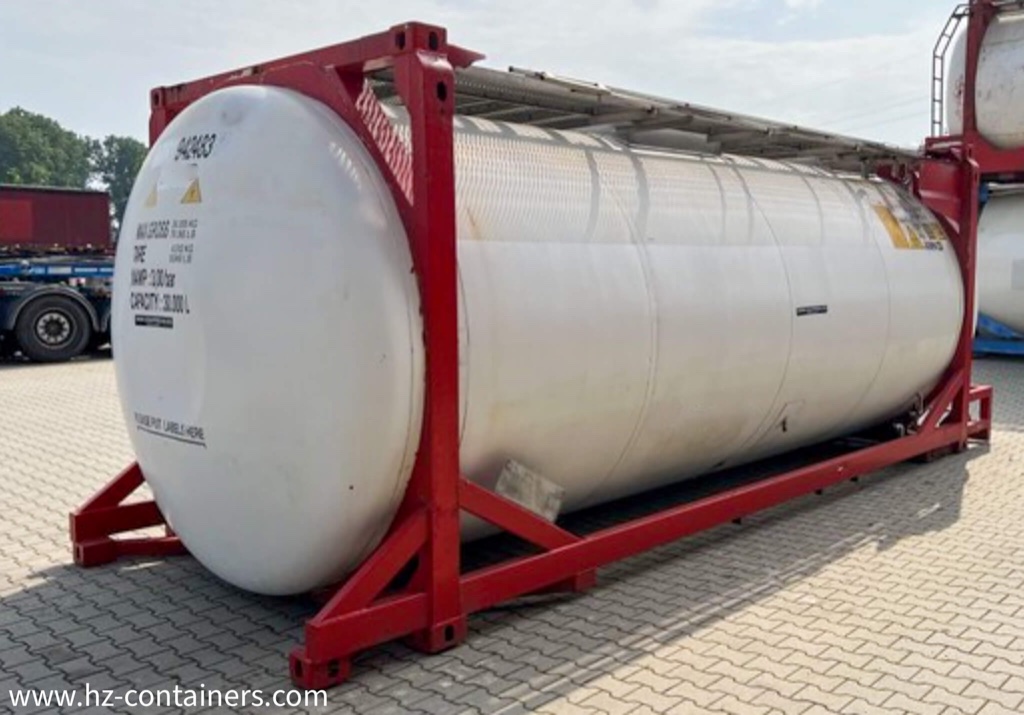
What is a tank container?
A container tank, also known as a tanktainer, is a type of intermodal container designed for transporting liquids, gases and some bulk materials. This cylindrical container is made of stainless steel and surrounded by an insulation layer, which is usually made of polyurethane and aluminum. These containers are constructed according to ISO standards, which ensures their compatibility with various types of transportation, such as road, rail and maritime transport.
Typical capacity of tank containers ranges between 17,500 and 26,000 liters, with larger units also available. Special containers for cryogenic substances or bulk materials may have specific design properties.
What is transported in tank containers?
1. Hazardous substances
One of the key uses of tank containers is the transportation of hazardous substances. For this purpose, containers must meet strict international standards, such as ADR, IMDG or RID. Typical hazardous substances include:
- Chemicals: acids (such as sulfuric, hydrochloric), bases, solvents, peroxides.
- Petroleum products: gasoline, diesel, lubricating oils.
- Liquefied gases: LPG (liquefied petroleum gas), ammonia, chlorine.
- Toxic and corrosive substances: oxides, hydroxides, toxic liquids.
2. Food products

Thanks to hygienic stainless steel construction and easy cleanability, tank containers are ideal for transporting food products, such as:
- Liquids: juices, milk, wine, edible oils.
- Alcoholic beverages: beer, spirits, wines.
- Sugar solutions or other liquid food raw materials.
3. Industrial liquids
Tank containers enable the transportation of industrial liquids, such as:
- Liquid fertilizers, such as ammonia.
- Lubricating oils and chemical additives.
- Special chemicals used in the manufacture of plastics and synthetic materials.
4. Bulk and powder materials
Special tank containers, such as silo tanks, are designed for transporting bulk materials, such as:
- Cement, lime, kaolin.
- Powder chemicals.
- Food powders, such as cocoa or dried milk.
5. Cryogenic substances
T75 ISO tanks are designed for transporting cryogenic substances, such as:
- Liquid oxygen (LOX).
- Liquid nitrogen (LIN).
- Liquid hydrogen (LH2).
Types of tank containers
1. Standard ISO tanks (T11)
The most common type of tanker, which is used for transporting a wide range of liquids, including hazardous ones.
2. Food-grade tanks
Certified tanks designed for transporting food products. These tanks require strict hygiene standards.
3. Reefer tanks
Tanks with temperature control capability, ideal for transporting temperature-sensitive liquids.
4. T50 tanks
Tanks designed for transporting liquefied gases under pressure.
5. T75 cryogenic tanks
Used for transporting substances at extremely low temperatures.
Advantages of transportation in tank containers
1. Safety
Thanks to highly resistant materials and construction, maximum transportation safety is ensured.
2. Versatility
Thanks to ISO standards, tanks are flexibly usable in various types of transportation.
3. Hygiene
Stainless steel construction and easy cleanability make these tanks ideal for transporting food and pharmaceutical substances.
4. Efficiency
Compared to traditional packaging, tanks allow for transporting larger volumes of substances.
5. Economic sustainability
Tanks have a lifespan of up to 30 years, which reduces costs in the long term.
How does transportation in tank containers proceed?
- Tank preparation: Thorough cleaning before loading.
- Loading: Filling by gravity or pumping system.
- Transport: Tanks are secured to road vehicles, railway wagons or ships.
- Unloading: By gravity or pressure system.
- Cleaning: After unloading, the tank is cleaned again.
Frequently asked questions
What certifications are required for tank containers?
ISO, ADR, IMDG and RID certifications.
What are the costs of renting a tank container?
Prices depend on the type of tank. Standard tanks cost approximately from 16,000 USD.

 Czech Republic, Třebíč
  FREE SHIPPING
Other container news...

The OPNBar leverage tool
The OPNBar leverage tool is a professional-grade, multi-purpose hand tool designed specifically for the shipping container and trucking industry. Manufactured by Shipping Container Safety International (SCS International) and proudly Made in the USA, the OPNBar is fundamentally a 3-in-1 trucker tool that combines a shipping container door leverage bar, a tire thumper, and a 5th wheel pull hook into a single, compact steel implement. The name “OPNBar” is a direct reference to its primary function: it is the bar that “opens” containers.

40 Foot Container Dimensions
If you have ever booked ocean freight, planned a warehouse layout, or designed a modular building project, you have asked the same question: what are the exact 40 foot container dimensions — and what do they mean for what you can actually load? The numbers are standardized worldwide, but the practical implications of those numbers are surprisingly nuanced. A 40-foot container is not simply 40 feet of usable space, and its weight limits are not what most people assume. This guide covers every measurement, every weight rating, and every loading consideration you need to make informed decisions about the world’s most common shipping container.
Quick Answer: A standard ISO 40-foot shipping container measures 12.19 m (40 ft) long × 2.44 m (8 ft) wide × 2.59 m (8 ft 6 in) high externally and provides approximately 67.7 m³ (2,390 ft³) of usable internal volume. The maximum gross weight is 30,480 kg (67,200 lbs), with a typical payload capacity of approximately 26,700–26,800 kg (58,900–59,000 lbs).
Shipping container wheels
Moving a 12-meter-long steel box that weighs up to 67,200 pounds was, for decades, exclusively a job for a crane and a licensed operator. That reality has changed. Shipping container wheels — an umbrella term covering a family of mobility solutions — now let a single person reposition a 20ft or 40ft container across a yard, warehouse, or construction site without calling in heavy equipment. This guide covers every aspect of container wheel systems: what they are, how they work, the types available, what they cost, and how to choose the right kit for your container.
Can You Modify a 40ft High Cube Container?
The short answer is yes — you absolutely can modify a 40ft high cube container, and it is one of the most popular container types for modification projects worldwide. But the real question is not whether you can modify one; it is how to do it correctly, safely, legally, and within budget. This guide answers every dimension of that question, drawing on engineering principles, real-world pricing data, and the collective experience of thousands of modified container projects.
Key Takeaway: A 40ft high cube container offers 320 square feet of floor space with an extra foot of ceiling height compared to a standard container — making it the ideal canvas for offices, workshops, homes, retail spaces, and industrial applications. The extra height is particularly valuable when you add insulation and still want comfortable headroom.