
What can be transported in reefer containers?
A reefer container — short for refrigerated container — is a temperature-controlled intermodal shipping container built to move goods that would spoil, melt, degrade, or lose efficacy outside a narrow temperature band. The question “what can be transported in reefer containers?” has a deceptively long answer, because reefers carry far more than just frozen peas and bananas. They move fresh produce, chilled meat and seafood, dairy, cut flowers, vaccines, biologics, specialty chemicals, photographic film, and even sensitive electronics and works of art. In short, if a cargo’s value depends on staying at a precise temperature — whether that is −60 °C or a comfortable +25 °C — a reefer container is how it travels across the ocean.
What Is a Reefer Container?
A reefer container looks, at first glance, like a standard 20-foot or 40-foot steel shipping container. The difference is in the hardware. One end carries an integrated refrigeration unit, and the box itself is heavily insulated so that the interior temperature can be held steady regardless of the weather outside — whether the container is baking on a tarmac in the Middle East or crossing the North Atlantic in winter.
The word “reefer” has a practical origin in shipping and railroading. It descends from “refrigerated” — specifically the refrigerated railcars and insulated ships that dominated cold transport before containers existed. Today the term is standard industry shorthand, used interchangeably with “refrigerated container,” “reefer box,” and “cool container.”
Reefers come in the same ISO intermodal dimensions as dry containers, so they slot into the same ships, railcars, and truck chassis. The two workhorse sizes are:
- 20-foot reefer — roughly 28–29 m³ of cargo capacity, used for heavy, dense loads like frozen meat and fish.
- 40-foot High Cube reefer — roughly 67–76 m³, the most common choice for volume-driven cargo such as fresh fruit, vegetables, and flowers.
The critical distinction from a dry box is that a reefer does not merely store cold; it actively conditions the air. Most standard units can maintain a setpoint anywhere between −25 °C and +25 °C, while advanced “super freezer” units can go as low as −60 °C to −70 °C for ultra-cold pharmaceutical and specialty cargo. A small but growing share of the global fleet can also be run in a heated mode, which matters when ambient conditions are colder than the cargo needs to stay — for example, shipping certain liquids or electronics through a Siberian winter.
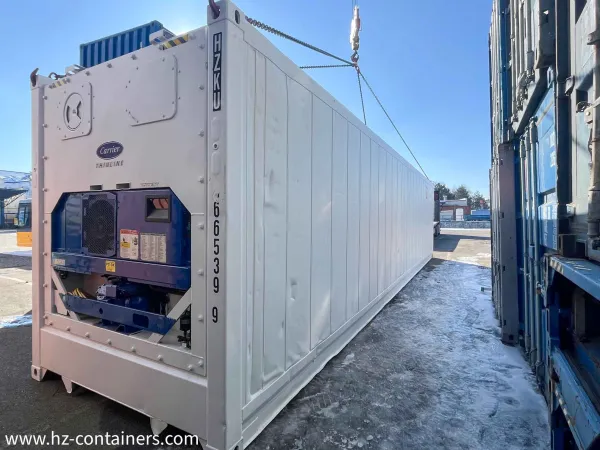
What Can Be Transported in Reefer Containers?
The cargo that travels in reefer containers splits into three broad categories: chilled cargo, frozen cargo, and non-food or “special” cargo. Understanding these buckets is the fastest way to answer the core question of what a reefer can carry.
Chilled (non-frozen) cargo
Chilled cargo is held above freezing point but well below ambient temperature — typically between about −1 °C and +15 °C. This is the domain of goods that are still biologically active: they respire, ripen, and can spoil if the temperature drifts. The most important chilled cargoes are:
- Fresh fruits and vegetables — bananas, pineapples, avocados, berries, citrus, grapes, stone fruit, leafy greens, and cruciferous vegetables. Bananas, in particular, are one of the highest-volume reefer cargoes in the world and are famously sensitive to both temperature and ethylene gas.
- Fresh meat, poultry, and seafood — chilled rather than frozen, kept just above 0 °C to preserve texture and color.
- Dairy products — milk, cream, cheese, yogurt, and butter, all of which require tight, cold-but-not-freezing control.
- Eggs and liquid egg products.
- Fresh juices and confectionery — chocolate and sugar-based goods that would melt or bloom at higher temperatures.
- Cut flowers and nursery plants — a large, high-value reefer segment where humidity control matters as much as temperature.
Frozen cargo
Frozen cargo travels at −18 °C or below, the temperature at which microbial activity effectively stops. Because the product is already frozen solid, the reefer’s job is to maintain that state — not to freeze the cargo en route. Typical frozen reefer cargo includes:
- Frozen meat, poultry, and fish (including IQF — individually quick-frozen — products).
- Frozen fruits and vegetables.
- Frozen prepared meals and bakery goods.
- Frozen fruit concentrates and juices.
- Ice cream and other high-fat frozen desserts, which need especially low temperatures (often −20 °C to −25 °C) because their high fat content softens at −18 °C.
Non-food and special cargo
One of the most common misconceptions is that reefers are only for food. In reality, a large and growing share of reefer volume is temperature-sensitive goods that have nothing to do with eating. These include:
- Pharmaceuticals and healthcare products — vaccines, insulin, biologics, blood products, clinical trial samples, and temperature-sensitive reagents. This is where precise, audited temperature control is non-negotiable, because a two-degree excursion can render a drug ineffective or unsafe.
- Chemicals and specialty materials — adhesives, resins, solvents, and industrial compounds that separate, polymerize, or degrade when they get too hot or too cold.
- Film and photographic equipment, as well as certain optical and electronic components that fail outside a controlled range.
- Cosmetics and personal care products — creams, lotions, and waxes that melt or separate in heat.
- High-value or delicate goods such as works of art, antiques, and musical instruments, where humidity control protects against warping and cracking.
The table below summarizes the three categories and their typical setpoint ranges.
| Cargo category | Common examples | Typical setpoint range |
|---|---|---|
| Chilled produce | Bananas, avocados, berries, leafy greens | +4 °C to +13 °C |
| Chilled meat/seafood/dairy | Fresh fish, poultry, milk, cheese | −1 °C to +4 °C |
| Frozen goods | Frozen meat, fish, vegetables, prepared meals | −18 °C to −25 °C |
| Ultra-cold / super freezer | Vaccines, biologics, specialty chemicals | −35 °C to −70 °C |
| Non-food / special | Pharmaceuticals, film, cosmetics, electronics | Product-specific |
How Does a Reefer Container Work?
A reefer container is best understood as a large, mobile refrigerator that does not merely blow cold air but carefully circulates it. Its cooling unit is a vapor-compression refrigeration system, conceptually the same cycle as a household fridge, scaled up and hardened for months at sea.
The clever part is the airflow design. Cold air is pushed through a T-shaped floor deck — a raised, slotted floor that channels air down the length of the container, up through the cargo, and back to the unit. This “bottom-air-delivery” design is what lets a reefer hold a uniform temperature across a fully loaded 40-foot box. Without it, the cargo at the back would cook while the cargo at the front froze.
Three additional controls make a reefer far more sophisticated than a simple fridge:
- Ventilation and fresh-air exchange. Living cargo such as fruits, vegetables, and flowers continues to respire after harvest, producing heat, carbon dioxide (CO₂), and ethylene gas. Fresh-air vents exchange some interior air to flush out these by-products and replenish oxygen. The correct setting depends on the commodity’s respiration rate.
- Humidity control. Produce loses water and wilts if the air is too dry; some cargoes need high humidity, while others (certain dairy and confectionery) do better dry. The reefer’s controller can be set to manage the moisture balance.
- Heating capability. Many modern units can also add heat, which matters when a container full of temperature-sensitive liquid crosses a freezing region and the setpoint is above ambient.
Power is the other half of the story. A reefer cannot run without electricity, and it has no engine of its own on the road. It draws power from:
- The vessel’s electrical supply while at sea (reefer slots on a container ship).
- Shore power at ports, terminals, and depots.
- Gensets — portable diesel or electric generator sets clipped to the container — during over-the-road trucking and inland rail segments, or whenever shore power is unavailable.
This is why reefer logistics is a continuous-power problem: the cold chain is only as strong as its weakest plug-in.
What Temperature Should Each Type of Cargo Be Shipped At?
There is no single “correct” reefer temperature. The right setpoint depends entirely on the commodity, and shippers who guess wrong pay for it in rejected loads. The table below consolidates common reefer commodities with their typical transport temperatures.
| Commodity | Typical transport temperature | Notes |
|---|---|---|
| Bananas | +13 °C to +14 °C | Ethylene-sensitive; ventilated |
| Avocados | +4 °C to +7 °C | Chilling injury below +4 °C |
| Berries (strawberries, raspberries) | 0 °C | High respiration, high humidity |
| Grapes | −0.5 °C to 0 °C | Sulfur-dioxide treated for mold |
| Apples | −1 °C to +4 °C | Long-term CA storage |
| Leafy greens / lettuce | 0 °C to +2 °C | Wilt rapidly if warm |
| Tomatoes (ripe) | +10 °C to +13 °C | Chilling injury below +10 °C |
| Fresh fish / seafood | 0 °C to +2 °C | On ice or chilled slurry |
| Fresh meat / poultry | −1 °C to +2 °C | Just above freezing |
| Milk and dairy | +2 °C to +4 °C | Strict band, short transit |
| Eggs | +10 °C to +13 °C | Avoid condensation |
| Cut flowers | +1 °C to +4 °C | High humidity, ethylene control |
| Frozen meat / fish / veg | −18 °C to −20 °C | Block stowage, no ventilation |
| Ice cream | −20 °C to −25 °C | Lower than standard frozen |
| Pharmaceuticals (refrigerated) | +2 °C to +8 °C | Validated, monitored |
| Pharmaceuticals (frozen/ultra-cold) | −20 °C to −70 °C | Super freezer for ultra-cold |
Two principles explain most of these numbers. First, tropical and subtropical fruits (bananas, tomatoes, avocados) suffer chilling injury — cellular damage from temperatures that are too cold — so they must stay warmer than you might expect. Second, high-fat frozen goods like ice cream need colder setpoints than lean products because fat does not freeze as hard as water.
What Is the Difference Between a Reefer Container and a Dry Container?
A dry container is a sealed steel box; a reefer is a sealed steel box with a climate-control system. The practical differences go well beyond “one is cold,” and they shape cost, capacity, and how cargo must be loaded.
| Feature | Dry container | Reefer container |
|---|---|---|
| Temperature control | None | Active heating and cooling |
| Insulation | Minimal | Heavy, full-wall insulation |
| Usable interior space | Higher (full cube) | Lower (unit + insulation eat space) |
| Power required | None | Continuous (vessel, shore, or genset) |
| Airflow design | None | T-floor bottom-air delivery |
| Ventilation | None | Adjustable fresh-air exchange |
| Cost | Lower | Significantly higher |
| Typical cargo | Manufactured goods, dry bulk | Perishables, pharma, chemicals |
The cost gap is the reason shippers never use a reefer for cargo that does not need it: reefers cost more to lease, more to ship (they occupy powered slots), and more to run on land. But for temperature-sensitive cargo, the alternative — a dry box with no climate control — is simply not an option, because the goods would arrive ruined.
What Is Controlled Atmosphere (CA) and How Does It Extend Shelf Life?
Temperature is only one lever for preserving fresh produce. The air around the cargo is the other. Controlled Atmosphere (CA) technology goes a step beyond simple refrigeration by actively managing the mix of oxygen (O₂), carbon dioxide (CO₂), and nitrogen inside the container.
Fresh produce continues to “breathe” after harvest. By lowering oxygen and raising carbon dioxide around the fruit, CA slows that respiration dramatically, which slows ripening, preserves firmness and color, and extends shelf life — in some cases two to three times longer than temperature control alone. This is what lets an apple picked in New Zealand arrive in Europe months later still crisp.
CA is most valuable for high-respiration, high-value cargo such as avocados, apples, kiwifruit, and certain berries. It requires specialized equipment and careful monitoring, and it costs more than a standard reefer — so it is reserved for commodities where the extended shelf life and reduced waste justify the premium.
What Is a Super Freezer Container and When Is It Needed?
Most standard reefers bottom out at −25 °C. A super freezer (or “deep freezer”) container is a specialized reefer engineered to hold cargo at −60 °C to −70 °C. These units use a different, more powerful refrigeration system and enhanced insulation.
Super freezers exist almost entirely for a single class of cargo: ultra-cold pharmaceuticals and biologics. This includes certain vaccines (notably the mRNA COVID-19 vaccines that required −70 °C storage), cell and gene therapies, and biological samples that must be preserved at cryogenic-adjacent temperatures. They are also used for some specialty chemicals and high-value seafood where maximum quality retention is demanded.
The trade-off is cost and complexity. Super freezers are rarer, more expensive to run, and require even more reliable power. They are used only when the cargo’s stability requirements leave no other choice.
What Is Cold Treatment and Why Is It Used?
Cold treatment is a phytosanitary procedure, not a temperature setting for product quality. It uses prolonged cold to kill the eggs and larvae of quarantine pests — most famously fruit flies — so that fresh produce can cross international borders without chemical fumigation.
The cargo is held at a tightly controlled low temperature (often below +1 °C, with strict tolerances) for a defined duration, which is validated and logged. Cold treatment can be performed in transit (in the reefer itself) or at destination. Because it replaces chemical treatments, it is the preferred method for markets that restrict pesticide residues, and it allows fruit such as citrus and grapes to satisfy import requirements in regions like the EU, Japan, and the United States.
The catch is that the treatment must be proven. Temperature probes are placed inside the fruit pulp, and the entire record must demonstrate that every part of the load met the required time-temperature profile — a single excursion can void the treatment and get the shipment rejected.
What Are the Most Common Mistakes When Loading a Reefer?
A reefer only performs as well as it is loaded. The most expensive losses in cold chain shipping usually trace back to loading and stowage errors rather than equipment failure. The most frequent mistakes are:
- Failing to pre-cool the cargo. A reefer is designed to maintain temperature, not to rapidly cool a warm load. Loading warm produce forces the unit to work far harder and often results in uneven temperature and condensation.
- Loading cargo that has not reached its setpoint. If the goods go in warm, they will not reach safe temperature quickly, and the center of the load can spoil while the edges look fine.
- Blocking airflow. Chilled and frozen cargo needs air moving over and through it. Cartons with misaligned ventilation holes, or packaging stuffed against the walls and doors, starve the load of cold air and create hot spots.
- Wrong stowage pattern for frozen goods. Frozen cargo should be stacked in solid block stowage with no gaps, so the air flows over the mass rather than channeling through it. Gaps actually hurt frozen loads.
- Over-ventilating frozen or non-respiring cargo. Ventilation is essential for fresh produce but pointless (and harmful) for frozen food, pharmaceuticals, and confectionery, which do not respire and need a stable, sealed atmosphere.
- Confusing setpoint with actual temperature. The setpoint is a target. Actual pulp temperature, verified with probes and data loggers, is what matters — especially for compliance-driven cargo like pharmaceuticals and cold-treated fruit.
- Leaving the container unplugged during handoffs. Every minute without power during loading, discharge, or inland transfer is a minute the temperature drifts. Reefer containers are plugged in as early as possible and disconnected as late as possible.
Getting these details right is the difference between a reefer that delivers pristine cargo and one that produces an insurance claim.
What Is the Future of Reefer Container Transport?
The reefer container is one of the quiet backbones of global trade, and its future is being shaped by several forces at once.
First, pharmaceutical and biotech demand is growing faster than food demand. The rise of biologics, cell and gene therapies, and temperature-sensitive vaccines is pulling the reefer fleet toward more precise, ultra-cold, and heavily monitored equipment. Data logging, real-time GPS, and remote monitoring — once premium add-ons — are becoming standard expectations, because regulators and buyers increasingly demand proof of the entire cold chain.
Second, the fleet is modernizing its refrigerants. Many existing reefers use high-global-warming-potential refrigerants, and there is steady pressure from regulators and carriers to shift toward lower-impact alternatives and more energy-efficient units. This is an operational and cost challenge, but it is also driving new unit designs.
Third, visibility and intelligence are the new battleground. The next generation of reefers and the telematics attached to them can flag temperature excursions in real time, predict failures before they happen, and generate the auditable records that high-value cargo demands. The container itself is becoming a sensor platform, not just a cold box.
Finally, controlled atmosphere and specialty units are expanding beyond premium fruit into more mainstream perishables as the technology matures and the cost comes down. The result is longer shelf life, less food waste, and more resilient supply chains.
None of this changes the fundamental answer to “what can be transported in reefer containers?” — but it steadily widens it, as the humble refrigerated box becomes more precise, more connected, and more capable of protecting the world’s most sensitive cargo.
Frequently Asked Questions
What is a reefer container?
A reefer container is a temperature-controlled intermodal shipping container — essentially an insulated steel box with an integrated refrigeration unit — used to transport goods that must stay at a specific temperature. Most standard units hold a setpoint between −25 °C and +25 °C, while super freezer units reach −60 °C to −70 °C.
What is the temperature range of a reefer container?
Standard reefer containers typically operate from −25 °C to +25 °C (about −13 °F to +77 °F), covering everything from deep-frozen to lightly chilled cargo. Some units add a heating function for higher setpoints, and super freezer containers extend the low end to −70 °C for ultra-cold pharmaceuticals.
What is the difference between a reefer container and a dry container?
A dry container is an uninsulated steel box with no temperature control, used for manufactured and dry goods. A reefer adds heavy insulation, an active refrigeration unit, a T-shaped airflow floor, and ventilation — plus a continuous power requirement — so it can keep sensitive cargo at a precise temperature.
How is a reefer container powered?
At sea, reefers plug into the vessel’s electrical supply. On land they run on shore power at terminals and depots, or on gensets — portable generator units — during truck and rail transit. Keeping a reefer powered through every handoff is what maintains the cold chain.
What is controlled atmosphere (CA) technology?
Controlled atmosphere technology actively manages oxygen, carbon dioxide, and nitrogen inside a reefer to slow the respiration of fresh produce. By reducing O₂ and raising CO₂, CA extends the shelf life of fruit like apples and avocados, sometimes two to three times longer than temperature control alone.
What is a super freezer container?
A super freezer container is a specialized reefer capable of holding cargo at −60 °C to −70 °C. It is used almost exclusively for ultra-cold pharmaceuticals and biologics — such as certain vaccines and cell therapies — and for select specialty chemicals and high-value frozen products.
What is cold treatment for reefer cargo?
Cold treatment is a phytosanitary procedure that uses prolonged, precisely logged cold to kill quarantine pests such as fruit-fly larvae in fresh produce. It lets fruit cross international borders without chemical fumigation, provided the entire load can be proven to have met the required time-temperature profile.
Can a reefer container heat cargo as well as cool it?
Many modern reefer units can run in a heating mode, adding warmth when the outside environment is colder than the cargo’s setpoint. This matters for temperature-sensitive liquids, chemicals, and some electronics traveling through very cold regions.

 Hamburg, Germany
 WITHOUT SHIPPING


Other container news...

Shipping container types
Roughly 80% of everything you own traveled to you inside a steel box. Shipping containers—also called cargo containers, ISO containers, or “conex” boxes—are the backbone of global trade, carrying about 90% of the world’s non-bulk cargo across oceans, rails, and highways. Yet a “shipping container” is not one single object. It is a family of specialized steel boxes, each engineered for a specific kind of cargo: some vent, some freeze, some open from the top, and some have no walls at all.

Where Can I Buy a 40ft High Cube Container?
A 40ft high cube container represents one of the most versatile and cost-effective storage and shipping solutions available today. Whether you are expanding warehouse capacity, starting a container home project, or need secure on-site storage for a construction site, knowing where to buy one — and what to expect — can save you thousands of dollars and weeks of frustration. This guide walks you through every aspect of purchasing a 40ft high cube container, from understanding what it actually is to comparing sellers, navigating delivery logistics, and handling permits.

How much does a 40 foot shipping container cost?
A 40 foot shipping container is the single most common large-format steel container in the world. Whether you are adding on-site storage, moving freight overseas, or converting a unit into a home or workshop, the first question almost everyone asks is the same: how much does a 40 foot shipping container cost?
The short answer is that a 40 foot shipping container price in the United States typically lands between $1,500 and $7,000 depending on condition, height, location, and delivery. Used, wind-and-watertight 40ft units often start near $1,500–$2,700, while a brand-new one-trip 40ft high cube can exceed $4,000–$6,500. The gap between those two ends of the range is wide because a “shipping container” is not one product—it is a graded commodity whose value shifts with its physical condition, its market, and even the distance from your site to a major port.

How to move a shipping container
Moving a shipping container is rarely as simple as “put it on a truck and drive.” A standard steel container weighs over two tons even when empty, spans 20 to 40 feet (or more), and has no wheels, no hitch, and no built-in way to attach to standard equipment. Whether you are repositioning a storage container across a jobsite, delivering one to a rural property, or relocating a loaded unit across the country, the method you choose determines your cost, your timeline, and whether the move succeeds at all.