
Use of 45’HC Pallet Wide Double Curtain Side Container
In the dynamic world of global logistics and transportation, efficiency is key. Standard shipping containers have revolutionized the movement of goods, but their rigid, closed construction presents challenges for certain types of cargo and logistics operations. In response to this need, specialized units have emerged that combine the best of different worlds. One of the most innovative and versatile solutions in this field is the 45’HC Pallet Wide Double Curtain Side container.
This glossary article provides a comprehensive and in-depth look at this specific container type, its construction, properties, main areas of use, and its place in the broader ecosystem of intermodal transport.
What is a 45’HC PW Double Curtain Side Container?
45’HC Pallet Wide Double Curtain Side (often abbreviated as 45’HCPWCS) is a specialized intermodal shipping container that combines the robustness and standardized dimensions of a large steel container with the flexibility and easy access of a curtain-sided trailer. Its unique design is a response to the need for fast and efficient loading and unloading of goods that are difficult or impossible to handle through standard front doors.
Meaning of Individual Name Parts
| Abbreviation/Part | Meaning | Technical Notes |
|---|---|---|
| 45′ | 45 feet (13.72 m external length) | Largest commonly used dimension in intermodal transport, competes with standard road trailers, permitted in the EU in combined transport mode. |
| HC (High Cube) | Increased height (2.896 m external, 2.695 m internal) | 30 cm higher than standard container, allows stacking of goods and transport of taller loads. |
| PW (Pallet Wide) | Pallet width (2.44 m internal) | Allows placement of two Euro pallets 1200×800 mm side by side, up to 33 total in one layer, which is the maximum for a European truck. |
| Double Curtain Side | Double side curtain | Side walls consist of robust PVC curtains on both sides, allowing quick side access along the entire length, similar to a tautliner. |
Summary: 45’HC PW Double Curtain Side is the largest standardized cube pallet wide container with maximum volume and capacity for palletized goods, plus unparalleled flexibility for loading and unloading from the side.
Detailed Technical Specification and Construction
Modern 45’HCPWCS containers meet strict European and global standards (e.g., ISO 668, EN 12642 XL for structural strength). Key parameters are summarized in the following table:
| Parameter | Typical Value | Note |
|---|---|---|
| External length | 13,716 mm (45′) | Standardized for intermodal transport |
| External width | 2,500 mm | Compared to standard 2,438 mm for ISO containers |
| External height | 2,896 mm (9’6″) | High Cube |
| Internal length | 13,555 mm | Maximized for 33 Euro pallets |
| Internal width | 2,444 mm | Pallet Wide (2 x 1,200 mm + clearance) |
| Internal height | 2,695 mm | Improves stacking and handling |
| Floor area | 34 m² | Efficient use of space |
| Internal volume | 89–90 m³ | Largest volume among common containers |
| Tare | 4,450 kg | Weight of empty container |
| Max. payload | 29,550 kg | Depends on manufacturer and certification |
| Max. gross weight | 34,000 kg | Including own weight |
| Pallet capacity | 33 Euro pallets (1200×800 mm) | In one layer, with optimal clearance |
Main Structural Elements
- Frame and floor: Robust frame made of CORTEN steel, floor made of laminated plywood (min. 28 mm), designed for repeated use by forklifts and resistant to moisture and mold. Floor load capacity typically 7,000 kg per m².
- Roof and front walls: Steel profiled roof with leak protection, solid front wall protecting the front of the cargo.
- Rear doors: Standard double-leaf doors with solid closure and double sealing, ISO locking system (possibility of sealing).
- Side curtains: Made of PVC with a minimum weight of 900 g/m², UV stabilized, resistant to tearing and water, suspended in the upper rail with the possibility of quick retraction along the entire length.
- Tensioning and securing system: Curtains tensioned with steel cables or straps with ratchets, lower edge of curtain equipped with hooks to secure to the frame, minimizes flapping and water/dust ingress.
- Sliding posts/internal gates: Posts typically aluminum or steel, removable, provide increased lateral stability and protect cargo when the curtain is opened.
Main Uses and Applications
45’HC Pallet Wide Double Curtain Side finds application where standard containers are insufficient:
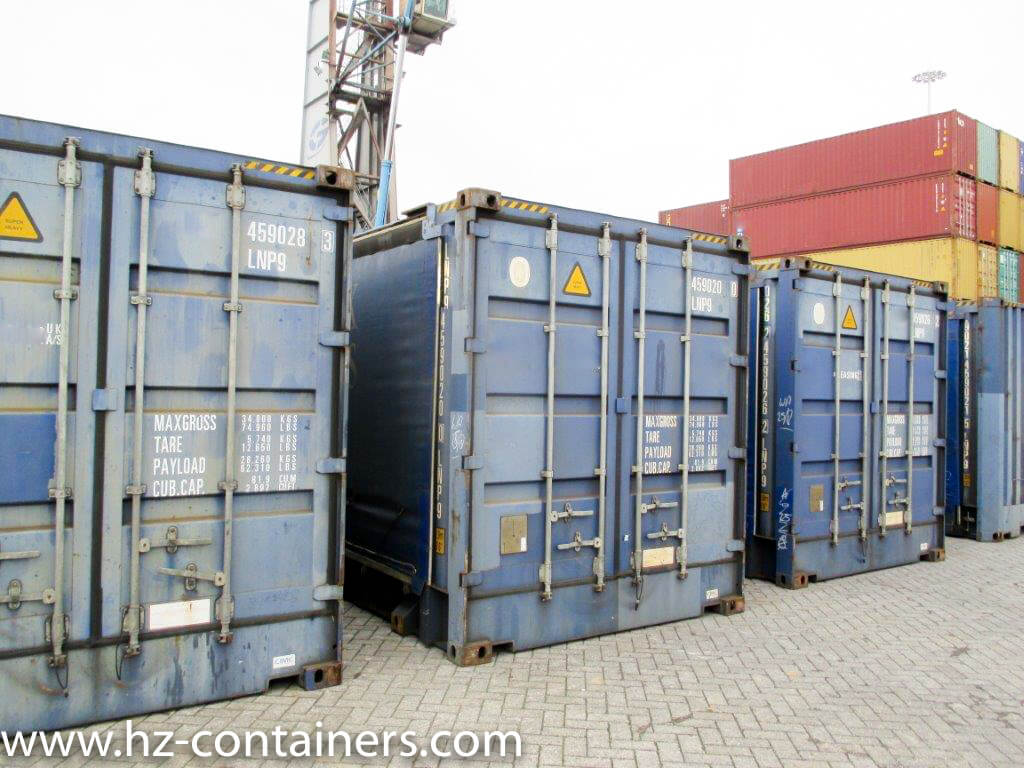
Intermodal transport of palletized goods
- Ideal for European logistics (in line with Euro pallet dimensions).
- Possibility of combining road, rail, and maritime transport without cargo transshipment.
- Side access saves time in distribution centers without ramps, cargo can be loaded and unloaded with forklifts along the entire length.
Transport of oversized and long cargo
- Suitable for profiles, pipes, wood, construction components, engineering parts.
- The ability to handle from the side is crucial for heavy or long objects that would not fit in a classic container or would be difficult to store this way.
Efficient storage (storage container)
- Industrial plants, construction sites, manufacturing areas – possibility of immediate access to any part of stored goods.
- Ideal for temporary warehouses where quick material movement and frequent inventory rotation are needed.
Events and mobile solutions
- Quick conversion to mobile shop, exhibition stand, service workshop, event facilities.
- Curtains can be easily pulled back and the space opened to the public or workers.
Just-in-Time (JIT) Logistics
- Reduces production downtime due to easy access to specific parts or deliveries at precisely scheduled times.
- Enables quick response to changes in the supply chain.
Advantages and Disadvantages
Advantages:
- Maximum loading flexibility: Ability to load from the side, quick handling of pallets and awkward cargo.
- Time optimization: Significant reduction in loading/unloading time, important for just-in-time logistics.
- High capacity: Combination of length, height, and width means one of the largest cargo volumes on the market.
- Full intermodality: Suitable for road, rail, and maritime transport.
- Cargo protection: Complete coverage against weather conditions, comparable to standard containers.
Disadvantages:
- Lower security: Curtains can be damaged or cut, lower level of physical protection against theft than steel walls.
- Higher purchase price and maintenance: More complex construction, curtains and mechanisms require regular inspection and possible repairs.
- Limited stacking capability: Curtain sides do not provide the same support as solid walls, limitations when stacking on ships or in warehouses.
- Lack of thermal insulation: Standard models are not insulated, unsuitable for temperature-sensitive goods.
Comparison with Other Container Types
| Container Type | Advantages | Disadvantages | Typical Use |
|---|---|---|---|
| 45’HC PW Double Curtain Side | Loading flexibility, capacity, intermodality | Security, higher price, maintenance | Pallets, long goods, events |
| Standard 40’/45′ HC | Security, lower price | Loading only from rear | General transport, storage |
| Open Top | Loading from above (crane) | Limited protection, unsuitable for pallets | Machinery, bulk materials |
| Flat Rack | Extreme dimensions, heavy loads | No protection, no flexibility | Machines, oversized units |
| Reefer (refrigerated) | Temperature control | Higher price, energy intensive | Food, pharmaceuticals |
| Tank Container | Liquids, gases | Limited use | Chemicals, food liquids |
Related Terms and Current Trends
- High Cube Pallet Wide (HCPW): Combination of high volume and width for pallets, key for optimizing logistics in Europe.
- Shipping containers sale: Sale and rental of these containers is the domain of specialized companies, most manufacturers offer new and used variants according to customer needs.
- Dangerous goods: Transport of hazardous substances in curtain-sided containers is subject to strict regulations (ADR, IMDG), requiring compliance with packaging, labeling, and securing.
- Intermodal transport: Trend of combining different types of transport without cargo transshipment, significant shift towards reducing the carbon footprint of transport.
Trends and Innovations
- Automation and digitalization: Real-time tracking of container location and condition using IoT devices, sensors for measuring humidity and temperature in curtain-sided containers.
- Enhanced security: Development of new curtain materials with higher puncture resistance, possibility of tracking curtain opening/closing.
- Custom modifications: Adaptations for events, mobile shops, warehouses with shelving, special fastening systems for transporting atypical oversized parts.

 Czech Republic, Třebíč
 FREE SHIPPING


Other container news...

Shipping container types
Roughly 80% of everything you own traveled to you inside a steel box. Shipping containers—also called cargo containers, ISO containers, or “conex” boxes—are the backbone of global trade, carrying about 90% of the world’s non-bulk cargo across oceans, rails, and highways. Yet a “shipping container” is not one single object. It is a family of specialized steel boxes, each engineered for a specific kind of cargo: some vent, some freeze, some open from the top, and some have no walls at all.

Where Can I Buy a 40ft High Cube Container?
A 40ft high cube container represents one of the most versatile and cost-effective storage and shipping solutions available today. Whether you are expanding warehouse capacity, starting a container home project, or need secure on-site storage for a construction site, knowing where to buy one — and what to expect — can save you thousands of dollars and weeks of frustration. This guide walks you through every aspect of purchasing a 40ft high cube container, from understanding what it actually is to comparing sellers, navigating delivery logistics, and handling permits.

How much does a 40 foot shipping container cost?
A 40 foot shipping container is the single most common large-format steel container in the world. Whether you are adding on-site storage, moving freight overseas, or converting a unit into a home or workshop, the first question almost everyone asks is the same: how much does a 40 foot shipping container cost?
The short answer is that a 40 foot shipping container price in the United States typically lands between $1,500 and $7,000 depending on condition, height, location, and delivery. Used, wind-and-watertight 40ft units often start near $1,500–$2,700, while a brand-new one-trip 40ft high cube can exceed $4,000–$6,500. The gap between those two ends of the range is wide because a “shipping container” is not one product—it is a graded commodity whose value shifts with its physical condition, its market, and even the distance from your site to a major port.

How to move a shipping container
Moving a shipping container is rarely as simple as “put it on a truck and drive.” A standard steel container weighs over two tons even when empty, spans 20 to 40 feet (or more), and has no wheels, no hitch, and no built-in way to attach to standard equipment. Whether you are repositioning a storage container across a jobsite, delivering one to a rural property, or relocating a loaded unit across the country, the method you choose determines your cost, your timeline, and whether the move succeeds at all.