
Shipping container: Overview of types, sizes and prices
A shipping container is no longer just a steel box for transporting bananas across the ocean. Today you will encounter it on a construction site as a tool storage, in the garden as a workshop, and increasingly as the foundation of modern housing. But precisely because the transport unit has become a multifunctional phenomenon, choosing the right shipping container is not easy at all. You need a different container for storing a lawnmower, a different one for transporting goods abroad, and a completely different one if you want to build a house from it.
This guide will walk you through everything you need to know about shipping containers — from the technical basics, through dimensions and types, to practical advice on how to choose the right piece and not make a mistake. Regardless of whether you are a tradesperson, a logistics manager, or just considering an unconventional garden house.
What is a shipping container and how does it work
A shipping container is a standardized steel transport unit that revolutionized global trade. Its genius lies in simplicity — identical dimensions, uniform corner fittings for handling, and the ability to be transported by ship, train, and truck without reloading the contents. This is called intermodal transport, and thanks to it, 90 % of the world’s goods are transported in containers today.
History and standardization
While previously goods were manually reloaded from ship to train and from train to truck, in the 1950s the American entrepreneur Malcom McLean came up with a simple idea: what if the entire cargo was moved together with its packaging? The first container ship sailed in 1956, and within two decades, the container became a global standard. Today, all shipping containers comply with strict ISO standards, which guarantee that a container loaded in Shanghai fits perfectly onto a train in Hamburg and onto a truck in Prague.
Material and construction
Shipping containers are made of COR-TEN steel — a special alloy that forms a stable layer of rust on the surface, which protects the internal structure from further corrosion. Thanks to this, a container lasts for decades even in the demanding conditions of salty sea air. The floor is traditionally made of plywood impregnated with anti-flame and anti-insect agents, and corner castings allow safe gripping by crane and stacking of up to 9 containers on top of each other.
CSC certificate and CSC plate
Every shipping container used in international transport must have a valid CSC plate (International Convention for Safe Containers). It is a metal plate on the container doors that contains:
- Date of manufacture
- Maximum gross weight
- Date of last and next periodic inspection
- Container identification number
Practical tip: If you are buying a used shipping container for transport, the CSC plate must be valid. If the container serves only as storage, CSC plate validity is not required — but its presence is a good indicator that the container has undergone regular maintenance.
Types of shipping containers and their dimensions
Not every shipping container is the same. The following table summarizes the three most common types you will encounter on the Czech market:
| Container type | External dimensions (L × W × H) | Internal dimensions (L × W × H) | Volume | Load capacity | Typical use |
|---|---|---|---|---|---|
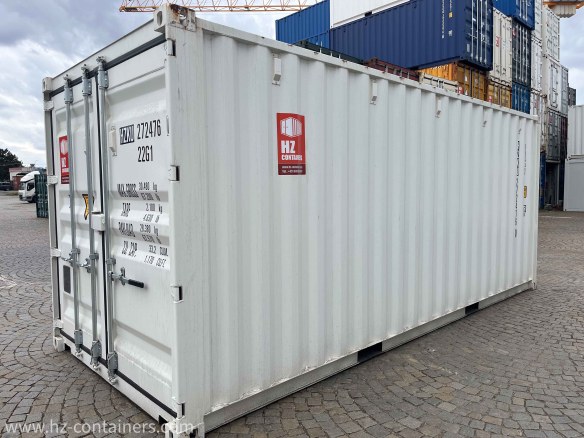
| 20′ DC (Dry Container) | 6 058 × 2 438 × 2 591 mm | 5 898 × 2 350 × 2 390 mm | ~33 m³ | ~28 000 kg | Smaller storage, workshops, garages |
| 40′ DC (Dry Container) | 12 192 × 2 438 × 2 591 mm | 12 032 × 2 350 × 2 390 mm | ~67 m³ | ~26 000 kg | Large storage, transport of bulky goods |
| 40′ HC (High Cube) | 12 192 × 2 438 × 2 896 mm | 12 032 × 2 350 × 2 695 mm | ~76 m³ | ~26 000 kg | Housing, offices, bulky storage |
20-foot container (20′ DC)
The best-selling format on the Czech market. The 6-meter length is ideal — it fits on most plots, does not require massive foundations, and handling is relatively easy. The internal volume of 33 m³ corresponds roughly to the size of a smaller garage. If you are looking for a universal storage solution, a 20-foot shipping container is the most common choice.
40-foot container (40′ DC)
Double the length means double the volume, but also greater demands on space and handling. For transporting bulky but lightweight goods (furniture, electronics), the 40-foot container is the standard. For storage, it is suitable if you have enough space and need to store a larger quantity of material.
40-foot High Cube container (40′ HC)
On the outside, it looks almost the same as a standard 40-foot container, but it is 30 cm taller. Those extra 30 centimeters make a fundamental difference — the internal height of 2.7 m allows comfortable movement even for taller people and provides enough space for ceiling insulation if you are planning a conversion to housing. This is precisely why the High Cube is the most popular choice for container houses.
Special types of shipping containers
In addition to basic dry containers, specialized variants also exist:
- Reefer container: With its own cooling unit for transporting food and medicines. Can also be used as a freezer box.
- Open-top container: With a removable roof for top loading — ideal for oversized cargo.
- Side-door container: With side doors for easier access to cargo without having to unload the entire contents.
- Flat rack: A container without walls and roof for heavy machines, vehicles, and atypical cargo.
Conditions of shipping containers: New vs. used
This is the chapter where the most mistakes are made when buying. Let’s therefore clearly explain what the individual categories mean — and especially what they mean for your wallet.
| Category | Age / wear | CSC validity | Price (indicative, 20′) | Suitable for |
|---|---|---|---|---|
| One Way (IICL) | 1 voyage, practically new | Yes | 55 000–85 000 CZK | Housing, representative purposes, demanding |
| Cargo Worthy (CW) | Used, fully functional | Yes | 40 000–60 000 CZK | Storage, transport, workshop |
| As Is (decommissioned) | Retired from service, various condition | No/expired | 25 000–40 000 CZK | Non-demanding storage, garden house |
One Way (IICL)
A container that has made only one journey — from the factory (typically in China) to Europe. It is practically new: no dents, no rust, perfect sealing, floor without damage. If you are building a house or want a container that will look perfect even in ten years, One Way is the number one choice. In terms of price, however, it is approximately 30–50 % more expensive than Cargo Worthy.
Cargo Worthy (CW)
A used container that still meets the conditions for maritime transport. It has a valid CSC plate, is watertight, and structurally flawless. However, it may bear signs of use — scratches, surface rust, minor dents. For regular storage and transport, it is the ideal price/performance ratio. Most companies and tradespeople choose precisely this category.
As Is (decommissioned)
A container retired from shipping transport. It may have damaged sealing, dents, local rust, or damaged floor. The price is the lowest, but expect that you will probably have to invest additional money into it — at least into repairing the sealing and repainting. Suitable for storing tools, hay, or as a cheap garden house where appearance doesn’t matter anyway.
Practical tip: If you are buying a used shipping container, always insist on a personal inspection or at least current photographs. Focus on the condition of the floor (sagging, rot), door sealing (whether it fits properly), and overall flatness of the walls.
How much does a shipping container cost? Indicative prices 2026
The price of a shipping container depends on four main factors: type, condition, location, and the current situation in the maritime transport market. The following table shows indicative prices on the Czech market (excluding 21 % VAT):
| Type | One Way | Cargo Worthy | As Is |
|---|---|---|---|
| 20′ DC | 55 000–85 000 CZK | 40 000–60 000 CZK | 25 000–40 000 CZK |
| 40′ DC | 65 000–100 000 CZK | 50 000–75 000 CZK | 35 000–55 000 CZK |
| 40′ HC | 75 000–110 000 CZK | 55 000–85 000 CZK | 40 000–60 000 CZK |
What affects the price
In addition to the type and condition itself, the following plays a role:
- Transport: Container transport to the destination can cost 5 000–20 000 CZK depending on the distance and the need to use a crane. Some sellers offer free transport when purchasing above a certain value.
- Season: Prices fluctuate depending on global demand for maritime transport. During crises (such as during the pandemic), prices skyrocket.
- Modifications: RAL color spray, electrical installation, shelves, security locks — all of this increases the price but saves you time.
- Location: Containers are generally cheaper near large ports (Hamburg, Rotterdam) and at large sellers with their own warehouse.
Where to buy a shipping container
Several large sellers operate on the Czech market, offering both new and used shipping containers:
- HZ CONTAINERS — a specialist in shipping containers with its own warehouse and a wide range from decommissioned pieces to One Way
How to choose a shipping container — a practical guide
We are getting to the heart of the matter. You have an idea of what you want, but how to choose the right shipping container? Follow these five steps.
Step 1: Determine the purpose
First, clarify what the container will primarily serve for:
- Storage: It will stand in one place. You don’t need a valid CSC. You can save on the condition.
- Transport: The container must have a valid CSC plate and be in flawless technical condition. Without compromise.
- Housing / conversion: You want a container as the basis of a house, office, or cottage. Here it pays to invest in One Way or very high-quality CW. The HC variant is strongly recommended due to space for insulation.
Step 2: Choose the right type and size
- 20 feet: Universal choice. Fits almost everywhere, handling is easy, price is the lowest.
- 40 feet: More space, but you need at least 14 meters of length for placement and handling.
- 40′ HC: The clear choice for housing. Those extra 30 cm are priceless during conversion.
Step 3: Choose the condition according to budget
- If you have a budget and want certainty: One Way.
- If you are looking for the best price/performance ratio: Cargo Worthy.
- If price comes first and you don’t mind appearance: As Is (but expect additional repair costs).
Step 4: Check the CSC plate and technical condition
During a personal inspection, focus on:
- CSC plate — is it on the door? Is it valid?
- Floor — step on it across the entire surface, look for soft spots, signs of rot, or chemical damage.
- Door sealing — open and close the doors, check whether they fit along the entire perimeter.
- Roof — from outside and inside. Any hole or crack means leakage.
- Walls — look for dents, punctures, or excessive rust (especially near the floor and corners).
Step 5: Don’t forget transport and handling
A shipping container weighs 2–4 tons. Without heavy equipment, you won’t move it. Before purchasing, check:
- Does the seller have their own transport? For how much?
- Is there enough space on your property for a crane or hydraulic arm?
- What is the access like? (Width of the gate, load-bearing capacity of the access road, overhead lines.)
Use of shipping containers beyond transport
Shipping container as storage
The most common “second life” of a shipping container. Why is it so popular?
- Security: Steel walls and a quality lock deter most thieves better than a wooden shed.
- Durability: Withstands wind, rain, snow, and hail. Service life of 20+ years with minimal maintenance.
- Speed: Order, deliver, install — done in a day.
- No building permit: Mostly. (See the chapter on legislation below.)
Shipping container for housing
Container houses are the fastest-growing segment of alternative housing in the Czech Republic. The reasons are clear:
- Construction speed: While a brick house takes a year to build, a container house can be habitable in 3–6 months.
- Modularity: You can assemble containers like building blocks — 2, 3, 5, or 10 containers side by side and on top of each other.
- Price: The rough construction of containers comes out significantly cheaper than traditional construction.
But watch out for the legislation. A container house is a building like any other — you need a building permit or at least a building notification. A single shipping container placed on the land without foundations and without connection to networks usually does not need a building permit (if it serves as storage and does not exceed certain dimensions). However, as soon as you start converting it into a residential space, you enter the building law regime. Always consult with your local building authority.
Other uses
Creativity knows no bounds. Shipping containers are commonly used today as:
- Workshop — ideal sound-insulated space for noisy work
- Garage — for a car, motorcycle, or as a shelter for equipment
- Sales stand — increasingly common at festivals and markets
- Office — cheap expansion of company premises
- Construction site facilities — changing room, tool storage, site manager’s office
Most common questions when buying a shipping container
How does transport and handling work?
The container is transported on a truck with a hydraulic arm or crane. On site, a crane places it on a prepared base — ideally a hardened surface, concrete panels, or at least a gravel bed. It is important that the container stands level and on the spacings where the largest load-bearing points are.
Do I need a building permit for a shipping container?
A standalone shipping container serving as a garden shed usually does not need a building permit — especially if it is smaller than 25 m² and is not permanently attached to the ground. Nevertheless, we recommend consulting with the local building authority, as the interpretation may differ from municipality to municipality. For conversion to a residential space, a building procedure is mandatory.
How long does a shipping container last?
With proper maintenance (mainly protection against corrosion and regular sealing inspection), a shipping container lasts 30–50 years or more. COR-TEN steel is designed to withstand extreme conditions. The weakest link is the wooden floor, which can be replaced relatively easily.
FAQ
How to choose a shipping container?
First clarify the purpose — storage, transport, or housing. Based on that, choose the type (20′, 40′, HC), condition (One Way, CW, As Is), and a suitable seller. Before purchasing, always check the CSC plate, floor, sealing, and overall technical condition.
How much does a 20-foot shipping container cost?
The price of a 20-foot shipping container in 2026 ranges from 25 000 CZK (decommissioned As Is) through 40 000–60 000 CZK (Cargo Worthy) up to 55 000–85 000 CZK (One Way). All prices are excluding 21 % VAT.
What is the difference between a new and a used shipping container?
A new container (One Way) has made only one voyage, is without defects, has perfect sealing and a long service life. Used (Cargo Worthy) is cheaper, still fully functional with a valid CSC, but bears signs of wear. Decommissioned (As Is) is the cheapest, but may have damage requiring repair.
What is the CSC certificate and why is it important?
CSC (Convention for Safe Containers) is an international agreement requiring every container in maritime transport to undergo regular safety inspections. The CSC plate on the container door confirms that the container is fit for transport. CSC is not required for storage, but its presence testifies to a maintained condition.
What are the dimensions of a 20-foot and 40-foot shipping container?
A 20-foot container has external dimensions of 6 058 × 2 438 × 2 591 mm and an internal volume of approximately 33 m³. A 40-foot container has external dimensions of 12 192 × 2 438 × 2 591 mm and a volume of 67 m³. The High Cube version (40′ HC) is 30 cm taller (2 896 mm) and offers a volume of 76 m³.
Can a house be built from a shipping container?
Yes, container houses are increasingly popular in the Czech Republic. Containers are joined into modules, insulated, and equipped like a regular house. For residential construction, a building permit and a project from an authorized architect are necessary. It is recommended to use One Way containers or quality Cargo Worthy, ideally in the High Cube version.
How does shipping container transport work?
The container is transported on a truck and assembled on site using a crane or hydraulic arm. It is necessary to ensure sufficient space for handling (at least 14 meters of length for a 40-foot container) and a hardened base for placement. Transport is usually arranged by the seller, the price starts from 5 000 CZK upward depending on distance.
Where to buy the cheapest shipping container in the Czech Republic?
The cheapest shipping containers are in As Is condition at large sellers, such as HZ CONTAINERS, or on marketplaces (Bazoš, Sbazar). Prices start around 25 000 CZK for a 20-foot container. Before purchasing, however, always consider the costs of possible repairs and transport.
How long does a shipping container last?
With proper maintenance and corrosion protection, a shipping container lasts 30–50 years. COR-TEN steel is extremely durable, the weakest link is the wooden floor, which can be replaced. A container placed on a hardened base and regularly inspected can serve for decades without major repairs.
Do I need a building permit for a shipping container in the garden?
A standalone shipping container in the garden serving as storage usually does not need a building permit, provided it is not permanently attached to the ground and does not exceed a built-up area of 25 m². Nevertheless, it pays to consult the intention with the local building authority — each municipality may have a different interpretation. For conversion to a residential space, a building permit is always necessary.

 Czech Republic, Třebíč
 FREE SHIPPING


Other container news...

Contamination of the inner walls of a shipping container: Why this is a normal operating condition and not a reason for a complaint
Dark streaks, scuffs, and marks on the interior walls of a shipping container are a completely normal occurrence during use. They arise naturally during the loading and unloading of goods via handling equipment and have no impact on the container’s watertightness or structural integrity. Find out why these aesthetic marks are not grounds for a complaint and how they can be easily touched up if necessary.

Obligation to Check Tightness When Selling a Reefer Container
Who is responsible for the refrigerant leak check when selling a refrigerated container? Find out what obligations the seller has at the time of handover and why they must provide a PTI report along with the technical data plate. Learn which regulatory requirements and F-gas record-keeping duties become the sole responsibility of the new owner.

New shipping containers
If you are currently considering purchasing a new shipping container, you are not alone. While just twenty years ago containers were used almost exclusively for maritime transport, today they have found their way into construction, storage, business, and even housing. This growing popularity brings with it a host of questions: Which type should you choose? How much does it cost? How do you recognize quality? How can you avoid falling victim to scammers?
New sea shipping containers
If you are currently considering purchasing a new shipping container, you are not alone. While just twenty years ago containers were used almost exclusively for maritime transport, today they have found their way into construction, storage, business, and even housing. This growing popularity brings with it a host of questions: Which type should you choose? How much does it cost? How do you recognize quality? How can you avoid falling victim to scammers?