
Safe Packing and Securing of Cargo in Shipping Containers
What Does Safe Packing and Securing of Cargo in a Shipping Container Mean?
Safe packing and securing of cargo represents a comprehensive set of measures that protect goods, transport units, and the people involved in the logistics process. The goal is to prevent damage to cargo, losses, environmental disasters, and threats to health and life during the entire transport – especially in maritime, rail, and road transport, where extreme stress occurs.
According to OECD data, up to 90% of global goods are transported in containers – every improperly packed or secured container poses a risk of chain damage: from deformation of packaging, through destructive movement and container overturning, to falling overboard or fire. Worldwide losses related to improper packing are estimated at up to 5 billion dollars annually.
The responsibility for proper packing rests primarily with the shipper, but safety is the result of cooperation among all links in the supply chain. It is essential to comply with standards – in particular CTU Code (IMO/ILO/UNECE Code of Practice for Packing of Cargo Transport Units), or IMDG Code for dangerous goods and ISPM 15 for wooden packaging.
Basic Principles of Safe Packing and Securing of Cargo
Table: Overview of Key Principles and Risks
| Principle | Risk if Not Followed | Typical Failure |
|---|---|---|
| Stability | Shifting, overturning of goods, domino effect | Pallet shifting, goods falling |
| Cargo Protection | Damage to goods, corrosion, contamination | Wetting, tearing, mold |
| Safety | Injury, environmental disaster | Cargo falling out of container |
| Efficiency | Unnecessary costs, unused space | Dead spaces, deformation |
Basic Recommendations:
- Stability: Cargo must not have room to move. It is recommended to combine multiple securing methods (strapping, filling, blocking).
- Protection: Choose materials with regard to humidity, temperature, vibrations, and the nature of the goods.
- Safety: Securing doors when opening, separating hazardous substances, proper labeling.
- Efficiency: Planning cargo placement, optimizing stacking, minimizing dead spaces.
Key Terminology and Technical Concepts
Transport Units and Cargo Types
| Type/Requirement | Description and Significance |
|---|---|
| Shipping Container | ISO standardized steel box (20′, 40′, high-cube, reefer, open-top, flat rack). It is important to check the condition before loading (corrosion, deformation, tightness). |
| Cargo Transport Unit (CTU) | Includes containers, trailers, swap bodies, tanks. All are subject to CTU Code. |
| FCL (Full Container Load) | Shipper is fully responsible for packing and securing. Full control over layout. |
| LCL (Less than Container Load) | Consolidation of multiple shipments, higher demands on packaging durability, responsibility often rests with the freight forwarder. |
Methods and Materials for Cargo Securing
Most Commonly Used Securing Devices:
- Air Bags (Dunnage Bags): Inserted into gaps between cargo. Protect against lateral movement, easy installation, reusable.
- Anti-Slip Liners: Increase friction under pallets or between cargo layers. Essential for heavy and slippery goods.
- Strapping Systems (PES, composite, woven, steel): Secure cargo to fixing points in the container. For heavy and bulky goods, double or cross strapping is recommended.
- Single-Use Lashing Devices: Suitable especially for export, where quick application and reliability are needed.
- Blocking and Bracing: Wooden beams, wedges, barriers. Nailed to the container floor, prevent even heavy objects from moving.
- SafetySheet: Special barrier at the container door, protects against cargo falling out when opening.
- Thermal Wraps and Sleeves: Protect against temperature fluctuations, humidity, and condensation.
- Filling Materials: Polystyrene, PE foam, corrugated cardboard, inflatable bags.
Table: Overview of Materials and Their Use
| Material / System | Use | Advantages | Limitations |
|---|---|---|---|
| Air Bags | Between pallets, drums | Speed, reusable | Limited load capacity |
| Anti-Slip Liners | Under pallets, between layers | Increase friction, inexpensive | Not suitable for extremely heavy pieces |
| Strapping (PES/Steel) | Pallets, machinery, heavy objects | High strength | Requires proper application |
| Wooden Blocks | Heavy machinery, bulky goods | Extreme durability | Requires ISPM 15 |
| Thermal Wraps | Sensitive goods, food, chemicals | Protection against temperature fluctuation | Higher cost |
| SafetySheet | At container door | Protection of persons, easy installation | Does not solve internal securing |
Processes and Regulations
Container Inspection and Preparation
- External Inspection: No deformations, cracks, corrosion. Check numbers, door condition, and locking.
- Internal Inspection: Dry, clean, odor-free, floor without nails and protrusions.
- Light-Tightness Test: Any leaks mean potential risk of water ingress.
- Securing Points: All must be functional – minimum 8-10 anchor rings/hooks on the sides.
Weight Distribution and Stacking
- Heaviest items always on the bottom and as close to the center of the container as possible.
- Distribute weight evenly across the floor area, never on just one side.
- Vertical Stacking: Stack goods on top of each other only if packaging strength allows.
- Separation of Incompatible Goods: Liquids and bulk materials always separately, protect sharp edges.
Dangerous Goods
- IMDG/ADR: Each item must be properly declared, packed, and labeled.
- Separation and Labeling: Dangerous and regular goods must not be in direct contact.
ISPM 15
- Wood used for securing must be heat-treated and marked with the ISPM 15 logo.
- Unmarked wood may result in shipment detention or return.
CTU Code
- Code of practice for packing and securing CTU, valid worldwide.
- Recommends: loading planning, selection of appropriate materials, documentation of all steps.
Best Practices: Step-by-Step Guide
Phase 1: Planning and Preparation
- Identify the type of goods, weight, dimensions, and environmental sensitivity.
- Select the optimal container type – for heavier goods, a 20-foot container is often better (higher load capacity per unit length).
- Plan stacking – prepare a stowage plan, consider center of gravity, unloading order.
Phase 2: Container Inspection
- Thorough 7-point inspection, photographic documentation.
- Check cleanliness, tightness, functionality of anchor points.
Phase 3: Loading and Stacking
- Center of gravity always as low and centered as possible.
- Tight stacking, no gaps, use of filling materials.
- Separate goods by nature, protect against humidity, mechanical damage.
Phase 4: Securing and Fastening
- Fill all gaps – inflatable bags, wooden fillings, anti-slip liners.
- Strapping, anchoring to securing points, blocking with wooden wedges.
- Protect doors with SafetySheet, netting, or barrier.
Phase 5: Finalization and Documentation
- Photographic documentation of loaded and secured cargo.
- Closing and sealing, recording seal number in transport documents.
- Check correctness and completeness of transport documents, if necessary fumigation certificates and ADR/IMDG declarations.
Roles and Responsibilities in the Supply Chain
| Supply Chain Link | Responsibilities in Packing and Securing |
|---|---|
| Shipper/Manufacturer | Proper packing, declaration, and loading of cargo (FCL) |
| Freight Forwarder/Logistics Provider | LCL shipment consolidation, planning, expert advice |
| Carrier | Safe transport, inspection of external condition and seal |
| Port/Terminal | Safe handling, inspection of container integrity |
| Maritime Carrier | Provision of suitable container, proper stowage on ship |
| Recipient | Safe unloading, inspection of cargo condition |
Most Common Errors and Examples of Failure
- Cargo too heavy on one side: Container overturning during handling.
- Insufficient securing: Cargo movement, packaging deformation, shipment integrity breach.
- Non-compliance with ISPM 15: Shipment detention at borders.
- Missing documentation: Insurance claim rejection, fines.
- Inappropriate material selection: Securing failure under vibrations, water ingress, temperature changes.
Trends and Innovations for 2025 and Beyond
- Smart Containers: Real-time monitoring of temperature, humidity, position, and shocks. Significantly reduces risks and allows immediate response to problems.
- Digital Documentation and Content Uploads: Photographic documentation and all documents online – increases transparency and speeds up claim resolution.
- Advanced Software for Loading Planning: Automated calculations of weight distribution, stacking, and securing.
- Ecological and Recyclable Securing Materials: Biodegradable bags, anti-slip pads made from recycled fibers.
- Growing Pressure for Auditability and Transparency Throughout the Chain: Emphasis on certification and compliance with standards.

 Czech Republic, Mělník
  WITHOUT SHIPPING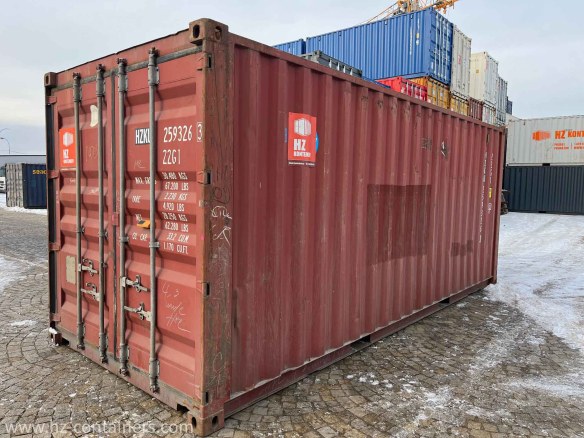


Other container news...

20 Foot shipping container cost
If you are researching the cost of a 20 foot shipping container, you have likely already encountered wildly different prices — from $999 listings online to quotes exceeding $5,500. That range is not a sign of inconsistency. It reflects real differences in container condition, location, delivery logistics, and the seller you are dealing with.
Side Opening container
A side opening container is an ISO-compliant intermodal shipping container engineered with full-length bi-fold doors along one of its long side walls, in addition to the standard cargo doors at one end. Unlike conventional containers that restrict access to a single set of rear doors, a side opening container — also widely called an open side container, open-sided shipping container, or side door container — provides unobstructed lateral access across the entire 20-foot or 40-foot length of the unit. This design transforms the container from a narrow tunnel into a wide-open space that forklifts can enter from the side, multiple workers can load simultaneously, and oversized cargo that would never fit through standard end doors can be placed without struggle.
40 Foot High Cube container cost
A 40 foot high cube container — often abbreviated as 40ft HC, 40′ HC, or 40-foot high cube — is one of the most common shipping container sizes sold on the secondary market. But if you are researching what a 40 foot high cube container costs, you have almost certainly noticed that prices are all over the map. One seller quotes $1,500. Another quotes $7,000. Both could be legitimate.
20 Foot container cost
If you have ever searched for a shipping container, you have almost certainly asked one question first: how much does a 20 foot container cost? The answer is not a single number. It is a range that spans from under $1,000 for a weathered, as-is unit to over $5,000 for a pristine, one-trip container — and that is before delivery, site preparation, or modifications enter the picture.