
Most Frequently Asked Questions About Refrigerated Shipping Containers
Welcome to the most comprehensive guide to the world of refrigerated shipping containers – so-called reefers. This article is intended for everyone who wants to understand in depth the technologies, operation, construction and use of these specialized units in modern logistics. We answer the most frequently asked questions, supplement them with technically accurate information from verified sources and provide practical advice for selection, operation and maintenance.
What is a Refrigerated Shipping Container (Reefer) and How Does It Work
Definition and Main Purpose
A refrigerated shipping container (reefer) is an intermodal transport unit designed to maintain precisely defined temperature conditions during transport and storage of goods. It is the highest standard for transporting fresh, chilled or deeply frozen goods by road, rail and sea.
Typical uses:
- Transport and storage of food (meat, fish, dairy products, fruit, vegetables)
- Pharmaceutical products and vaccines
- Chemicals and industrial semi-finished products sensitive to temperature
- Flowers and plant material
Operating Principle: Active Cooling and Air Circulation
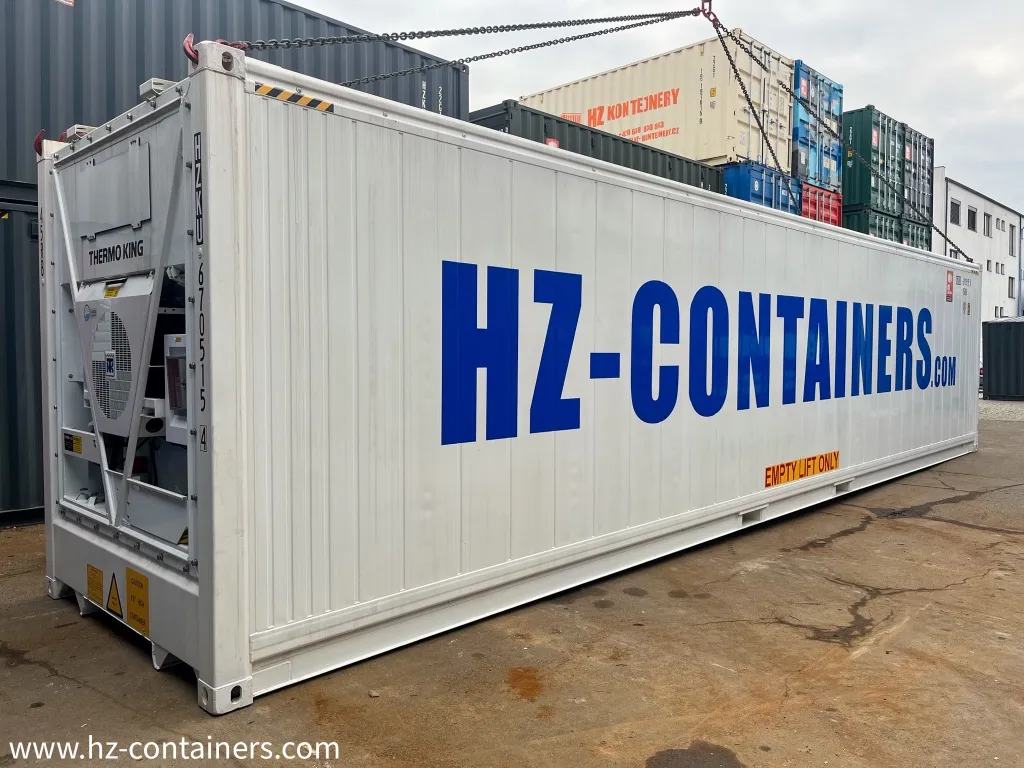
Unlike standard storage containers, reefers have an integrated cooling unit. It operates on the principle of active cooling using a compressor, condenser, expansion valve and evaporator. Important is the bottom air flow (so-called T-floor), where cold air is forced under the cargo, rises up, where it is drawn back into the cooling unit, and the cycle repeats. The result is uniform temperature throughout the container volume.
System advantages:
- Minimization of temperature fluctuations even with frequent door opening
- Effective removal of moisture and condensate
- Possibility of precise temperature regulation (typically from -30 °C to +30 °C, some models up to -60 °C)
| Parameter | Typical Value | Note |
|---|---|---|
| Temperature Range | -30 to +30 °C | Special models up to -60 °C |
| Regulation Accuracy | ±0.25 °C | According to manufacturer, model and unit age |
| Air Humidity | 60–85 % | Some models with active dehumidification |
| Air Flow Method | Bottom (T-floor) | Uniform cooling of entire cargo |
Key Components and Structural Elements of Refrigerated Containers
Building Materials and Layers
1. Outer Shell (Corten Steel):
- Durable weather-resistant steel that protects against corrosion (patina)
- Complies with ISO standards (ISO 1496/1) and international standards for maritime transport
2. Insulation Core (Polyurethane Foam):
- Thickness 55–100 mm depending on container type and manufacturer
- Closed cell structure ensures excellent insulation properties and prevents water vapor diffusion
3. Inner Shell (Stainless Steel/Aluminum):
- Food-grade stainless steel (AISI 304/316) ensures hygiene, easy cleaning and resistance to chemicals
4. Floor (T-profile Aluminum):
- Load capacity up to 25,000 kg (depends on model)
- Enables efficient air flow and easy handling with forklifts
| Layer | Material | Function |
|---|---|---|
| Outer Wall | Corten Steel | Mechanical and corrosion protection |
| Insulation | Polyurethane Foam | Minimization of heat loss |
| Inner Wall | Stainless Steel/Aluminum | Hygiene, durability, easy cleaning |
| Floor | Aluminum T-profiles | Air flow, load capacity, handling |
Cooling Unit – The Heart of the Reefer
Vapor Compression Cycle Principle
Refrigerant is compressed by a compressor, cooled in a condenser, expanded by an expansion valve and evaporated in an evaporator, where it removes heat from the interior space.
Main Components:
- Compressor (hermetic/screw): Ensures refrigerant circulation, usually powered by an electric motor
- Condenser: Heat exchanger located on the outside, requires free space for air flow
- Evaporator: Cools the interior space, equipped with a fan for efficient circulation
- Expansion Valve: Precisely regulates refrigerant flow for optimal performance
Refrigerants:
- History: Previously R134a, R404A
- Present: More environmentally friendly refrigerants: R452A, R513A, R32 (lower GWP)
- Trends: Reducing emissions and energy consumption (EU F-Gas regulation)
Control Electronics:
- Microprocessor control units with remote monitoring capability (telematics)
- Sensors for temperature, humidity, door status, alarms
Additional Equipment:
- Dehumidification: Some models have active air dehumidification (e.g., for banana storage)
- Sockets: Standard 32A/380–460V (3-phase), cable length 18–25 m
Types of Refrigerated Shipping Containers by Size and Technology
Most Common Sizes and Volumes
| Type | External Dimensions (mm) | Usable Volume (m³) | Note |
|---|---|---|---|
| 20′ Reefer | 6,058 × 2,438 × 2,591 | 28–30 | Standard Height |
| 40′ Reefer | 12,192 × 2,438 × 2,591 | 58–60 | Standard Height |
| 40′ HC | 12,192 × 2,438 × 2,896 | 67–69 | High Cube – Higher |
Classification by Condition
- One-Trip (New): Single journey from factory, warranty of technical and aesthetic condition
- Used: Meets standards (IICL5, Cargo Worthy, WWT)
- Renovated: After major repair, suitable for stationary cooling
Specialized Technologies
- Standard Reefer: Maintains temperatures -30 to +30 °C, most common use
- Super-Freezer: Temperatures up to -60 °C (e.g., for tuna, pharmaceuticals)
- Controlled Atmosphere (CA): Active gas control (O₂, CO₂, N₂) – extension of fruit shelf life
- AFAM+ (Automatic Fresh Air Management): Automatic air exchange based on sensors
Operation and Power Supply of Refrigerated Containers
Electrical Power Supply
- Standard: 3-phase voltage 380/400/460 V, 50/60 Hz
- Consumption: Usually 4–11 A/h depending on temperature, age, insulation and ambient conditions
- Dirty Power: Unsuitable power supply (voltage fluctuations, poor phasing) can damage electronics and compressor
Power Supply Options:
- Connection to fixed infrastructure (port, warehouse, facility)
- Diesel generators (gen-set) for transport by rail/road
- Mobile units for stationary use outside reach of electrical grid
Operating Recommendations
- Pre-cooling: Cool both cargo and container to the required temperature before loading
- Loading: Optimally distributed cargo, do not block air flow between floor and walls
- Monitoring: Regular temperature and alarm checks, ideally via telematics
Life Cycle, Maintenance and Service
Life Cycle Phases
- Manufacturing (mostly China, Singapore): Container and cooling unit manufacturing with quality control
- Primary Operation: 7–12 years in intensive maritime transport (international lines)
- Secondary Market: Sale for inland, regional and stationary use (cold storage)
- Decommissioning/Recycling: Materials can be partially recycled (steel, aluminum, copper)
Maintenance and Most Common Tasks
- PTI (Pre-Trip Inspection): Mandatory functionality check before each trip
- Cleaning Condenser and Evaporator: Regularly due to dust and contaminants
- Door Seal and Drainage Check: Prevent moisture and condensate penetration
- Cooling Circuit Service: Refrigerant replenishment, leak checks, electronics testing
- Repairs: Specialized services, manufacturer’s contractual partner recommended
Average Lifespan:
- Structure: 25–35 years with proper maintenance
- Cooling Unit: 10–15 years (thereafter more frequent service or replacement)
Practical Recommendations, Safety and Telematics
Container Placement
- Base: Level, reinforced surface (concrete, asphalt)
- Space Around Cooling Unit: Minimum 1–2 m of free space for air flow
- Accessibility: For equipment handling and power supply
- Weather Protection: Ideally shaded from direct sunlight
Telematics and Monitoring
- Standard Equipment: GPS, GSM/LTE modules, sensors for temperature, humidity, door status
- Advantages: Online monitoring of cargo condition, alarms for power failure or temperature deviation
- Recording Device: Data export for HACCP and audit of transport conditions
Safety Measures
- Always work with power disconnected
- Do not exceed recommended floor load limits
- Use protective equipment when servicing cooling circuit (glasses, gloves)
- Never block fans and air flow
Most Frequently Asked Questions (FAQ)
| Question | Answer |
|---|---|
| What is the main difference between a refrigerated shipping container and a storage container? | A maritime reefer is designed for extreme conditions, has robust construction and effective insulation, integrated cooling unit meeting ISO standards. A standard storage container is not designed to maintain temperature. |
| How long does a reefer maintain temperature without power? | In the order of hours (1–6 h) depending on insulation, ambient temperature and cargo temperature. For long-term storage, continuous power supply is required. |
| What temperatures can refrigerated containers maintain? | Standard from -30 °C to +30 °C, special models up to -60 °C. |
| Are refrigerated containers energy efficient? | New models have efficient compressors and environmentally friendly refrigerants, but consumption depends on operating conditions. |
| What is PTI and why is it important? | Pre-Trip Inspection is a comprehensive check of reefer condition and function before each trip. |
| What is the lifespan of a refrigerated container? | Structure lasts 25–35 years, cooling unit 10–15 years. Depends on intensity of operation and quality of maintenance. |

 Czech Republic, Uherské Hradiště
  FREE SHIPPING


Other container news...

20 Foot shipping container cost
If you are researching the cost of a 20 foot shipping container, you have likely already encountered wildly different prices — from $999 listings online to quotes exceeding $5,500. That range is not a sign of inconsistency. It reflects real differences in container condition, location, delivery logistics, and the seller you are dealing with.
Side Opening container
A side opening container is an ISO-compliant intermodal shipping container engineered with full-length bi-fold doors along one of its long side walls, in addition to the standard cargo doors at one end. Unlike conventional containers that restrict access to a single set of rear doors, a side opening container — also widely called an open side container, open-sided shipping container, or side door container — provides unobstructed lateral access across the entire 20-foot or 40-foot length of the unit. This design transforms the container from a narrow tunnel into a wide-open space that forklifts can enter from the side, multiple workers can load simultaneously, and oversized cargo that would never fit through standard end doors can be placed without struggle.
40 Foot High Cube container cost
A 40 foot high cube container — often abbreviated as 40ft HC, 40′ HC, or 40-foot high cube — is one of the most common shipping container sizes sold on the secondary market. But if you are researching what a 40 foot high cube container costs, you have almost certainly noticed that prices are all over the map. One seller quotes $1,500. Another quotes $7,000. Both could be legitimate.
20 Foot container cost
If you have ever searched for a shipping container, you have almost certainly asked one question first: how much does a 20 foot container cost? The answer is not a single number. It is a range that spans from under $1,000 for a weathered, as-is unit to over $5,000 for a pristine, one-trip container — and that is before delivery, site preparation, or modifications enter the picture.