
ISO Container Castors
Moving a 40-foot steel box that weighs up to 67,200 pounds has, for decades, meant one thing: calling in a crane and a licensed operator. But the rise of ISO container castors has rewritten that equation entirely. Whether you manage a container yard, own a converted container home, run a construction site, or operate a military logistics hub, understanding how container castors work — and how to choose, install, and use them safely — is essential knowledge. This guide covers everything: from the ISO standard that makes it all possible to the material science inside the wheel treads, from budget-friendly bolt-on kits to professional-grade dolly systems, and from installation safety to future trends.
What Are ISO Container Castors and How Do They Work?
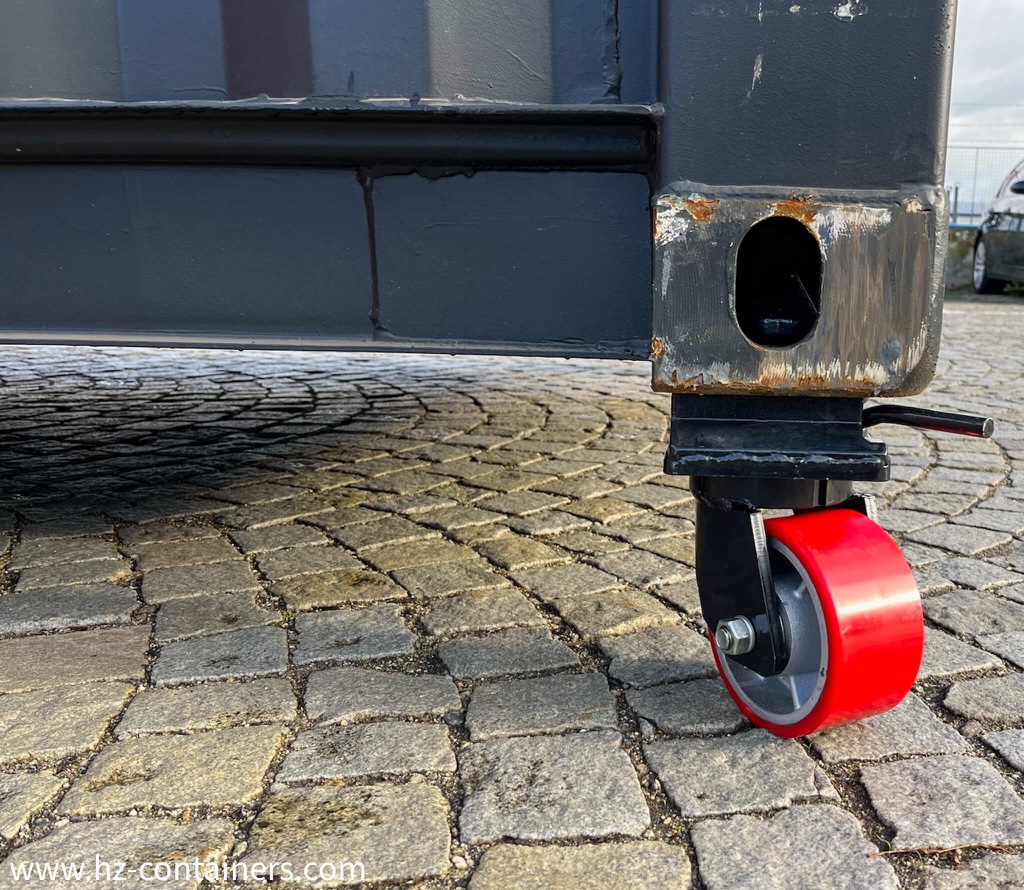
An ISO container castor (also spelled caster in American usage) is a heavy-duty wheel assembly specifically engineered to attach to the standardized corner castings of an intermodal shipping container. Rather than lifting a container onto a trailer or summoning a crane, operators attach four castors directly to the bottom corner castings of the container, transforming a stationary steel box into a towable, maneuverable unit that can be repositioned around a yard, warehouse, or construction site in minutes.
The defining feature of an ISO container castor is its twist-lock mechanism — a rotating steel lug that inserts into the oval aperture of the container’s ISO 1161 corner casting and locks with a simple 90-degree turn. No bolts. No welding. No permanent modification.
The Anatomy of a Container Castor
Every ISO container castor shares a common architecture, though specifications vary by manufacturer and load rating. The key components are:
- Top Plate: A machined steel plate that mates flush with the underside of the container’s corner casting. It houses the twist-lock mechanism.
- Twist-Lock Pin: A forged steel lug, typically operated by a lever or handle, that rotates 90 degrees inside the corner casting’s oval aperture to create a secure mechanical lock.
- Swivel Raceway: A precision-bearing assembly (ball bearings or tapered roller bearings) that allows the wheel bracket to rotate freely through 360 degrees. This is what makes the castor swivel.
- Wheel Bracket (Fork): The steel frame that holds the wheel or wheels. On heavy-duty castors, this is often a welded, gusseted steel fabrication.
- Wheel Tread: The tire material that contacts the ground — most commonly polyurethane, but also available in nylon, solid rubber, or pneumatic (air-filled) configurations.
- Optional Features: Directional lock (locks swivel at 90-degree intervals), wheel brake (prevents rolling on slopes), tow-bar attachment point, and anti-theft lock.
How the Twist-Lock Mechanism Secures the Castor
The twist-lock is the universal language of container handling. Every ISO shipping container manufactured since the late 1960s features eight corner castings — hollow steel blocks measuring approximately 7 × 6 × 4.5 inches, with oval apertures on three faces — positioned at all eight corners. These castings are engineered to carry the entire weight of a loaded container, whether stacked nine-high on a container ship or suspended from a spreader crane.
The twist-lock on a container castor exploits this same load path. The operator inserts the twist-lock pin through the bottom aperture of the corner casting and rotates the lever 90 degrees. The pin’s oblong head now sits perpendicular to the aperture, mechanically locked against the interior walls of the casting. The result is a connection rated for tens of thousands of pounds — achieved in seconds, with no tools.
| ISO 1161 Corner Casting Specification | Value |
|---|---|
| Standard | ISO 1161:2016 (current revision) |
| Material | Cast steel (typically ASTM A27 Grade 70-36 or equivalent) |
| Approximate dimensions | 178 mm × 162 mm × 118 mm (7″ × 6.4″ × 4.6″) |
| Aperture (bottom face) | Oval, ~125 mm × 64 mm (4.9″ × 2.5″) |
| Load rating (compression) | Up to 86 metric tons per casting |
| Positions per container | 8 (4 top, 4 bottom) |
This standardized interface means a set of castors purchased from any manufacturer will fit a container built by any other manufacturer anywhere in the world. The castors can be attached for a move and detached for storage, preserving the container’s structural integrity and stackability.
Where Did ISO Container Castors Come From? A Brief History
The story begins not with castors but with containers. In 1956, North Carolina trucking entrepreneur Malcolm McLean launched the first container ship — the Ideal X — carrying 58 aluminum truck bodies from Newark to Houston. His insight was deceptively simple: instead of loading loose cargo piece by piece, put everything into a standardized steel box and move the box.
By the late 1960s, the International Organization for Standardization (ISO) had codified container dimensions and corner casting specifications, and the intermodal shipping container as we know it was born. But the revolution created an unexpected problem on land. At ports, rail yards, and distribution centers, containers arrived by the thousands — and they needed to be repositioned constantly. Cranes could lift them, but crane time was expensive and scheduling was inflexible. Forklifts could nudge them, but fork widths rarely matched container floor spans, and a misplaced fork could buckle the container floor. The crude alternative — dragging containers across asphalt with chains — damaged both the container and the ground surface.
From Dockyard Casters to Engineered Systems
The earliest shipping container wheels were simple industrial casters adapted from heavy-manufacturing applications. Steel wheels with minimal tread, bolted or welded to makeshift frames, let dockworkers push empty containers short distances across smooth concrete. These first-generation solutions were crude: no swivel capability, no standardized attachment mechanism, and capacity ratings that were often little more than guesswork.
The introduction of the twist-lock caster in the 1980s marked the first major leap. By integrating the same twist-lock mechanism used on ship decks and crane spreaders, manufacturers created wheels that could lock into a container’s corner casting in seconds with no tools and no permanent modification. Companies like Tandemloc (USA) and JUNG (Germany) began engineering container casters as specialized products rather than adapted general-purpose wheels.
The 2000s and 2010s brought a wave of innovation driven partly by the container home movement. As architects and DIY builders repurposed shipping containers into houses, offices, and retail spaces, the need for clean, reliable, low-impact mobility solutions grew. Products like EZY Wheels and ContainGo End Wheels emerged, designed specifically for the container owner — not just the port operator. These systems prioritized tool-free installation, lower price points, and compatibility with common tow vehicles like pickup trucks and skid steers.
Today, the market spans a wide spectrum: budget bolt-on kits for occasional DIY moves, mid-range caster sets for warehouse operations, and professional-grade dolly systems for daily industrial use. The common thread remains the ISO corner casting — a 60-year-old design that remains the universal mounting point for every wheel system on the market.
What Are the Different Types of Shipping Container Mobility Systems?
The term “shipping container wheels” is a catchall. In practice, the industry uses several distinct categories, each with different attachment methods, steering behavior, and ideal use cases. Understanding the differences is the first step toward choosing the right system.
| Type | Attachment Method | Steering | Typical Capacity (Set of 4) | Best Surface | Tow Vehicle | Approx. Price Range |
|---|---|---|---|---|---|---|
| Swivel Casters | Twist-lock into bottom corner castings | Full 360° swivel (directional lock optional) | 10,000–67,200 lbs | Smooth concrete, flat asphalt | Forklift, yard tug | $1,500–$10,000+ |
| Rigid Casters | Twist-lock into bottom corner castings | Fixed (straight-line only) | 10,000–67,200 lbs | Smooth concrete, flat asphalt | Forklift, yard tug (straight pulls) | $1,000–$7,000 |
| End Wheels | Pin-through corner casting side apertures | Fixed (straight-line only) | 11,000–32,000 lbs | Concrete, asphalt, compacted gravel | Forklift, skid steer, pickup | $500–$1,500 |
| Bolt-On Spindle Kits | Bolted through corner casting apertures | Fixed | 6,400–30,000 lbs | Gravel, dirt, pavement | Pickup, ATV, tractor | $200–$600 |
| Dolly Systems (Steerable) | Twist-lock + tow bar connecting front pair | Front axle steers via tow vehicle | 20,000–120,000 lbs | Concrete, asphalt, hard-packed ground | Forklift, tractor, yard tug | $5,000–$20,000+ |
| Hydraulic Self-Lifting | Integrated hydraulic jacks + twist-lock | Swivel or fixed depending on model | 20,000–80,000 lbs | Concrete, asphalt | Forklift, tractor | $8,000–$25,000+ |
For most users — warehouse operators, construction sites, container home builders — a set of four swivel casters with directional locks offers the best balance of maneuverability, cost, and ease of use. Dolly systems and hydraulic self-lifting units are typically reserved for high-frequency industrial operations where containers are moved daily.
How Do You Choose Between Swivel and Rigid Container Castors?
The choice between swivel and rigid castors — and the related question of directional locks — is one of the most consequential decisions when specifying a container mobility system.
Swivel Castors: 360° Maneuverability
A swivel castor rotates freely around its vertical axis, allowing the wheel to orient itself in any direction. When all four corners of a container are fitted with swivel castors, the container can be pushed, pulled, or towed in any direction — including sideways — and can spin on its own axis. This is invaluable in tight warehouse aisles, container yards with limited turning radii, or any scenario where the container must be positioned precisely.
The trade-off is control. A fully swiveling container can be difficult to steer in a straight line, especially at speed or on uneven ground. This is where the directional lock comes in.
Rigid Castors: When Straight-Line Towing Is Enough
Rigid castors are fixed in orientation — they only roll forward and backward. They are simpler, cheaper, and often have a slightly higher load rating than an equivalent swivel unit (since there is no swivel bearing to size). Rigid castors are ideal when containers are moved primarily in straight lines — for example, along a dedicated tow path between a loading dock and a storage yard.
A common configuration is to use two rigid castors at the rear and two swivel castors at the front, mimicking the steering geometry of a standard cart or trailer.
The Directional Lock: Best of Both Worlds
Many high-quality swivel castors include a directional lock — a mechanism that locks the swivel at 90-degree intervals (0°, 90°, 180°, 270° relative to the container’s long axis). This allows the operator to:
- Unlock all four castors for maximum maneuverability in tight spaces.
- Lock two rear castors in the straight-ahead position for stable, straight-line towing — the container behaves like a cart with fixed rear wheels and swiveling front wheels.
- Lock all four castors for pure straight-line towing when precision is needed.
Directional locks are strongly recommended for any application where the container must be towed behind a vehicle. An unlocked swivel castor at speed can oscillate violently — a phenomenon known as “caster flutter” — which can damage the castor and create a safety hazard.
What Wheel Materials Should You Choose for Your Container Castors?
The material that meets the ground determines almost everything about a castor’s performance: its load capacity, rolling resistance, noise level, floor protection, weather resistance, and suitability for different surfaces.
| Material | Load Capacity | Best Surface | Weather Resistance | Floor Protection | Noise Level | Approx. Cost | Common Applications |
|---|---|---|---|---|---|---|---|
| Polyurethane | High | Concrete, asphalt, factory floors | Excellent (UV-resistant grades available) | Very good (non-marking) | Low | $$ | Warehouses, ports, general industrial |
| Nylon | Very high | Smooth concrete, steel decking | Excellent | Poor (can mark/damage floors) | Moderate | $$ | Heavy industrial, steel-surfaced yards |
| Pneumatic (Air-Filled) | Moderate | Grass, gravel, sand, uneven dirt | Good (check pressure regularly) | Excellent (floats over soft ground) | Moderate | $$ | Construction sites, soft terrain, farms |
| Solid Rubber | Low–Moderate | Smooth concrete, tile, epoxy | Good (can degrade in UV) | Excellent (softest tread) | Very low | $ | Light-duty, indoor, floor-sensitive environments |
| Cast Iron / Steel | Very high | Rough concrete, steel | Poor (rusts without treatment) | Very poor (damages floors) | High | $ | Extreme heavy-duty, scrap yards, demolition |
Polyurethane is the most common material for ISO container castors — and for good reason. It offers the best all-around balance of load capacity, durability, floor protection, and cost. High-quality polyurethane wheels can carry loads of up to 13 metric tons per castor while rolling smoothly on concrete and asphalt. They resist oil, grease, and many chemicals, and modern formulations include UV stabilizers for outdoor use.
Nylon wheels excel on perfectly smooth surfaces and offer slightly higher load capacities than polyurethane. However, they are hard — which means they transmit more vibration to the container and can damage epoxy-coated or painted floors. Nylon is often chosen for port environments with steel-plate or concrete decking.
Pneumatic (air-filled) tyres are the go-to choice for soft, uneven, or unpaved surfaces. The large contact patch distributes the weight, preventing the castor from sinking into grass, sand, or mud. The trade-off is maintenance — pneumatic tyres must be checked for correct pressure before each use, and punctures are a risk on debris-strewn job sites.
How Do You Calculate the Correct Load Capacity for ISO Container Castors?
Weight capacity is the single most important specification when choosing shipping container castors — and the one that causes the most confusion. Overloading a castor can lead to catastrophic failure: a collapsed wheel, a dropped container, and potentially fatal injuries.
The Standard Calculation Formula
The industry-standard formula accounts for the fact that load is rarely distributed evenly across all four corners:
Required capacity per castor = (Weight of container + Weight of cargo) ÷ 2.5
Why divide by 2.5 rather than 4? Because on anything less than a perfectly flat surface, the load shifts — sometimes dramatically. Two diagonal castors can briefly bear nearly the entire weight if the container traverses a dip or a threshold. The factor of 2.5 builds in a safety margin for these real-world conditions.
Example calculation:
A 40-foot high-cube container weighs approximately 8,000 lbs empty (tare weight). Loaded with 44,000 lbs of cargo, the gross weight is 52,000 lbs.
52,000 ÷ 2.5 = 20,800 lbs minimum capacity per castor.
Some manufacturers use a factor of 3 for additional conservatism, especially when the surface is known to be uneven:
52,000 ÷ 3 = ~17,333 lbs per castor.
Always defer to the more conservative figure when in doubt.
Understanding Dynamic vs. Static Load Ratings
Manufacturers often quote both a static load rating (what the castor can hold when stationary) and a dynamic load rating (what it can support while rolling). The dynamic rating is always lower — typically 25–50% lower — because rolling introduces impact forces, vibration, and lateral loads. When purchasing, always confirm which rating is being quoted and ensure the dynamic rating meets your calculated requirement.
Why Uneven Weight Distribution Is the Hidden Killer
Even if you calculate perfectly, real-world weight distribution can undermine your safety margin. A container loaded with dense machinery at one end, or a container traversing a surface with a 2-inch dip under one corner, can place far more than 25% of the total weight on a single castor. For this reason, many safety guidelines recommend:
- De-rate capacity by 50% when operating on uneven or unpaved surfaces.
- Assume diagonal loading (two castors bearing most of the weight) as your failure condition.
- Visually inspect load distribution before every move. If the container is visibly tilted, do not proceed.
How Do You Install ISO Container Castors Safely?
Installing container castors is straightforward, but every step matters. A rushed or incorrect installation can result in a dropped container — with potentially fatal consequences.
Step-by-Step Installation Guide
- Inspect the Surface: The planned path and installation area must be flat, level, and free of debris, potholes, thresholds, and slopes. Even a 1-inch drop under one corner can destabilize the container during lifting.
- Inspect the Corner Castings: Check all four bottom corner castings for rust, cracks, deformation, or debris inside the aperture. A damaged corner casting may not engage the twist-lock properly. Never use castors on a container with compromised corner castings.
- Lift the Container: Use one of the following methods:
- Container jacks (claw jacks): The safest and most controlled method. Position one jack at each end of the container (or one at a time) and lift just enough to insert the castors — typically 6–8 inches of clearance.
- Forklift: Use a spreader bar or lifting eyes rated for the container’s weight. Lift from the top corner castings only. Never lift from the fork pockets unless the container is specifically designed for it.
- Crane: Use a spreader beam with twist-locks. This is the fastest method but requires a certified operator and rigger.
- Insert the Castors: Position each castor underneath the lifted corner. Align the twist-lock pin with the oval aperture in the corner casting. Push the castor upward until the top plate is flush with the bottom face of the corner casting.
- Engage the Twist-Lock: Rotate the twist-lock lever 90 degrees. You should feel a firm mechanical stop. Visually confirm that the twist-lock pin has rotated fully and is no longer aligned with the aperture. Give the castor a firm lateral tug to confirm it is locked.
- Set Directional Locks (If Applicable): If you plan to tow the container in a straight line, engage the directional locks on the two rear castors (or all four) before lowering the container.
- Lower the Container: Lower the container slowly and evenly. As the weight settles onto the castors, watch for any settling or tilting. If one corner drops unevenly, re-lift and check that the twist-lock on that corner is fully engaged.
- Attach the Tow Bar: If using a tow bar, connect it to the designated attachment points on the front castors. Ensure the coupling pin is fully seated and secured.
Critical safety rule: Never position any part of your body under a suspended container. Stay at least 2 meters (6.5 feet) away from the container during lifting and lowering.
Common Installation Mistakes to Avoid
- Installing on uneven ground: The single most dangerous mistake. If the surface isn’t flat, the container can shift unpredictably when weight transfers to the castors.
- Failing to fully engage the twist-lock: A partially engaged twist-lock may hold the castor in place under no load — but slip out under load, dropping the corner of the container.
- Using a forklift without a spreader bar: Fork pockets on shipping containers are designed for empty handling only. Lifting a loaded container by the fork pockets can buckle the floor structure.
- Skipping the directional lock on front castors: When towing, an unlocked front swivel castor can oscillate and cause loss of control.
What Safety Standards and Regulations Apply to Container Castor Use?
Container castor operations are subject to both regulatory standards and manufacturer safety guidelines. Understanding both is essential for any professional operation.
OSHA Guidelines for Containerized Cargo Handling
In the United States, the Occupational Safety and Health Administration (OSHA) regulates container handling under 29 CFR 1918.85 (Containerized Cargo Operations). While this standard primarily addresses crane and top-lift operations, its broader safety principles apply to any container movement:
- Employers must determine whether a container is loaded or empty before handling.
- Before moving, containers must be inspected for visible structural damage.
- Personnel must be kept clear of suspended or moving containers.
- Only qualified, trained personnel may operate lifting or moving equipment.
OSHA’s Materials Handling and Storage standard (29 CFR 1910.176) also applies, requiring that storage areas be kept free of hazards and that mechanical handling equipment be used in accordance with manufacturer instructions.
Manufacturer Safety Recommendations
Most castor manufacturers specify the following safety parameters:
| Parameter | Typical Limit | Rationale |
|---|---|---|
| Maximum towing speed | 4–6 km/h (2.5–3.7 mph) | Walking pace. Higher speeds risk castor flutter, heat buildup, and loss of control. |
| Exclusion zone | 2 meters (6.5 feet) | No personnel within this radius of a moving container. |
| Uneven surface derating | 50% of rated capacity | Peak loads on diagonal castors can exceed 50% of total weight. |
| Slope limit | 2–3% grade (1–2°) | Beyond this, braking and control become unreliable. |
| Wind limits | Check manufacturer specs | High winds can move an empty container on castors. |
Pre-Use Inspection Checklist
Before every use, inspect each castor for:
- [ ] Twist-lock mechanism operates smoothly and locks firmly
- [ ] No visible cracks, bends, or deformation in the top plate or fork
- [ ] Wheels rotate freely without grinding, wobbling, or excessive play
- [ ] Tread is intact — no chunks missing, no flat spots, no embedded debris
- [ ] Swivel bearing rotates smoothly through full 360 degrees
- [ ] Directional lock engages and disengages cleanly at all four positions
- [ ] Tow bar coupling pin is present, straight, and secure
- [ ] No significant rust or corrosion (surface rust is acceptable; pitting is not)
If any item fails the inspection, do not use the castor. Tag it out of service and arrange repair or replacement.
How Do ISO Container Castors Compare to Other Mobility Solutions?
Choosing the right mobility solution requires matching the system to your specific use case: surface type, frequency of use, budget, and available tow vehicles.
| Feature | Swivel Castors | End Wheels | Bolt-On Spindle Kits | Dolly Systems |
|---|---|---|---|---|
| Installation time | ~10–15 min | ~5–10 min | ~30–60 min | ~10–20 min |
| Tools required | None (twist-lock) | None (pin) | Wrenches, sockets | None (twist-lock) |
| Maneuverability | Excellent (360°) | Poor (straight-line only) | Poor (straight-line only) | Good (steerable front axle) |
| Surface versatility | Concrete, asphalt | Concrete, asphalt, compacted gravel | Gravel, dirt, pavement, grass | Concrete, asphalt |
| Tow vehicle needed | Forklift, yard tug | Forklift, skid steer, pickup | Pickup, ATV, tractor | Forklift, tractor |
| Typical cost (set of 4) | $1,500–$10,000 | $500–$1,500 | $200–$600 | $5,000–$20,000 |
| Best for | Frequent moves, tight spaces | Occasional repositioning, budget-conscious | DIY, soft terrain, one-off moves | High-frequency industrial use |
| Weight capacity (max) | Up to 67,200 lbs | Up to 32,000 lbs | Up to 30,000 lbs | Up to 120,000 lbs |
For most commercial users — warehouses, distribution centers, construction sites — a set of four swivel castors represents the best balance of capability and cost. End wheels and bolt-on kits serve the budget-conscious or occasional user. Dolly systems are the professional-grade solution for operations that move containers daily.
What Are Common Misconceptions About Shipping Container Castors?
Several myths persist about container castors. Addressing them directly can prevent costly mistakes and dangerous situations.
“You Can Move a Fully Loaded Container by Hand”
This is perhaps the most persistent myth — fueled by marketing videos that show a single person pushing a container across smooth concrete. The reality: a 40-foot container loaded to 52,000 lbs requires approximately 1,560–2,600 lbs of force to initiate movement on smooth concrete (assuming a coefficient of rolling friction of 0.03–0.05 for polyurethane on concrete). That’s the pushing force of 8–15 strong adults. Even an empty 8,000-lb container requires roughly 240–400 lbs of force. In practice, manual pushing is only feasible for empty containers on perfectly smooth, level surfaces over very short distances. For anything else, use a tow vehicle.
“Any Flat Surface Works — Gravel Is Fine”
Flatness is not the same as suitability. Gravel, even when graded flat, creates high rolling resistance and subjects castors to constant impact loading from individual stones. This accelerates tread wear, increases the peak load on each castor, and makes controlled movement nearly impossible. Polyurethane castors are designed for hard, paved surfaces. If you must move a container across gravel, use pneumatic-tyred castors or a dolly system with large-diameter wheels.
“One Caster Size Fits All Containers”
While ISO corner castings are standardized, castor specifications — load capacity, wheel diameter, tread width — vary enormously. A lightweight 6-ton castor designed for an empty 20-foot container is dangerously undersized for a loaded 40-foot high-cube. Always calculate the required capacity for your specific container and load, and factor in surface conditions with appropriate safety margins.
“Castors Are a Permanent Installation”
Container castors are designed to be temporary. Leaving them attached for extended periods — especially outdoors — exposes the bearings to weather, allows rust to develop at the twist-lock interface, and makes eventual removal more difficult. Best practice is to remove castors after each use, inspect them, and store them in a dry, covered location.
How Do You Maintain and Inspect Container Castors?
Proper maintenance extends the service life of container castors and, more importantly, prevents the kind of failures that lead to dropped containers and serious injuries.
Routine Inspection Checklist
After every use — and at least every six months for castors in storage — perform the following checks:
| Component | What to Check | Action If Failed |
|---|---|---|
| Twist-lock mechanism | Smooth operation, firm lock, no slop | Disassemble, clean, lubricate; replace if worn |
| Top plate | Cracks, bends, corrosion pitting | Remove from service; weld repair only by qualified fabricator |
| Swivel bearing | Smooth 360° rotation, no grinding or binding | Repack or replace bearings |
| Wheel tread | Chunking, flat spots, delamination, embedded metal | Replace wheel |
| Wheel bearing | Free rotation, no side-play or grinding | Replace bearings |
| Directional lock | Engages/disengages cleanly at all positions | Clean mechanism; replace spring if weak |
| Tow bar | Straight, no bends, coupling pin present and secure | Straighten or replace |
| General corrosion | Surface rust acceptable; pitting is not | Sand and repaint surface rust; replace if pitted |
Storage Best Practices
- Store castors indoors or under cover, away from rain, snow, and direct sunlight.
- Keep castors upright (top plate facing up) to prevent deformation of the tread.
- Apply a light coating of anti-corrosion spray to exposed steel surfaces before long-term storage.
- Store castors separated — do not stack them, as the weight can flat-spot the treads.
When to Replace vs. Repair
- Replace wheels when tread depth is below 50% of original, or when chunking, flat spots, or delamination is present.
- Replace bearings if they grind, bind, or show visible pitting.
- Replace the entire castor if the top plate or fork shows any crack — weld repair is possible but must be performed by a certified welder following the manufacturer’s specifications.
- Repair surface rust with sanding and repainting. Never paint the twist-lock mechanism; only use light oil or graphite lubricant.
What Does the Future Hold for Container Mobility Technology?
The container castor market is evolving. Several trends point toward more sophisticated, safer, and more sustainable mobility solutions.
Electric-assist drive systems are gaining traction in European and Asian markets. These systems integrate an electric hub motor into one or more castors, allowing a single operator to move a loaded container with push-button control. Battery packs are typically lithium-ion, with enough capacity for a full day’s operation. Expect to see these systems become more common in North American warehouses and distribution centers over the next 3–5 years.
Smart monitoring — sensors embedded in castors that track load per wheel, bearing temperature, cycle count, and impact events — is an emerging technology. Early adopters in port logistics are using this data to predict maintenance needs and prevent failures before they occur.
Sustainable materials are entering the market. Recycled-content polyurethane formulations and bio-based polymers are reducing the environmental footprint of castor manufacturing. Some manufacturers are also exploring circular-economy models where worn castors are returned, refurbished, and resold rather than scrapped.
Modular autonomous systems — self-driving dolly units that can attach to a container, move it to a programmed location, and detach — are being prototyped for large-scale container yards. While still years away from commercial viability, they point toward a future where container movement is increasingly automated and human-free.
Frequently Asked Questions
What are ISO container castors?
ISO container castors are heavy-duty wheel assemblies that attach to the standardized ISO 1161 corner castings found on every intermodal shipping container. They use a twist-lock mechanism to secure themselves without tools, bolts, or welding, allowing containers to be moved around yards, warehouses, and job sites without a crane.
How does the twist-lock mechanism work on container castors?
The twist-lock consists of a rotating steel pin with an oblong head. The operator inserts the pin into the oval aperture of the container’s corner casting and rotates a lever 90 degrees. The pin’s head rotates perpendicular to the aperture, locking mechanically against the interior walls of the casting. The connection is rated for tens of thousands of pounds and can be engaged or disengaged in seconds.
How do you install shipping container castor wheels?
First, ensure the surface is flat and obstacle-free. Lift the container using jacks, a forklift, or a crane. Insert each castor from underneath into the ISO corner casting. Rotate the twist-lock lever 90 degrees until it locks firmly. If towing, engage directional locks on the rear castors and attach a tow bar. Lower the container slowly and evenly. Never place any part of your body under a suspended container.
How much weight can ISO container castors support?
Capacity varies by model. Light-duty castors may support 2,500–5,000 lbs per wheel. Heavy-duty models can support 16,800 lbs or more per wheel. A set of four high-end castors can support a gross container weight exceeding 60,000 lbs. Always calculate the required capacity using the formula (container weight + cargo) ÷ 2.5 to account for uneven load distribution.
What is the difference between swivel and rigid container castors?
Swivel castors rotate 360 degrees around their vertical axis, allowing the container to move in any direction — including sideways. Rigid castors are fixed in a straight-ahead orientation and only roll forward and backward. Swivel castors offer superior maneuverability; rigid castors are simpler, cheaper, and slightly stronger. Many swivel castors include a directional lock that can convert them to rigid mode for straight-line towing.
What surface types are shipping container castors suitable for?
Polyurethane-wheeled castors are designed for hard, paved surfaces — concrete, asphalt, and factory floors. Nylon wheels excel on smooth steel or concrete decking. Pneumatic (air-filled) tyres are required for soft surfaces like grass, gravel, sand, or dirt. Never use polyurethane or nylon castors on soft or uneven ground, as they will sink, bog down, and may be damaged.
How do you calculate the required load capacity for container castors?
Use the formula: (container tare weight + cargo weight) ÷ 2.5 = minimum capacity per castor. The divisor of 2.5 accounts for uneven load distribution — on anything less than a perfectly flat surface, two diagonal castors can briefly bear nearly the entire load. For rough or uneven surfaces, use a divisor of 3 for additional safety margin.
What is a directional lock and when should you use it?
A directional lock is a mechanism on swivel castors that locks the swivel rotation at 90-degree intervals (0°, 90°, 180°, 270°). Use it to convert swivel castors into rigid ones for stable straight-line towing. A common configuration is to lock the two rear castors in the straight-ahead position while leaving the front castors free to swivel — this provides both stability and maneuverability.
How do container castors compare to dolly systems and end wheels?
Container castors are attached individually to each corner and offer the best maneuverability for frequent, short-distance moves. Dolly systems connect front and rear pairs via a tow bar and offer higher capacity and better straight-line control — ideal for daily industrial use. End wheels mount to side apertures and are the simplest, cheapest option for occasional straight-line repositioning. Bolt-on spindle kits are the budget option for soft terrain and one-off moves.
What maintenance do container castors require?
After every use, inspect the twist-lock mechanism, top plate, swivel bearing, wheel tread, wheel bearing, directional lock, and tow bar for damage or wear. Store castors indoors, upright, and protected from weather. Lubricate moving parts lightly. Perform a full inspection every six months. Replace wheels when tread depth falls below 50% or when chunking or flat-spotting is present. Replace any castor with cracked structural components immediately.
Other container news...

20 Foot shipping container cost
If you are researching the cost of a 20 foot shipping container, you have likely already encountered wildly different prices — from $999 listings online to quotes exceeding $5,500. That range is not a sign of inconsistency. It reflects real differences in container condition, location, delivery logistics, and the seller you are dealing with.
Side Opening container
A side opening container is an ISO-compliant intermodal shipping container engineered with full-length bi-fold doors along one of its long side walls, in addition to the standard cargo doors at one end. Unlike conventional containers that restrict access to a single set of rear doors, a side opening container — also widely called an open side container, open-sided shipping container, or side door container — provides unobstructed lateral access across the entire 20-foot or 40-foot length of the unit. This design transforms the container from a narrow tunnel into a wide-open space that forklifts can enter from the side, multiple workers can load simultaneously, and oversized cargo that would never fit through standard end doors can be placed without struggle.
40 Foot High Cube container cost
A 40 foot high cube container — often abbreviated as 40ft HC, 40′ HC, or 40-foot high cube — is one of the most common shipping container sizes sold on the secondary market. But if you are researching what a 40 foot high cube container costs, you have almost certainly noticed that prices are all over the map. One seller quotes $1,500. Another quotes $7,000. Both could be legitimate.
20 Foot container cost
If you have ever searched for a shipping container, you have almost certainly asked one question first: how much does a 20 foot container cost? The answer is not a single number. It is a range that spans from under $1,000 for a weathered, as-is unit to over $5,000 for a pristine, one-trip container — and that is before delivery, site preparation, or modifications enter the picture.