
Differences Between Road, Rail, and Sea Container Transport
In today’s globally interconnected world, efficient movement of goods is the foundation of success for every company. Container transport forms the backbone of modern logistics and enables safe, fast, and economical transportation of goods across continents. The choice of the right type of transport – road, rail, or sea – has a fundamental impact on costs, delivery speed, environmental footprint, and cargo safety. This article explains in detail the technical, economic, and environmental differences between individual transport modes and provides a comprehensive glossary of key terms and latest trends.
Basic Characteristics and Historical Context
Container transport is one of the greatest logistics inventions of the 20th century. Standardization of dimensions and fixed technical parameters (according to ISO) enabled the creation of a global network where a single container can travel by sea, rail, and road without cargo transshipment.
Intermodal Transport
Intermodal transport uses two or more types of transport (for example, a combination of ship, train, and truck) within a single transport chain. The container remains sealed throughout and only changes the means of transport, which minimizes the risk of damage and loss. Standardization (ISO 668) enables compatibility across terminals, ports, and railway nodes worldwide.
Multimodal Transport
Unlike intermodal transport, multimodal transport is provided by a single operator based on a single transport document. It is particularly suitable for customers who want simplicity and responsibility “in one place.”
In-Depth Technical Comparison of Transport Modes
Road Transport of Containers (Road Transport)
- Description: Transport of containers by tractors and trailers over the road network. It provides the “first and last mile” in the logistics chain.
- Technical Limitations: Maximum 1x 40′ or 2x 20′ containers per unit, weight limits (e.g., in the Czech Republic max. 40 tons), strict ADR regulations, driver working hours.
- Flexibility: Highest, availability almost everywhere.
- Speed: Fastest for distances up to 500 km.
- Tracking: Modern GPS systems enable detailed real-time monitoring of cargo movement.
- Safety: Cargo is more exposed to the risk of theft or traffic accidents.
- Typical Uses: Short and medium distances, urgent shipments, transport to/from remote areas.
Advantages of Road Transport
- Door-to-door delivery without transshipment
- Quick response to logistics changes
- Easy planning and high availability
Disadvantages of Road Transport
- Highest CO₂ emissions per ton-kilometer
- Highest energy consumption per ton-kilometer
- Risk of delays due to traffic congestion, weather, accidents
- Limited capacity (compared to train/ship)
- Need for regular driver breaks
Table: CO₂ Emissions and Energy Intensity of Road Transport
| Parameter | Road Transport (Truck) |
|---|---|
| CO₂ Emissions (g/tkm) | 60–150 |
| Energy Consumption (MJ/tkm) | 1.2–2.0 |
Source: Railway Administration 2022, EcoTransIT World
Rail Transport of Containers (Rail Freight)
- Description: Transport of containers on special railway cars (most often platforms or pocket wagons).
- Technical Limitations: Bound to the railway network and terminals. Suitable for routes over 300–500 km.
- Capacity: One train transports 60–110 TEU on a 650m unit, depending on station length and wagon type.
- Speed: Medium, typically 30–70 km/h including handling.
- Safety: High, low rate of theft and accidents.
- Ecology: Lowest CO₂ emissions per ton-kilometer, especially with electrification.
- Typical Uses: Long inland routes, port connections, high-volume transport.
Advantages of Rail Transport
- Lowest environmental impact (electrified lines up to 90% less CO₂ than truck)
- High capacity and efficiency for large volumes
- Lower unit costs for long distances
- Stable schedules, less weather impact
- Suitable for heavy and bulky cargo
Disadvantages of Rail Transport
- Lower flexibility (bound to track, terminals, interfaces)
- Requires combination with road transport for collection/delivery
- Higher infrastructure costs
- Inefficient for short distances
Table: CO₂ Emissions and Energy Intensity of Rail Transport
| Parameter | Rail Transport (Electric) | Rail Transport (Diesel) |
|---|---|---|
| CO₂ Emissions (g/tkm) | 4–22 | 20–40 |
| Energy Consumption (MJ/tkm) | 0.2–0.5 | 0.5–0.9 |
Source: Railway Administration 2022, EcoTransIT World
Sea Transport of Containers (Sea Freight)
- Description: Transport of containers on container ships between ports worldwide.
- Technical Limitations: Bound to ports, requires additional inland transport.
- Capacity: Largest ships (ULCV) up to 24,000 TEU, commonly 8,000–15,000 TEU.
- Speed: Low, typically 18–25 knots (33–46 km/h), transport time in weeks.
- Ecology: Very low emissions per ton-kilometer due to economies of scale.
- Typical Uses: Intercontinental transport, goods with low time sensitivity, large volumes.
Advantages of Sea Transport
- Cheapest transport per unit volume/km
- Highest capacity
- Low environmental impact per ton-kilometer (in terms of CO₂)
- Suitable for heavy, bulky, and non-perishable goods
Disadvantages of Sea Transport
- Long transport time (weeks)
- Need for combination with other transport for door-to-door
- Susceptibility to delays (weather, port congestion, customs inspections)
- More complex administration
Table: CO₂ Emissions and Energy Intensity of Sea Transport
| Parameter | Sea Transport (Container Ship) |
|---|---|
| CO₂ Emissions (g/tkm) | 3–14 |
| Energy Consumption (MJ/tkm) | 0.1–0.3 |
Source: EcoTransIT World, IMO
Types of Containers and Their Uses
| Container Type | Use | Volume (m³) | Max. Capacity (t) |
|---|---|---|---|
| 20′ Standard (Dry Van) | General cargo, palletized goods, cartons, drums | ~33 | 28 |
| 40′ Standard (Dry Van) | General cargo, larger volumes | ~67 | 28 |
| Open Top/Hard Top | Oversized, tall and heavy loads, top loading | ~32–65 | 28–30 |
| Flat Rack/Platform | Machinery, construction equipment, oversized and heavy loads | – | 40–50 |
| Tank Container | Liquids, gases | 20–26 | 24 |
| Reefer (Refrigerated) | Food, pharmaceuticals, temperature-sensitive goods | 28–67 | 27 |
| Bulk Container | Bulk materials (grain, fertilizers) | ~33–67 | 28 |
| Special (Ventilated, Insulated, Livestock) | Special purposes | Various | Various |
Source: Goodloading, HZ Containers
Comprehensive Comparison Table
| Factor | Road Transport | Rail Transport | Sea Transport |
|---|---|---|---|
| CO₂ Emissions (g/tkm) | 60–150 | 4–40 | 3–14 |
| Energy Consumption (MJ/tkm) | 1.2–2.0 | 0.2–0.9 | 0.1–0.3 |
| Capacity (TEU) | 1–2 / unit | 60–110 / train | 8,000–24,000 / ship |
| Speed | High (short routes) | Medium | Low |
| Flexibility | Highest | Low (bound to network) | Very low |
| Availability | High | Medium | Ports |
| Reliability | Medium (congestion, weather) | High | Medium |
| Price per Ton-Kilometer | High | Medium/Low | Lowest |
| Typical Route Length | Up to 500 km | 300–2,000 km | 2,000+ km |
| Ideal For | Door-to-door, urgent | Large volumes, long routes | Intercontinental |
Environmental Impacts and Legislative Aspects
- Road Transport: Largest producer of CO₂ emissions in transport. In the Czech Republic, road transport accounts for more than 90% of transport emissions. Subject to strict regulation (Euro emission standards, road taxes, tolls).
- Rail Transport: Only 1.5% of transport emissions in the Czech Republic, with electrification nearly zero emissions can be achieved (depending on energy mix).
- Sea Transport: Globally approximately 2.5% of global CO₂ emissions. IMO (International Maritime Organization) introduces strict limits on fuel sulfur content and plans to reduce emissions by 50% by 2050 compared to 2008.
Key Terms and Glossary
- TEU (Twenty-foot Equivalent Unit): Standard unit of measurement for container ship and terminal capacity, corresponding to a 20-foot container.
- FEU (Forty-foot Equivalent Unit): 40-foot container, equivalent to 2 TEU.
- EcoTransIT World: Internationally recognized tool for calculating energy intensity and emissions of transport modes.
- ULCV (Ultra Large Container Vessel): Largest class of container ships (20,000+ TEU).
- ADR: European Agreement concerning the International Carriage of Dangerous Goods by Road.
- Slot: Physical space for a container on a ship, train, or in a port.
- Reefer: Refrigerated container with active temperature control.
Recommendations for Transport Selection
- Short routes, urgent shipments: Road transport
- Long inland routes, large volumes: Rail transport (electric)
- Intercontinental transport, lowest price: Sea transport
- Maximum emphasis on ecology: Rail (electrification, green energy)
- Door-to-door logistics: Combination of all modes within intermodal transport

 Czech Republic, Neratovice
  FREE SHIPPING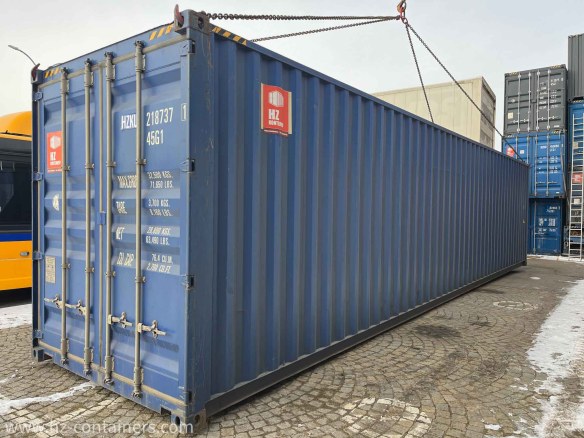
Other container news...

Obligation to Check Tightness When Selling a Reefer Container
Who is responsible for the refrigerant leak check when selling a refrigerated container? Find out what obligations the seller has at the time of handover and why they must provide a PTI report along with the technical data plate. Learn which regulatory requirements and F-gas record-keeping duties become the sole responsibility of the new owner.

New shipping containers
If you are currently considering purchasing a new shipping container, you are not alone. While just twenty years ago containers were used almost exclusively for maritime transport, today they have found their way into construction, storage, business, and even housing. This growing popularity brings with it a host of questions: Which type should you choose? How much does it cost? How do you recognize quality? How can you avoid falling victim to scammers?
New sea shipping containers
If you are currently considering purchasing a new shipping container, you are not alone. While just twenty years ago containers were used almost exclusively for maritime transport, today they have found their way into construction, storage, business, and even housing. This growing popularity brings with it a host of questions: Which type should you choose? How much does it cost? How do you recognize quality? How can you avoid falling victim to scammers?

6m shipping container
Are you thinking about buying a 6-meter shipping container but aren’t sure what to look for? You are not alone—this 20-foot container is the best-selling size on the Czech market, and the differences between various types, conditions, and prices can be significant. In this guide, you will find everything you need to know: from exact dimensions and a comparison of categories (such as “one-way,” refurbished, and “Cargo Worthy”) to current prices and shipping advice.