
Anatomy of a Shipping Container
Welcome to the most comprehensive dictionary page that reveals every detail of shipping container anatomy. This page is intended not only for logistics specialists, manufacturers and sellers, but also for anyone planning to buy a shipping container, modify it, or is interested in the technical aspects of global transport. In each section you will find expanded, practical and technical information based on the latest world and Czech sources, including specific standards and material specifications.
Basic Frame Structure – Container Skeleton
The frame forms the backbone of the container and ensures its load-bearing capacity even at maximum load. It is a highly precise steel structure whose individual elements are designed and manufactured according to strict international standards (in particular ISO).
Corner Castings
| Parameter | Value/Description |
|---|---|
| Standard | ISO 1161 |
| Material | Cast steel, e.g. ASTM A27 Grade 70-36 |
| Dimensions | 178 mm × 162 mm × 118 mm |
| Number per container | 8 |
| Openings | 3 on each corner casting |
| Fastening | Welding |
| Quality control | ISO 1161 certification, strength tests |
Main roles:
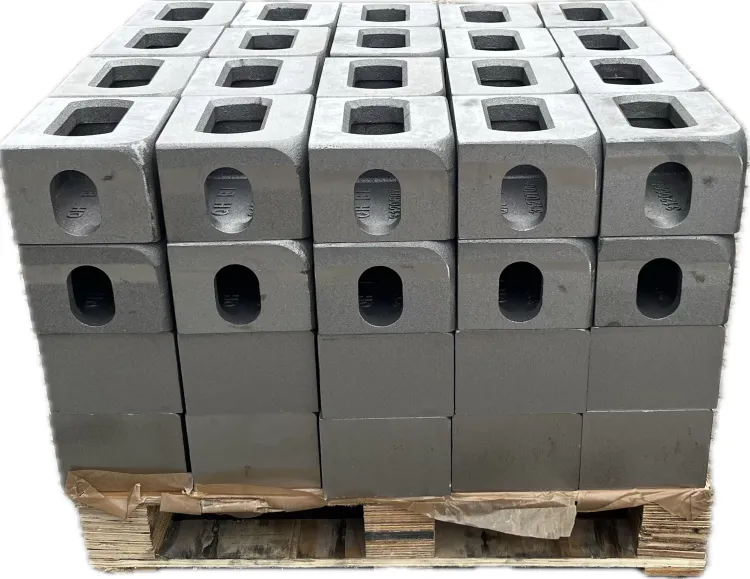
- Lifting and handling: Openings are precisely calibrated for spreaders, cranes and clamping mechanisms.
- Stacking: All weight of stacked containers is transferred through corner castings and posts – the roof is NOT load-bearing.
- Fastening: Twist locks secure safe connection between containers and with transport vehicles.
Technical highlights:
- Corner castings are milled with millimeter precision, which is essential for global compatibility.
- Cast steel is preferred due to extreme strength, weldability and resistance to long-term stress.
- Welding is the only recommended fastening method – only this guarantees connection integrity.
Corner Posts
- Material: High-strength steel, thickness up to 10 mm
- Function: Transfer vertical forces; their strength is essential for stacking safety
- Control: Repairs and replacements always according to IICL standard to ensure structural safety
Top and Bottom Rails and Cross Members
| Element | Material | Function |
|---|---|---|
| Top rail | Steel (e.g. Corten) | Ensures longitudinal rigidity, load-bearing capacity and connection of corner posts |
| Bottom rail | Steel | Weight transfer to cross members, floor support |
| Cross members | Steel beams | Even weight distribution of cargo, increased floor clearance |
- Cross member spacing: Usually 305 mm (12 inches) for maximum floor support
- Advantage: Due to robust construction, there is no need to build solid foundations for container buildings
Cladding and Floor – Protective Shield
Wall and Roof Panels – Corten Steel
| Property | Value/Description |
|---|---|
| Material | Corten steel (COR-TEN, weathering steel) |
| Thickness | 1.6–2.0 mm |
| Surface finish | None required; a self-healing layer forms on the surface |
| Service life | 20+ years in aggressive outdoor environment |
| Function of corrugated sheets | Increases rigidity and resistance to deflection and impact |
| Additional info | Also used on bridges and sculptures (e.g. Angel of the North) |
Why Corten Steel?
- Creates a stable rust layer on the surface that acts as a protective shield – the so-called “self-healing mechanism”.
- Resists sea salt, rain and wind without need for coatings.
- Allows long service life even under extreme stress.
Front End Wall
- Construction: Profiled Corten sheet, firmly welded to front corner posts
- Function: Solid barrier that prevents deformation and protects cargo during transport
Floor
| Material | Description |
|---|---|
| Marine-grade plywood | 28 mm thick, laminated, impregnated against pests |
| Alternative | Bamboo flooring – more ecological, durable |
| Installation | Bolted to cross members |
| Load capacity | 2,000–3,000 kg/m² (depending on container type) |
| Treatment | Insecticides according to international shipping regulations |
- Advantage: The floor is designed to withstand repeated movement of forklifts and point loads when handling heavy goods.
Door Assembly and Identification
Cargo Doors
| Element | Description |
|---|---|
| Material | Steel, often Corten steel |
| Opening | Up to 270° for maximum access |
| Reinforcement | Horizontal and vertical for increased strength |
| Sealing | Rubber around entire perimeter |
| Locking | 2× (for 20′, 40′ – 4×) locking bars |
Locking Bars and Cams
- Material: Steel
- Function: Lock doors along entire height, ends (cams) fit into holders in the frame
- Safety: Handles are equipped with padlock capability, often in protective box against cutting
Door Gaskets
- Material: Rubber (EPDM, NBR)
- Function: Ensures water-tightness, air-tightness and protection against dust and pests
- Tightness test: Light test – no light should penetrate inside after closing
CSC Plate
| Name | Description |
|---|---|
| Standard | International Convention for Safe Containers (CSC), 1972 |
| Location | Left door leaf |
| Data | Manufacturer, year of manufacture, maximum gross weight, stacking weight, date of next inspection or ACEP program |
- Without a valid CSC plate, the container is not suitable for international transport.
- ACEP: Continuous inspection and maintenance program that allows operation without the need for regular periodic inspections.
Special and Supplementary Elements

Forklift Pockets
- Use: Allow handling of empty container with forklift
- Standard: Common for 20′ containers, less frequent for 40′ due to safety and weight
- Dimensions: Standard 362 mm (width) × 115 mm (height), spacing 2,050 mm
Twist Locks
- Function: Mechanical connection of containers to each other and to chassis/wagon/ship
- Use: 90° rotation secures locking in corner casting

Gooseneck Tunnel
- Location: In the middle of the floor at the front end of 40′ containers
- Function: Allows seating on special “gooseneck” chassis and reduces overall height of the unit
Ventilators
- Number: 2–4 per container
- Function: Passive ventilation, reduces risk of condensation and mold formation
Materials and International Standards
Most Common Materials
| Element | Material |
|---|---|
| Frame, walls, roof | Corten steel (COR-TEN) |
| Corner castings | Cast steel (ASTM A27 etc.) |
| Floor | Water-resistant plywood, bamboo |
| Sealing | Rubber (EPDM, NBR) |
Main International Standards
| Standard | Description |
|---|---|
| ISO 1161 | Corner castings – dimensions, strength, quality control |
| ISO 668 | Basic dimensions and container classification |
| ISO 1496 | Technical requirements for construction and testing |
| CSC (1972) | Safety standards for construction and maintenance |
| Customs Convention (1972) | Simplification of customs procedures for containers |
 Czech Republic, Litoměřice
  FREE SHIPPING
Other container news...

High Cube container specifications
A high cube container — also referred to as an HC container, HQ container, or high-cube — is an intermodal shipping container that stands one foot taller than the standard ISO container. While a standard general-purpose container measures 8 feet 6 inches (2.59 m) in external height, a high cube container extends to 9 feet 6 inches (2.89 m). This extra 12 inches of vertical clearance translates into approximately 10–15% more cubic capacity without altering the container’s footprint — the same length and width are maintained, meaning the container occupies the same floor space on a vessel, chassis, or storage yard.

Shipping container parts
A shipping container looks like a simple steel box from the outside, but it is an assembly of dozens of precisely engineered shipping container parts — each governed by international standards, each designed to survive decades of ocean transit, crane lifts, and stacking loads that would crush an ordinary structure. Whether you are buying a used container, planning a container home, troubleshooting a repair, or simply building your logistics vocabulary, understanding every individual component is the difference between making an informed decision and an expensive mistake.

40 Foot Container Dimensions
If you have ever booked ocean freight, planned a warehouse layout, or designed a modular building project, you have asked the same question: what are the exact 40 foot container dimensions — and what do they mean for what you can actually load? The numbers are standardized worldwide, but the practical implications of those numbers are surprisingly nuanced. A 40-foot container is not simply 40 feet of usable space, and its weight limits are not what most people assume. This guide covers every measurement, every weight rating, and every loading consideration you need to make informed decisions about the world’s most common shipping container.
Quick Answer: A standard ISO 40-foot shipping container measures 12.19 m (40 ft) long × 2.44 m (8 ft) wide × 2.59 m (8 ft 6 in) high externally and provides approximately 67.7 m³ (2,390 ft³) of usable internal volume. The maximum gross weight is 30,480 kg (67,200 lbs), with a typical payload capacity of approximately 26,700–26,800 kg (58,900–59,000 lbs).

Cargo worthy container
If you have ever shopped for a used shipping container, you have almost certainly encountered the term cargo worthy — often abbreviated as CW or CWO (Cargo Worthy Only). It is one of the most important classifications in the container industry, yet it is also one of the most misunderstood. A cargo worthy container is not a container that looks new. It is not necessarily a container that has a valid CSC plate. And it is definitely not the same as a wind and watertight container. This guide explains what cargo worthy really means — from its technical definition and historical origins to the precise structural criteria, inspection process, cost implications, and common misconceptions that trip up even experienced buyers.