
20 Foot container dimensions
A 20-foot shipping container is the most widely used freight unit on the planet. Whether you are a logistics manager booking FCL cargo, a site superintendent ordering a storage container, or a homeowner planning an international move, the numbers behind this steel box dictate whether your project succeeds or fails. Get the dimensions wrong by even a few inches, and your cargo will not fit through the door. Misjudge the payload, and you face overweight penalties, safety violations, or a second unplanned delivery.
This guide consolidates every measurement, weight rating, and capacity figure you need — in imperial, metric, and millimeter precision — and goes beyond the numbers to explain the history, the variants, and the practical realities that spec sheets rarely mention.
What Are the Exact Dimensions of a 20 Foot Container?
The term “20-foot container” is a nominal designation. The actual exterior length is 20 feet, but the interior length is shorter because the walls consume space. All standard Series 1 freight containers share the same width of 8 feet and the same general-purpose height of 8 feet 6 inches, as defined by ISO 668.
Exterior Dimensions
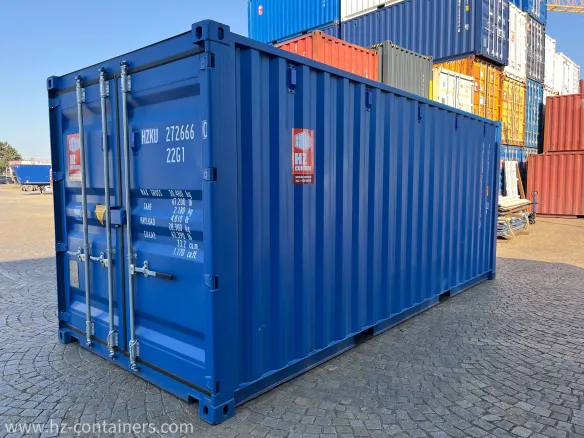
A standard 20-foot dry container measures exactly 20 feet long × 8 feet wide × 8 feet 6 inches high on the outside. In metric terms, that is 6.06 meters × 2.44 meters × 2.59 meters. These exterior dimensions are universal across every ISO-compliant 20-foot general-purpose container, regardless of manufacturer. They are what allow the container to lock securely onto chassis, railcars, and vessel cell guides anywhere in the world.
Interior Dimensions
The interior is smaller because the corrugated Corten steel walls, roof, and floor consume approximately 4 inches of length, 4 inches of width, and 3–4 inches of height on each side. The standard interior dimensions are:
In feet and inches: 19 feet 4 inches long × 7 feet 8 inches wide × 7 feet 10 inches high.
In meters: 5.90 meters long × 2.35 meters wide × 2.39 meters high.

| Measurement | Exterior (Imperial) | Exterior (Metric) | Interior (Imperial) | Interior (Metric) |
|---|---|---|---|---|
| Length | 20 ft 0 in | 6.06 m | 19 ft 4 in | 5.90 m |
| Width | 8 ft 0 in | 2.44 m | 7 ft 8 in | 2.35 m |
| Height | 8 ft 6 in | 2.59 m | 7 ft 10 in | 2.39 m |
Dimensional conversions at a glance: 20 ft = 240 in = 6,060 mm. Interior length: 232 in = 5,890 mm. Interior width: 92 in = 2,330 mm. Interior height: 94 in = 2,400 mm.
Door Opening Dimensions (and Why They Are Smaller)
The door opening is the most frequently overlooked dimension — and the one that causes the most loading failures. The doors sit within a steel header and sill frame, which reduces the clear opening compared to the interior ceiling and floor.
| Door Opening | Imperial | Metric |
|---|---|---|
| Width | 7 ft 8 in | 2.34 m |
| Height | 7 ft 6 in | 2.28 m |
The door opening height is 4 inches shorter than the interior ceiling height because of the structural header beam above the doors. If you are loading tall items on a forklift, measure against the 7 ft 6 in door opening — not the 7 ft 10 in interior ceiling. A crate that clears the ceiling inside the container may still collide with the door header during entry.
How Much Can a 20 Foot Container Hold? Weight, Volume & Capacity
Three numbers govern how much you can load into a 20-foot container: tare weight (the empty container), payload (the cargo it can carry), and maximum gross weight (the combined total). Miscalculating any of these leads to rejected loads, road safety violations, or structural damage.
Tare Weight, Payload, and Maximum Gross Weight
| Weight Specification | Imperial | Metric |
|---|---|---|
| Tare weight (empty container) | ~5,070 lbs | ~2,300 kg |
| Maximum payload (cargo only) | ~62,170 lbs | ~28,200 kg |
| Maximum gross weight (container + cargo) | ~67,200 lbs | ~30,480 kg |
Important: Tare weight varies by manufacturer, age, and floor type. Some older containers may weigh as little as 2,120 kg, while newer units with thicker floors can reach 2,380 kg. Always confirm the exact tare weight stamped on the CSC plate of the specific container you are using.
The 20-foot container is unusual among container sizes in that its payload often exceeds its volume capacity. Dense cargo — steel coils, machinery, tiles, cement bags — can reach the weight limit long before the container is physically full. This makes the 20-footer the preferred choice for heavy, compact goods, whereas a 40-foot container typically runs out of volume before hitting its weight ceiling.
Ground-bearing pressure is worth calculating if you plan to place the container on asphalt, soft ground, or a parking lot. A fully loaded 20-foot container exerts roughly 3,300 lbs per linear foot across its two bottom side rails. On hot asphalt, that can cause sinking without proper dunnage or concrete pads.
Cubic Capacity and Floor Space
| Capacity Metric | Value |
|---|---|
| Usable volume | ~33 m³ (1,172 cubic feet) |
| Floor space | ~150 sq ft (13.94 m²) |
The 33 cubic meters (or 1,172 cubic feet) of volume is a theoretical maximum. In practice, irregularly shaped cargo, pallet gaps, and the inward taper of corrugated walls reduce usable volume to roughly 30–32 m³. Always factor in at least 5–10% buffer when estimating whether your cargo will fit.
How Many Pallets Fit in a 20 Foot Container?
Pallet count depends on pallet dimensions and loading orientation. The table below shows the standard single-tier capacities for the three most common pallet types:
| Pallet Type | Dimensions | 20ft Container Capacity |
|---|---|---|
| Euro pallet (EPAL 1) | 1,200 × 800 mm | 11 pallets |
| Industrial pallet (EPAL 2) | 1,200 × 1,000 mm | 9–10 pallets |
| North American GMA pallet | 48 × 40 in (1,219 × 1,016 mm) | 10 pallets |
These figures assume no overhang from the cargo beyond the pallet edges. If your boxes, bags, or shrink-wrapped goods extend past the pallet footprint, the count drops. Double-stacking is possible only when the cargo can support the weight of the upper tier and the total height remains within the door opening and interior ceiling limits.
Pallet-wide containers — a niche variant with extra internal width — can hold 12 Euro pallets in a 20-foot length. Availability is limited and route-dependent; confirm with your carrier before planning around this option.
What Is the Difference Between a 20ft Standard and a 20ft High Cube Container?
A high cube container adds exactly 1 foot (30 cm) to the exterior height. This single change cascades through every vertical dimension and adds approximately 4.2 cubic meters of usable volume.
| Specification | Standard 20ft | High Cube 20ft |
|---|---|---|
| Exterior height | 8 ft 6 in (2.59 m) | 9 ft 6 in (2.89 m) |
| Interior height | 7 ft 10 in (2.39 m) | 8 ft 10 in (2.69 m) |
| Door opening height | 7 ft 6 in (2.28 m) | 8 ft 6 in (2.59 m) |
| Interior volume | ~33 m³ | ~37.4 m³ |
| Tare weight | ~2,300 kg | ~2,315 kg |
| Max payload | ~28,200 kg | ~28,180 kg |
| ISO code | 22G0 | 25G0 |
When to Choose a High Cube Over a Standard
The high cube makes sense when your cargo is tall but not especially heavy — think stacked furniture, industrial equipment with vertical clearance needs, or bulk lightweight goods. The extra foot of interior height (from 2.39 m to 2.69 m) lets you stack an additional layer of boxes or accommodate machinery that would hit the ceiling of a standard container.
The trade-off is a marginally higher tare weight and slightly reduced payload. The high cube also requires confirmation that your transport route can handle the 9 ft 6 in exterior height — most road and rail networks accommodate it, but low bridges, tunnels, and older warehouse bay doors can be a problem.
Where Did the 20 Foot Container Standard Come From?
The 20-foot container is not an arbitrary size. It is the product of one of the most consequential standardization efforts in industrial history.
Before the 1960s, cargo was loaded onto ships piece by piece — a process called break-bulk shipping. Sacks, barrels, crates, and pallets of every imaginable dimension were manhandled into ship holds by longshoremen. A single transatlantic voyage could spend more time in port than at sea. The American trucking entrepreneur Malcom McLean changed all of this when he launched the first container ship, the Ideal X, in 1956, carrying 58 aluminum containers from Newark to Houston.
By 1961, the International Organization for Standardization (ISO) formed Technical Committee 104 — Freight Containers — and began codifying what a shipping container should be. The result was ISO 668, which defined the Series 1 freight container classification. The standard established the key external dimensions: 8 feet wide, 8 feet 6 inches high, and lengths of 10, 20, 30, and 40 feet. The 20-foot length became the fundamental unit of measurement for the entire industry — the Twenty-foot Equivalent Unit, or TEU.
A TEU is not a physical container. It is a unit of capacity. One 20-foot container equals 1 TEU. A 40-foot container equals 2 TEU. A vessel’s capacity is measured in TEU — the Ever Alot, the world’s largest container ship as of 2026, carries over 24,000 TEU.
The companion standard, ISO 6346, governs the coding and marking system painted on every container: the owner code, product group code, serial number, and check digit that uniquely identify each unit worldwide.
Why Exterior and Interior Dimensions Differ
The corrugated steel panels that form the walls, roof, and doors of a container are typically 1.6 mm to 2.0 mm thick Corten steel. The floor is a 28 mm plywood laminate over steel cross members. The front wall and door frame each add structural depth. All of this subtracts from the interior:
- Length loss: ~4 inches (the front wall and door frame combined)
- Width loss: ~4 inches (two corrugated side walls)
- Height loss: ~3–4 inches (roof panel plus floor thickness)
The corrugation itself — the wave-like profile of the steel — is not just for strength. It also creates the slight inward profile that makes the interior width narrower at the walls than at the centerline. Most spec sheets quote the minimum interior width, which is the measurement at the corrugation peaks.
What Are the Different Types of 20 Foot Containers?
The dry van is the most common, but the 20-foot form factor is available in several specialized variants. Each has different internal dimensions, door configurations, and weight ratings.
| Type | Key Feature | Best For | Interior Height |
|---|---|---|---|
| Dry van (22G0) | Standard enclosed box | General cargo, storage | 2.39 m |
| High cube (25G0) | Extra 1 ft height | Tall or bulky goods | 2.69 m |
| Open top | Removable roof/tarpaulin | Top-loaded cargo, tall machinery | 2.39 m (with roof bows removed, unlimited) |
| Refrigerated (reefer) | Built-in cooling unit | Perishable food, pharma | ~2.26 m (reduced by cooling unit) |
| Flat rack | No side walls, collapsible ends | Oversized machinery, vehicles, pipes | N/A |
| Double door | Doors at both ends | Drive-through loading, long items | 2.39 m |
Reefer containers deserve special attention for dimension planning. The internal refrigeration unit reduces interior length by approximately 30–40 cm compared to a dry van, and the insulated walls reduce internal width by an additional 5–10 cm. Always use the specific reefer spec sheet from your carrier — never assume dry van dimensions apply.
Flat racks are dimensionally different from enclosed containers. A 20-foot flat rack has the same external length (6.06 m) and width (2.44 m) but no fixed height limit. The end walls can be folded down to create a completely flat platform, making flat racks the only option for cargo that exceeds the door opening of a dry van in any dimension.
Forklift Pockets and Loading Considerations
Every 20-foot dry container has two sets of forklift pockets cast into the bottom side rails. The pocket spacing is standardized at 2,050 mm (80.7 inches) center-to-center, with each pocket opening approximately 360 mm wide × 115 mm high. The pockets are designed to accommodate forks from a standard counterbalance forklift with a rated capacity of at least 7–8 tons when handling a fully loaded container.
Critical loading note: The forklift pockets are intended for handling an empty or lightly loaded container only. A fully loaded 20-foot container (30,480 kg gross) should always be lifted from the top corner castings using a spreader bar or reach stacker. Using forklift pockets on a gross-weight container risks structural failure.
What Are Common Misconceptions About 20 Foot Container Dimensions?
“20 Foot” vs. Actual Length
The most persistent misconception is that a 20-foot container is 20 feet long on the inside. It is not. The exterior is 20 feet. The interior is 19 feet 4 inches. The “20 foot” is a nominal class designation, not a usable-length measurement. This 8-inch difference is the single most common reason cargo that was “measured to fit” does not go through the door.
Door Height vs. Interior Height
As noted above, the door opening height (7 ft 6 in / 2.28 m) is 4 inches shorter than the interior ceiling height (7 ft 10 in / 2.39 m). If you build a crate to 7 ft 9 in, it will fit inside the container but will not clear the door header during loading. The door opening is the binding constraint.
Weight Capacity Confusion
The 30,480 kg maximum gross weight is a structural limit of the container itself, not necessarily the legal limit on the road. Many countries impose lower gross vehicle weight limits on trucks. A container that is legally loaded for ocean transport may be overweight for road transport in a given jurisdiction. Always check the road weight regulations at both origin and destination.
“All 20-Foot Containers Are the Same”
Dimensions vary subtly between manufacturers, production years, and container grades. A 20-foot container built in 2024 by CIMC may have interior dimensions that differ by 10–20 mm from one built in 2010 by Singamas. The CSC plate on every container gives the exact tare weight and payload for that specific unit. Use the plate, not a generic spec sheet.
Frequently Asked Questions
What are the exact dimensions of a 20 foot container in feet?
Exterior: 20 ft long × 8 ft wide × 8 ft 6 in high. Interior: 19 ft 4 in long × 7 ft 8 in wide × 7 ft 10 in high. Door opening: 7 ft 8 in wide × 7 ft 6 in high.
What are the dimensions of a 20 foot container in meters?
Exterior: 6.06 m × 2.44 m × 2.59 m. Interior: 5.90 m × 2.35 m × 2.39 m. Door opening: 2.34 m × 2.28 m.
How many pallets fit in a 20 foot container?
A standard 20-foot container holds 11 Euro pallets (1,200 × 800 mm), 9–10 industrial pallets (1,200 × 1,000 mm), or 10 North American GMA pallets (48 × 40 in). These counts assume single-tier loading with no cargo overhang.
How much weight can a 20 foot container hold?
The maximum payload is approximately 28,200 kg (62,170 lbs). The maximum gross weight, including the container itself, is approximately 30,480 kg (67,200 lbs). Exact figures are stamped on the container’s CSC plate.
What is the difference between a 20ft standard and a 20ft high cube container?
The high cube has an additional 1 foot (30 cm) of exterior height: 9 ft 6 in instead of 8 ft 6 in. This increases interior height from 7 ft 10 in to 8 ft 10 in and adds roughly 4.2 m³ of usable volume.
What is a TEU?
TEU stands for Twenty-foot Equivalent Unit. It is the standard unit of measurement in container shipping. One 20-foot container equals 1 TEU. A 40-foot container equals 2 TEU. Vessel capacity, port throughput, and freight statistics are all expressed in TEU.
How much does an empty 20 foot container weigh?
The tare weight of an empty 20-foot dry container is approximately 2,300 kg (5,070 lbs). This varies by manufacturer, age, and floor type, ranging from roughly 2,120 kg to 2,380 kg.
What is the cubic capacity of a 20 foot container?
The usable volume is approximately 33 cubic meters (1,172 cubic feet). Practical capacity is slightly lower — around 30–32 m³ — once wall corrugation, pallet gaps, and irregular cargo shapes are accounted for.
Can a 20 foot container be double-stacked?
Yes, 20-foot containers are designed to be stacked up to 9-high on ships and 2–3-high on land. The corner castings transfer the load through the vertical frame posts. However, stacking requires proper twist-lock engagement and a level surface.
What are the forklift pocket dimensions on a 20 foot container?
The forklift pockets are spaced 2,050 mm (80.7 in) center-to-center, with each pocket opening approximately 360 mm wide × 115 mm high. Use only for empty or lightly loaded containers. Fully loaded containers must be lifted from the top corner castings.

 Czech Republic, Prague
  WITHOUT SHIPPING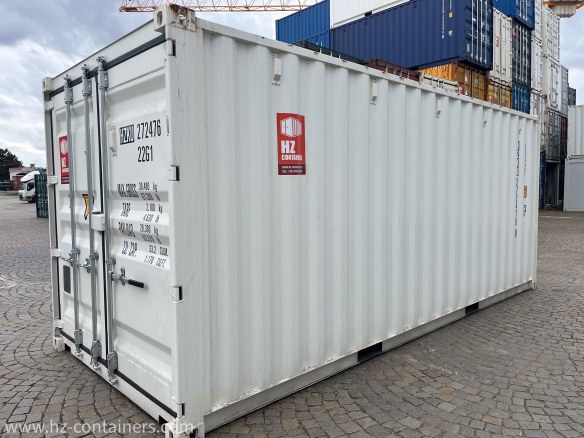

Other container news...
Corner casting steel vs aluminum
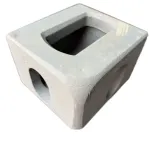
Every shipping container in the world — all 40 million of them — rests on eight critical components. Corner castings are the load-bearing blocks at each corner of an ISO shipping container, and they are the universal interface between the container and every crane, twistlock, spreader, and chassis on the planet. When you lift a container, stack it nine high on a ship, or lock it to a truck trailer, every ton of force flows through these fittings.

Construction cabin – selection, tips, dimensions and prices
Every construction project – whether a family house, a development project or a reconstruction – starts with the infrastructure. No construction manager, craftsman or investor who needs an on-site office, a changing room for workers or a safe storage for tools can do without a quality construction cell. But navigating the offer is not easy: residential containers, sanitary cells, storage modules, rental, purchase, refurbished pieces… This guide will give you answers to all the essential questions in one place.
Storage container
A storage container is a lockable steel box designed for the safe and dry storage of materials, tools, goods or equipment. Originally created as a shipping container for maritime transport, its durability and versatility have found their way onto construction sites, corporate premises and private land.
Shipping container 12m (40 ft)
A 12m shipping container is an investment that, if properly selected and cared for, will pay off in decades of trouble-free use. Whether you plan to use it as a warehouse, workshop, garage or the basis for a residential module — the key is careful selection of the condition, a thorough inspection before purchase and high-quality preparation of the base for placement. Take the time to compare offers, check the seller’s references and do not hesitate to personally inspect the container before buying. A properly selected 40-foot container will serve you reliably for many years.