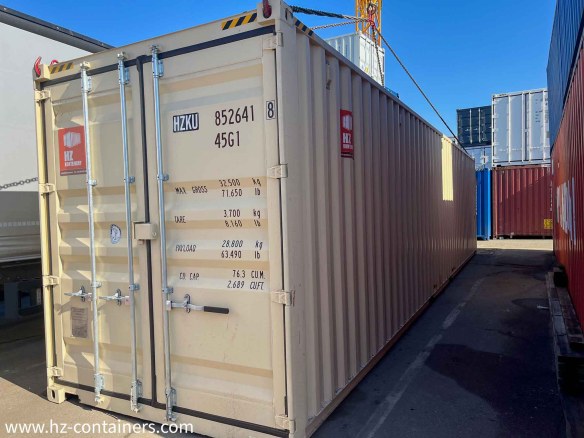
ISO Standards for Shipping Containers
What are ISO Standards for Shipping Containers?
ISO standards for shipping containers are globally recognized specifications established by the International Organization for Standardization (ISO). These standards encompass various aspects of design, dimensions, strength, coding, and handling of containers to ensure uniformity, safety, and seamless interoperability across different modes of transport, such as ships, trains, and trucks. Compliance with these standardized guidelines is crucial for facilitating international trade, streamlining logistics, reducing costs, and promoting environmental sustainability.
ISO containers, also known as intermodal containers, are designed to withstand harsh environmental conditions. They are manufactured from durable materials, such as Corten steel, to ensure their longevity and structural integrity. These containers are stackable and versatile, serving not only as transport vehicles but also as modular structures for various applications.
Why are ISO Standards Important?
ISO standards form the foundation of the global supply chain. They play a crucial role in ensuring the efficient movement of goods across borders. Here is why they are indispensable:
- Global Standardization: ISO standards ensure uniform dimensions and properties of containers, enabling smooth transitions between different modes of transport and compatibility with global transportation systems.
- Safety Assurance: Containers undergo rigorous testing for durability, tightness, and structural integrity, ensuring the safety of transported goods and workers.
- Cost Efficiency: Through standardization of container sizes and properties, the need for repackaging and multiple handling is reduced, saving time and lowering logistics costs.
- Environmental Benefits: Standardized containers optimize transport efficiency, reduce fuel consumption, and minimize carbon emissions.
Key ISO Standards for Shipping Containers
ISO has developed several key standards to regulate various aspects of shipping containers. An overview:
1. ISO 668: Classification, Dimensions, and Carrying Capacity
- Defines the external dimensions, gross weight limits, and structural strength of Series 1 containers.
- Established in the 1960s and updated several times, the latest version ensures compatibility during intermodal transport.
- Standard sizes include a width of 8 feet, a height of 8.5 feet, and lengths of 20 or 40 feet.
2. ISO 1496: Specifications and Testing
- A multi-part standard covering specifications for general, thermally insulated, tank, and other specialized containers.
- Ensures compliance with durability requirements, performance under various conditions, and tightness.
- Example: Part 1 addresses general cargo, while Part 2 focuses on thermally insulated containers.
3. ISO 6346: Coding, Identification, and Marking
- Establishes a universal coding system for container identification.
- Includes owner codes, serial numbers, and country codes for tracking and inventory management.
- BIC codes and safety certifications are key for logistics management.
4. ISO 1161: Corner Fittings
- Details the dimensions and strength of corner fittings for lifting and stacking.
- Corner castings are critical components for safe handling.
5. ISO 3874: Handling and Securing
- Provides guidelines for safe lifting, stacking, and securing during transport.
- Aims to reduce risks and prevent container damage, thereby increasing operational safety.
6. International Convention for Safe Containers (CSC)
- Although not an ISO standard, the CSC, which was established by the International Maritime Organization (IMO), complements ISO guidelines.
- Mandates regular inspections and structural strength requirements for containers used in international transport.
Types of ISO Shipping Containers
ISO standards classify containers according to their construction and intended use. Below are the main types:
- Dry Containers (General Purpose): Suitable for non-perishable goods, available in standard sizes of 20 feet and 40 feet.
- Refrigerated Containers (Reefers): Maintain specific temperatures for perishable goods.
- Open Top Containers: Best for oversized or irregular cargo.
- Flat Rack Containers: Used for heavy and bulky items, such as vehicles or machinery.
- Tank Containers: Specialized for liquids, gases, and hazardous materials.
- High Cube Containers: Offer extra height for bulky cargo or modular construction.
- Ventilated Containers: Ensure air circulation for products such as coffee beans or cocoa.
- Half-Height Containers: Used in industries such as mining for dense cargo.
- Specialized Containers: Custom-built designs for unique needs, such as military or medical purposes.
Dimensions and Classification
ISO standards ensure uniform dimensions and classifications of containers worldwide. Key parameters include:
- External Dimensions: Standard lengths include 20 feet, 40 feet, and 45 feet (for high cube variants).
- Internal Dimensions: Guaranteed minimum internal capacity for efficient utilization.
- Maximum Gross Weight: Typically ranges between 24–36 metric tons.
- Stacking Strength: Containers must support heavy loads when stacked.
Common Container Sizes:
- 20-foot Container: 19 feet 10 ½ inches (length) x 8 feet (width) x 8 feet 6 inches (height).
- 40-foot Container: 39 feet 5 ¾ inches (length) x 8 feet (width) x 8 feet 6 inches (height).
- 45-foot High Cube Container: 45 feet (length) x 8 feet (width) x 9 feet 6 inches (height).
Applications of ISO Containers
ISO containers are used in various industries and innovative applications:
- Intermodal Transport: Ensures seamless movement across different modes of transport.
- Construction Projects: Modular units for offices, homes, and classrooms.
- Emergency Shelters: Temporary housing or medical facilities.
- Cold Chain Logistics: Supporting the transport of perishable goods.
- Secure Storage Solutions: Widely used for both commercial and personal storage.
Frequently Asked Questions (FAQ)
1. What is the Lifespan of an ISO Container?
With proper maintenance, an ISO container can last more than 25 years.
2. Do ISO Containers Withstand Extreme Weather?
Yes, they are wind and water-resistant, designed to withstand harsh environmental conditions.
3. How are Containers Uniquely Identified?
Codes complying with ISO 6346 include owner information, serial numbers, and check digits.
4. What is the Stacking Strength of ISO Containers?
They typically support loads between 192,000 kg and 216,000 kg depending on the container type.

 Czech Republic, Kladno
  FREE SHIPPING