Glossary
>
#Dimensions of a 40-foot High Cube Shipping Container
Dimensions of a 40-foot High Cube Shipping Container
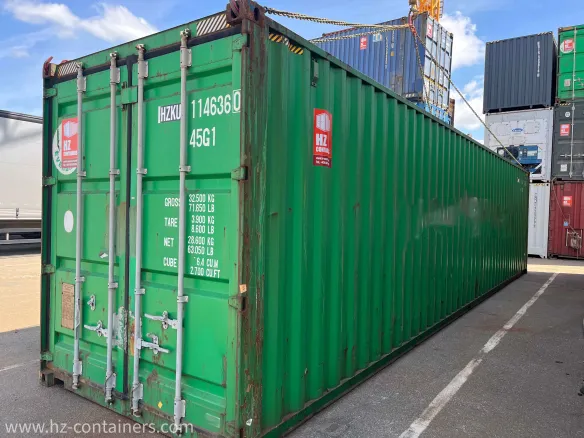
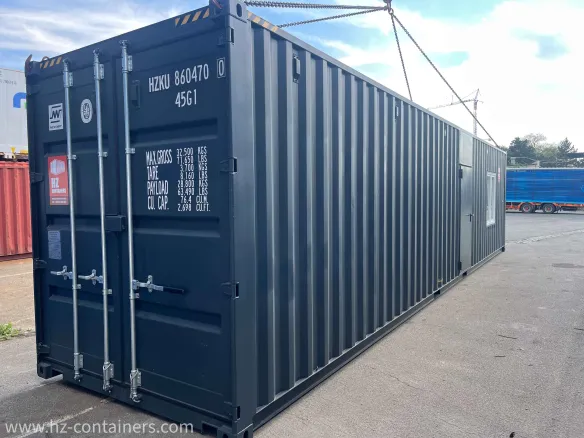
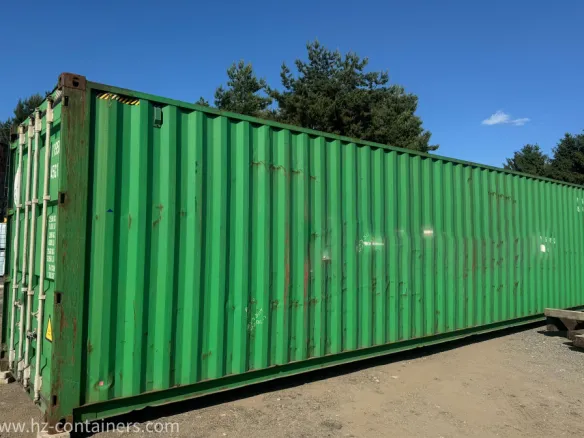
40ft High Cube container — often abbreviated as 40ft HC or 40′ HQ — is one of the most widely used shipping containers in global logistics. It shares the same length and width as a standard 40ft container, but adds one foot of vertical space, making it the default choice for shippers transporting bulky, oversized, or stackable cargo that does not quite reach the weight limit. This article is the definitive reference for every dimension, weight limit, door opening size, and pallet configuration you need to know when working with 40ft High Cube containers.
What is a 40ft High Cube container?
The 40ft High Cube container is an intermodal freight container measuring 40 feet in length, 8 feet in width, and — critically — 9 feet 6 inches in external height. That extra foot above the standard 8 feet 6 inches is the defining feature of every High Cube. It is built from Corten steel (corrosion-resistant steel) and designed to ISO specifications for stacking, lifting, and transport on ships, trains, and trucks.
Key definition: A High Cube container is any ISO Series 1 freight container with an external height of 2,896 mm (9′6″), as opposed to the standard height of 2,591 mm (8′6″). The word “cube” in the name refers to cubic capacity — the extra height provides approximately 13% more internal volume than a standard container with the same footprint.
Where does the term “high cube” come from?
The history of the High Cube container is inseparable from the history of containerization itself. When Malcolm McLean launched the first container ship voyage in 1956, the original containers — derived from truck trailer bodies — measured 35 feet in length and 8 feet in width. By the late 1960s, the International Organization for Standardization (ISO) had issued ISO 668, which fixed standardized external dimensions for what it called “Series 1 freight containers.” The 40ft length became the global standard, with a height of 8 feet 6 inches.
Shippers quickly identified a problem: many types of cargo — furniture, machinery, loosely packed textiles, plastic products — filled the container’s volume long before reaching its weight limit. The container was “cubed out” before it was “weighed out.” The industry’s response was the High Cube container, which entered commercial service in the 1970s and expanded throughout the 1980s. By adding 12 inches of internal height, shippers gained roughly 10 cubic metres of extra capacity without enlarging the footprint on ship, depot, or chassis.
The term “high cube” itself emerged from shipping slang. “Cube” was already a standard industry shorthand for cubic capacity — forwarders spoke of “cubing out” a container as opposed to “weighing out.” A container with extra volume was naturally a “high cube.”
How does ISO 668 classify High Cube containers?
Under ISO 668:2020, the international standard for Series 1 freight containers, the 40ft High Cube is classified as type 42. This classification prescribes the following external dimensions:
Dimension
Millimeters
Feet and inches
External length
12,192 mm
40′ 0″
External width
2,438 mm
8′ 0″
External height
2,896 mm
9′ 6″
The external width of 2,438 mm (8 feet) is universal across all standard ISO containers — it is the dimension that allows containers to sit safely in ship guides, on rail wagons, and on truck chassis anywhere in the world. The height difference between a standard container (corresponding type at 2,591 mm) and a High Cube (2,896 mm) is exactly 305 mm — precisely 12 inches. ISO 668 also prescribes minimum internal dimensions and door opening sizes, although commercial manufacturers typically exceed these minimum values.
Which industries use 40ft High Cube containers?
High Cube containers serve three broad markets:
Maritime transport and intermodal logistics. This is the primary use case. 40ft HC carry everything from consumer electronics to industrial machinery on all major trade lanes. They are especially prevalent on Asia-to-North America and Asia-to-Europe routes, where cargo composition tends toward bulky, medium-weight industrial goods.
Storage and warehousing. Because 40ft HC offer 76+ cubic metres of weatherproof, lockable storage, thousands of decommissioned High Cube containers spend their post-shipping life as storage units on construction sites, retail locations, farms, and industrial facilities. The extra height makes them significantly more practical than standard containers for storing tall equipment or racking systems.
Modified/alternative use. High Cube containers are the preferred starting point for container homes, portable offices, temporary retail spaces, and event infrastructure. The additional internal height — 2,585–2,700 mm after finishing — provides sufficient headroom for comfortable occupancy even after installing flooring, insulation, and ceiling treatments.
What are the exact internal and external dimensions of a 40ft High Cube container?
The answer to this question depends on whether you are looking at official ISO minimums, a specific carrier’s specification, or a particular manufacturer’s construction dimensions. Below is a comprehensive reference table summarizing the most commonly reported dimensions.
Complete dimensions reference table
Measurement
Metric (mm)
Imperial (ft/in)
External length
12,192 mm
40′ 0″
External width
2,438 mm
8′ 0″
External height
2,896 mm
9′ 6″
Internal length
12,024–12,032 mm
39′ 5″ – 39′ 6″
Internal width
2,350–2,352 mm
7′ 8½″ – 7′ 9″
Internal height
2,697–2,700 mm
8′ 10″ – 8′ 10¼″
Door opening width
2,340 mm
7′ 8″
Door opening height
2,585–2,597 mm
8′ 5⅞″ – 8′ 6¼″
Usable cubic capacity
~76.4 m³
~2,694–2,698 ft³
Why internal dimensions vary between manufacturers
You will notice that the internal dimensions above are given as ranges rather than single figures. This is not carelessness — it reflects actual variation in container construction. The corrugated steel side panels that give containers their strength have a profile depth typically between 25 mm and 45 mm. The deeper the corrugation, the more the internal width is reduced. Similarly, the floor construction — usually 28 mm of marine-grade plywood on steel crossmembers — sits at slightly different heights depending on the manufacturer’s design and whether a gooseneck tunnel is present.
Most major carriers’ 40ft High Cube fleets cluster around an internal height of 2,700 mm (8′10″), which has become the de facto industry expectation. When planning cargo, assume 2,700 mm as the maximum vertical clearance inside the container.
Door opening dimensions and why they matter
The door opening at the rear end of a 40ft High Cube container measures approximately 2,340 mm wide × 2,585 mm high (7′8″ × 8′5⅞″). This is often the most overlooked dimension by shippers.
Why? Because the door opening is significantly smaller than the container’s internal cross-section. A cargo item that could theoretically fit inside a container with an internal width of 2,350 mm and internal height of 2,700 mm may still not pass through the door frame of 2,340 mm × 2,585 mm. This is especially important when loading with forklifts — the forklift mast must clear the top door header, and the load plus fork tines must pass through the door width.
Practical rule of thumb: The door opening is your real “will it fit / won’t it fit” measure. If your tallest palletized load including the pallet exceeds 2,550 mm, you should verify the clearance with your forwarder, even though the internal height is 2,700 mm.
What is a gooseneck tunnel?
Most 40ft containers — both standard and High Cube — have a recessed channel in the floor at the front end (the end opposite the doors). This recess, which typically extends 1,000–1,200 mm along the length and approximately 100–120 mm in depth, is called the gooseneck tunnel.
Its purpose is to accommodate the raised neck of a gooseneck chassis — a specialized trailer used for road transport of containers. When the container sits on a gooseneck chassis, the tunnel allows the container to ride lower, reducing overall road height. For a 40ft High Cube container, which is already 9′6″ tall, riding on a gooseneck chassis with the tunnel engaged keeps the combined height within the limits permitted for road transport in most jurisdictions (typically under 13′6″ in North America).
A practical consequence for cargo planning: the floor is not perfectly flat along the entire 40ft length. In the front metre of the container, the floor sits approximately 100–120 mm higher than the rest of the floor. For most cargo, this is irrelevant, but for loads that need a perfectly level surface across the entire floor area, it is worth noting.
How do the dimensions compare with a standard 40ft container?
The difference between a 40ft standard container and a 40ft High Cube is almost entirely about one number: height. Everything else — length, width, corner casting positions, twist-lock spacing — is identical.
Key takeaway: internal height rises from approximately 2,390 mm (7′10″) to 2,700 mm (8′10″) — an increase of 310 mm or just over 12 inches. Cubic capacity increases by approximately 8.7 m³, or about 13% more volume, while the tare weight of the empty container increases by only about 200 kg. External length and width are identical, meaning the High Cube fits the same guides, chassis, and rail slots as a standard container.
When should you choose a High Cube over a standard container?
The decision framework is simple:
Choose a 40ft High Cube if: your cargo is tall (over ~2,300 mm per pallet), your cargo is light but bulky (you will hit the volumetric limit before the weight limit), or you want the flexibility to stack pallets higher and fit more into a single container.
Choose a standard 40ft if: your cargo is dense and heavy (the extra height would go unused, while the slightly lower tare weight provides a marginally higher payload), or you are shipping on a route where availability or surcharges for High Cube are a concern.
What is the weight capacity and cubic volume of a 40ft High Cube container?
Weight specifications matter just as much as dimensions. A container’s payload is not unlimited — it is bounded by the Maximum Gross Weight (MGW), which is the combined weight of the container itself (tare weight) plus the cargo inside.
Note the variation in tare weight — from 3,750 kg to over 4,020 kg. This reflects differences in manufacturing era, steel thickness, floor construction, and whether the container is equipped with additional features such as extra lashing rings or ventilation. A heavier container means a correspondingly lower payload capacity, because the MGW is a fixed number. Always check the CSC (Container Safety Convention) plate mounted on the container doors for the legally binding weight values for that specific unit.
Cubic capacity: understanding the 76 m³ standard
The internal cubic capacity of a 40ft High Cube container is consistently reported as approximately 76.3–76.4 cubic metres (2,694–2,698 cubic feet). This is the theoretical maximum volume based on internal length × width × height. In practice, the usable cargo volume is always somewhat smaller because:
Cargo cannot perfectly fill every cubic centimetre of corrugated walls
Palletized cargo leaves air gaps between stacks
Door closure requires some clearance at the rear
A realistic planning figure is 85–90% of the stated cubic capacity, or approximately 65–68 m³ of actual stowed cargo volume, depending on how efficiently the cargo packs.
Floor load capacity
The floor of a 40ft High Cube container is typically rated for a uniformly distributed load equal to the container’s MGW — meaning the full 32,500 kg can sit on the floor if evenly distributed. Point loads are a different matter, however. The forklift axle load the floor can withstand during loading is typically around 5,460 kg per axle (approximately 12,000 lbs), which is why most container-handling forklifts use wide tyres or load distribution beams. For exact floor load capacity ratings, consult the CSC plate of the specific container.
How many pallets fit in a 40ft High Cube container?
Pallet capacity is not a function of height — a High Cube and a standard 40ft will hold the same number of pallets in a single layer on the floor, because the floor footprint is identical. Where the High Cube wins is in stackability: you can double-stack taller pallets and still clear the door opening height.
The classic euro pallet loading plan for a 40ft container places 11 pallets along one side (1,200 mm lengthwise, requiring 13,200 mm, which fits within the internal length of 12,032 mm) and 14 crosswise on the other side (800 mm each). In practice, many loaders comfortably achieve 25 pallets by alternating orientation.
Loading standard US / ISO pallets
Configuration
Number of pallets
Arrangement
Single layer, on floor
20–22 pallets (48″ × 40″ / 1,219 × 1,016 mm)
20 pallets in two rows of 10
Optimized single layer
Up to 24 pallets
Fan or staggered arrangement
The 48-inch dimension of a standard US pallet means that exactly 10 pallets fit lengthwise in each row (480 inches = nominally 40 feet, with tight clearance). Two rows give 20 pallets. Some loading configurations squeeze in 21–22 with a fan arrangement (rotating pallets 90 degrees at the ends).
How the extra height enables double stacking
This is where the High Cube earns its name. With an internal height of 2,700 mm (106 inches) and a door opening height of 2,585 mm (102 inches), you can stack two layers of pallets provided each pallet stack is no taller than approximately 1,250–1,280 mm. Given that a standard euro pallet itself is 144 mm tall, that leaves approximately 1,100 mm of cargo height per layer — sufficient for many types of packaged consumer goods, textiles, and light industrial products.
In a standard 40ft container with only 2,390 mm of internal height, each pallet layer would be limited to approximately 1,120 mm, and the 2,280 mm door opening tightens this constraint even further.
What are common misconceptions about 40ft High Cube container dimensions?
“All 40ft High Cubes have identical dimensions”
Not quite. While external dimensions are strictly standardized under ISO 668, internal dimensions vary between manufacturers by 5–15 mm in each direction. A container built by CIMC (a Chinese manufacturer, the largest in the world) may have an internal height of 2,698 mm, while a Singamas unit may have 2,700 mm, and an older European container may have 2,690 mm. These small variations are within ISO tolerances, but can matter when loading precisely dimensioned cargo or racking systems.
“The extra foot of height is free capacity”
Only if you can use it. A High Cube container adds roughly 200 kg of tare weight compared to a standard container, which slightly reduces net payload. More importantly, some ocean carriers levy a High Cube surcharge on certain trade lanes, and road transport of a 9′6″ tall container can occasionally encounter height-restricted routes that a standard container would clear. In North America, a High Cube on a standard chassis typically rides at around 13′6″ — right at the maximum permitted road height in many states and provinces. Any chassis variation that adds even an inch can push the load into permit-required territory.
“High Cube containers are only for maritime shipping”
While maritime transport is the dominant use, High Cube containers are extensively used for domestic intermodal rail transport in North America, for on-site storage at construction and industrial sites, and as the structural basis for container architecture. The secondary market for decommissioned 40ft High Cubes is actually robust precisely because the extra headroom makes them far more comfortable for human-occupied spaces.
Frequently asked questions
What are the dimensions of a 40ft High Cube container?
A 40ft High Cube container measures externally 40 feet long × 8 feet wide × 9 feet 6 inches tall (12,192 × 2,438 × 2,896 mm). Internally, it measures approximately 39 feet 6 inches long × 7 feet 9 inches wide × 8 feet 10 inches tall (12,032 × 2,352 × 2,700 mm). The door opening measures approximately 7 feet 8 inches wide × 8 feet 5⅞ inches tall (2,340 × 2,585 mm).
How much taller is a High Cube container than a standard container?
A High Cube container is exactly 12 inches (305 mm) taller externally than a standard container — 9′6″ (2,896 mm) versus 8′6″ (2,591 mm). Internally, the increase is approximately 310 mm, from roughly 2,390 mm to 2,700 mm, which represents about 13% more cubic capacity.
How many pallets fit in a 40ft High Cube container?
In a single layer on the floor, approximately 25 europallets (1,200 × 800 mm) or 20–22 standard US pallets (48 × 40 inches). With double stacking, up to 50 europallets or 40–44 US pallets, depending on the height of the stacked cargo and door opening clearance.
What is the maximum payload of a 40ft High Cube container?
Typical payload capacity ranges from 26,300 kg to 28,750 kg (58,000–63,400 lbs), depending on the tare weight. The maximum gross weight is typically 32,500 kg (71,650 lbs), although some older containers may be rated at 30,480 kg. Always verify using the CSC safety plate on the specific container.
What is a High Cube container used for?
High Cube containers are used for shipping bulky or tall cargo — furniture, machinery, textiles, plastic products, and any cargo that fills the container’s volume before reaching its weight limit. They are also widely used for on-site storage and as a structural basis for container homes, offices, and retail spaces, where the extra headroom is essential for comfort and usability.
Can a 40ft High Cube container be double-stacked during transport?
Yes. Like all standard ISO containers, 40ft High Cube containers are designed to be stacked up to nine high when fully loaded (depending on the specific stacking rating on the CSC plate). Corner castings and corner posts are designed to transfer vertical loads directly through the container structure. The extra height of a High Cube does not reduce its stacking capability.
What is the door opening height of a 40ft High Cube container?
The door opening height is approximately 2,585–2,597 mm (8′5⅞″–8′6¼″). This is 100–115 mm less than the internal height of 2,700 mm, because the top door header construction occupies vertical space in the rear frame. This is a critical clearance dimension for loading with a forklift mast and should be used as the maximum height measure when planning palletized cargo.
To provide the best experiences, we use technologies like cookies to store and/or access device information. Consenting to these technologies will allow us to process data such as browsing behavior or unique IDs on this site. Not consenting or withdrawing consent, may adversely affect certain features and functions.
Functional
Always active
The technical storage or access is strictly necessary for the legitimate purpose of enabling the use of a specific service explicitly requested by the subscriber or user, or for the sole purpose of carrying out the transmission of a communication over an electronic communications network.
Preferences
The technical storage or access is necessary for the legitimate purpose of storing preferences that are not requested by the subscriber or user.
Statistics
The technical storage or access that is used exclusively for statistical purposes.Technical storage or access that is used exclusively for anonymous statistical purposes. Absent a subpoena, voluntary compliance by your ISP, or additional records from a third party, information stored or obtained solely for this purpose cannot typically be used to identify you.
Marketing
The technical storage or access is required to create user profiles to send advertising, or to track the user on a website or across several websites for similar marketing purposes.


 Czech Republic, Třebíč
  FREE SHIPPING