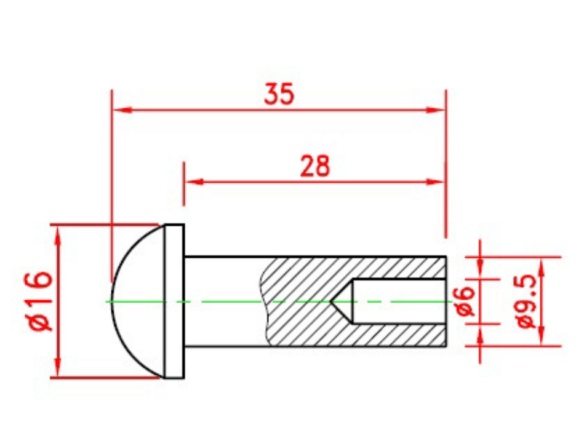
Bush & Rivet
In the vast and complex world of global logistics and maritime transport, the shipping container is the undeniable king. Its robust steel structure is designed to withstand the most demanding conditions at sea and on land. Although attention often focuses on large components such as wall panels, corner castings and massive doors, the true integrity, functionality, and service life of these steel giants depend on countless smaller, yet critically important components. Among these unsung heroes are the Bush & Rivet.
Catalog Number: HZ000255
This term does not refer to a single component, but a synergistic pair of specialized fastening and functional elements that are essential for both the manufacture of new containers and their efficient and durable repair. A rivet serves as a permanent mechanical joint, while a bush provides a reinforced and often functional point, for example, for rotation or as a threaded attachment. Together, they ensure that every shipping container not only holds together but also functions safely and reliably throughout its demanding service. This article details the types, materials, technical standards, applications, and maintenance of these key components.
Rivet in Shipping Containers
Basic Definition and Anatomy of a Rivet
A rivet is one of the oldest and most reliable mechanical fasteners, whose principle remains indispensable in modern engineering. In container manufacturing and repairs, they are particularly valued for their high joint strength, resistance to vibrations, and permanent load.
Anatomy of a Rivet:
| Part | Description |
|---|---|
| Head | Original factory-formed head on one end |
| Shank | Cylindrical body that passes through the joined materials |
| Tail | Head formed on the other side after deformation |
Principle of Function:
A rivet is inserted into a pre-drilled hole, where, after deformation of the shank, a tail is formed on the other side. The joint is thus strong, non-dismountable, and extremely resistant to shear and tension.
Types of Rivets Used in Containers
Solid Rivets
- Used more for heavy, static joints where access from both sides is possible.
- Material: carbon steel, stainless steel.
Blind Rivets / Pop Rivets
- The most common joint for containers due to the possibility of installation from only one side.
- Consist of a hollow body and an internal mandrel.
- After installation, the mandrel remains inside, increasing the strength of the joint.
Advantages of Blind Rivets:
- Fast, efficient assembly (ideal for field repairs).
- High resistance to vibrations and dynamic stress.
- Some types provide a watertight joint (important for cargo protection).
- Ability to join different materials (steel, aluminum, stainless steel).
- Less dependent on the installer’s skill than welding.
Special Rivets
- Watertight rivets with a special washer.
- Rivets for increased pull-out resistance (e.g., for floor joints).
Materials and Surface Treatments
| Material | Properties and Use |
|---|---|
| Carbon steel | Standard for most structural joints |
| Cast steel | High-strength joints in exposed areas |
| Stainless steel | Highly durable joints in aggressive or marine environments |
| Aluminum | Special applications where low weight is desired |
Surface Treatments:
- Galvanic Zinc Plating: corrosion protection.
- Hot Dip Galvanized: thicker zinc layer, suitable for marine environments.
- Stainless: no further treatment required.
Typical Use of Rivets in Containers
- Panel repairs (wall, roof, floor)
- Fastening plywood flooring to the frame (must withstand high loads)
- Mounting accessories (ventilation, brackets, locking mechanisms)
- Attaching identification and CSC plates
Technical Standards and Certifications
- ISO 1161, ISO 6346, ISO 1496 – define general requirements for containers, dimensions, and types of fasteners.
- Manufacturers must meet certifications such as ISO, CE, ABS, BV (e.g., Shouguang Esen Wood).
Bush in Shipping Containers
Basic Definition and Types of Bushes
A bush is a hollow cylinder used to protect, reinforce, or functionally define an opening in another part. In containers, they are primarily used for:
1. Bushes for Door Locking Mechanisms
- Serve as bearings for rotating the locking bar handle.
- Protect metal parts from wear due to friction.
- Ensure smooth door operation even after years in demanding conditions.
2. Rivet Bushes
- Allow for the creation of a strong threaded joint in thin sheet metal.
- Installation by riveting (deformation of the bush flange).
3. Spacer and Locating Bushes
- Used where precise spacing between two parts needs to be maintained.
Materials and Treatments for Bushes
| Material | Properties and Use |
|---|---|
| Cast steel | Most common, high strength, long service life |
| Carbon steel | Standard design for common applications |
| Stainless steel | For high resistance in aggressive/marine environments |
| Brass, bronze | Special applications (lower friction, anti-corrosion) |
Surface Treatments:
- Galvanic Zinc Plating – for common applications.
- Hot Dip Galvanized – for marine and outdoor containers.
- Stainless – for maximum protection.
Technical Specification (example):
| Parameter | Value |
|---|---|
| Material | Carbon steel / cast steel |
| Surface treatment | Galvanization (zinc) |
| Weight | approx. 0.007 kg / piece |
| Certification | ISO, CE |
| Customization | Yes, according to customer requirements |
| Typical use | Container manufacturing, repairs |
Bushes in Door Mechanisms
Function:
- Ensure precise guidance and rotation of the locking bar handle.
- Reduce wear, minimize play, prevent seizing.
- High resistance to corrosion is a necessity (humidity, salt, dust).
Rivet Bushes – Installation and Advantages
- Mounting into a hole and deforming the flange (securing against falling out/rotation).
- Creating a strong thread for bolted joints in thin sheet metal.
- High resistance to pull-out and rotation.
- Possibility of a watertight variant (so-called tank bush).
Maintenance and Replacement of Bushes
- When worn, the bush can be punched out and replaced with a new one.
- Regular inspection of play in the door mechanism is recommended.
- Replacement is possible in the field using common tools.
Manufacturing, Standards, and Quality Control
Bush & Rivet Manufacturing
- Carried out on modern machinery in accordance with ISO standards.
- Strict control of dimensional accuracy and material quality.
- Surface protection (galvanizing, stainless steel) is crucial for durability.
Certifications and Test Reports
- ISO, CE, ABS, BV, CCS certifications demonstrate compliance with international standards.
- Manufacturers provide test reports for material, dimensions, and surface treatment.
- Quality products are audited by a third party.
Market and Availability
- B2B platforms (e.g., Made-in-China.com) allow for quick comparison of parameters.
- Possibility to order samples and customization according to customer requirements.
- Standard components in stock, possibility of express delivery for repairs.
Table: Comparison of Rivets and Bushes for Containers
| Property | Rivet | Bush |
|---|---|---|
| Function | Permanent joint, panel fixation | Bearing, sliding element, threaded insert |
| Material | Carbon/cast/stainless steel, aluminum | Carbon/cast/stainless steel, bronze, brass |
| Surface treatment | Zinc, stainless, colored paints | Zinc, stainless, bronze, paint |
| Installation | Riveting, manually/machine | Press-fitting, riveting, screwing |
| Maintenance | Replacement only destructively | Easy replacement, standard service |
| Standards | ISO, CE, ABS, BV | ISO, CE, ABS, BV |
Synergy, Proper Assembly, and Operational Recommendations
- Rivet and bush often form a single unit in door mechanism assemblies – the rivet attaches the bush, which serves as a bearing for rotation.
- A bush can also be a rivet bush, allowing for the mounting of other components without damage to the thin sheet metal of the container.
- Correct material selection (including surface treatment) is crucial, especially in marine applications due to corrosion.
- Regular inspection of mechanical joints (especially in the door locking system) extends the container’s service life and reduces the risk of failure during transport.
Practical Advice for Maintenance and Repairs
- When performing repairs, use only certified parts from verified manufacturers.
- Always ensure correct sizing of the rivet/bush according to the material thickness and type.
- Perform replacement according to the manufacturer’s recommendations, including the use of correct tools.
- After repair, it is advisable to check the tightness and door functionality.
Conclusion
Bush & Rivet are small but absolutely essential components that are at the heart of the reliability, safety and longevity of every shipping container. Their correct selection, installation and maintenance are key to the successful transport of goods around the world. Without them, containers would not be able to fulfill their role in the global supply chain.

 Czech Republic
  WITHOUT SHIPPING