
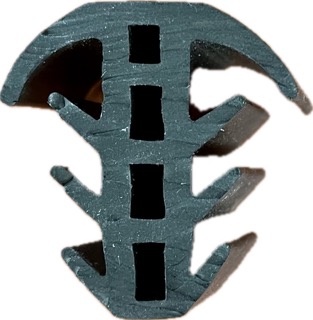
Rubber Between Shipping Containers – small T type


 Czech Republic
  WITHOUT SHIPPING
 Sealing Rubber Between Containers
Sealing rubber between containers, or also “gasket”, refers to special rubber seals or strips designed to create a tight, waterproof and airtight connection around the doors or connection points of shipping containers. These seals, made from highly durable materials such as EPDM (Ethylene Propylene Diene Monomer), protect containers from environmental influences such as water, dust, air, pests and extreme weather conditions. They are a key component for maintaining the integrity and functionality of shipping containers.
Shipping containers often face demanding conditions during transport and storage, including exposure to storms, UV radiation and large temperature fluctuations. Sealing rubbers act as a barrier against these influences and ensure that the cargo inside remains safe, undamaged and in optimal condition.
Sealing rubbers are a key component of the shipping industry, offering protection from environmental influences and ensuring cargo safety. By understanding their materials, types and maintenance, operators can maximize the efficiency and lifespan of containers. For those seeking durable and reliable sealing solutions, materials such as EPDM offer excellent performance in various conditions.
Price is stated per 1 m. Option to send by courier service.
Shipping cost according to the ordered quantity and according to the specific country.
If interested, please send an inquiry through the inquiry form. Remember to specify the required number of pieces and complete delivery address including postal code. We will send you a shipping quote.
Dimensions:
Width top: 31 mm
Width bottom: 20 mm
Length: 32 mm
The dimensions of the rubber are approximate and are measured in a quiet state at room temperature. It is always necessary to take into account the elasticity of the rubber +- 3mm depending on the bend and the surrounding conditions. The technical specification of the product with detailed dimensions is given in the offer.
Why are sealing rubbers important?
Weather Protection and Durability
Sealing rubbers are essential for protecting containers from weather influences. They prevent water, dust and snow from penetrating the container, which is crucial for protecting sensitive cargo such as electronics, textiles or food. Without effective seals, containers are prone to leaks that can lead to mold formation, corrosion or cargo degradation.
Temperature Regulation
For refrigerated containers (reefers) transporting perishable goods or temperature-sensitive items, sealing rubbers play a key role in maintaining internal temperature. They create an airtight seal that minimizes heat exchange, increases the efficiency of cooling systems and ensures stable temperature control.
Durability in Demanding Conditions
Materials used for sealing rubbers, such as EPDM, exhibit exceptional resistance to environmental stress. They withstand prolonged exposure to UV radiation, ozone and temperatures ranging from -40 °C to 120 °C, making them suitable even for the most demanding shipping routes.
Protection Against Pests and Contaminants
These seals create a tight seal that prevents the entry of pests, insects and airborne contaminants that could compromise the safety and hygiene of the cargo inside.
Improved Structural Integrity
Sealing rubbers increase the structural stability of the container by ensuring secure door closure. This reduces container wear and extends its lifespan.
Materials Used for Sealing Rubbers
EPDM Rubber
EPDM is the industry standard for container seals due to its excellent properties:
- Weather resistance: Resists degradation caused by UV radiation, ozone and extreme weather conditions.
- Temperature resistance: Operates in a wide temperature range (-40 °C to 120 °C).
- Durability: Maintains elasticity and flexibility even with repeated door opening and closing.
- Chemical resistance: Is resistant to weak acids, bases and corrosive substances.
PVC (Polyvinyl Chloride)
PVC seals are popular for their resistance to wear, but are less flexible than EPDM and can harden at extremely low temperatures.
Silicone Rubber
Silicone is used in special applications where resistance to high temperatures or greater flexibility is required. However, its higher cost limits its use in standard containers.
Composite Rubber Seals
Some manufacturers incorporate metal clips or internal reinforcement into rubber seals to improve adhesion and lifespan.
Types of Sealing Rubbers
Door Seals
These seals line the edges of container doors and ensure an airtight and waterproof seal. They are the most common type of seal used in shipping containers.
“J” Type Seals
“J” type seals have a cross-section shaped like the letter “J” and are widely used in marine and shipping applications due to their high resistance to environmental influences.
“H” Type Seals
“H” type seals have a cross-section shaped like the letter “H” and are designed for heavy-duty applications where they provide a firm and reliable seal.
Extruded Rubber Strips
Custom-designed rubber strips fit precisely along the edges of the container door and create a tight seal. They are often used in combination with other sealing systems.
Brush Seals
Brush seals contain bristles that prevent dust and contaminant penetration. They are particularly useful in environments with high levels of particulate matter.
Characteristics of Quality Sealing Rubbers
- Exceptional weather resistance: Resist rain, snow and UV radiation without degradation.
- Flexibility and durability: Maintain elasticity over time and repeated use.
- Easy installation: Designed for simple application without the need for adhesives or complex tools.
- Cost effectiveness: Due to their long lifespan, they require minimal replacement.
- Sustainability: Manufactured with consideration for ecological processes and materials.
Sealing Rubber Installation Guide
- Removal of old seals: Using a flat screwdriver or knife, carefully remove the old seal.
- Surface cleaning: Ensure that the edges are clean of dirt, rust or adhesive residue.
- Measurement and cutting: Adjust the new seal to the required length, with a slight overlap for secure fastening.
- Adhesive application (if necessary): Some seals come with pre-applied adhesive, others may require separate adhesive.
- Firm pressing: Align the seal and press it firmly in place for good adhesion to the edge.
- Seal test: Close the container door and check for any gaps or inconsistencies in adhesion.
Maintenance Tips for Sealing Rubbers
- Regular inspection: Check for cracks, tears or signs of wear.
- Frequent cleaning: Use a damp cloth and gentle cleaning agent to remove dirt and deposits.
- Silicone spray lubrication: Prevents drying and cracking of seals.
- Immediate replacement of damaged seals: Damaged seals compromise container integrity and should be replaced immediately.
Innovations in Sealing Technology
- Self-healing rubbers: Advanced seals that can repair minor cuts or abrasions, thereby extending their lifespan.
- Smart seals: Equipped with sensors to detect leaks or breaches and provide instant alerts.
- Improved material composition: New rubber blends offer better heat resistance, durability and flexibility.
All information, services, prices, etc. may vary.
The price list may be indicative, we always charge according to actual conditions.
We offer all spare parts for shipping containers. Opening of shipping containers at super prices. Spare parts for containers are in stock, can be sent immediately. Quantity in stock upon request.
Send inquiry
Shipping container colors
RAL 1001 RAL 1003 RAL 1014 RAL 1015 RAL 1018 RAL 1023 RAL 2001 RAL 2008 RAL 2011 RAL 3000 RAL 3001 RAL 3002 RAL 3009 RAL 3013 RAL 3020 RAL 4008 RAL 5003 RAL 5005 RAL 5010 RAL 5011 RAL 5013 RAL 5017 RAL 6005 RAL 6007 RAL 6018 RAL 6029 RAL 6031 RAL 6038 RAL 7000 RAL 7004 RAL 7005 RAL 7012 RAL 7015 RAL 7016 RAL 7021 RAL 7024 RAL 7031 RAL 7032 RAL 7035 RAL 7036 RAL 7037 RAL 7038 RAL 7040 RAL 7042 RAL 8004 RAL 8008 RAL 9003 RAL 9004 RAL 9005 RAL 9010 RAL 9016 CAMOUFLAGEQUESTIONS & ANSWERS TO THE MOST FREQUENTLY ASKED QUESTIONS:
We always guarantee the size, quality, and specific type of container including the pickup location of your choice.
Why is it not possible to access the depot to inspect the container? And for what reason is it not possible to take photos of the container from the depot?
How does the self-pickup of a container from the depot work?
What if the container we came to pick up at the depot does not match the condition and quality we ordered?
Afraid of being scammed and not receiving the container? Many questions are answered in our article container purchase scams.
You can find out how to arrange for the unloading of a shipping container here.
The photos are for illustrative purposes only. Detailed information about the properties of shipping containers can be found here: shipping container quality

 Czech Republic, Ostrava

