
What is the Steel Floor of a Shipping Container Used For?
Steel floor, more precisely a floor made of steel or aluminum, represents a highly durable variant of a flooring system designed for applications with extreme demands on mechanical durability, hygiene, chemical stability, and easy maintenance. While standard containers have a floor made of thick marine plywood laid on steel cross members, a steel floor is installed where maximum load capacity, impermeability, and long service life are required.
What is the Steel Floor Used For?
- Withstands extreme point loads (for example, under the wheels of heavy machinery, feet of presses and machines, excavator tracks).
- Ensures water tightness and easy cleaning – ideal for transporting food, pharmaceuticals, chemicals, or liquids.
- Meets the highest hygiene standards – metal is non-porous, does not absorb odors, moisture, or contaminants.
- High fire and chemical resistance – suitable for storing hazardous materials.
- Increases transport safety through the possibility of using stronger fasteners and other securing elements.
Modern steel floors are also an ecological alternative to tropical plywood (for example, according to Hapag-Lloyd innovation, they are 100%25 recyclable, have a longer service life, and there is no need for pesticide protection or chemical treatment).
Context: Standard Construction of a Shipping Container Floor
To understand the importance of a steel floor, it is necessary to know the construction of a standard floor:
What Does a Standard Container Floor Consist Of?
| Component | Function and Design |
|---|---|
| Steel load-bearing structure | Frame made of Corten steel (weather-resistant alloy) with cross members every 15 cm. Height of beams approximately 12–15 cm. |
| Floor covering | 28–30 mm marine plywood (most commonly Apitong or Keruing), impregnated against rot and pests. |
- Load capacity: Up to 28 t of evenly distributed load for a 20′ container.
- Protection: The space between the beams and the ground protects the floor from moisture and allows handling (e.g., forklift).
- Pesticide treatment: During manufacturing, pesticides must be used for international transport (see CSC label). This is why it is advisable to remove the floor or seal it with an epoxy layer when converting to residential spaces such as shipping container homes.
Disadvantages of Standard Construction
- Porosity of plywood → absorbs liquids and odors.
- Limited resistance to point loads.
- Need for pesticide treatment → potential health risk when converting to residential space (container houses).
Primary Use and Benefits of Steel Floor
Why and Where is Steel Floor Used?
Extreme Load Capacity and Resistance to Point Loads
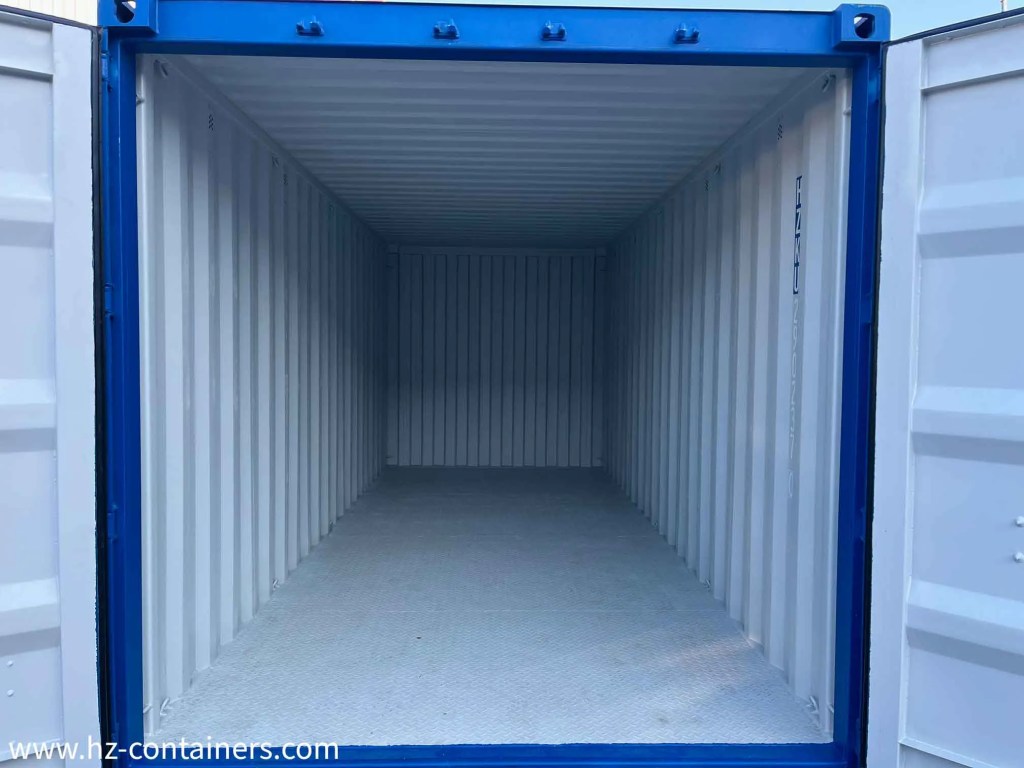
- Steel/aluminum floor: Designed for high point loads (for example, heavy handling equipment, construction machinery, presses, automotive transport).
- Practical applications:
- Storage and transport of machinery and equipment.
- Transport of vehicles, motorcycles, tractors, construction machinery.
- Mobile workshops, tire services, garages.
- Spaces with frequent movement of forklifts.
Hygiene and Easy Maintenance
- Metal is non-porous – does not absorb liquids or odors.
- Easy to clean – the surface can be disinfected, washed with pressure water, steam, or chemicals.
- Without odor and dirt – suitable for food industry, pharmaceutical manufacturing, laboratories.
- Reefer containers (refrigerated): Standardly equipped with aluminum floor in T-profile shape for air circulation and easy sanitation.
Resistance to Chemicals and Fire
- Steel/aluminum: High chemical resistance (oils, acids, solvents).
- Non-flammability: Increases safety when storing and transporting flammable materials.
- Long service life: Steel floors are resistant to mechanical wear and corrosion.
Sustainability and Ecology
- Long service life: Steel floors last for decades, requiring minimal maintenance.
- 100%25 recyclability: Metal can be completely recycled, unlike plywood.
- No pesticides: No need for chemical protection of wood.
Types of Metal Floors in Shipping Containers
Most Common Variants:
| Floor Type | Description and Use |
|---|---|
| Smooth steel/aluminum | Flat, easily washable surface. Suitable for hygienic operations and pallet storage. |
| Ribbed/anti-slip | Steel/aluminum tear-drop plate (checker plate) with anti-slip finish. Ideal for movement of people, vehicles, even in demanding environments. |
| T-profile (T-floor) | Aluminum profiles in T-shape (standard for refrigerated containers) – allow circulation of cold air and rapid drainage. |
| Combined/reinforced | Combination of several layers (e.g., 3 mm steel base + 3 mm aluminum anti-slip layer), often supplemented with reinforced cross members. |
Innovations in Steel Floor Technology (According to Hapag-Lloyd Steel Floor)
- Higher number of fasteners for cargo securing (lashing rings, each rated for 2,000 kg).
- Greater dimensional stability and higher point load capacity.
- Better options for transporting goods with food certification.
- Lower need for repairs, longer service life, and cleaner environment inside the container.
Comparison with Alternative Floor Types
| Floor Type | Advantages | Disadvantages | Typical Use |
|---|---|---|---|
| Steel (steel/aluminum) | Max. load capacity, hygiene, durability, service life, recycling | Higher price, higher weight, heat transfer | Industry, machinery, refrigerated containers |
| Marine plywood | Sufficient load capacity, low price, easy replacement | Porosity, pesticides, limited service life | Standard transport and storage of goods |
| Bamboo | Ecological, hard, resistant to pests | Higher price, susceptibility to scratching, requires modification | Modern and ecological container conversions |
| Epoxy coating | Waterproof surface, wood reinforcement, sealing of pesticides | Professional application, possibility of damage | Workshop and residential conversions, floor improvements |
| Vinyl/wood imitation | Aesthetics, water resistance, easy installation, low price | Lower durability, possible VOC, less natural appearance | Showrooms, offices, temporary modifications |
| Carpet tiles | Comfort, thermal and sound insulation, easy replacement | Susceptibility to moisture, more complex cleaning | Offices, residential modules, showrooms |
Technical Details of Steel Floors (According to Manufacturers and Carriers)
| Parameter | Value / Range |
|---|---|
| Steel floor thickness | Usually 3–7 mm (depending on container type) |
| Material | Steel (often Corten), aluminum |
| Surface finish | Industrial paint, galvanizing, anti-slip |
| Point load capacity | Up to 10–20 t per 1 m² (depending on design) |
| Securing fasteners | Standard 8–16, innovative up to 36 |
| Recycling | 100%25 |
| Certification | ISO 1496-1, CSC, IICL6, food-grade |
| Maintenance | Minimal, regular cleaning recommended |
Installation Process and Maintenance
Standard Steel Floor Installation Procedure:
- Removal of original floor – unscrewing plywood, removal of original joints.
- Frame inspection – condition check, possible repair/reinforcement of cross members.
- Installation of reinforced profiles (optional) – e.g., RHS tubes for higher point load capacity.
- Laying and welding of steel/aluminum sheets – with emphasis on tightness and weld strength.
- Surface protection – painting, galvanizing, anti-slip finish.
Maintenance
- Regular washing and inspection of welds.
- Repair of coatings in case of corrosion.
- Minimal need for repairs (compared to plywood).
Impact of Steel Floor on Container Use
| Aspect | Steel Floor | Plywood/Bamboo |
|---|---|---|
| Hygiene | Excellent, easy to clean | Average, porous material |
| Chemical resistance | High | Low |
| Fire resistance | High (non-flammable) | Low (flammable) |
| Point load capacity | Extreme (up to 20 t/m²) | Limited (risk of damage) |
| Thermal conductivity | High (insulation necessary for residential modifications) | Low |
| Ecology | 100%25 recycling, no pesticides | Pesticides, limited recycling |
Frequently Asked Questions (FAQ)
Is Steel Floor Standard in Shipping Containers?
No, the standard is plywood on steel beams. Steel floor is a specialized modification or standard only for certain types (e.g., refrigerated).
What Effect Does Metal Floor Have on Temperature Inside the Container?
Metal floor quickly transfers heat and cold – in summer it is hot inside, in winter it is cold. For residential modifications such as shipping container houses, strong floor insulation is essential.
Can the Original Plywood be Kept When Converting to Residential Use?
It is possible, but it is recommended to apply an epoxy coating, which prevents the release of pesticides and increases water resistance.
What is the Strength and Load Capacity of Steel Floor?
The thickness of steel sheet is usually 3–7 mm depending on the container type, with point load capacity up to 20 t/m². Total load capacity is determined by the frame design.
How Does Steel Floor Maintenance Differ?
Maintenance is minimal – it is sufficient to clean regularly and occasionally renew the anti-corrosion coating.
When to Choose Steel Floor?
Steel floor is an ideal choice for:
- Industrial and technical applications with extreme loads.
- Spaces with requirements for maximum hygiene and simple cleaning.
- Storage and transport of chemicals, machinery, vehicles, and heavy loads.
- Special projects (mobile workshops, garages, refrigerated containers).
- Long-term use where durability and sustainability are necessary.
For standard storage or residential shipping container home modifications, plywood or its modern variants (bamboo, epoxy) are often sufficient.

 Czech Republic, Třebíč
  FREE SHIPPING


Other container news...


Container Caster Wheels: The Ultimate Guide to Moving Shipping Containers Safely and Efficiently
Moving a 40-foot steel box that weighs up to 67,200 pounds used to mean one thing: calling a crane. For decades, that was the only realistic option for repositioning a shipping container on a job site, in a yard, or at a depot. Today, that equation has changed. Container caster wheels — heavy-duty, twist-lock-mounted wheel assemblies that attach directly to the corner castings of ISO shipping containers — have transformed container mobility from a specialized, expensive operation into a task that a small crew can complete in under an hour.

Shipping containers Hamburg Germany
Hamburg is one of the most interesting places in Europe for anyone thinking about buying a shipping container. It is home to the third largest container port on the continent, and millions of shipping containers pass through it every year. The huge volume of transhipment means that Hamburg’s depots and terminals accumulate a large stock of used shipping containers of all types, sizes and quality classes – often at significantly lower prices than those found at Czech dealers. This guide will guide you through everything you need to know: from the history of the Port of Hamburg to the types of containers and the specific procedure for purchasing and transporting them to the Czech Republic.

Shipping containers Großbeeren Germany
If you are looking for shipping containers in Großbeeren, you have probably come across information that this village south of Berlin is home to one of the most important container depots in Central Europe. This guide was created because the Czech internet still lacks a comprehensive resource that would explain to Czech-speaking interested parties exactly what Großbeeren offers, which sellers operate there, how much containers can be purchased for, and how the entire purchase, including transport to the Czech Republic, practically works.