
What insulation properties does a refrigerated shipping container have?
Refrigerated shipping containers, also known as “reefer containers”, are indispensable in the cold chain logistics sector. They ensure safe transport of temperature-sensitive goods, such as perishable food, pharmaceutical products and other items that require strict thermal control. A key aspect of their functionality is insulation, which minimizes energy consumption, maintains stable internal temperatures and protects goods during transport. This glossary examines the insulation properties of refrigerated containers with the aim of answering the question: What insulation properties does a refrigerated shipping container have?
What is refrigerated container insulation?
Refrigerated container insulation is made of special materials designed to minimize heat transfer between the interior and exterior of the container. This insulation helps maintain a controlled environment inside the container regardless of external temperature fluctuations.
Why is refrigerated container insulation important?
- Temperature stability: Insulation ensures that cargo remains fresh and undamaged by preventing external temperatures from affecting conditions inside.
- Energy efficiency: Reducing heat transfer minimizes the energy required to maintain the desired temperature, thereby reducing operating costs.
- Protection of perishable goods: Proper insulation protects temperature-sensitive goods, such as food and pharmaceutical products, from deterioration or spoilage.
- Environmental sustainability: Energy-efficient insulation reduces the carbon footprint of refrigerated transport.
Types of insulation materials used in refrigerated containers
Refrigerated containers use advanced insulation materials to improve thermal properties. Below are the main materials used:
1. Polyurethane foam
Polyurethane foam is the most common insulation material due to its high thermal resistance (R-value) and long lifespan. It easily adapts to various shapes, making it ideal for walls, ceilings and floors of containers.
- Properties:
- High R-value ensures effective thermal resistance.
- Lightweight and compact, facilitating transport.
- Long lifespan and resistance to wear.
- Often used as the core of container panels.
2. Vacuum Insulation Panels (VIPs)
VIPs represent cutting-edge insulation technology with excellent thermal properties compared to traditional foam.
- Properties:
- Up to 10 times more efficient than traditional foam insulation.
- Space savings due to thinner walls while maintaining performance.
- Very efficient, but more expensive than other types of insulation.
3. Polystyrene foam panels
Rigid polystyrene foam panels are cost-effective and provide moderate thermal resistance, suitable for less demanding temperature control conditions.
- Properties:
- Cost-effective and easy to install.
- Suitable for applications with moderate thermal resistance requirements.
- Less effective than polyurethane foam or VIPs.
4. Spray foam insulation
Closed-cell spray foam is an effective insulation option that creates a seamless and durable layer.
- Properties:
- High R-value per inch (approximately R-6).
- Reduces the risk of condensation by effectively sealing gaps.
- Durable and water-resistant.
5. Glass fiber
Glass fiber insulation is less common in active refrigerated containers, but is occasionally used due to its cost-effectiveness.
- Properties:
- Moderate R-value, suitable for storage or modified containers.
- Requires additional construction for installation.
- Less resistant in humid environments.
Factors affecting insulation performance
The effectiveness of refrigerated container insulation depends on several factors:
1. Ambient temperature
Extreme heat or cold can compromise the insulation’s ability to maintain stable internal temperatures.
2. Humidity
High humidity can reduce insulation performance and cause condensation, which can damage cargo.
3. Container construction
The thickness and type of insulation, as well as the overall design of the container, affect insulation efficiency.
4. Sealing and gaps
Proper sealing of doors and other openings is crucial to prevent heat loss. Damaged insulation or poorly sealed doors can significantly affect performance.
5. Insulation thickness
Thicker insulation typically provides better thermal resistance, but the choice of material also plays a crucial role:
- Foam insulation: 60mm–100mm.
- VIPs: 20mm–30mm for equivalent thermal performance.
Innovative insulation technologies
Recent advances in insulation technologies have improved the energy efficiency and performance of refrigerated containers:
- Phase Change Materials (PCMs): These materials absorb and release heat, thereby maintaining constant temperature.
- Hybrid systems: Combination of different insulation materials, such as foam and VIPs, for optimal performance.
- Microcelular polyurethane foam: Lightweight foam with excellent thermal efficiency, ideal for long-distance cold chain logistics.
Comparison of refrigerated and insulated containers
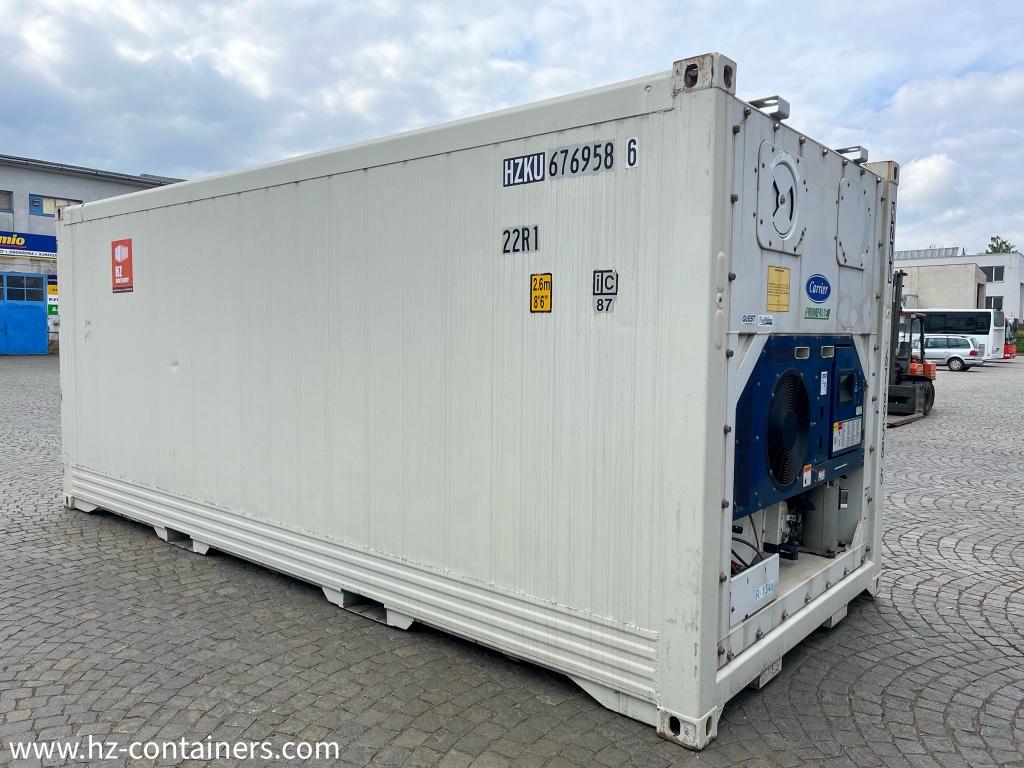
- Refrigerated containers (Reefers): Actively cooled using cooling units. Ideal for frozen or chilled goods.
- Insulated containers: Rely on passive temperature regulation through insulated walls. Suitable for less sensitive goods.
Applications and challenges
Refrigerated containers play a key role in transporting perishable goods, such as food, pharmaceutical products and flowers. However, they face challenges such as condensation, temperature fluctuations and high insulation costs. These problems can be addressed through regular maintenance and inspections.

 Czech Republic, Třebíč
 FREE SHIPPING


Other container news...

Shipping container types
Roughly 80% of everything you own traveled to you inside a steel box. Shipping containers—also called cargo containers, ISO containers, or “conex” boxes—are the backbone of global trade, carrying about 90% of the world’s non-bulk cargo across oceans, rails, and highways. Yet a “shipping container” is not one single object. It is a family of specialized steel boxes, each engineered for a specific kind of cargo: some vent, some freeze, some open from the top, and some have no walls at all.

Where Can I Buy a 40ft High Cube Container?
A 40ft high cube container represents one of the most versatile and cost-effective storage and shipping solutions available today. Whether you are expanding warehouse capacity, starting a container home project, or need secure on-site storage for a construction site, knowing where to buy one — and what to expect — can save you thousands of dollars and weeks of frustration. This guide walks you through every aspect of purchasing a 40ft high cube container, from understanding what it actually is to comparing sellers, navigating delivery logistics, and handling permits.

How much does a 40 foot shipping container cost?
A 40 foot shipping container is the single most common large-format steel container in the world. Whether you are adding on-site storage, moving freight overseas, or converting a unit into a home or workshop, the first question almost everyone asks is the same: how much does a 40 foot shipping container cost?
The short answer is that a 40 foot shipping container price in the United States typically lands between $1,500 and $7,000 depending on condition, height, location, and delivery. Used, wind-and-watertight 40ft units often start near $1,500–$2,700, while a brand-new one-trip 40ft high cube can exceed $4,000–$6,500. The gap between those two ends of the range is wide because a “shipping container” is not one product—it is a graded commodity whose value shifts with its physical condition, its market, and even the distance from your site to a major port.

How to move a shipping container
Moving a shipping container is rarely as simple as “put it on a truck and drive.” A standard steel container weighs over two tons even when empty, spans 20 to 40 feet (or more), and has no wheels, no hitch, and no built-in way to attach to standard equipment. Whether you are repositioning a storage container across a jobsite, delivering one to a rural property, or relocating a loaded unit across the country, the method you choose determines your cost, your timeline, and whether the move succeeds at all.