
Vertical connectors for shipping containers
Vertical connectors for shipping containers represent specialized steel mechanical components designed for the safe connection of two or more containers in the vertical axis (stacking), optionally fixing them to a solid base such as a ship, truck chassis, railway wagon or concrete foundation. These connectors are a key element of container logistics and modern container architecture because they ensure:
- Stability of stacked containers even in extreme conditions (sea, wind, handling).
- Transport safety – they prevent horizontal and vertical separation of columns during transport (so‑called container lashing).
- Modularity and flexibility – they enable not only stacking but also the attachment of structural elements, equipment, technologies, etc.
The basis of their universality is international standardization of container corner castings according to ISO 1161, which guarantees compatibility between containers and connectors from different manufacturers worldwide.
Types of vertical connectors
| Type of connector | Main use | Locking mechanism | Load resistance | Advantages |
|---|---|---|---|---|
| Twistlock (rotary lock) | Stacking, transport | Yes | High | Safety, universality |
| Stacking cone | Storage, light stacking | No | Low | Simplicity, low cost |
| Clamp (Domino) | Accessory installation | Yes (bolt/arm) | High to rigid | No‑bolt holes, versatility |
| Bridge fitting | Horizontal connection | Yes | High | Connection of containers side‑by‑side |
| Welded/bolted twistlock | Permanent attachment to structure | Yes | High | Permanence, construction |
Twistlock – detailed explanation
Twistlock is the most widely used and also the most complex vertical connector. It consists of a robust steel body, upper and lower conical heads, and a rotating mechanism (lever/rope). When inserted into a corner casting hole it rotates 90° and locks securely. Types of twistlocks:
- Manual – the operator rotates the lever by hand, offering high control; suitable for smaller operations and construction applications.
- Semi‑automatic – during stacking the twistlock locks automatically and is released manually; ideal for ports where rapid handling without operator entry onto the container is required.
- Fully automatic – controlled from the crane (spreader), providing extreme speed and safety.
Technical parameters (according to catalogs JOST, MyteeProducts, Pacific Marine):
- Material: high‑quality cast steel (SCW490)
- Surface treatment: hot‑dip galvanised for maximum corrosion resistance
- Tensile breaking load: typically 250–500 kN (25–50 t), some heavy‑duty versions up to 680 kN
- Compression/shear load: minimum 250 kN (some versions up to 400 kN)
- Manufacturing tolerance: must comply with ISO 1161 (hole dimensions, geometry)
- Weight per twistlock: approx. 10–15 kg
- Installation: before stacking, fit into all four corners of the lower container, rotate into lock, lower the upper container and secure the twistlock
Advantages of twistlocks:
- Active locking and resistance to forces from all directions (tension, compression, shear)
- Re‑usability
- High safety, required for maritime transport (IMO, Lloyd’s Register, etc.)

Stacking cone
A simple steel piece inserted into a corner casting hole. It has no active locking mechanism, only preventing horizontal movement of containers on each other. Unsuitable for locations with vibration, impacts, strong wind or vertical movement (ship deck!). Ideal for warehouses, depots, temporary stacks. Cost‑effective, weight 2–5 kg.
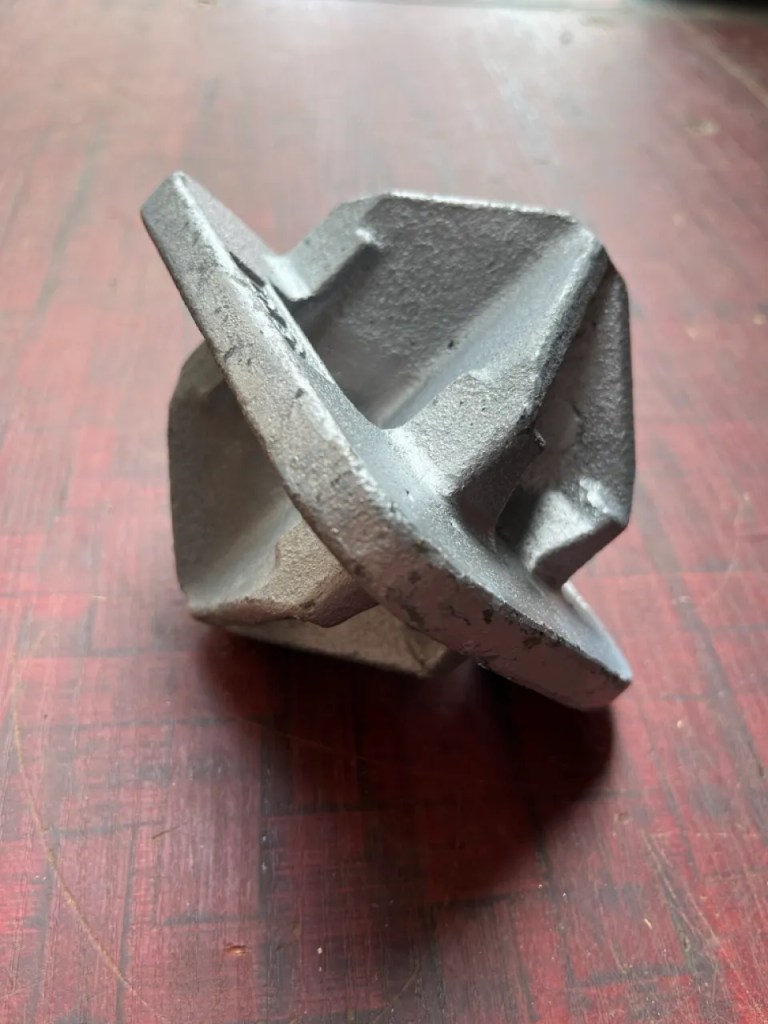
Clamp (Domino, Tandemloc)
Modern type for a solid, bolt‑free connection of two containers or for mounting accessories. They work on the principle of an internal arm (Tandemloc) or an external clamp (Domino).
- Allow precise, rigid connections in architecture, where stiffness and strength are critical.
- Domino clamps provide threaded holes for easy mounting without drilling or welding.
Applications:
- Installation of columns, antennas, lighting, facades, cameras, solar panels, banners, etc.
- Connection of a container to a frame, base plate or another container.
Bridge fitting
Bridge fitting is used for horizontal connection of two containers side‑by‑side (e.g., to create a wider hall). The steel element has two locking heads that insert into and rotate within the corner castings of both containers.
Benefits:
- Enables quick and safe creation of larger modular units
- Easy installation (no lifting of containers)
- Suitable for fixation during stacking in extreme weather conditions
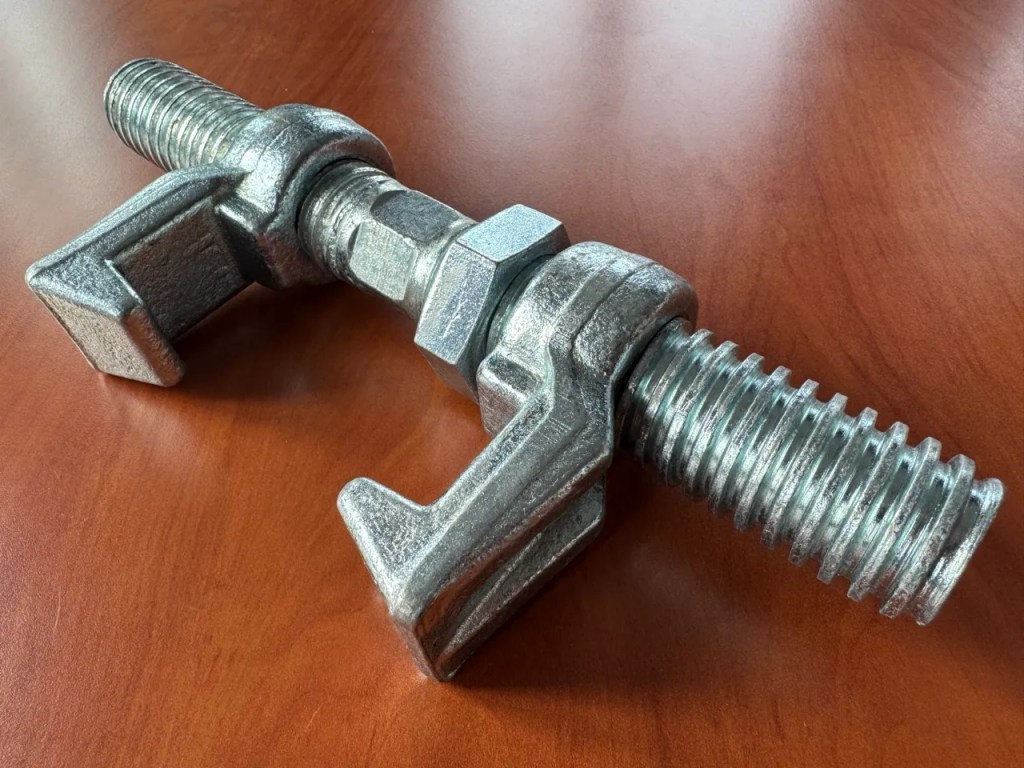
Welded and bolted twistlocks
Designed for installation on a fixed structure (chassis, frame, base plate). The connector base is intended to be welded or bolted, after which the twistlock functions like a regular container twistlock and secures the container to the structure.
Technical standards and parameters
ISO 1161 – foundation for compatibility
- Corner casting dimensions: 178 × 162 × 118 mm
- Wall thickness: approx. 19 mm
- Weight of one casting: approx. 11 kg
- Material: high‑quality cast steel SCW490 or equivalent
- Twistlock hole diameter: 52 mm (standard), other holes as required by position
- Strength requirements: all connectors must be designed to safely transmit container loads up to 34 t (standard 20′/40′ ISO container) and meet a safety factor of 4–5 × SWL (safe working load)
Other standards and certifications
- ISO 1496 – container construction
- EN 284/452 – interchangeable containers
- Lloyd’s Register, Bureau Veritas, DNV GL – approval of connectors for maritime transport
- TÜV, StVZO – German regulations for road transport
Overview of typical values and parameters
| Parameter | Twistlock (standard) | Twistlock (heavy duty) | Stacking cone | Clamp | Bridge fitting |
|---|---|---|---|---|---|
| Material | Cast steel | Cast steel | Steel | Steel | Steel |
| Surface treatment | Hot‑dip galvanised | Hot‑dip galvanised | Paint/galvanised | Paint/galvanised | Paint/galvanised |
| Tensile load (kN) | min. 250 | up to 500 | – | up to 250+ | up to 200 |
| Compression load (kN) | min. 250 | up to 400 | – | up to 250+ | up to 200 |
| Shear load (kN) | 150–250 | up to 300 | – | up to 150 | up to 150 |
| Weight (kg) | 10–15 | 15–20 | 2–5 | 3–7 | 8–12 |
| ISO 1161 compatibility | Yes | Yes | Yes | Yes | Yes |
| Installation | Manual/automatic | Manual/automatic | Manual | Manual | Manual |
Practical applications
1. Transport and stacking of containers (logistics, ports)
- Twistlocks are mandatory for maritime transport – without them containers cannot be safely stacked on a ship’s deck or in port warehouses.
- Typical stack height: 6–9 containers (larger vessels up to 11–12).
- Combination of twistlocks and lashing rods forms a robust block resistant to wind, waves and impacts.
2. Container architecture and construction
- Vertical connectors enable multi‑storey modular construction (offices, apartments, shipping container homes, schools, container houses, technical buildings).
- Clamps and bridge fittings are essential for strength and rigidity of the whole structure.
- Domino clamps allow installation of balconies, facades, steel columns without damaging the container.
3. Accessory installation – technology, safety, advertising
- Fast mounting of lighting, cameras, antennas, solar panels, banners.
- Re‑usable and quick disassembly (e.g., for rented containers).
- High safety of attachment (tested for wind, vibration, vandalism).
4. Mobility – chassis, wheels, dollies
- Twistlocks and clamps for attaching a container to a mobile platform (chassis, wheels, railway wagon).
Practical tips for selection and use
- Before any installation verify connector compatibility with the container type (ISO 1161).
- When stacking always use connectors at all four corners.
- For temporary/light applications (warehouse, dry environment) stacking cones are acceptable; for transport or extreme conditions always use twistlocks.
- For construction projects (shipping container homes) recommend heavy‑duty variants with certification.
- Follow the manufacturer’s installation instructions, including torque checks and safety pins.
- Regularly inspect connectors for corrosion, deformation and play.
Safety and legislation
- Twistlocks must always be approved by the relevant classification society (Lloyd’s, DNV, etc.).
- For public structures a certificate of strength and ISO 1161 compatibility must be provided.
- In maritime and railway transport the use of twistlocks is mandatory and regularly inspected.
- Failure to follow proper procedures can lead to container collapse, property damage and personal injury.
Frequently asked questions (FAQ)
Which connectors should be used for stacking on a ship?
- Always use certified twistlocks for maritime transport; stacking cones are not sufficient.
Are all twistlocks the same?
- No, they differ in load capacity, mechanism (manual, automatic), surface treatment and compatibility. Always check the specifications for your needs.
Can containers be connected side‑by‑side?
- Yes, use bridge fittings (horizontal connectors) designed for that purpose.
Is it possible to attach accessories without drilling?
- Yes, e.g., with Domino clamps or internal clamp systems.
What is the price of a twistlock?
- Typically 45–60 EUR each (depending on type and execution); bridge fitting about 45–50 EUR; special heavy‑duty or certified versions may be more expensive.
Related terms
- Corner castings: fundamental structural element of a container according to ISO 1161.
- Lashing rods: steel rods for securing container stacks.
- Spreader: crane frame used for handling containers.
- Container dolly: chassis for moving empty containers.
- Heavy‑Duty connectors: extra‑reinforced types for extreme loads.

 Czech Republic
  WITHOUT SHIPPING


Other container news...

Hörmann garage doors as a great addition to a shipping container
Hörmann garage doors as an addition to a shipping container are a comprehensive solution that brings users maximum comfort, safety and aesthetic level. Their installation is an investment in the long-term value, functionality and representative appearance of the container space. The combination of the robustness of the container and the top technology of Hörmann is the ideal choice for anyone who wants to get the most out of their container.

What are the widths of a shipping container
The width of a shipping container – 2.438 m – is one of the pillars of global logistics. Thanks to its standardized size, it is possible to transport goods across continents efficiently, safely and without any problems, stack containers high and optimize handling. When choosing a container, it is necessary to take into account not only the width, but also the length, height, type (standard vs. High Cube) and any special requirements – for example, Pallet Wide or Reefer.

What are the tolerances for unevenness of a shipping container?
Shipping container unevenness tolerances are the basis for safe, efficient and standardized transportation and storage. Each container must meet precisely defined limits for deformation, dents and structural damage. These limits protect not only the value of the cargo, but also the lives of logistics workers and the stability of the entire logistics chain. Keeping containers within tolerances is an investment in the safety, longevity and reliability of your transportation solutions.

Side opening container for rent
A side-opening container for rent from HZ KONTEJNERY s.r.o. is a technically advanced, versatile and highly accessible storage space, available without the need for ownership and with complete service. It is the ideal choice for companies and individuals who need to quickly and flexibly solve storage, transportation or special projects without investment costs and maintenance worries.