
Used Shipping Containers La Spezia – Italy
La Spezia is one of the most important Italian and Mediterranean ports, strategically located on the Ligurian coast. This privileged location makes it an ideal entry point for those seeking used shipping containers with certified quality. The warehouse in La Spezia offers an extensive selection of standard ISO containers, available in various sizes and conditions, all subject to strict quality controls. In this guide, you will learn how to select a container that best suits your needs, understand international quality standards, and gain access to basic logistical information for pickup and delivery. Whether you are looking for a container for storage, transport, or conversion to housing, you will find all the answers needed to make an informed decision.
Why Choose Used Shipping Containers in La Spezia, Italy
La Spezia as a Strategic Port
La Spezia stands out as one of the main European port centers with a geographical location that facilitates connections to the Mediterranean Sea, the Atlantic, and Asian markets. This means direct access to containers returning from international transport, which guarantees a constantly updated selection and competitive prices. The proximity of the port reduces logistics costs and enables rapid delivery throughout Italy and Europe.
The warehouse in La Spezia benefits from this strategic location and offers containers that have completed actual transport cycles and have been subject to strict inspections before being placed on the secondary market. This guarantees that each unit has a traceable history and verifiable certifications.
Economic Advantages and Sustainability
Purchasing a used container brings significant savings compared to buying a new one. A new 20-foot container costs approximately 2,500–4,500 EUR, while the same model in good condition (Cargo Worthy) costs 1,500–3,500 EUR. For 40-foot High Cube containers, the savings are even more significant: 3,500–5,500 EUR for new, compared to 2,500–3,500 EUR for certified used.
| Container Type | New (EUR) | Used Cargo Worthy (EUR) | Savings (%) |
|---|---|---|---|
| 20-foot Standard | 2,500–4,500 | 1,500–3,500 | 60–70% |
| 40-foot Standard | 3,500–4,500 | 1,500–3,000 | 55–65% |
| 40-foot High Cube | 3,500–5,500 | 2,500–3,500 | 50–60% |
Beyond the immediate economic advantage, choosing a used container is a sustainable choice. Containers are made of Corten steel, a material of exceptional durability, designed to last for decades. By purchasing a used container, you contribute to the circular economy, reduce demand for new manufacturing, and reduce the environmental impact associated with steel production. Every reused container is a resource that remains in circulation instead of becoming waste.
Guaranteed Quality at the La Spezia Warehouse – Italy

The warehouse in La Spezia applies strict standards to every container in stock. All containers are subject to complete structural inspection, tightness verification, door functionality checks, and CSC certification verification (Container Safety Convention). Each unit is classified according to international ISO 1496 standards and CSC regulations, which guarantees complete transparency of conditions and suitability for use.
Cargo Worthy certification, our minimum standard for most containers, means that each unit has passed strict technical tests and is structurally suitable for maritime transport and long-term storage. This level of quality protects you from purchasing containers with hidden defects and ensures a long-term investment.
Types of Available Shipping Containers
20-foot vs 40-foot Containers
The two main formats on the shipping container market are 20-foot (TEU – Twenty-foot Equivalent Unit) and 40-foot (FEU – Forty-foot Equivalent Unit). The choice between these two depends on your volume needs, load capacity, and transport constraints.
A 20-foot container offers a compact solution ideal for limited spaces, modular storage, and transport in areas with limited access. It is perfect for small construction sites, temporary offices, and medium-sized warehouses. A 40-foot container doubles the interior space, making it more economical for large storage volumes and heavy goods transport. The cost per cubic meter is lower for 40-foot, although the unit price is higher.
Standard ISO Box Containers
The standard ISO Box container is the most common and most universal model. It has a robust steel structure, a durable wooden floor, and four lifting corners (corner castings) in accordance with international regulations. Interior dimensions allow for storage of European pallets and transport of diverse goods.
| Specification | 20-foot Standard | 40-foot Standard |
|---|---|---|
| External Length | 6.058 m | 12.192 m |
| External Width | 2.438 m | 2.438 m |
| External Height | 2.591 m | 2.591 m |
| Internal Length | 5.867 m | 12.032 m |
| Internal Width | 2.350 m | 2.350 m |
| Internal Height | 2.392 m | 2.392 m |
| Internal Volume | 33.2 m³ | 67.7 m³ |
| Load Capacity | 18,000 kg | 28,000 kg |
| Empty Weight | 2,300 kg | 3,800 kg |
High Cube (HC) Containers
High Cube containers are identical to standard containers, but with an internal height increased by 30 cm (from 2.392 m to 2.692 m). This modification increases the internal volume by approximately 13% without increasing length or width. A 40-foot HC container contains 76.2 m³ instead of 67.7 m³, making it ideal for lightweight goods with high volume or residential projects requiring greater vertical space.
HC containers are slightly more expensive than standard models, but the added value in terms of space makes them advantageous for most modern uses. They are especially valued for residential conversions, modular offices, and storage of bulky materials.
Specialized Containers
In addition to standard and High Cube models, our warehouse in La Spezia offers specialized containers for specific needs. Open Top containers have a removable roof, ideal for transporting large loads or loading from above. Flat Rack containers are minimalist structures without side walls, perfect for transporting heavy machinery. Refrigerated containers (Reefer) maintain controlled temperatures and are essential for transporting perishable goods. Contact our team and verify the availability of these specialized models.
How to Assess the Quality of a Used Container
International Quality Standards
All shipping containers are classified according to recognized international standards that define their suitability for use and market value. Understanding these standards is essential for informed purchasing. The main classification systems are: As-Is, Cargo Worthy, IICL (International Institute of Container Lessors), and FC (Full Container Load).
ISO 1496 standard establishes technical specifications for containers, including dimensions, load capacity, materials, and structural durability requirements. The Container Safety Convention (CSC) is an international treaty requiring regular inspections and certification of safety conditions. Each container must have a valid CSC plate for international transport.
| Quality Grade | Description | Recommended Use | Relative Price |
|---|---|---|---|
| As-Is | Sold in current condition without warranties. Possible structural damage, extensive corrosion, non-functional doors | Demolition, complete reconstruction, steel recycling | Lowest (200–600 EUR) |
| Cargo Worthy (CW) | Suitable for maritime transport. Structurally intact, watertight, valid CSC. Minor aesthetic imperfections acceptable | Transport, storage, warehouse, residential conversions | Medium (800–2,500 EUR) |
| IICL | Excellent condition. Inspected according to stricter standards. Minimal imperfections. Suitable for any use | Demanding clients, long-term rental, premium projects | Higher (1,500–3,500 EUR) |
CSC and ACEP Certification
The CSC plate is a stainless steel plate attached to the outside of the container door. It contains critical information: container serial number, year of manufacture, maximum gross weight (MGW – Maximum Gross Weight), and certification expiration date. A valid CSC plate is mandatory for international transport and indicates that the container has been inspected by a certified entity.
ACEP (Approved Continuous Examination Program) is an internationally recognized continuous inspection program. ACEP containers are subject to regular checks not only at scheduled intervals, but also after each significant event (damage, repairs, change of ownership). If a container has ACEP certification, it means it has been carefully maintained and frequently inspected. This is an indicator of higher quality, although it is not mandatory for purchase.
Visual and Structural Inspection
Before purchasing a container, conduct a thorough visual inspection. Check the exterior for signs of corrosion, dents, wall and roof damage. Verify that the doors open and close completely, that hinges function, and that seals are intact. Inspect the interior floor for holes, rotted wood, and water intrusion.
The container structure is designed to withstand significant vertical and horizontal loads. Check the four lifting corners (corner castings) for deformation or cracks. Verify that the frame is straight and that there are no visible signs of settling. If the container has suffered significant accidents (such as falling during transport), there may be structural damage that is not immediately visible.
Tightness and Waterproofing Condition
A container must be watertight to protect its contents from water and moisture. The tightness test (light test) is performed by certified inspectors: the container is sealed and lit from inside, while the inspector checks the outside for any points of light that indicate leaks. A Cargo Worthy container must pass this test.
When you visit our warehouse, ask for a visual tightness test to be performed: enter the container in low light conditions and observe whether you see points of light passing through the walls or roof. Also check the floor for signs of moisture, dark spots, or mold odor. These signals indicate that the container may not be completely watertight.
Inspection Checklist
- Exterior: Check for corrosion, dents, wall damage, intact roof, visible and legible CSC plate
- Doors: Verify complete opening/closing, functional hinges, intact seals, secure locking mechanism
- Floor: Inspect for holes, rotted wood, water intrusion, structural damage
- Lifting Corners: Check for deformation, cracks, significant corrosion
- Waterproofing: Perform visual tightness test, verify absence of interior moisture
- Frame and Structure: Verify that the container is straight, without visible settling or deformation
Logistics Information and Pickup from the La Spezia Warehouse, Italy
Warehouse Location and Access
The warehouse in La Spezia is strategically located near the port, which guarantees direct access to containers and reduced delivery times. The location facilitates loading onto trucks and transport to destinations in Italy and Europe. The warehouse is equipped with container handling equipment (cranes, reach stackers) and specialized personnel who assist with the pickup process and documentation.
Documents Required for Pickup
To complete your purchase and pick up a container from our warehouse, you will need the following documentation:
- Valid identification document: Passport, identity card, or driver’s license (to verify the buyer’s identity)
- Proof of payment: Bank statement, bank transfer, or cash payment confirmation
- Purchase invoice: Official document specifying the container, price, and terms of sale
- Original CSC certificate: Copy of the CSC plate or certification document (provided by our warehouse)
- Transport authorization: If the container will be transported on public roads, authorization is required (our team can assist)
- Transport insurance: If you use an external transport service, ensure it is insured
Delivery Times and Availability
If you choose direct pickup from our warehouse, the container is generally available the next business day after purchase, after documentation verification and payment completion.
Common Uses of Used Containers
Storage and Warehouse
The most common use of used shipping containers is for storing goods and materials. A 20-foot container can store approximately 17 EUR pallets, while a standard 40-foot contains 25 EUR pallets. A 40-foot High Cube container increases this capacity to 26–28 pallets due to the additional height. Containers provide protection from water and weather, making them ideal for outdoor storage of equipment, raw materials, and finished products.
Many companies use containers to create modular and expandable warehouses. If your business grows, you can add additional containers without investing in permanent building structures. Containers are also easily transportable, allowing you to relocate your warehouse if your operational location changes.
Residential Solutions and Offices
Used Cargo Worthy containers are increasingly being used to create modular residential spaces and offices. A 20-foot container (33 m³) is sufficient for a small studio or office, while a 40-foot High Cube (76 m³) can accommodate a studio apartment or open office. The steel structure provides a robust and durable foundation for these conversions.
Residential conversions require thermal insulation (for cold climates), adequate ventilation, certified electrical installations, and hydraulic systems. Total costs for a residential conversion range from 5,000 to 15,000 EUR per container, depending on the required level of finish. Containers offer a sustainable and economical alternative to traditional construction, especially valued by those seeking ecological housing solutions.
Industrial and Construction Use
On construction sites, containers are used as temporary offices, changing rooms, material storage, and tool storage. A 20-foot container is easy to place in limited spaces and can be quickly removed after work is completed. Containers are also used as mobile workshops, maintenance structures, and quality control stations.
In industry, containers are used for storing components, semi-finished products, and finished goods. Their robustness makes them suitable for difficult industrial environments, and their modularity allows for flexible organization of factory layouts.
Conversion Projects
In addition to residential conversions and offices, containers are used to create bars, cafes, pop-up shops, recreational structures, and even temporary medical facilities. The versatility of the container allows it to be adapted to almost any use with appropriate modifications. Contact our team and discuss the feasibility of your conversion idea and get advice on which type of container is most suitable for your project.
Frequently Asked Questions on Selection and Purchase
What are the standard dimensions of a shipping container?
Standard shipping containers have dimensions of 20 feet (6.06 m length) and 40 feet (12.19 m length), with a width of 2.44 m and height of 2.59 m. High Cube (HC) containers have a height of 2.89 m, offering greater internal volume without changing the length. These international standards are defined by ISO 1496 standard, which ensures compatibility with transport, handling, and storage systems worldwide.
What is the difference between a Cargo Worthy container and an As-Is container?
A Cargo Worthy (CW) container is suitable for maritime transport, has passed a certified inspection by a recognized entity, has a valid CSC plate, and has minor aesthetic imperfections that do not affect structural functionality. An As-Is container is sold in its current condition without warranties, with possible significant structural damage, extensive corrosion, non-functional doors, and damaged flooring. Cargo Worthy is suitable for international transport and long-term storage; As-Is is recommended only for demolition or complete reconstruction.
How can I verify that a container is CSC certified?
CSC certification is indicated by a stainless steel plate attached to the outside of the container door. The plate contains manufacturing data, serial number, maximum gross weight (MGW), and certification expiration date. Verify that the date is current (not expired) and that the serial number matches the sales documents. You can contact the container manufacturer and confirm the authenticity of the certification using the serial number.
Can I use a used container for international transport?
Yes, but only if the container has Cargo Worthy certification and a valid CSC plate. For international maritime transport, the container must pass tightness tests and comply with ISO 1496 and CSC standards. For domestic storage or industrial use unrelated to transport, certifications are less critical. Verify the specific requirements of your destination country, as some countries have additional regulations.
Is a used container suitable for conversion to housing?
Yes, a used Cargo Worthy container is suitable for residential conversion if it is structurally intact and watertight. You will need thermal insulation (for cold climates), adequate ventilation, certified electrical and hydraulic installations. The quality of the used container directly affects renovation costs: a container in excellent condition will require less work. Consult an architect and verify compliance with local building codes in your area.
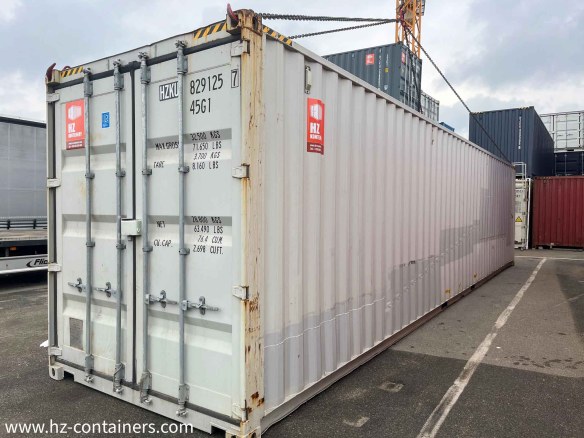
 Italy, La Spezia
  WITHOUT SHIPPING


Other container news...

20 Foot shipping container cost
If you are researching the cost of a 20 foot shipping container, you have likely already encountered wildly different prices — from $999 listings online to quotes exceeding $5,500. That range is not a sign of inconsistency. It reflects real differences in container condition, location, delivery logistics, and the seller you are dealing with.
Side Opening container
A side opening container is an ISO-compliant intermodal shipping container engineered with full-length bi-fold doors along one of its long side walls, in addition to the standard cargo doors at one end. Unlike conventional containers that restrict access to a single set of rear doors, a side opening container — also widely called an open side container, open-sided shipping container, or side door container — provides unobstructed lateral access across the entire 20-foot or 40-foot length of the unit. This design transforms the container from a narrow tunnel into a wide-open space that forklifts can enter from the side, multiple workers can load simultaneously, and oversized cargo that would never fit through standard end doors can be placed without struggle.
40 Foot High Cube container cost
A 40 foot high cube container — often abbreviated as 40ft HC, 40′ HC, or 40-foot high cube — is one of the most common shipping container sizes sold on the secondary market. But if you are researching what a 40 foot high cube container costs, you have almost certainly noticed that prices are all over the map. One seller quotes $1,500. Another quotes $7,000. Both could be legitimate.
20 Foot container cost
If you have ever searched for a shipping container, you have almost certainly asked one question first: how much does a 20 foot container cost? The answer is not a single number. It is a range that spans from under $1,000 for a weathered, as-is unit to over $5,000 for a pristine, one-trip container — and that is before delivery, site preparation, or modifications enter the picture.