
Easy Container Unloading with ConFoot Legs
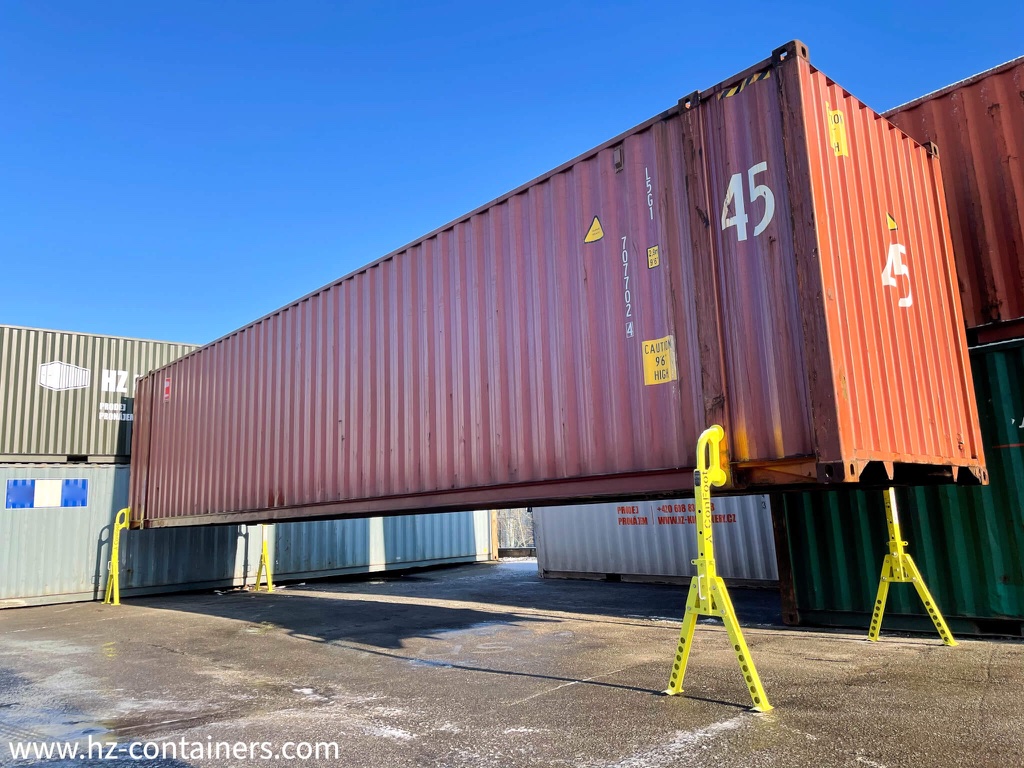
Easy unloading of containers with ConFoot legs is an innovative technology that enables safe and rapid unloading of ISO maritime containers from a trailer to the ground without the need for a crane or other heavy handling equipment. The foundation consists of patented lifting legs ConFoot, which are installed into corner castings of the container and allow its weight to be transferred to a solid surface. Handling is performed using the air suspension of the trailer, which is standard equipment on modern transport vehicles – making the system accessible to practically anyone who transports containers.
Key advantages of the technology:
- Eliminates the need for expensive cranes, side loaders or reach stackers.
- Increases work efficiency and speed.
- Enables container unloading even in places without technical infrastructure (construction sites, rural areas, humanitarian operations).
- Reduces operating costs and saves driver time.
Principle and Technology of ConFoot Legs Operation
The ConFoot system uses a simple yet sophisticated principle:
| Phase | Description |
|---|---|
| 1. Container Lifting | The driver parks the trailer, raises the air suspension to maximum level, thereby lifting the container by approximately 10–15 cm. |
| 2. Leg Installation | An operator (usually one person is sufficient) installs four telescopic ConFoot legs into the lower corner castings (corner castings). The legs are lightweight (24 kg) and a magnet in the upper part holds them to the container for easy handling. |
| 3. Weight Transfer | The air suspension is slowly released, the trailer descends and the container’s weight transfers to the legs. The vehicle disconnects and can drive away. The container safely stands on the legs at ramp height or as needed. |
The entire process can be completed in 5–10 minutes!
Construction, Materials and Safety Certification
Material and Construction
- Material: High-strength steel (Finnish manufacture, specific alloys for maximum load capacity and low weight)
- Leg weight: 24 kg (models CF, CFP, CFL)
- Load capacity: up to 34,000 kg (CF, CFL), 30,000 kg (CFP), up to 45,000 kg (CFU 45)
- Telescopic construction: Adjustable height 1,043 – 1,448 mm (CF, CFP, CFL), CFU models up to 1,500 mm
Safety and Certification
- Locking mechanisms: All legs have safety pins and locks that prevent accidental collapse or retraction.
- Magnetic stabilization: The upper part is equipped with a strong magnet – facilitates single-person operation.
- Patented design: Folding construction in an inverted “V” shape for maximum stability and load distribution.
- Certifications:
- European standard EN 283 (testing of static and dynamic loading of containers)
- CE certification – complies with Directive 2006/42/ES on machinery
- Compliance with standards ISO 668 (container dimensions) and ISO 1161 (corner castings)
Overview of ConFoot Models and Variants
| Model | Max. Load Capacity | Weight per Leg | Adjustable Height | Specifications and Use | Price (excl. VAT) |
|---|---|---|---|---|---|
| CF (Standard) | 34,000 kg | 24 kg | 1,043 – 1,448 mm | For standard unloading on flat surfaces, universal use | 3,700 EUR (approx. 92,500 CZK) |
| CFP (Pocket) | 30,000 kg | 24 kg | 1,043 – 1,448 mm | Allows container door opening up to 270°, ideal for ramps | 3,700 EUR |
| CFU 20/30/45 | 20,000 / 30,000 / 45,000 kg | 46 kg | up to 1,500 mm | Active lifting device with hydraulics/mechanics for ground placement | 6,500–13,000 EUR |
| CFL (Light) | 34,000 kg | 24 kg | 1,043 – 1,448 mm | For frame/tank containers | 3,700 EUR |
Note: All prices are indicative, dependent on quantity and region, current steel prices, etc.
Detailed Step-by-Step Container Unloading Procedure
Required Equipment
- 4 pcs of ConFoot container legs (according to container type)
- Vehicle with chassis and air suspension
- Personal protective equipment (PPE)
Procedure
- Site Preparation
- Check the strength, flatness and load capacity of the surface (concrete/asphalt/compacted gravel).
- Vehicle Securing
- Park, apply the handbrake, place chocks.
- Chassis Lifting
- Use the control to raise the air suspension to maximum.
- Container Unlocking
- Release the twist-lock locks at all four corners.
- Leg Installation
- Insert the leg into the corner casting, rotate to vertical position, the magnet secures the leg to the wall.
- Spread the arms into a “V” shape, secure with pins.
- Extend the telescopic part so it contacts the ground, secure with a safety pin.
- Repeat at all corners.
- Weight Transfer
- Slowly release air from the suspension, monitor weight transfer to the legs.
- Vehicle Departure
- Once the chassis is free, drive out from under the container.
Reloading back onto the chassis is performed in reverse.
Comparison with Alternative Handling Methods
| Method | Equipment | Number of People | Time | Costs | Safety | Flexibility |
|---|---|---|---|---|---|---|
| ConFoot Legs | Set of legs | 1 | 5–10 min | Low (one-time investment) | High | Highest |
| Mobile Crane | Crane, slings | 2–3 | 30–60 min | High (rental/operation) | Medium | Low (must be ordered) |
| Side Loader | Special trailer | 1–2 | 15–30 min | Very high (purchase/service) | High | Medium |
| Reach Stacker | Special handler | 1–2 | 10–20 min | High | High | Low (infrastructure required) |
| Forklift | 10t+ forklift | 2 | 15–30 min | Medium | Low (damage risk) | Medium |
Conclusion: ConFoot is the only method without heavy equipment and with extreme operational flexibility.
Key Advantages and Benefits of the ConFoot System
- Cost savings: No crane rental needed, driver waiting times disappear, investment payback is quick.
- Time savings: The process takes only a few minutes, the driver can immediately continue with other work.
- Maximum flexibility: The container can be unloaded anywhere on a solid surface.
- Safety: Handling takes place on the ground, the system is certified according to EN 283 and CE.
- Independence from external services: The company organizes unloading itself as needed.
- Cargo protection: A container standing on legs is protected from moisture, pests and floods.
Practical Examples of Use in Various Industries
Logistics and Transport
- Rapid container exchange through “drop & hook” system, maximizing vehicle utilization.
Construction
- Containers serve as mobile warehouses, offices or changing rooms directly on the construction site. Easy relocation according to work progress.
Agriculture
- Temporary storage of crops, equipment or feed without the need for foundation investments.
Humanitarian and Military Deployment
- Rapid creation of facilities (warehouses, hospitals, accommodation) in difficult conditions without infrastructure.
Event Management, Festivals
- Mobile warehouses, catering, cash registers, facilities for events of all kinds.
Retail and Distribution
- Temporary expansion of storage capacity directly at the ramp (CFP).
Safety Guidelines, Maintenance and Lifespan
Safety Rules
- Use exclusively on solid, flat and load-bearing surfaces.
- Do not exceed maximum load capacity.
- Regularly inspect the condition of the legs (damage, deformation, corrosion).
- Do not handle legs in strong winds (>22.5 m/s).
- No one should be under the container during work.
Maintenance
- After use, clean from mud, salt, dirt.
- Lubricate moving parts at least once a year.
- Store in a dry place, protect from weather.
Lifespan
- With proper maintenance, typical lifespan is >10 years even in intensive operation.
Economic Aspects: Price and Return on Investment
| Model | Price (excl. VAT) | Price (incl. VAT) |
|---|---|---|
| CF, CFP, CFL | 3,700 EUR | 4,477 EUR |
| CFU 20 | 6,500 EUR | 7,865 EUR |
| CFU 30 | 7,500 EUR | 9,075 EUR |
| CFU 45 | 13,000 EUR | 15,730 EUR |
Return on Investment:
- Crane rental: 100–200 EUR / operation
- Driver waiting: 20–40 EUR/hour (typically 2–3 hours/operation)
- With several operations per month, payback within 1 year!
Related Terminology and Standards
| Term | Meaning / Standard |
|---|---|
| ISO Container | ISO 668 standard – standardized container dimensions |
| Corner Casting | Corner casting (ISO 1161) – used for securing, lifting and stacking containers |
| Twist-lock | Lock on the chassis for container fixation |
| Chassis | Trailer designed for transporting ISO containers |
| EN 283 | European standard for container strength and testing |
| CE Mark | Declaration of conformity according to European directives |

 Czech Republic
 WITHOUT SHIPPING


Other container news...

Shipping container types
Roughly 80% of everything you own traveled to you inside a steel box. Shipping containers—also called cargo containers, ISO containers, or “conex” boxes—are the backbone of global trade, carrying about 90% of the world’s non-bulk cargo across oceans, rails, and highways. Yet a “shipping container” is not one single object. It is a family of specialized steel boxes, each engineered for a specific kind of cargo: some vent, some freeze, some open from the top, and some have no walls at all.

Where Can I Buy a 40ft High Cube Container?
A 40ft high cube container represents one of the most versatile and cost-effective storage and shipping solutions available today. Whether you are expanding warehouse capacity, starting a container home project, or need secure on-site storage for a construction site, knowing where to buy one — and what to expect — can save you thousands of dollars and weeks of frustration. This guide walks you through every aspect of purchasing a 40ft high cube container, from understanding what it actually is to comparing sellers, navigating delivery logistics, and handling permits.

How much does a 40 foot shipping container cost?
A 40 foot shipping container is the single most common large-format steel container in the world. Whether you are adding on-site storage, moving freight overseas, or converting a unit into a home or workshop, the first question almost everyone asks is the same: how much does a 40 foot shipping container cost?
The short answer is that a 40 foot shipping container price in the United States typically lands between $1,500 and $7,000 depending on condition, height, location, and delivery. Used, wind-and-watertight 40ft units often start near $1,500–$2,700, while a brand-new one-trip 40ft high cube can exceed $4,000–$6,500. The gap between those two ends of the range is wide because a “shipping container” is not one product—it is a graded commodity whose value shifts with its physical condition, its market, and even the distance from your site to a major port.

How to move a shipping container
Moving a shipping container is rarely as simple as “put it on a truck and drive.” A standard steel container weighs over two tons even when empty, spans 20 to 40 feet (or more), and has no wheels, no hitch, and no built-in way to attach to standard equipment. Whether you are repositioning a storage container across a jobsite, delivering one to a rural property, or relocating a loaded unit across the country, the method you choose determines your cost, your timeline, and whether the move succeeds at all.