
Certified Leveling Legs for Shipping Containers
Certified leveling legs for shipping containers are specialized, highly durable devices that enable precise, safe and efficient leveling of ISO shipping containers on any, even very uneven surface. Their main function is to ensure stability, structural integrity and extend the service life of the container by transferring its weight to a solid, height‑adjustable base.
Modern logistics, construction and alternative uses of containers (modular buildings, mobile warehouses, workshops, living units) require maximum safety and fast installation. Leveling legs are a key accessory that allows:
- Eliminate frame deformation and prevent door‑opening problems
- Minimise the risk of container overturning or settling
- Prevent moisture accumulation and floor‑frame corrosion
HZ CONTAINERS s.r.o. is a leading supplier of these systems for the Czech Republic, Slovakia and Central Europe. The range includes proprietary robust solutions known for their innovation, low weight and fast installation.
Key Features and Operating Principle
Operating principle of leveling legs
| Step | Description |
|---|---|
| Anchoring | Each leg is fastened to the lower corner casting (ISO corner casting), which is designed to transfer extreme forces according to DIN ISO 1161. |
| Lifting and adjustment | Legs are mechanically adjustable (hand‑wheel or wrench). Each corner can be individually and precisely height‑adjusted. |
| Leveling | Using a spirit level (ideally laser) all four corners are aligned to a single plane. Leveling is essential for proper door operation and statics. |
| Stabilisation | After adjustment the legs provide a stable base that prevents movement, settling or overturning of the container. |
Why is container leveling essential?
- Structural integrity – An improperly supported container can deform, leading to seam cracking and statics failure.
- Door functionality – A twisted frame prevents doors from closing or opening.
- Safety – Risk of overturning in strong wind or uneven loading.
- Corrosion resistance – Lifting the container allows airflow, drains water and greatly slows rusting.
Types of Certified Legs
1. Patented ConFoot Legs

- Manufactured in Finland from high‑quality steel
- Extremely low weight (24 kg each – handling by one person)
- Load capacity up to 34 t per set
- Patented clamping mechanism – quick installation without heavy equipment
- CE certification (2006/42/EC)
- Variants:
- ConFoot CF – standard handling (storage, construction)
- ConFoot CFP – optimised for loading ramp connection
- ConFoot CFU – with hydraulics for easier lifting and lowering
Unique benefits:
- Installation in 5 minutes by one person
- Enables independent loading/unloading of the container without a crane
- Light storage and transport
- Resistance to extreme climate conditions
2. Standard Leveling Pads

- Made of hot‑dip galvanized steel (higher corrosion resistance)
- Load capacity 12 000 kg per set
- Weight 4.5 kg each – easy handling
- Adjustable range up to 260 mm
- Variants:
- Without lock – pure leveling, additional securing required
- With lock (twist‑lock) – stable connection to corner casting (prevents shifting, suitable for stacking)
Advantages:
- Economical solution for permanent or temporary installations
- High re‑usability
- Excellent price‑performance ratio

3. Certified Supports for Extreme Loads
- Load capacity up to 10 000 kg per set
- Combination of hot‑dip galvanized steel and anodised aluminium
- Manual drive (hand‑wheel)
- Maximum lift 200 mm
- Full compatibility with DIN ISO 1161
- Durable for industrial and construction use
Comparison of Main Parameters
| Parameter | ConFoot CF | HZ CONTAINERS Standard | HZ CONTAINERS Certified |
|---|---|---|---|
| Load capacity (set of 4) | 34 000 kg | 12 000 kg | 10 000 kg |
| Adjustable range | 1043–1448 mm | up to 260 mm | up to 200 mm |
| Weight (per piece) | 24 kg | 4.5 kg | 9.45 kg |
| Material | High‑strength steel | Hot‑dip galvanized steel | Galvanised steel, aluminium |
| Main advantage | Fast handling | Versatility, price | Robustness |
| Certification | CE | — | DIN ISO 1161 |
| Suitable use | Logistics, temporary placement | Warehouses, construction sites | Industry, construction |
Certifications, Standards and Materials
- DIN ISO 1161 – defines dimensions and strength parameters of corner castings, which are crucial for safe anchoring of leveling legs.
- ISO 668 – sets basic dimensions and construction requirements for shipping containers.
- CE certification – required for mechanical devices in the EU; guarantees safety, durability and compliance with legislation.
- Hot‑dip galvanized steel – surface treatment that significantly extends service life and protects against corrosion (especially important outdoors and with prolonged water contact).
- Anodised aluminium – used in selected types to reduce weight while maintaining high strength.
Detailed Installation Procedure
Preparation
- Site cleaning – remove stones, vegetation, level the surface. On soft ground a gravel bed is recommended.
- Lift container corner – use a hydraulic jack (exclusively under the corner casting).
Installing the Legs
- Insert leg – place the leg into the opening of the corner casting.
- Height adjustment – turn the nut, hand‑wheel or hydraulic mechanism to set the height.
- Repeat for all four corners.
Inspection and Final Adjustments
- Check the plane – use a long spirit level or laser to align all corners.
- Securing – legs with a lock fix the container against shifting. For pads without lock use additional anchors or straps.
Important Safety Rules
- Never stand under an unsecured container!
- Perform all lifts gradually and monitor stability.
- After installation always verify door operation and overall stability.
Advantages Over Traditional Methods
- Speed – installation < 30 min by one person
- Accuracy – millimetre adjustment even on sloped or uneven ground
- Re‑usability – legs can be easily dismantled and relocated
- No permanent ground interventions – unlike concrete pads, footings or timber bases
- Long service life – surface treatment protects against corrosion for 20+ years
- Ecological – minimal ground disturbance, no waste building materials
Broader Context – System Solution for Containers
Leveling legs are only part of a comprehensive accessory system for containers. For larger modular assemblies the following are also important:
- Horizontal connectors (Bridge Fitting, Lashing Bridge Fitting) – essential for safely joining containers side‑by‑side.
- Twist‑lock systems – for stacking and securing containers on chassis or foundations.
The combination of proper leveling and connector elements ensures static safety and long‑term stability even under extreme loads.
Documentation
Available for proper use:
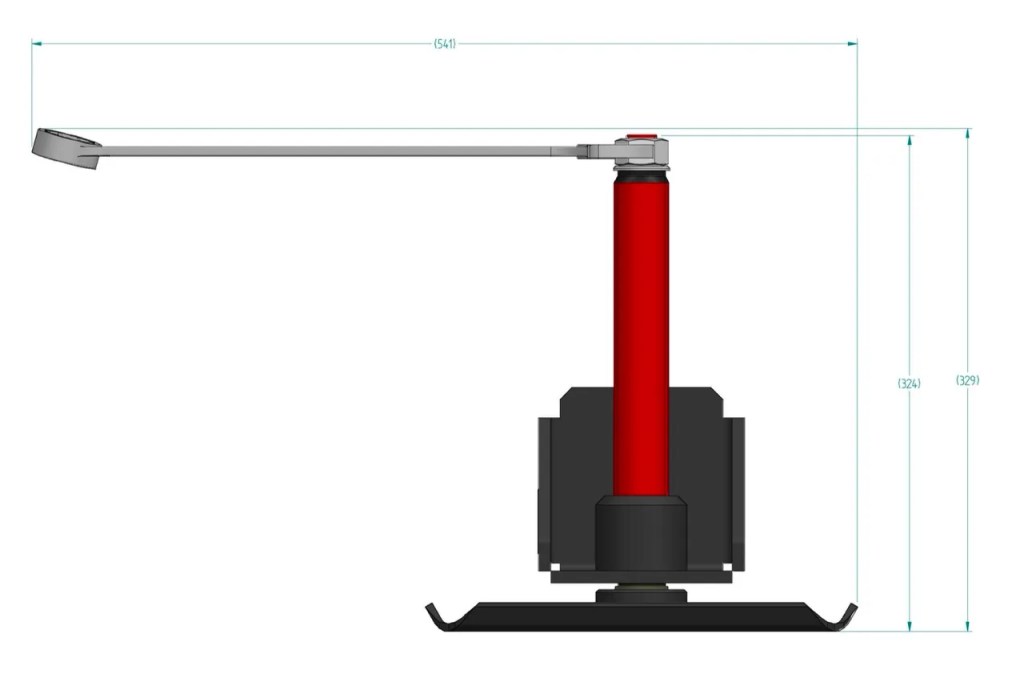
- Technical drawings (dimensions, ISO corner casting compatibility)
- Assembly manuals (step‑by‑step procedures)
- Photographic documentation from practice


Related Terms
- Corner Casting – standardised steel element per DIN ISO 1161 for lifting, stacking, securing and leveling containers.
- Twist Lock – locking mechanism for safe connection of containers to each other or to a chassis.
- Dunnage – wooden or plastic shims for provisional leveling (less precise, short‑term solution).
- Corten Steel – weather‑resistant steel used for frames and walls of containers.
Frequently Asked Questions (FAQ)
How often should container leveling be checked?
At least twice a year and after extreme weather events or load changes.
Can the legs be reused?
Yes, all types are designed for long‑term repeated use.
What to do if container doors won’t open?
Most likely the cause is poor leveling – check and adjust leg heights.
What is the best foundation for a permanent container installation?
A compacted gravel bed combined with certified leveling legs. For residential units (shipping container homes, shipping container houses) a concrete slab is recommended.
Certified leveling legs for shipping containers are essential for anyone working with ISO containers who values safety, longevity and operational efficiency. Patented systems (e.g., ConFoot) and robust steel pads from HZ CONTAINERS enable fast, precise and safe installation without heavy equipment. Choosing the right solution protects your investment and provides maximum flexibility in handling and long‑term container use.

 Czech Republic
  WITHOUT SHIPPING


Other container news...

Hörmann garage doors as a great addition to a shipping container
Hörmann garage doors as an addition to a shipping container are a comprehensive solution that brings users maximum comfort, safety and aesthetic level. Their installation is an investment in the long-term value, functionality and representative appearance of the container space. The combination of the robustness of the container and the top technology of Hörmann is the ideal choice for anyone who wants to get the most out of their container.

What are the widths of a shipping container
The width of a shipping container – 2.438 m – is one of the pillars of global logistics. Thanks to its standardized size, it is possible to transport goods across continents efficiently, safely and without any problems, stack containers high and optimize handling. When choosing a container, it is necessary to take into account not only the width, but also the length, height, type (standard vs. High Cube) and any special requirements – for example, Pallet Wide or Reefer.

What are the tolerances for unevenness of a shipping container?
Shipping container unevenness tolerances are the basis for safe, efficient and standardized transportation and storage. Each container must meet precisely defined limits for deformation, dents and structural damage. These limits protect not only the value of the cargo, but also the lives of logistics workers and the stability of the entire logistics chain. Keeping containers within tolerances is an investment in the safety, longevity and reliability of your transportation solutions.

Side opening container for rent
A side-opening container for rent from HZ KONTEJNERY s.r.o. is a technically advanced, versatile and highly accessible storage space, available without the need for ownership and with complete service. It is the ideal choice for companies and individuals who need to quickly and flexibly solve storage, transportation or special projects without investment costs and maintenance worries.