
20ft Open Side container
A 20ft Open Side container is not just a standard shipping container with added doors — it is a fundamentally redesigned steel structure in which one entire 20-foot side wall is replaced by folding doors that fold down completely and provide unrestricted access by forklift along the entire length of the unit. For warehouse operators handling palletized goods, site managers storing long materials, and entrepreneurs opening temporary retail spaces, this dual access mode — end doors plus full side opening — eliminates one of the biggest limitations of standard containers: the inability to reach cargo stored deep inside without unloading everything in front of it.
Definition: A 20ft open side container is an ISO-standard steel shipping container measuring 20 feet in length, 8 feet in width, and 8 feet 6 inches in height (standard) or 9 feet 6 inches (high cube), in which one full-length side wall is replaced by four folding door panels that open in two sections and fold flat against the outer side, exposing the entire side — while standard double doors remain on one end wall.
This guide covers all dimensions, specifications, technical details, use cases, and pricing factors associated with the 20ft open side container. Whether you are considering a purchase, comparing configurations, or simply exploring this category, you will find all the information that existing product pages and competitors leave out.
What is a 20ft Open Side container?
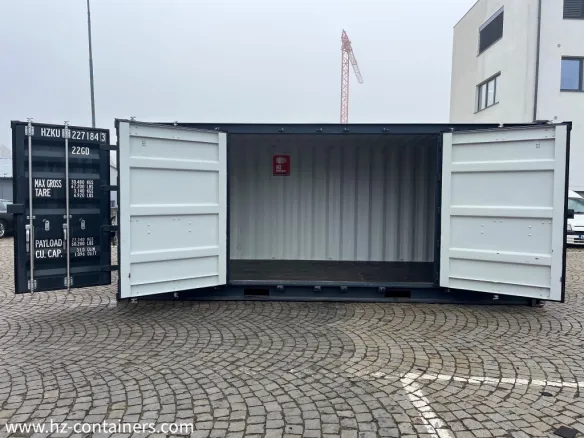
A 20ft Open Side container is a specialized variant of the standard ISO dry box container. The key difference is the construction: instead of two solid, corrugated side walls made of Corten steel, one of the longitudinal walls consists of four hinged folding door panels. When closed, these panels are secured with latches, and when opened, they fold down at an angle of 180–270 degrees, exposing the entire interior space from floor to ceiling along the 20-foot length.
Standard end doors remain in place on one short wall. This gives the container two independent loading modes:
- End-door loading — common access by forklift or manually through the rear double doors, useful when the container is placed against a wall or in tight configurations.
- Full side access — the entire longitudinal wall opens, allowing forklifts to enter at any point, multiple workers to load or unload simultaneously, and long or wide materials (steel beams, lumber, bundles of pipes) to be placed without tilting or maneuvering.

Alternative names and industry terminology
The container industry uses several overlapping terms for this configuration, which can cause confusion when purchasing. The following table clarifies the differences:
| Term | Meaning | Notes |
|---|---|---|
| Open side container | Full side opening using folding doors | Most precise and most commonly used industry term |
| Full side access container (FSA) | Emphasizes complete side opening | Common in supplier catalogs and specification sheets |
| Side opening container | Generic term for any side access | May refer to partial or full side opening |
| Container with side doors | One or more door panels on the side wall | Does not have to be full length; often a single 5–10 ft panel |
| OS container | Abbreviation in freight documents | “OS” = Open Side |
| Folding door container | Describes the door mechanism | Technically accurate but rarely used as a primary search term |
Key difference: a true open side container opens along the entire length of one side wall — approximately 19 feet 4 inches of clear access. A container with side doors may have only a single door panel measuring 5, 10, or 15 feet. When inquiring, specify “full side access” or “full-length folding side doors” to avoid receiving a container with only partial side opening.
How does the folding side door mechanism work?
The side door system of a 20ft open side container is substantially more complex than standard end doors. Unlike the rear doors — which are two independent leaves spanning an 8-foot opening — the side doors must span 20 feet while remaining operable by one person, maintaining watertightness, and withstanding the same stresses of the marine environment as the rest of the container.
Door assembly and opening procedure
Each open side door assembly consists of four folding leaves — two hinged together on the left side, two hinged together on the right side. A pair of leaves is mounted to the top and bottom side rails using durable continuous stainless steel hinges. When closed, vertical locking rods with cam mechanisms engage at multiple points along the top rail and floor rail, compressing EPDM rubber seals at each joint, creating a watertight and windproof closure.
Opening the doors follows a specific, sequential procedure:
- Release the locking rods on each leaf sequentially — typically starting from one end and working toward the center.
- Swing each pair of leaves outward — the outer leaf carries the inner leaf with it.
- Fold the inner leaf back against the outer leaf — this is the folding action that reduces the projection by half.
- Secure both folded pairs of leaves flat against the outer walls of the container using retaining straps or magnetic latches.
When fully folded, the door panels project only 6–12 inches from the outer side of the container, depending on the manufacturer’s hinge geometry. This compact folded profile is critical — it allows containers to be placed side by side in storage yards without the doors blocking neighboring units.
Door panel materials and weather sealing
The door panels themselves are made of the same Corten steel (weathering steel) used for standard container walls. Corten steel forms a protective rust-like patina that resists further corrosion, making it ideal for marine and outdoor environments. Each panel is reinforced with tubular steel bracing to prevent warping.
Weather sealing is achieved using:
- EPDM rubber seals lining each edge and door joint, compressed when the locking rods are activated.
- Drainage channels in the bottom rail that channel water away from the seal line.
- Overlapping sealing lips between adjacent door leaves that prevent wind-driven rain from penetrating.
When properly closed and locked, a new or well-maintained open side container is wind- and watertight (WWT), meeting the same weather resistance standard ISO 1496-1 as a standard dry container.
Door configuration types
Not all open side containers use a four-leaf folding design. The following table compares the two main configurations:
| Configuration | Description | Best for | Typical availability |
|---|---|---|---|
| Four-leaf folding | Two pairs of hinged leaves; fold at 180–270° against the outer side | Forklift access, tight yards, most common configuration | Widely available; industry standard |
| Roller shutter | One continuous steel roller shutter on a spring spindle, rolls up vertically | Applications with extremely limited side space | Rare; mostly custom modifications |
The four-leaf folding design dominates the market because it is simpler to manufacture, easier to repair, and does not rely on spring tension that can fail over time. Roller shutter variants exist, but are typically custom modifications, not factory standard open side containers.
What are the dimensions and specifications of a 20ft Open Side container?
Knowing the exact dimensions of a 20ft Open Side container is essential for planning loading operations, arranging the construction site, and transport logistics. The dimensions below represent the ISO standard for a 20 ft × 8 ft × 8 ft 6 in container with full side access.
External and internal dimensions
| Specification | Standard 20ft Open Side | 20ft High Cube Open Side |
|---|---|---|
| External length | 20 ft (6.06 m / 240 in) | 20 ft (6.06 m / 240 in) |
| External width | 8 ft (2.44 m / 96 in) | 8 ft (2.44 m / 96 in) |
| External height | 8 ft 6 in (2.59 m / 102 in) | 9 ft 6 in (2.89 m / 114 in) |
| Internal length | 19 ft 4 in (5.89 m / 232 in) | 19 ft 4 in (5.89 m / 232 in) |
| Internal width | 7 ft 8 in (2.29–2.33 m / 90–92 in) | 7 ft 6–8 in (2.29–2.33 m) |
| Internal height | 7 ft 10 in (2.39–2.40 m / 94 in) | 8 ft 6–10 in (2.60–2.69 m) |
| Side door opening width | ~19 ft 0 in (5.79 m) | ~19 ft 0 in (5.79 m) |
| Side door opening height | ~7 ft 6 in (2.28 m) | ~8 ft 6 in (2.59 m) |
| End door opening (W × H) | 7 ft 8 in × 7 ft 6 in (2.34 m × 2.28 m) | 7 ft 8 in × 8 ft 6 in (2.34 m × 2.59 m) |
| Internal volume | ~1,098 ft³ (31.1 m³) | ~1,250 ft³ (35.4 m³) |
| Floor area | ~150 ft² (13.9 m²) | ~150 ft² (13.9 m²) |
Important: The internal width of an open side container is typically 1–3 inches narrower than a standard 20ft container (7 ft 8 in vs. 7 ft 8–9 in). This is because the reinforced frame needed to support the side door opening consumes slightly more wall thickness on the door side.
Weight specifications
| Specification | Standard 20ft Open Side | 20ft High Cube Open Side |
|---|---|---|
| Tare weight (empty) | ~6,996–7,500 lb (3,173–3,402 kg) | ~7,500–8,200 lb (3,402–3,720 kg) |
| Maximum payload | ~52,000–60,000 lb (23,587–27,216 kg) | ~55,000–62,000 lb (24,948–28,123 kg) |
| Maximum gross weight | ~67,200 lb (30,480 kg) | ~67,200–70,000 lb (30,480–31,751 kg) |
An open side container is typically 1,500–2,500 lb heavier (tare weight) than an equivalent standard container due to reinforced corner posts, heavier top and bottom side rails, added cross members, and the weight of the folding door assembly. This reduces the available payload by the same amount.
Forklift access and clearance
The full side opening provides approximately 19 feet of unrestricted access width along the entire length. This means a forklift can drive into the container perpendicularly at any point, pick up or place a pallet, and drive out without having to maneuver inside the container. The side door opening height of approximately 7 ft 6 in (standard) or 8 ft 6 in (high cube) is a critical dimension for forklift mast clearance — the mast must be lowered below this height before entering.
How does an open side container differ from a standard shipping container?
The differences between an open side container and a standard dry container are not cosmetic — they are structural, functional, and financial. Understanding these differences prevents costly purchasing mistakes.
Structural engineering differences
A standard shipping container derives its strength from a monocoque steel construction: corrugated side walls, roof, and floor are all welded to the corner posts and frame and function as a single load-bearing unit. The corrugated side walls significantly contribute to torsional rigidity — the ability to resist twisting and lateral forces during crane lifting, ship motion, and stacking.
When one entire side wall is removed and replaced by hinged door panels, the container loses a substantial part of its inherent stiffness. To compensate, manufacturers must:
- Reinforce the corner posts with thicker steel profiles (typically 6 mm vs. 4 mm for standard containers).
- Upgrade the top and bottom side rails with deeper, heavier steel.
- Add additional cross members in the floor frame to distribute the forces that the side wall would normally carry.
- Integrate door hinges and locking rods into the structural load-bearing path, meaning the doors themselves become load-bearing elements when closed and locked.
This is why an open side container costs more, weighs more, and has a lower stacking rating than a standard container.
Side-by-side comparison
| Specification | Standard 20ft container | 20ft open side container | 20ft double-door container | 20ft flat rack container |
|---|---|---|---|---|
| Access points | One end (double doors) | One end + full side (folding) | Both ends (double doors) | All sides (fold-down ends) |
| Tare weight (approx.) | 4,980 lb (2,259 kg) | 7,000 lb (3,175 kg) | 5,200 lb (2,358 kg) | 5,500–6,500 lb |
| Typical stacking capacity | 192,000 kg (9 high) | 96,000–120,000 kg (4–5 high) | ~170,000 kg (7–8 high) | Limited (varies) |
| Internal width | 7 ft 8 in (2.34 m) | 7 ft 7–8 in (2.29–2.33 m) | 7 ft 8 in (2.34 m) | Open sides |
| Price premium over standard | Base | 2×–3× | 1.2×–1.5× | 1.5×–2× |
| Best for | General cargo, basic storage | Palletized cargo, long materials, retail conversions | Drive-through loading, high-turnover inventory | Oversized machinery, structural steel |
| CSC certification | Standard | Yes (with valid inspection) | Yes (with valid inspection) | Yes |
Torsional rigidity and stacking capacity
The stacking capacity of an open side container is almost always lower than a standard container. While a standard 20ft container can typically support up to 192,000 kg (423,000 lb) of stacked weight above it — equivalent to nine fully loaded containers — an open side container is typically rated for 96,000 to 120,000 kg (211,000 to 264,000 lb), or about 4 to 5 fully loaded containers.
This reduced stacking capacity has practical implications:
- On container ships, open side containers are typically placed in the upper tiers of the stack, not at the bottom.
- In storage yards, stacking higher than three tiers requires verification of the load per the specific CSC plate of the given unit.
- For on-site storage where containers are placed side by side (unstacked), the stacking limitation is irrelevant.
Always check the CSC plate — the official safety certification plate attached to every ISO container. The permissible stacking weight for a specific unit is stamped on this plate. Never assume a container’s stacking capacity based solely on its type.
Where did the open side container design come from?
The open side container did not emerge from a single invention, but evolved gradually as the logistics industry struggled with a recurring problem: standard containers, designed only for end loading, created bottlenecks whenever side access to cargo was needed.
Origins in industrial logistics
The standard ISO shipping container — standardized in the late 1960s following Malcolm McLean’s pioneering intermodal freight experiments — was optimized for one thing: transporting homogeneous cargo as efficiently as possible from port to port. The single-end-door design minimized manufacturing complexity and maximized structural integrity. For decades that was enough — cargo arrived in boxes, boxes went on pallets, pallets went into containers through the rear doors, and that was the system.
But in the 1980s and 1990s, logistics operators began reporting the same problems repeatedly:
- Long materials (steel beams, pipes, lumber exceeding 20 ft) could only be loaded through end doors at shallow angles, wasting internal volume.
- Palletized cargo stored deep inside required “cascade” unloading — removing everything in front to reach items at the back.
- Forklift limitations — a forklift cannot turn inside a container that is only 7 ft 8 in wide, making deep loading dangerous and slow.
The side access innovation
The solution — replacing one side wall with doors — seems obvious in hindsight, but the engineering challenge was significant. Early side-access containers appeared in specialized industrial fleets in Europe and Asia in the late 1980s, primarily for transporting steel and timber. These early units were often custom modifications, not factory-standard products.
In the early 2000s, major container manufacturers — especially in China, which became the world’s dominant hub for container production — began offering open side containers as standard catalog items with full ISO and CSC certification. The four-leaf folding design established itself as the industry standard because it better balanced operability, sealing, and manufacturing cost than alternatives like roller shutters or sliding panels.
CSC certification and open side containers
The Container Safety Convention (CSC) — adopted by the International Maritime Organization in 1972 — requires that every container used in international transport carry a valid CSC safety approval plate. Open side containers can and do carry CSC certification, provided they pass the same rigorous testing regime as standard containers:
- Stacking test — the container must support the specified stacking weight without permanent deformation.
- Racking test — the container must withstand a transverse (side) force of at least 150 kN (kilonewtons).
- Floor strength test — the floor must withstand a forklift axle load of 5,460 kg (12,030 lb) per wheel.
Because the open side frame cannot achieve the racking resistance of a fully welded wall, manufacturers compensate with the reinforced frame described above. A CSC-certified open side container is fully approved for international transport — but always verify the CSC plate expiration date, because plates expire and require periodic re-inspection.
What can you use a 20ft Open Side container for?
The combination of the compact 20ft open side container footprint (20 ft, easily deliverable to most locations) and full side accessibility makes it suitable for a remarkably wide range of applications across industrial, commercial, and creative uses.
Industrial and logistics applications
Palletized cargo handling is the primary use case. A forklift can approach the container from the side, place a pallet anywhere along the 19-foot interior, and exit without having to turn inside the container. This eliminates double handling, reduces loading time by an estimated 40–60% compared to end-door-only loading, and dramatically reduces the risk of cargo or container wall damage from forklift contact.
Long material storage — steel pipes, copper tubes, lumber, rebar, and structural beams — benefits from being able to slide materials in from the side, rather than forcing them through end doors at awkward angles. A 20ft open side container can store materials nearly along its entire internal length without the “last few feet” problem that plagues end-loaded containers.
Construction and site applications
On construction sites, the 20ft open side container serves as a secure equipment and material storage unit that can be quickly accessed during the workday. Unlike a standard container, where tools at the back require a morning ritual of clearing out the front section, the open side design lets workers reach any item immediately. Common site applications include:
- Tool and PPE storage with shelving installed along the solid wall
- Small equipment storage (generators, compressors, pumps)
- Material staging for phased construction work
- Temporary site office with the open side serving as a service counter
Retail and commercial conversions
The open side container has become a popular platform for temporary retail spaces, food service, and event venues. With the side fully open, the container transforms into a covered stand, kiosk, or stage. Common modifications include:
- Installing a service counter along the open side
- Adding lighting, shelving, and branding elements
- Equipping with electricity, water, and POS systems
- Using the closed end as a back-of-house area
Summary table of use cases
| Application category | Specific use | Why open side is better than standard |
|---|---|---|
| Logistics | Palletized goods storage | Forklift access at any point; no cascading |
| Logistics | Long material storage (pipes, lumber) | Sliding materials in from the side |
| Construction | Tool and equipment storage on site | Immediate access to any item; no unloading to reach the back |
| Construction | Temporary site office or welfare unit | Open side can serve as a counter or entry point |
| Retail | Pop-up shop or market stand | Full side opens into an inviting display |
| Food service | Food stand or bar | Open side = service counter; interior = kitchen/prep |
| Agriculture | Feed, equipment, and tool storage | Easy access for daily operations; pest-resistant steel |
| Events | Stage, ticket booth, or merchandise stand | Quick setup; secure locking after hours |
| Disaster relief | Supply distribution point | Full side access for rapid loading/unloading of humanitarian goods |
| Automotive | Motorcycle or small vehicle storage with side ramp | Securing or driving in from the side |
How much does a 20ft Open Side container cost?
The price of a 20ft open side container reflects the additional engineering, materials, and lower production volumes compared to standard containers. Expect a significant premium.
Price ranges by condition
| Condition | Typical price range (USD) | Notes |
|---|---|---|
| New / One trip | $6,500 – $9,500 | One freight trip from the factory; near-perfect condition; expected lifespan 20–25 years |
| Used (Cargo-Worthy) | $4,500 – $7,000 | 5–10 years of service; surface wear, but structurally sound; valid CSC |
| Used (Wind and Watertight) | $3,500 – $5,500 | Older unit; may have cosmetic defects; seals intact; typically storage grade only |
| Rental (monthly) | $200 – $400 / month | Varies by location; transport fees separate |
Why the premium over standard containers?
A new 20ft open side container costs approximately 2 to 3 times more than a standard 20ft container (which typically sells for $2,700–$3,500 new). The premium is caused by:
- Reinforced frame materials — heavier corner posts and rails increase raw material costs.
- Manufacturing the folding doors — four door leaves with hinges, locking rods, and seals represent significantly more manufacturing work than a solid corrugated wall panel.
- Lower production volumes — open side containers represent a small fraction of total container production, so unit costs are higher.
- Specialized quality control — additional sealing and structural testing is required for each unit.
Rental vs. purchase analysis
| Factor | Purchase | Rental |
|---|---|---|
| Initial cost | $4,500–$9,500 | $200–$400/month |
| Best for | Long-term needs (2+ years), permanent installations | Short-term projects, seasonal use, concept testing |
| Customization | Full freedom to modify | Limited; must be returned in original condition |
| Residual value | Retains 60–80% after 5 years (special container) | None (returned) |
| Maintenance | Owner’s responsibility | Typically included |
For projects lasting longer than 18–24 months, purchasing is generally more economical. For seasonal pop-up shops, short construction phases, or one-off events, rental provides flexibility without capital commitment.
Factors affecting price
- Location — delivery distance from the nearest depot significantly affects the total cost with delivery.
- High cube vs. standard height — high cube adds $500–$1,500.
- Modifications — shelving, insulation, electrical installation, lock boxes, and custom paint all add cost.
- Market conditions — container prices fluctuate with global trade volumes and steel prices.
What are the limitations and common misconceptions about open side containers?
The open side container is a powerful tool — but it is not a standard container with a bonus feature. Buyers who do not understand its limitations often face costly surprises.
Stacking capacity is significantly reduced
As detailed above, an open side container typically supports half the stacking weight of a standard container (96,000–120,000 kg vs. 192,000 kg). This means:
- Do not place an open side container at the bottom of a tall stack. It should occupy upper positions.
- Verify the CSC plate before stacking any open side container — never assume capacity.
- For single-story on-site storage, the stacking limitations are irrelevant.
Side clearance is a non-negotiable requirement
An open side container requires usable clearance on the door side — not only so the door panels can open (which requires approximately 3–4 feet), but so forklifts can approach, workers can walk through, and cargo can move in and out. Placing the open side against a wall, fence, or other container negates the entire value proposition.
Plan for at least 15–20 feet of clear working space on the door side for forklift operation. For manual loading, 8–10 feet may suffice.
Structural rigidity: A trade-off
Even with a reinforced frame, an open side container is less rigid than a standard container with respect to lateral forces. This has practical implications:
- The container should be placed on a level, stable surface. Uneven terrain creates torsional stress on the frame that a standard container’s welded walls would withstand, but the open side frame dependent on the doors may not handle as well.
- The doors must be fully closed and locked before lifting the container with a crane or reach stacker. Lifting with the doors open can cause frame deformation.
- Over time, door hinges and locking mechanisms may require more maintenance (lubrication, seal replacement) than the equivalent solid wall component on a standard container.
Common misconceptions
“It’s just a standard container with a door cut into the side.”
False. A factory-built open side container has a fundamentally different frame, heavier structural members, and integrated load-bearing door assemblies. Cutting a door into a standard container after the fact — without frame reinforcement — compromises structural integrity and will almost certainly void CSC certification. Aftermarket side door modifications should only be performed by certified container modification facilities.
“An open side container cannot be CSC certified for international transport.”
False. Factory-built open side containers from reputable manufacturers carry full CSC certification. Certification reflects the tested capacity of the container, which accounts for structural differences. Always verify the CSC plate, but do not assume the side-opening design is automatically uncertifiable.
“Open side containers are only for special projects — not practical for everyday use.”
In many cases false. For any operation requiring forklift side loading, palletized storage, or frequent access to diverse goods, an open side container can reduce labor costs and loading times enough to justify the price premium within months.
How to choose between open side, open top, and double-door containers?
Different special container configurations solve different problems. The choice depends on what you are shipping, how you handle it, and where the container will be placed.
Decision matrix
| Your requirement | Best container type | Why |
|---|---|---|
| Loading pallets with a forklift from one side | Open side | Full-length side access; forklift enters perpendicularly |
| Loading from both ends (drive-through workflow) | Double door | Doors on both short ends; forklift enters one end, exits the other |
| Top loading by crane | Open top | Removable roof/tarp; crane lowers cargo down |
| Storing oversized machinery that won’t fit through doors | Flat rack | No side walls; fold-down end walls; loading from any direction |
| Mix of end loading and occasional side access | Side door container (not full open side) | Single side door panel for selective access; lower cost than full open side |
| Temporary retail or event space | Open side | Full side opening creates an inviting display |
| High-turnover inventory with frequent access to various SKUs | Open side | Access to any item anytime without rearranging |
| Standard transport of boxed/palletized cargo | Standard dry container | Lowest cost; sufficient for homogeneous end-loaded cargo |
When each type makes sense
Choose a standard container when cost is the main consideration, the cargo is uniform, and end-door loading is sufficient for your workflow. This covers most basic storage and one-way transport scenarios.
Choose an open side container when you need forklifts to load from the side, store long materials, run a retail or food service operation from the container, or manage inventory where frequent access to items anywhere in the container is required.
Choose a double-door container when you want the flexibility of loading from both ends — for example, on a busy construction site where only one end is accessible at a given moment, or for a drive-through material storage workflow where goods enter one door and exit the other.
Choose an open top container when your cargo is loaded by overhead crane (rotors, bulk materials, heavy machinery lowered from above) or when your cargo height exceeds the door opening height.
Choose a flat rack container when your cargo is truly oversized — structural steel beams, large-diameter pipes, heavy equipment that exceeds the container’s dimensions in several directions.
Frequently asked questions
What is a 20ft Open Side shipping container?
A 20ft Open Side shipping container is an ISO-standard steel container, 20 feet long, 8 feet wide, and 8 feet 6 inches high, in which one full-length side wall is replaced by folding doors that open to provide unrestricted side access along the entire length of the container. Standard end doors remain in place, giving it two access modes in one unit.
How does a 20ft Open Side container differ from a standard 20ft container?
The main difference is the full-length side door assembly replacing one solid side wall. This requires a reinforced frame (heavier corner posts, upgraded rails, additional cross members), results in a higher tare weight (approximately 7,000 lb vs. 4,980 lb), reduced stacking capacity, and a 2–3× price premium over a standard container. The internal width is also slightly narrower by 1–3 inches.
What are the exact dimensions of a 20ft Open Side container?
External dimensions: 20 ft (L) × 8 ft (W) × 8 ft 6 in (H). Internal dimensions: approximately 19 ft 4 in (L) × 7 ft 7–8 in (W) × 7 ft 10 in (H). Side door opening: approximately 19 ft wide × 7 ft 6 in high. High Cube variants add 1 foot of height. All dimensions may vary slightly by manufacturer.
How much weight can a 20ft Open Side container hold?
Maximum gross weight is typically 67,200 lb (30,480 kg). With a tare weight of approximately 7,000 lb, the maximum payload is approximately 60,000 lb (27,216 kg). Always verify with the specific unit’s CSC plate, as individual units may vary.
How much does a 20ft Open Side container cost?
New (one trip) units range from $6,500 to $9,500. Used cargo-worthy units range from $4,500 to $7,000. Rental typically ranges from $200 to $400 per month. Prices vary significantly by location, delivery distance, and current market conditions.
Can an open side container be stacked?
Yes, but with reduced capacity compared to standard containers. Open side containers typically support 96,000–120,000 kg of stacked weight (4–5 fully loaded containers), versus 192,000 kg for standard containers. Always verify the permissible stacking weight on the unit’s CSC plate before stacking.
Is an open side container CSC certified for international transport?
Yes, factory-built open side containers from reputable manufacturers carry full CSC (Container Safety Convention) certification and can be used for international freight transport, provided the CSC plate is valid and inspections are current. Aftermarket side door modifications may void CSC certification.
What are the most common uses of a 20ft Open Side container?
Common uses include palletized cargo storage with forklift access, tool and equipment storage on construction sites, long material storage (pipes, lumber, steel), pop-up shops and food stands, event spaces, agricultural storage, and humanitarian aid distribution points.
How do you open the side doors of an open side container?
Release the vertical locking rods on each folding door leaf sequentially, swing each pair of leaves outward, fold the inner leaf back against the outer leaf (folding action), and secure both folded pairs of leaves against the outer side of the container using retaining straps or latches. The doors fold down at an angle of 180–270 degrees, projecting only 6–12 inches from the container surface.
What is the difference between a side door container and a full open side?
A side door container has one or more door panels cut into the side wall — typically a single 5–10 ft panel — providing partial side access. A full open side container opens along the entire length of one side (approximately 19 ft), providing complete unrestricted access. When ordering, specify “full side access” if you need the entire side to open.

 Italy, Genova
 WITHOUT SHIPPING


Other container news...

Obligation to Check Tightness When Selling a Reefer Container
Who is responsible for the refrigerant leak check when selling a refrigerated container? Find out what obligations the seller has at the time of handover and why they must provide a PTI report along with the technical data plate. Learn which regulatory requirements and F-gas record-keeping duties become the sole responsibility of the new owner.

New shipping containers
If you are currently considering purchasing a new shipping container, you are not alone. While just twenty years ago containers were used almost exclusively for maritime transport, today they have found their way into construction, storage, business, and even housing. This growing popularity brings with it a host of questions: Which type should you choose? How much does it cost? How do you recognize quality? How can you avoid falling victim to scammers?
New sea shipping containers
If you are currently considering purchasing a new shipping container, you are not alone. While just twenty years ago containers were used almost exclusively for maritime transport, today they have found their way into construction, storage, business, and even housing. This growing popularity brings with it a host of questions: Which type should you choose? How much does it cost? How do you recognize quality? How can you avoid falling victim to scammers?

6m shipping container
Are you thinking about buying a 6-meter shipping container but aren’t sure what to look for? You are not alone—this 20-foot container is the best-selling size on the Czech market, and the differences between various types, conditions, and prices can be significant. In this guide, you will find everything you need to know: from exact dimensions and a comparison of categories (such as “one-way,” refurbished, and “Cargo Worthy”) to current prices and shipping advice.