
Shipping Container iC 33
Certified shipping container iC 33 is a highly standardized transport unit that meets international standards for transporting goods across all types of transport (maritime, rail, road). The specific code “iC 33” means that:
- iC: The container is approved for rail transport within the InterContainer system, which is a marking system approved by the International Union of Railways (UIC).
- 33: Designates the national railway authority that performed the certification, in this case the Hungarian State Railways (MÁV).
This container therefore complies not only with ISO standards and the CSC safety convention, but also with specific requirements and markings for safe movement across the European railway network.
Basic Concepts and Certification Systems
For international and intermodal transport, the container must undergo several levels of certification. These systems ensure global interoperability, safety, and traceability.
ISO 6346 Standard: Container Identification and Marking
ISO 6346 is an international standard that precisely establishes the method of coding, identification, and marking of transport containers. It enables their unambiguous identification in global logistics.
Main marking elements according to ISO 6346:
| Element | Meaning and Description |
|---|---|
| Owner Code | 3 letters, unique for each owner, registered with BIC |
| Equipment Category | 1 letter (most commonly “U” for standard freight containers) |
| Serial Number | 6 digits, unique within the owner |
| Check Digit | 1 digit, calculated by a special algorithm to verify the correctness of the entire number |
| ISO Code | 4 characters: first two determine size (length, height), next two determine container type (e.g., G1 = general purpose) |
Example identification number:
HZKU 305438 3- HZK = owner code
- U = category (freight container)
- 305438 = serial number
- 3 = check digit
Meaning of the check digit:
- Serves to eliminate errors when entering data into logistics systems.
- The algorithm is precisely defined in ISO 6346 standard.
CSC Plate (Container Safety Convention)
Every internationally transported container must be equipped with a CSC plate according to the Convention for Safe Containers (CSC) from 1972.
Main rules for CSC plate:
- Located on the left door of the container, permanently and irreversibly.
- Minimum size 200 × 100 mm, non-flammable and non-corrosive material.
- Main inscription: “CSC SAFETY APPROVAL” (minimum font height 8 mm), other data minimum 5 mm.
Mandatory data on CSC plate:
| Data | Meaning and Description |
|---|---|
| Country of Approval and Reference Number | National authority and approval number |
| Date of Manufacture | Month and year |
| Manufacturer Identification Number | Or operational number assigned by BIC |
| Maximum Gross Weight (kg/lbs) | Total permitted weight including cargo |
| Maximum Useful Load (Payload) | Maximum cargo weight |
| Date of Next Inspection | Mandatory for Periodic Examination Scheme (PES) |
| Inspection Scheme (ACEP/PES) | If the container is in ACEP mode, the scheme number is listed |
| Test Load for Stacking | Indicates maximum permitted load when stacking containers |
| Test Load for Racking | Indicates resistance for storage in racks |
Inspection Modes:
- PES (Periodic Examination Scheme): First inspection within 5 years of manufacture, then every maximum 30 months.
- ACEP (Approved Continuous Examination Programme): Inspection at each repair, ACEP scheme number is listed on the plate.
UIC Certification and “iC 33” Marking
For movement on the European railway network, the freight container must meet the requirements of UIC (International Union of Railways), particularly the UIC Leaflet 592 standard.
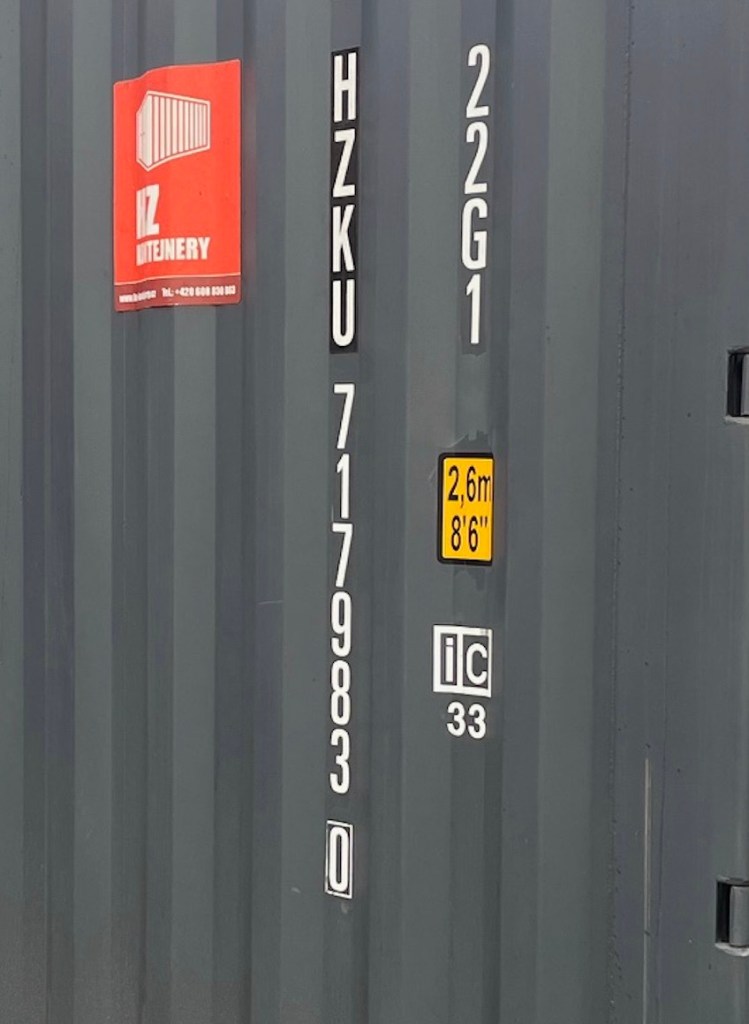
What the “iC” marking means:
- iC = “InterContainer”, indicates that the container is approved for rail transport according to UIC.
- The number after “iC” (e.g., 33) designates the specific national railway certification authority.
- A container marked this way can freely travel across the European railway network without additional formalities.
Certification Process:
- The container must be approved by a national authority (e.g., MÁV for Hungary) according to UIC 592.
- It must meet requirements for dimensions, handling points, strength, and safety standards for rail transport.
Marking in Practice:
- The “iC 33” marking is located on a typical yellow or white plate on the side of the container.
- There are other marking classes (it, ic, etc.) depending on the type of approval and dimensions.
Difference between ISO and UIC Marking:
- ISO marking (container number, ISO code) is mandatory for all containers.
- UIC marking (iC + number) is necessary for rail transport in Europe.
Technical Parameters and Container Types
Standard Dimensions of Shipping Containers
| Container Type | External Dimensions (L/W/H mm) | Internal Dimensions (L/W/H mm) | Volume (m³) | Empty Weight (kg) | Certification |
|---|---|---|---|---|---|
| 20′ Standard | 6 058 × 2 438 × 2 591 | 5 898 × 2 350 × 2 390 | 33 | 2 245 | ISO, CSC |
| 20′ High Cube | 6 058 × 2 438 × 2 896 | 5 898 × 2 344 × 2 695 | 37 | 2 320 | ISO, CSC |
| 40′ Standard | 12 192 × 2 438 × 2 591 | 12 032 × 2 344 × 2 390 | 67 | 3 790 | ISO, CSC |
| 40′ High Cube | 12 192 × 2 438 × 2 896 | 12 032 × 2 344 × 2 695 | 76 | 3 950 | ISO, CSC |
High Cube containers are 1 foot higher (2 896 mm) than standard ones, thus providing approximately 10–15%25 greater volume.
Material and Construction
- COR-TEN Steel: High resistance to corrosion, long lifespan, recyclability. Due to weather influences, a protective patina is formed.
- Floor: Mostly made of hardwood (e.g., tropical wood), thick 28–30 mm, often with certified pest protection (ISPM 15).
- Handling Points: Corner castings for safe lifting by cranes, forklifts, and for stacking.
Other Mandatory Markings and Data
- Weight Limits: Listed in kg/lbs on labels and on the container body.
- Volume Capacity: Stated in m³ and cu ft.
- Warning Signs: For high cube, hazardous cargo, electrical power (for refrigerated containers).
- Data Labels: Modern containers often contain QR codes or RFID tags for digital management.
Importance of Certification in Global Logistics
Certification is not merely a “stamp”, but a fundamental prerequisite for:
- Safety: Guarantees that the container can withstand extreme forces (stacking 8–9 layers, ocean waves, railway vibrations).
- Interoperability: Enables handling of containers worldwide without the need to transfer cargo.
- Traceability: Unique number allows tracking the container in real time across continents.
- Efficiency: Minimizes delays in ports and terminals, supports rapid information exchange between operators.
Frequently Asked Questions (FAQ)
Does “iC 33” mean that the container was manufactured in Hungary?
- No, it only means that the certification for rail was performed by the Hungarian authority (MÁV). Manufacturing is most often in China.
Can a container without “iC” be transported on European railways?
- No, without this marking it would be rejected or would require special permission.
What is the difference between a standard and high cube container?
- High cube is 1 foot higher, has greater volume (e.g., 40′ HC has 76 m³ compared to 67 m³ for 40′ standard).
Where can I find all key data?
- On the right door of the container (identification number, ISO code, weights, CSC plate).
How to verify the correctness of a container number?
- Using the check digit; online calculators are available (e.g., on BIC websites).