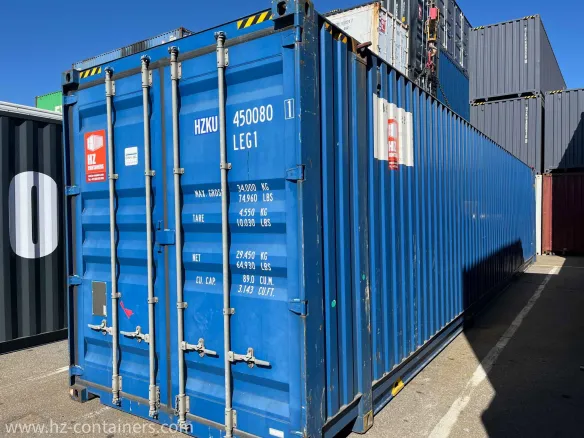
PW – Pallet Wide Shipping Container
Shipping Container PW (Pallet Wide) is a specially designed intermodal container whose main advantage is an optimized internal width for transporting euro pallets (EUR pallets). While a standard container (Dry Van, DV) is not dimensioned to accommodate two euro pallets side by side in their longer dimension, Pallet Wide containers have an internal width of approximately 2.44–2.45 m (compared to 2.35 m for the standard). This modification allows loading two pallets measuring 1200 × 800 mm side by side without unused space.
Pallet Wide containers thus significantly increase transport efficiency, particularly in the European logistics chain, where euro pallets are the standard. However, they maintain external dimensions according to ISO (e.g., width 2.438 m), which is key for compatibility with maritime, rail, and road transport. This type of container is a response to the requirement for maximum space utilization and minimization of transport costs within the transport of palletized goods.
Key Features and Differences Compared to Standard Containers
Overview of Main Differences
| Property | Standard Container | Pallet Wide Container |
|---|---|---|
| Internal Width | approx. 2.35 m | approx. 2.44–2.45 m |
| External Width | 2.438 m | 2.438–2.462 m (depending on manufacturer) |
| Utilization for EUR Pallets | maximum 1 side by side | 2 side by side |
| Volume | lower (loss in width) | higher |
| Transport Compatibility | global | primarily Europe, but also global routes |
| Availability | high | lower, mostly Europe |
| Price | lower | higher (approx. +10–15%25) |
Brief Characteristics
- Construction: Steel frame construction (Corten steel), robust wooden or plywood flooring, standard ISO corners for stacking and handling.
- Tightness: Waterproof and dustproof design, resistant to weather and corrosion.
- Handling: Compatible with standard handling equipment, cranes, forklifts.
Detailed Dimensions and Specifications (Pallet Wide Container Dimensions)
Overview of Typical Dimensions
| Container Type | External Dimensions (L × W × H) | Internal Dimensions (L × W × H) | Volume | Tare | Max. Payload | Palletization (EUR) |
|---|---|---|---|---|---|---|
| 20′ PW | 6.058 × 2.438 × 2.591 m | 5.898 × 2.440 × 2.390 m | ~34.3 m³ | ~2,400 kg | ~28,080 kg | 14–15 pallets |
| 40′ PW | 12.192 × 2.438 × 2.591 m | 12.032 × 2.440 × 2.390 m | ~70.2 m³ | ~3,800 kg | ~26,680 kg | 30 pallets |
| 40′ HC PW | 12.192 × 2.438 × 2.896 m | 12.032 × 2.440 × 2.695 m | ~79.0 m³ | ~3,920 kg | ~28,580 kg | 30 pallets (higher volume) |
| 45′ HC PW | 13.716 × 2.438 × 2.896 m | 13.556 × 2.440 × 2.695 m | ~89.2 m³ | ~4,800 kg | ~29,200 kg | 33 pallets |
Notes:
- Height: Standard 8’6″ (2.591 m) or High Cube 9’6″ (2.896 m).
- Variability: Some models have an external width up to 2.462 m, depending on the manufacturer and intended use.
Capacity and Efficiency: How Many Euro Pallets Fit in a Container?
Comparison Table
| Container Type | Number of EUR Pallets (1200×800 mm) | Difference vs. Standard |
|---|---|---|
| 20′ Standard | 11 | – |
| 20′ Pallet Wide | 14–15 | +3 to 4 |
| 40′ Standard | 24–25 | – |
| 40’/40′ HC Pallet Wide | 30 | +5 to 6 |
| 45′ HC Standard | 27 | – |
| 45′ HC Pallet Wide | 33 | +6 |
Thanks to this optimization, with larger volumes, the number of containers needed to transport the same amount of goods can be reduced. Efficiency increases by up to 25%25.
Main Advantages of Pallet Wide Containers
1. Maximum utilization of cargo space
- Two euro pallets side by side without unused gaps.
- Every m³ efficiently utilized, reduces the number of transported units.
2. Reduction of logistics costs
- Lower costs for transport, storage, handling, and terminal fees.
- Savings of up to 15%25 on distribution costs with regular use.
3. More efficient and faster handling

- Easy loading/unloading, without the need for complex alternating pallet stacking.
- Lower risk of damage to goods and containers.
4. Higher cargo security
- Tight placement of pallets minimizes movement during transport.
- Lower need for securing materials (dunnage).
5. Ideal for intermodal transport
- 45′ PW HC can fully replace a road trailer (swap body).
- Seamless transshipment between road, rail, and sea without repalletization.
6. Reduction of packaging costs
- Cargo stability allows some companies to reduce the amount of secondary packaging.
Disadvantages and Limitations
- Higher acquisition price and rental: Compared to standard containers, costs are higher, approximately 10–15%25.
- Limited availability outside Europe: Overseas (Asia, America), the supply is limited, which can complicate global logistics.
- Specific use: The advantage is only realized when transporting EUR pallets. For bulk goods, atypical dimensions, or other types of pallets (e.g., US GMA 1219×1016 mm), the added value is lost.
Typical Uses and Industrial Sectors
Suitable sectors:
- Automotive industry (parts, components on pallets)
- FMCG (food, drugstore goods, beverages)
- Chemistry (drums, IBC containers on pallets)
- Pharmaceuticals (medicines, medical materials)
- Retail (supply of distribution centers)
- Construction (tiles, bagged mixtures)
Further Uses
- Storage: Mobile warehouses on construction sites, temporary storage spaces.
- Building units: Conversions into offices, facilities, residential containers such as shipping container homes and container houses thanks to greater width.
- Special projects: Container pools, public restrooms, restaurants.
How to Obtain a Pallet Wide Container: Sales, Rental, Platforms
Methods of Acquisition
1. Direct purchase (new/used)
- Suitable for companies with high transport volumes that want to own their own fleet.
- Prices depend on condition, location, current demand.
2. Rental (leasing)
- For seasonal/short-term needs, operational leasing is more advantageous.
- Can be arranged for weeks or months, often with the option to purchase.
3. Online marketplaces and specialized sellers
- Some portals allow comparison of prices and availability from hundreds of suppliers worldwide.
- Specialized sellers in the Czech Republic (e.g., hz-containers.com) offer PW containers in stock with free delivery.
Practical Tips When Selecting
- Verify container certification (CSC validity, ISO 668).
- Check the condition of the floor, door tightness, presence of any corrosion.
- Consider whether you need standard height or High Cube.
Innovation and Trends in PW Containers
- New Materials: Manufacturers are experimenting with lighter alloys to reduce tare weight (lower tare = higher payload).
- Digitalization: Real-time tracking of container location and condition (IoT, RFID).
- Ecology: Better insulation and possibility of recycling at the end of the lifecycle.
- Construction Use: PW containers are in demand for modular construction due to greater internal space width.
Legislative and Regulatory Aspects
- ISO 668: Defines standardized dimensions and corner fittings for international transport.
- CSC Certification: Every container must have a valid “Container Safety Convention” label for maritime transport.
- European Standards: Adaptation to European logistics requirements (EUR pallet).
Tips for Customers and Logistics Planning
- When planning transport, consider whether you are transporting exclusively goods on EUR pallets – in such a case, PW containers are the most efficient choice.
- Consult with carriers about the availability of PW containers on specific routes, especially for export outside Europe.
- Consider long-term partnerships with specialized rental companies/sellers for the possibility of individual conditions.
Shipping Container PW – Pallet Wide is a cutting-edge tool for 21st-century logistics focused on palletized goods, particularly in the European environment. Its key feature is the ability to efficiently store two EUR pallets side by side, which brings savings, accelerates handling, and increases cargo security. Although their availability is still lower and the acquisition price higher, with regular use, the investment pays back very quickly.
If your company regularly transports palletized goods within Europe or exports to/from Europe, definitely consider including PW containers in your logistics mix.

 Gemlik, Turkey
  WITHOUT SHIPPING