
MULTI TRIP – shipping container
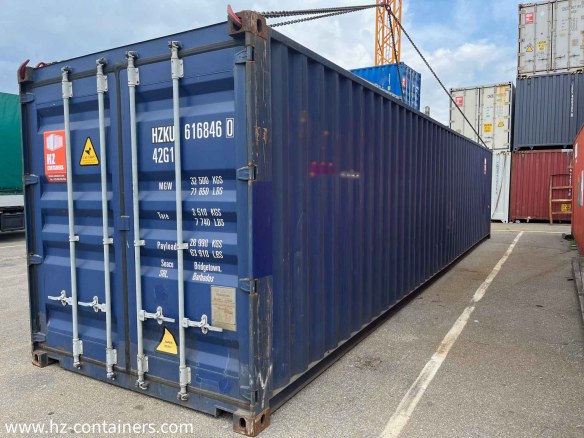
MULTI TRIP – shipping container (also often referred to as used shipping container) is a standardized intermodal transport unit that has been used for more than one maritime or land journey after its manufacture. Unlike a “One-Trip” container (only one journey), which is sold almost new after a single trip from the factory, a Multi‑Trip container typically has 8–15 years of intensive operation in maritime, rail and road logistics.
Main advantages of Multi‑Trip containers:
- Significantly lower purchase price (compared to new units)
- Robust construction and long service life thanks to the use of COR‑TEN steel
- Ecological sustainability – extension of the product’s service life
- Universal use: storage, construction, transport, modifications (offices, shipping container houses, etc.)

Detailed Explanation
Shipping Container Lifecycle
- Manufacture:
- Most often takes place in Asia (China, Korea)
- Material: highly durable COR‑TEN steel (see below)
- Each container is produced according to strict ISO standards and must obtain CSC certification (see Standards and Certification section)
- First journey – “One‑Trip”:
- The container is filled with goods and shipped to the target market (Europe, USA, …)
- After unloading it is sold as almost new
- Multi‑Trip phase:
- Containers that remain in service undertake multiple journeys
- Routinely loaded/unloaded, stacked (up to 9 high), exposed to extreme conditions (salty air, rain, frost, UV radiation)
- Normal wear occurs (dents, scratches, surface rust), but structural integrity is usually retained
- After 8–15 years they are decommissioned from the fleet and sold on the secondary market
- Second life – secondary use:
- Storage, construction modules, garages, technological conversions (e.g., living modules)
- A well‑maintained Multi‑Trip container can serve another 10–20 years
Standards and Certification
International standards (ISO)
Shipping containers are subject to an international standardisation system that ensures interchangeability and safety in global transport. Most important standards:
- ISO 668 – basic dimensions and container types
- ISO 830 – terminology
- ISO 1161 – corner castings, essential for stacking and handling
- ISO 1496‑1 – technical requirements and tests
- ISO 6346 – marking and identification
CSC certification (Convention for Safe Containers)
Every container used in international transport must have a valid CSC label:
- Shows maximum authorised load, year of manufacture, manufacturer, unique identification number, date of last inspection
- Ensures the container is safe for stacking, handling and transport
- For secondary applications (storage, construction) the CSC plate is no longer required, but it remains a sign of higher structural integrity
Material and Construction – COR‑TEN Steel
What is COR‑TEN steel?
- COR‑TEN (“CORrosion resistance”, “TENsile strength”) is a special alloyed steel designed for extreme conditions
- Developed in the USA in 1933, now a global standard for shipping containers
- Main alloying elements: copper (Cu), chromium (Cr), nickel (Ni), phosphorus (P), manganese (Mn), silicon (Si)
- Key property: formation of a protective patina layer that prevents deeper corrosion
- Service life of a COR‑TEN container is typically 15–25 years even in harsh environments
| Element | Standard steel | COR‑TEN steel |
|---|---|---|
| Copper (Cu) | max 0.25 % | 0.25–0.55 % |
| Chromium (Cr) | max 0.25 % | 0.40–1.25 % |
| Nickel (Ni) | max 0.30 % | 0.20–0.50 % |
| Phosphorus (P) | max 0.04 % | 0.035–0.15 % |
| Manganese (Mn) | 0.60–1.50 % | 0.55–1.35 % |
Benefits of COR‑TEN steel for containers
- High resistance to salt water and atmospheric corrosion (up to 8 × higher than ordinary steel)
- High tensile strength – containers can be safely stacked up to 9 tiers
- Self‑healing patina – the protective layer regenerates within weeks after damage
- Low maintenance – no regular painting required
- Environmental advantage – longer lifespan means a smaller ecological footprint
Construction Elements of a Multi‑Trip Container
Corner castings
- Eight massive steel castings – essential for handling, lifting and stacking
- Conform to ISO 1161
Frame and corrugated walls
- Frame consists of longitudinal girders and cross‑members made of high‑strength steel
- Walls are made of corrugated COR‑TEN sheet (increases stiffness and resistance to bending)
Floor
- Standard 28 mm thick, marine‑grade plywood (often combined with bamboo)
- Resistant to moisture, chemicals and insects
- Newer variants may use composite materials
Doors
- Double‑leaf doors on one (standard) or both sides (special version)
- Lockable (security lockbox can be added)
- Rubber seals ensure wind and water tightness
Other components
- Ventilation valves (minimum 2–4)
- Forklift fork pockets (mandatory on 20′ containers)
- Optional modifications: internal insulation, electrical wiring, partitions, windows, doors
Classification (Grades) of Multi‑Trip Containers
| Grade | Description | Characteristics | Suitable Use |
|---|---|---|---|
| IICL | Highest category, meets strict Institute of International Container Lessors (IICL‑5/6) requirements | Minimal dents, full water‑tightness, perfect floor, rigorous inspection | International transport, construction projects, long‑term storage of valuable goods |
| Cargo‑Worthy (CW) | Certified for transport, valid CSC label | Structurally sound, minor repairs allowed, surface rust and dents | Further transport, moving, storage with higher requirements |
| Wind & Watertight (WWT) | Guaranteed water‑tightness, not suitable for transport | More surface defects, dents, repairs, still functional doors and floor | Storage, garden sheds, construction yards |
| As‑Is | Sold “as seen”, no warranties | Significant damage, holes, broken parts, extensive corrosion | Scrap, storage of non‑valuable material, steel source |
Technical Specifications and Dimensions
Common shipping container dimensions (according to ISO 668):
| Type | External dimensions (mm) | Internal dimensions (mm) | Empty weight (kg) | Maximum payload (kg) | Volume (m³) |
|---|---|---|---|---|---|
| 20′ Standard | 6058 × 2438 × 2591 | 5898 × 2352 × 2393 | 2200–2450 | 28 000 | 33 |
| 40′ Standard | 12192 × 2438 × 2591 | 12032 × 2352 × 2393 | 3700–4000 | 30 480 | 67 |
| 40′ High Cube | 12192 × 2438 × 2896 | 12032 × 2352 × 2698 | 3900–4300 | 30 480 | 76 |
| 10′ HC | 2991 × 2438 × 2896 | 2840 × 2350 × 2698 | 1350 | 10 000 | 15 |
Note: Dimensions, weight and payload may vary for used units depending on manufacturer, age and repairs.
Practical Characteristics of Multi‑Trip Containers
Appearance and aesthetics
- Naturally show signs of wear: dents, scratches, surface rust, original carrier logos
- Repairs (welding, steel patches) performed according to standards (especially for CW and IICL)
- Floor condition – important when selecting for storage of sensitive materials
Structural integrity
- Crucial for safe stacking, handling and long‑term use
- Main loads are borne by corner castings, frame and floor; walls add stiffness
- Long service life when properly maintained and placed on a firm, dry foundation
Modification possibilities and accessories
- Thermal insulation (sandwich panels, PUR foam)
- Electrical wiring, lighting, heating/air‑conditioning
- Security lockbox, camera systems
- Interior fittings (shelves, partitions, sanitary facilities)
- Graphic wraps and corporate branding
Maintenance and refurbishment
- Surface rust can be removed mechanically and primed with protective paint
- Regularly check door seals, floor condition and ventilation openings
- Repairs should follow IICL/CSC standards to preserve container value
Comparison: Multi‑Trip vs. One‑Trip Containers
| Criterion | Multi‑Trip container | One‑Trip container |
|---|---|---|
| Purchase price | Up to 30–50 % lower | Higher |
| Condition | Visible wear | Almost new, minimal defects |
| Structural integrity | CW/IICL – very good | Maximum |
| Service life | 10–20 years (storage) | 25–35 years |
| Modification options | Possible (requires preparation) | Ideal |
| Environmental impact | Second life of product | Higher resource consumption |
| Recommended use | Storage, construction | Residential conversions, representation, transport of valuable goods |
Purchasing Process for a Multi‑Trip Container
- Define intended use
- Storage: WWT is sufficient
- Transport, moving: CW with a valid CSC plate
- Construction modifications: CW/IICL recommended
- Thorough inspection (ideally in person)
- Check tightness (doors closed, no light inside)
- Floor condition (delamination, contamination)
- Door and seal functionality
- Type and extent of corrosion (surface vs. penetrating)
- Choose a reliable seller
- Transparent classification, possibility of personal viewing
- Warranty on water‑tightness (for WWT) or structural integrity (for CW/IICL)
- Verified references and experience
Common Applications of Multi‑Trip Containers
- Storage (commercial, private, agricultural)
- Construction (temporary offices, tool sheds, changing rooms)
- Modular buildings (recreational units, cafés, workshops, garages, shipping container homes, container houses)
- Agriculture (headquarters, feed storage, equipment shelters)
- Industry and logistics (temporary warehouses, transport hubs)
- Technical applications (substations, fuel stations, transformer stations)
- Special projects (garden houses, emergency shelters, pop‑up shops, exhibition stands)
Advantages and Limitations of Multi‑Trip Containers
Advantages:
- Robustness, durability, long service life
- Universality of use
- Low acquisition and operating costs
- Easy to modify
- Environmental sustainability
Limitations:
- Aesthetic defects (rust, dents, logos)
- Higher preparation requirements when converting to residential (container home, shipping container house) or representative spaces
- Limited warranty for cheaper (As-Is) pieces
 Czech Republic, Liberec
  FREE SHIPPING

