
Hook Lifting of a Shipping Container? MULTILIFT
Imagine a construction site deep in a rural area. No port crane. No heavy forklift. No loading dock. A 20-foot ISO shipping container loaded with 16 tons of equipment needs to be delivered and placed precisely on uneven ground — and the same truck that drops it off needs to pick up a flatrack of steel beams on the return trip. This is exactly the scenario that hook lifting of a shipping container was designed to solve — made possible by specialized container handling systems such as the MULTILIFT Commander by Hiab (part of Cargotec).
Hook lifting of a shipping container is a method of loading, transporting, and unloading ISO intermodal shipping containers using a hydraulic hooklift system mounted on a truck chassis. Instead of relying on cranes, forklifts, or spreader bars, a hooklift truck uses a hydraulic arm and hook to engage the container, pull it onto the truck bed, and secure it for transport — all controlled by a single operator from inside the cab.
The MULTILIFT Commander by Hiab is one of the most advanced hooklift container handling units on the market. It transforms a standard hooklift truck into a hybrid machine capable of switching between ISO containers and conventional flatracks at the push of a button. This article is the definitive guide to how hook lifting works, where it came from, how it compares to alternatives, and why it has become essential for intermodal logistics, construction, defense, and emergency services.
What Is Hook Lifting of a Shipping Container? The Complete Lifting Commander Guide

Understanding Hooklift Systems
At its core, a hooklift is a demountable body system — a hydraulic mechanism mounted on a truck chassis that allows a single vehicle to pick up, transport, and drop off interchangeable bodies or containers. Unlike a fixed-bed truck that is permanently married to one type of cargo body, a hooklift truck can carry a dump body in the morning, a flatbed at midday, and a shipping container in the afternoon.
The hooklift works by extending a hydraulic boom fitted with a hook at the end. The hook engages a bail bar (a heavy-duty loop) on the front of the container or body. The boom then retracts, pulling the container up and onto the truck’s chassis rails. Once the container is fully loaded, a locking mechanism — typically a pneumatic or mechanical latch — secures it in place. The entire loading sequence takes approximately 90 to 150 seconds depending on the system.
The key advantage of a hooklift is its independence from external infrastructure. A hooklift truck can load and unload containers anywhere the truck can access — no crane, no forklift, no loading dock required. This capability is what makes hook lifting of shipping containers such a transformative approach to intermodal logistics, particularly in remote or undeveloped locations.
The MULTILIFT Commander: A Hybrid Hooklift and ISO Container Handler
The MULTILIFT Commander is an application developed specifically for the MULTILIFT XR21 hooklift that enables a standard hooklift truck to handle ISO 1C and 1CC freight containers (20-foot containers, both 8-foot and 8.5-foot tall variants). Originally developed for governmental and military logistics, the Commander was released to the commercial market in 2018 and has since become the benchmark for integrated hooklift container handling.
What sets the Commander apart from a basic hooklift is its dual-mode capability. With the Commander attachment installed, a truck can switch between handling conventional DIN-standard flatracks and lifting ISO shipping containers at the push of a button. The electric actuator deploys the lifting frame from its stowage position behind the cab into the lifting position, engaging the container’s corner castings through twist locks and ratchets. When the container is not needed, the lifting frame stows neatly behind the cab, and the truck operates as a normal hooklift.
| Feature | Standard Hooklift | MULTILIFT Commander |
|---|---|---|
| Container types handled | Flatracks, dump bodies, skip bins | All standard hooklift bodies plus ISO 1C/1CC containers |
| Container engagement | Bail bar only | Twist locks (rear) + ratchets (front) + bail bar |
| Mode switching | N/A (single mode) | Push-button: flatrack ↔ container |
| ISO container capacity | Not supported | Up to 16.5 tons (36,376 lbs) |
| Container security | Hook latch only | Twist locks, ratchets, pneumatic safety latch, side guards |
| Stowage | N/A | Lifting frame stows behind cab when not in use |
| Truck configurations | 2, 3, or 4 axles | 3-axle or 4-axle trucks |

Where Did the MULTILIFT Hooklift System Come From?
The Terho Brothers and the 1949 Invention
The history of hook lifting begins in post-war Finland with two brothers who saw a problem that needed solving. In 1949, the Terho brothers — working with a second-hand GMC truck purchased from the Finnish army — recognized that loading and unloading cargo was a slow, labor-intensive bottleneck that limited how much work a single truck could do in a day. Their solution was radical: rather than permanently attaching a cargo body to a truck, they designed a hydraulic system that allowed bodies to be swapped on and off the same chassis.
The Terho brothers patented one of the world’s first hydraulic demountable cargo systems, and the company that grew from their invention — MULTILIFT — became the foundation of an entire industry. The hooklift allowed for faster loading and unloading of cargo, dramatically increasing efficiency and productivity. One truck could now do the work that previously required multiple specialized vehicles.
Over the decades, MULTILIFT grew from a small Finnish workshop into a global brand. In 1998, the company was acquired by Partek, and through subsequent mergers, it became part of Cargotec. Today, MULTILIFT operates as a brand under Hiab, Cargotec’s load-handling division, with manufacturing, sales, and service networks spanning the globe.
From Military to Commercial: The Evolution of Container Handling
The MULTILIFT Commander has a lineage that is more military than commercial. Thousands of MULTILIFT hooklift units were supplied to government and defense organizations over several decades, where they were used to move containers, flatracks, and specialized bodies in field conditions. These military applications demanded absolute reliability, durability, and the ability to handle ISO containers in places with no infrastructure whatsoever.
The Commander container handling unit was Hiab’s answer to bringing that military-grade capability to the commercial market. “This is a new application for the commercial hooklift market,” said Henri Janhonen, Director of Sales and Product Business Management for Demountables at Hiab, at the 2018 launch. “It effectively means that our customers can transport a container to any location that a truck can access, where no infrastructure such as a port crane or heavy forklift truck exists, and drop it off and collect it again at any subsequent date.”
The launch was timely. As intermodal freight volumes grew and construction and logistics companies pushed into increasingly remote locations, the need for infrastructure-independent container handling became acute. The Commander bridged the gap between the precision of a port crane and the flexibility of a road-going truck.
How Does the MULTILIFT Commander Hook Lift a Shipping Container?
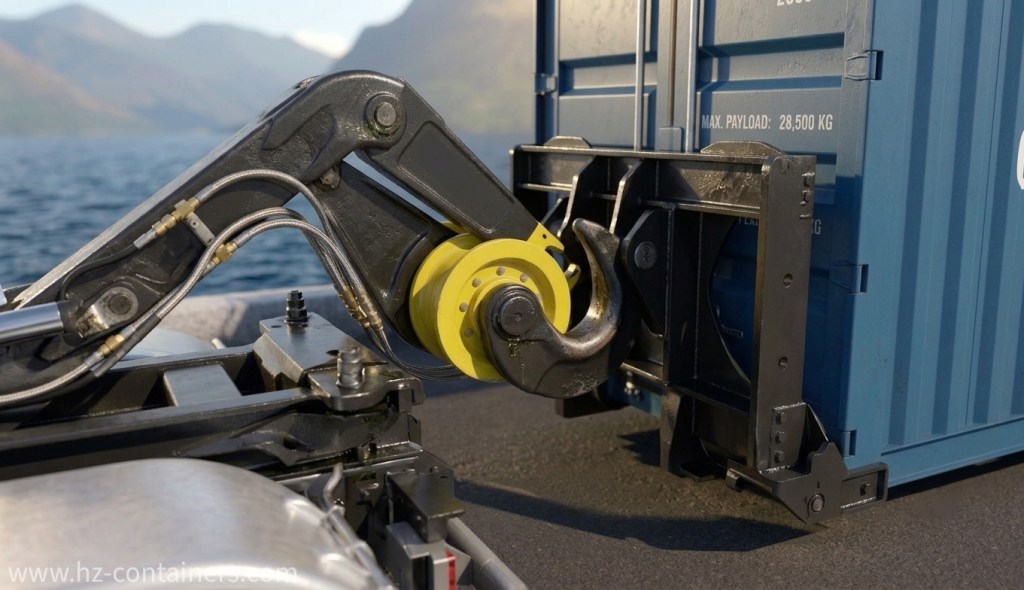
The Three-Part System: Lifting Frame, Support Rollers, and Stowage Frame
The MULTILIFT Commander container handling unit is not a single component but a carefully engineered system of three interconnected parts:
- The Lifting Frame — Constructed from high-tensile steel, the lifting frame is the heart of the Commander. It is mounted on the hooklift’s boom and contains the engagement points that connect to the container’s ISO corner castings. An electric actuator moves the frame from its stowed position to the active lifting position. The frame is engineered to handle the full weight of a loaded 20-foot container while maintaining precise alignment.
- The Rear Support Rollers — Fitted directly to the truck’s chassis, these rollers support the container as it is pulled onto the truck bed. They reduce friction during the loading sequence and protect both the container and the chassis from wear. Side guards integrated into the roller assembly help guide the container during loading and unloading, preventing lateral misalignment.
- The Stowage Frame — When the Commander is not handling ISO containers, the lifting frame retracts and stows behind the cab. This stowage frame keeps the lifting frame secure during transit and protects it from road debris and weather. The stowage design is critical because it means the Commander does not compromise the truck’s ability to handle standard hooklift bodies — the conversion is seamless.
A pneumatic safety latch in the hooklift mechanism firmly secures the lifting frame to the hook, preventing any shifting during operation. This redundancy is essential: if the primary engagement were to fail, the pneumatic latch provides a fail-safe that prevents the container from releasing unexpectedly.
Step-by-Step Operation: Loading and Unloading an ISO Container
The loading sequence for a shipping container using the MULTILIFT Commander follows a precise, repeatable pattern:
- Frame Deployment — The operator activates the electric actuator from the cab. The lifting frame moves from its stowage position behind the cab to the lifting position, extending the engagement points.
- Approach and Alignment — The truck backs up to the container. The Commander can engage a container up to approximately 30 degrees off-center, a significant advantage when operating in tight or uneven spaces where perfect alignment is not possible.
- Hook Engagement — The hydraulic boom extends, and the hook engages the lifting frame’s bail bar. The lifting frame is now connected to the container via the corner castings.
- Pull-Up Sequence — The hydraulic boom retracts, pulling the container up onto the truck’s chassis. The rear support rollers guide the container smoothly, and the side guards ensure it stays centered on the rails.
- Securing — Once the container is fully loaded, it is secured at four points: two ratchets at the front lock into the container’s forward corner castings, and two twist locks at the rear engage the aft corner castings. The pneumatic safety latch on the hook provides an additional layer of security.
- Transit — The container is now locked to the truck with the same security as a purpose-built container chassis. The operator can drive at highway speeds with confidence.
The unloading sequence is essentially the reverse: the twist locks and ratchets are released, the hydraulic boom extends, pushing the container off the rear of the truck, and the container is lowered to the ground under controlled hydraulic pressure. The side guards guide the container during the descent, and the operator can precisely position the container on the ground.
Technical Specifications: What the Commander Can Handle
The MULTILIFT ULTIMA 21S Commander — the primary model available in North America — is engineered to demanding specifications:
| Specification | Value |
|---|---|
| Lifting capacity | 46,000 lbs (20,865 kg) |
| Unit weight | 8,290 lbs (3,760 kg) |
| Hook height | 61.75 inches (1,568 mm) |
| Container sizes | 20′ × 8′ (ISO 1C) and 20′ × 8.5′ (ISO 1CC) |
| Body length range | 20′ to 22′ (hooklift mode) |
| Truck configurations | 3-axle or 4-axle chassis |
| Container payload | Up to 16.5 tons (36,376 lbs) for ISO containers |
| Control system | uControl next-generation electronic control |
| Mode switching | Electric actuator, push-button operation |
The Commander is available in two lengths to accommodate different truck configurations. The 3-axle version is suited for lighter-duty applications and urban environments, while the 4-axle version handles the full rated capacity and is preferred for heavy intermodal and construction applications.
How Does Hook Lifting Compare to Other Container Handling Methods?
Hooklift vs. Roll-Off Cable Hoist Systems
The two dominant demountable systems on trucks are hooklifts and cable hoists (roll-off cable systems). While both load and unload containers at ground level, their mechanisms and capabilities differ significantly.
A cable hoist uses a winch and cable to pull a container up angled rails. The driver must physically exit the cab, attach the cable to the container’s hook, and then operate the winch. Cable systems have one distinct advantage: they can unload containers in spaces with low overhead clearance, such as inside buildings, because the rail angle can be adjusted to keep the container low during the pull.
Hooklifts, by contrast, load and unload on a fixed geometric plane. The container is lifted from back to front in an arc motion, which requires approximately 22 feet of overhead clearance. However, hooklifts offer compelling advantages in nearly every other dimension:
- Precision placement — Hooklifts can position containers with far greater accuracy than cable systems, which is critical when placing containers on foundations, loading docks, or uneven terrain.
- No-cable operation — The absence of cables eliminates cable maintenance, rust, and replacement costs. Cable systems require regular inspection and eventual replacement of cables that can fray or corrode.
- Off-center engagement — A hooklift can engage a container up to 30 degrees off-center, while a cable system requires the stingers to be in full alignment with the container’s forward wheels.
- Operator safety — The driver can complete the entire loading and unloading cycle from inside the cab, never needing to handle heavy cables or stand near moving equipment in adverse weather.
MULTILIFT Commander vs. Stellar Spider vs. ISO Subframe
The MULTILIFT Commander is not the only solution for handling shipping containers with a hooklift truck. Two other common approaches exist: the Stellar Spider attachment and ISO subframe conversions.
| Aspect | MULTILIFT Commander | Stellar Spider | ISO Subframe |
|---|---|---|---|
| Design philosophy | Integrated hooklift attachment | Bolt-on spreader frame | Permanent frame under container |
| Installation | Factory or dealer-installed on MULTILIFT hooklift | Bolt-on to any Stellar hooklift | Welded/bolted to container |
| Container compatibility | ISO 1C, 1CC (20-ft) | 20-ft ISO containers, 8′ and 8.5′ tall | Any ISO container with subframe |
| Weight capacity | 46,000 lbs gross | 40,000 lbs gross | Depends on hooklift |
| Mode switching | Push-button, automatic | Manual attachment swap | Container permanently modified |
| Flatrack mode | Yes — push-button return | No — requires removal | No — container is dedicated |
| Container protection | Twist locks + ratchets + side guards | Corner casting engagement | Standard bail bar |
| Cost (approximate) | $90,000+ (full system) | ~$16,960 (attachment kit) | $2,500–$5,000 (subframe only) |
| Best for | Fleets needing both container and flatrack capability | Occasional container moves | Dedicated container fleets |
The Stellar Spider is a more affordable bolt-on solution. It attaches to a standard Stellar hooklift and uses four arms (the “spider”) to engage the container’s corner castings. It handles up to 40,000 lbs and works well for operators who occasionally need to move containers. However, it lacks the Commander’s push-button mode switching and integrated safety features.
An ISO subframe is the simplest solution: a steel frame with a bail bar is permanently attached to the bottom of a shipping container, converting it into a standard hooklift body. This is the cheapest option per container, but it permanently modifies the container and adds weight. It’s best for operators who own dedicated containers that will never be used in pure intermodal service.
The Commander stands apart because it handles containers in their native ISO configuration — no permanent modifications needed — while retaining full hooklift functionality for flatracks and other bodies. This dual-mode capability is what makes it a true hybrid system rather than a simple attachment.
What Are the Key Advantages of Hook Lifting Shipping Containers?
Versatility and Fleet Consolidation
The most powerful economic argument for hook lifting of shipping containers is fleet consolidation. A single hooklift truck equipped with the MULTILIFT Commander can replace multiple dedicated vehicles. In the course of a single day, the same truck can deliver a loaded shipping container to a construction site, swap to a flatrack to haul steel beams, and finish the day with a dump body for demolition debris.
This versatility translates directly to the bottom line. Instead of maintaining, insuring, and registering a dedicated container chassis, a flatbed truck, and a dump truck, an operator manages one vehicle with one driver, one license plate, and one insurance policy. The cost savings compound over the life of the equipment.
For small and medium-sized operations, this consolidation can be the difference between profitability and loss. The ability to serve multiple markets with a single truck means higher equipment utilization rates — the industry metric that separates profitable fleets from underutilized assets.
Operational Efficiency and Speed
Time is the most expensive resource in logistics. The MULTILIFT Commander’s loading and unloading cycle takes approximately 90 to 120 seconds once the operator is positioned. This speed means the truck can complete more jobs per day, dramatically improving revenue per truck.
The 30-degree off-center engagement capability is an underappreciated efficiency advantage. In real-world conditions — muddy construction sites, narrow urban alleys, crowded storage yards — perfect alignment is often impossible. The Commander’s ability to engage a container that is not perfectly aligned with the truck saves time, reduces maneuvering, and prevents the frustration of multiple approach attempts.
Equally important is the elimination of cable handling. Cable hoist operators must exit the cab, drag a heavy cable to the container, attach it, return to the cab, and reverse the process at the destination. In a typical day of 20 container moves, this adds up to a significant productivity drain — and exposes the operator to weather, traffic, and physical strain.
Safety and Operator Control
Hook lifting significantly improves safety compared to both cable hoist systems and traditional crane-based container handling. The operator remains inside the cab throughout the loading and unloading cycle, protected from the elements and from the risk of being struck by moving equipment.
The MULTILIFT Commander adds multiple layers of safety redundancy:
- Pneumatic safety latch — Prevents the lifting frame from shifting or releasing while in use, even if hydraulic pressure is lost.
- Automatic body locks — Secure the container to the chassis during transit without requiring manual intervention.
- Side guards and guide rollers — Keep the container centered during loading and unloading, preventing dangerous lateral movement.
- Overload protection — The hydraulic system includes relief valves that prevent lifting beyond the rated capacity.
- Twist lock engagement — The container is secured at its engineered lifting points (corner castings), not at non-structural points.
These safety features are not merely convenient — they address the real-world risks that occur when containers are handled in uncontrolled environments, far from the standardized safety protocols of a port or terminal.
What Are the Limitations and Common Misconceptions?
Overhead Clearance Requirements
The most significant limitation of hook lifting compared to cable hoist systems is the overhead clearance requirement. Because the hooklift loads and unloads containers on a fixed geometric arc, the system needs approximately 22 feet of vertical clearance. This makes hooklifts unsuitable for placing containers inside buildings with low ceilings, in parking garages, or under overhead obstructions like power lines and tree canopies.
For operators who primarily work in urban environments with height restrictions, a cable hoist system may be the better choice despite its other disadvantages. However, for the vast majority of intermodal, construction, and remote logistics applications, the overhead clearance requirement is rarely a constraint.
Common Myths About Hooklift Container Handling
Myth 1: “Hooklifts can only handle empty containers.”
This is demonstrably false. The MULTILIFT Commander is rated for ISO containers weighing up to 16.5 tons (36,376 lbs). The Stellar Spider handles up to 40,000 lbs gross. These systems are engineered specifically for loaded containers, and their hydraulic systems, frame construction, and locking mechanisms are all designed with the full rated load in mind. The military origins of the Commander — where loaded containers are the norm, not the exception — further dispel this myth.
Myth 2: “Hook lifting damages shipping containers.”
Damage occurs when equipment is used improperly, not because hook lifting is inherently damaging. The Commander engages the container at its ISO corner castings — the same structural points used by spreader bars, cranes, and container chassis. The side guards and guide rollers prevent the metal-on-metal contact that could cause abrasion. When operated correctly by a trained operator, hook lifting is no more damaging to a container than any other handling method.
Myth 3: “Hooklifts are only for the waste industry.”
While hooklifts are indeed widely used in waste and recycling, the MULTILIFT Commander was specifically developed for intermodal logistics, defense, emergency services, and construction. The ability to handle ISO containers expands the hooklift’s utility far beyond waste management. The Commander’s dual-mode capability — flatracks and containers on the same truck — is a feature that serves logistics, not waste.
Myth 4: “Any hooklift can pick up a shipping container.”
A standard hooklift cannot safely handle an ISO shipping container. Shipping containers are not designed with bail bars — they have corner castings that require specialized engagement hardware. Attempting to lift a container by hooking onto its structure risks catastrophic failure. The Commander, the Spider, and subframe solutions all exist precisely because a standard hooklift is not compatible with ISO containers.
What Industries and Applications Use Hook Lifting of Shipping Containers?
Construction, Waste Management, and Intermodal Logistics
The construction industry is one of the largest adopters of hooklift container handling. A single MULTILIFT Commander-equipped truck can deliver a loaded container of tools and materials to a job site in the morning, return with a container of demolition debris, and make an afternoon run with a flatrack of lumber. The ability to drop a container at a site and leave it there as secure storage — then retrieve it days or weeks later — is invaluable for phased construction projects.
In waste management, hooklift trucks are the backbone of roll-off container service. The Commander extends this capability to sealed containers for hazardous materials, liquid-tight containers for sludge and wet waste, and high-capacity containers for commercial and industrial waste streams. The same truck that services a 20-yard construction debris container can also handle a sealed ISO container for contaminated soil.
Intermodal logistics is the Commander’s natural habitat. The system bridges the gap between port-to-terminal container movement (handled by specialized equipment) and the last-mile delivery of containers to locations without infrastructure. A container can arrive at a rail terminal, be transferred to a Commander-equipped truck, and be delivered directly to a factory, warehouse, or construction site — all without intermediate handling by a crane or forklift.
Defense, Emergency Services, and Remote Logistics
The Commander’s military pedigree is not an accident. Defense organizations need to move containers, flatracks, and specialized bodies in field conditions where there is no infrastructure — no loading docks, no cranes, no paved surfaces. The ability to self-load and self-unload in any terrain, at any time, is a tactical necessity.
Emergency services and disaster relief organizations face similar challenges. When a hurricane, earthquake, or flood destroys infrastructure, the ability to deliver containers of supplies, medical equipment, or temporary shelter to any accessible location is critical. The Commander’s independence from external handling equipment makes it ideal for disaster response.
Greenfield infrastructure projects — building roads, pipelines, and power lines in undeveloped areas — present the same logistical challenge. The Commander allows containers of equipment and materials to be delivered precisely where they are needed, not just where a crane happens to be available.
What Is the Future of Hooklift Container Handling?
Fossil-Free Steel, Electrification, and Smart Technology
In 2022, Hiab unveiled a landmark achievement: the world’s first hooklift manufactured using fossil-free steel, produced in partnership with the Swedish steel company SSAB. The steel is produced using hydrogen instead of coal, resulting in zero CO2 emissions from the steelmaking process. The first product was a MULTILIFT Ultima hooklift, and from 2026, Hiab has committed to delivering load handling equipment made from fossil-free steel as standard. By 2030, Hiab aims to make its own operations carbon-neutral.
This is not merely a marketing initiative. The construction and logistics industries face increasing regulatory pressure to reduce carbon emissions. A hooklift built from fossil-free steel, mounted on an electric or hydrogen-powered truck, represents a fully zero-emission container handling solution — from manufacturing through operation.
Technology is advancing on multiple fronts. HiConnect, Hiab’s telematics platform, provides real-time data on equipment utilization, location, and maintenance needs. Fleet managers can monitor container movements, optimize routing, and schedule preventive maintenance based on actual usage rather than calendar intervals. HiVision, a camera-based operator assistance system, is being adapted for hooklifts, providing the operator with enhanced visibility during loading and unloading.
The broader trend toward automation — self-loading systems, AI-driven predictive maintenance, and augmented reality operator training — is reshaping the hooklift industry. The MULTILIFT Commander’s electric actuator and push-button mode switching are early examples of this automation trend, and future iterations will likely incorporate even more autonomous capabilities.
Market Growth and Emerging Trends
The hooklift trailer market was valued at approximately $1.94 billion in 2024 and is projected to grow at a compound annual growth rate (CAGR) of 5.6% to 6.3% through 2035, reaching an estimated $3.8 billion to $3.95 billion. This growth is driven by several converging trends:
- Increasing intermodal freight volumes — As global trade shifts toward containerized transport, the need for flexible last-mile container handling grows.
- Infrastructure investment — Government spending on roads, bridges, green energy, and rural development creates demand for mobile container handling.
- Labor shortages — Hooklifts reduce the number of operators needed per job, addressing the chronic driver shortage in logistics.
- Sustainability mandates — The shift toward fossil-free steel and electric drivetrains aligns with corporate and government decarbonization goals.
The MULTILIFT Commander sits at the intersection of all these trends: a proven, military-grade system that is becoming more sustainable, more connected, and more essential to the future of intermodal logistics.
Frequently Asked Questions
What is the MULTILIFT Commander hooklift attachment?
The MULTILIFT Commander is a container handling unit manufactured by Hiab that attaches to a MULTILIFT hooklift truck, enabling it to lift, transport, and position ISO 20-foot shipping containers. It consists of a high-tensile steel lifting frame, rear support rollers, and a stowage frame. The Commander allows the truck to switch between handling ISO containers and standard flatracks at the push of a button.
How much weight can a MULTILIFT Commander lift?
The MULTILIFT ULTIMA 21S Commander is rated for a gross lifting capacity of 46,000 lbs (20,865 kg). For ISO container handling specifically, it can manage containers weighing up to 16.5 tons (36,376 lbs). The unit itself weighs 8,290 lbs.
How much does a MULTILIFT Commander cost?
Pricing for the MULTILIFT ULTIMA 21S Commander system varies by region, dealer, and truck configuration. As a reference point, new complete systems have been listed in the range of approximately €90,500 (approximately $100,000 USD). The Commander is a premium, integrated system and is priced accordingly — it is more expensive than simple bolt-on attachments like the Stellar Spider ($16,960 kit) but offers substantially more capability and dual-mode functionality.
Can a hooklift handle loaded shipping containers?
Yes. The MULTILIFT Commander is specifically designed and rated to handle loaded ISO containers. Its military origins mean it was engineered from the start for fully loaded containers in field conditions. The lifting frame, hydraulic system, and locking mechanisms are all rated for the full 16.5-ton container payload. The Stellar Spider similarly handles containers up to 40,000 lbs gross weight.
Is hook lifting safe for ISO containers?
When performed with properly engineered equipment like the MULTILIFT Commander, hook lifting is safe for ISO containers. The Commander engages the container at its corner castings — the same structural lifting points used by cranes, spreader bars, and container chassis. The system includes multiple safety redundancies: pneumatic safety latch, automatic body locks, twist locks, ratchets, side guards, and overload protection. Damage to containers is virtually always the result of operator error or using incompatible equipment, not an inherent flaw in the method.
What trucks are compatible with the MULTILIFT Commander?
The MULTILIFT Commander is designed for 3-axle and 4-axle truck chassis equipped with a MULTILIFT XR21 hooklift. It is not a universal attachment — it is engineered specifically for the MULTILIFT hooklift platform. The truck must have sufficient chassis length, weight capacity, and hydraulic capability to support the Commander’s 8,290-lb unit weight plus the rated container payload.
How do I switch between flatrack and container mode?
Switching between modes is a push-button operation controlled from the cab. An electric actuator moves the lifting frame from its stowage position behind the cab to the lifting position (container mode) or retracts it (flatrack mode). The entire transition takes seconds and requires no tools, no manual adjustments, and no physical intervention by the operator.
What maintenance does a hooklift container system require?
The MULTILIFT Commander requires the same maintenance as a standard hooklift, plus specific attention to the electric actuator, pneumatic safety latch, twist locks, and ratchet mechanisms. Routine maintenance includes hydraulic fluid checks, pin and bushing inspection, lubrication of moving parts, and structural inspection of the lifting frame and rollers. Annual maintenance costs for a hooklift system typically range from $3,000 to $4,500 depending on utilization. The Commander’s pneumatic and electric components add modestly to this baseline but eliminate the cable maintenance costs associated with roll-off systems.