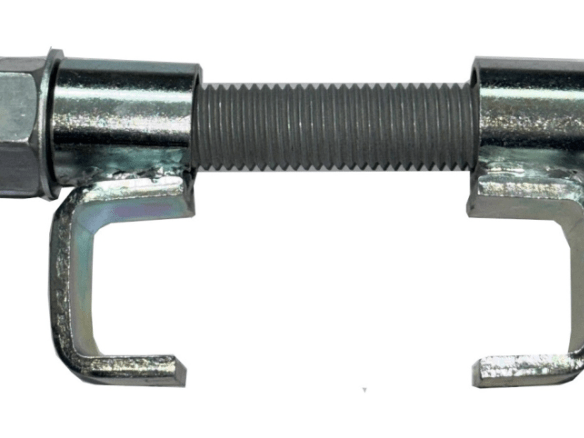
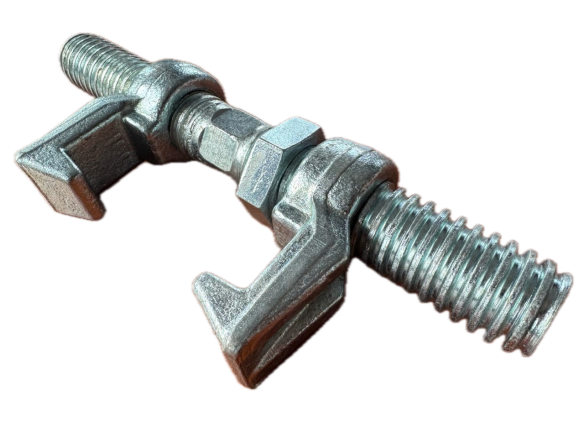
Bridge Fitting (also known as bridge clamp, bridge joint) is a special mechanical connecting element designed to safely connect two adjacent shipping containers horizontally. It allows you to create a solid block from several containers, which is absolutely essential for safety, efficiency and stability in maritime, railway and land logistics.
Basic Principle:
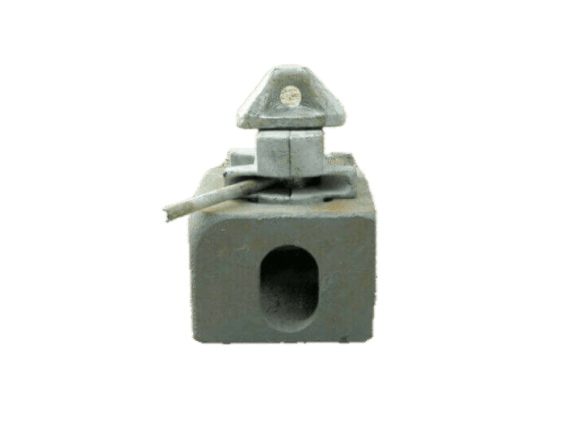
Bridge fitting is anchored into standardized corner castings, which are part of every ISO container according to ISO 1161 standard.
Using counter-threaded bolts, it allows quick tightening and loosening of the connection with common tools (most often a 32 mm wrench or adjustable wrench).
It connects containers side-by-side or end-to-end and ensures their stability against horizontal displacement, vibrations and impacts.
Construction, Principle and Mechanics of Bridge Fitting
Main Parts and Their Functions
Component
Description and Function
Central body
Robust steel part with internal thread, often forged or cast, forms the core of the fitting
Hooks (clamps)
Two massive hooks made of forged or cast steel, precisely shaped for holes in corner castings
Threaded rod
Rod with right and left thread, allows simultaneous pulling of hooks together
Tightening nut
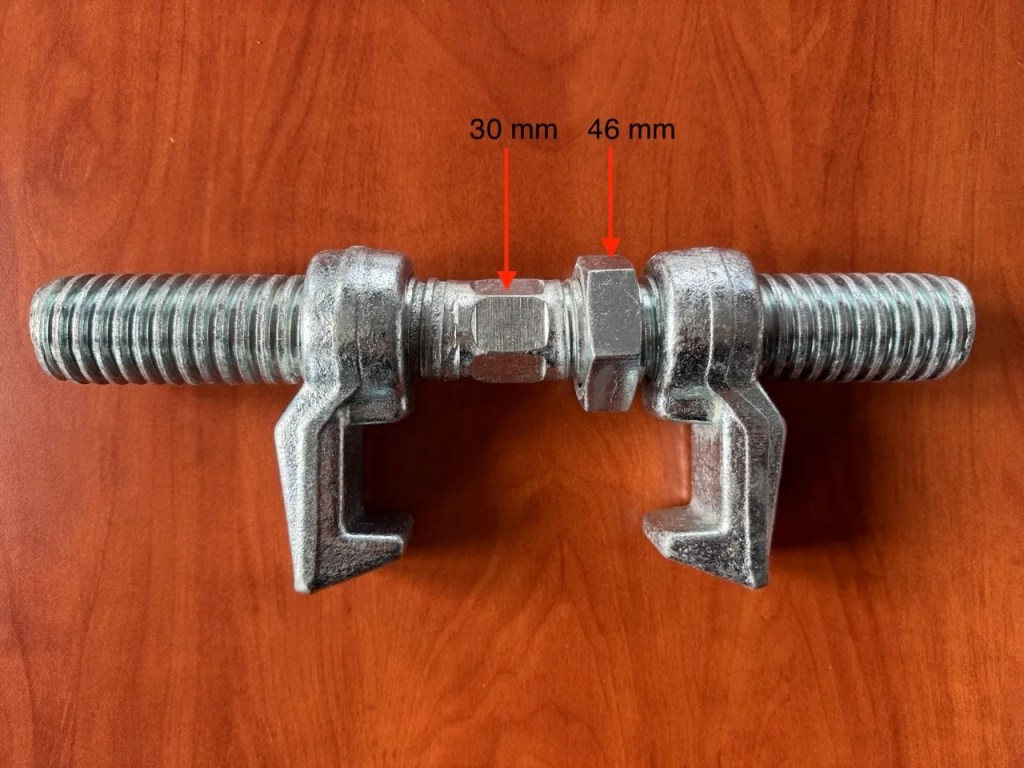
Controls the tightening mechanism, usually for 32 mm wrench or adjustable wrench (Bahco)
Counter nut
Secures the connection against self-loosening due to vibrations and dynamic forces during transport
Tightening Mechanism
After inserting the hooks into the holes of the corner elements of two adjacent containers, the tightening nut is rotated.
Counter-threaded bolts cause both hooks to pull together, creating a tight connection and joining the containers without play.
A pre-tensioned connection is created that safely transfers tensile, compressive and shear forces.
After tightening, the connection must be secured with a counter nut.
Materials, Surface Treatment and Durability
Material: Predominantly forged steel or high-quality cast steel (for economical variant). Forged steel fittings offer longer service life and higher strength.
Surface treatment: Always hot-dip galvanized, which guarantees high resistance to salt water, moisture and chemical exposure in demanding maritime conditions.
Standards and certification: Products should comply with ISO 1161 standard (for corner castings), are often approved by companies such as DNV-GL, ABS, Bureau Veritas or CCS, which is necessary for international maritime transport.
Dimensions, Types and Technical Parameters
Variants and Adjustable Span
Type
Length at Max. Tightening
Adjustable Range
Use
Small
260 mm
approx. 179–259 mm
For containers placed closely together
Large
330 mm
up to approx. 310 mm
For connection across larger gap (e.g., due to ship construction)
Short-term and long-term connection of container rows in depots
Modular construction
Creation of solid building, storage and residential assemblies from containers
Industrial areas
Interconnection of containers in temporary operations, offices, changing rooms, etc.
Step by Step: Bridge Fitting Installation
Pre-adjustment: Set the hook spacing to be slightly larger than the gap between the corner elements of the containers.
Hook insertion: Insert one hook into the corner casting hole of the first container, the other into the hole of the adjacent container.
Tightening: Using a wrench, rotate the tightening nut until the containers are pulled firmly together.
Securing: Tighten the counter nut against the tightening nut.
Repetition: For safe connection of two 40′ containers, a minimum of 4 bridges along the top edges are recommended, possibly additional ones along the bottom.
In practice, both systems are combined: twist locks hold containers in columns, bridge fittings connect the columns horizontally into a solid block.
Certification, Standards and Legislation
Standards: ISO 1161 (corner casting), ISO 3874 (container handling), ISO 1496 (design requirements).
Certification: Products often bear marks from DNV-GL, ABS, Bureau Veritas, CCS – essential for use in international maritime transport.
Legal requirements: All fittings used in transport must be certified and regularly inspected, otherwise there is a risk of loss of insurance coverage and legal penalties.
Maintenance and Safety Principles
Regular Inspection
Visual inspection for cracks, deformations, thread wear and condition of the zinc coating before each use.
Damaged pieces must be immediately decommissioned.
Maintenance
Regular cleaning and lubrication of threads with quality grease.
Storage in dry conditions, away from aggressive chemicals and extreme corrosive environments when not in use.
Legislative Requirements
All components must comply with applicable international standards and certificates.
Regular records of inspections and maintenance may be required during audits.
Innovation, Trends and Future of Bridge Fitting
New materials: Development towards composites and innovative alloys with higher strength and lower weight.
Smart fittings: Variants with sensors are being tested to monitor stress, load and wear in real time (IoT solutions).
Sustainability: Manufacturers are moving towards more environmentally friendly hot-dip galvanizing processes, production optimization and recyclable materials.
Automation: Development of tools for faster and safer installation in automated terminals.
Importance of Bridge Fitting in Global Logistics
Safety: Prevents container movement in extreme sea conditions, reduces the risk of cargo loss and environmental disasters.
Efficiency: Allows higher and tighter stacking, maximizes ship and storage capacity.
Supply chain stability: Ensures that goods arrive on time and in undamaged condition – the foundation for smooth global trade.
Common Mistakes and Recommendations
Use of uncertified or damaged fittings – risk of failure, danger of cargo loss.
Neglecting regular maintenance – increased wear, thread galling, loss of corrosion resistance.
Incorrect number of fittings – always follow the manufacturer’s recommendations for the given type and size of containers.
Bridge fitting is an indispensable, though often overlooked, element in the global logistics ecosystem. Its proper use is key to the safety, efficiency and reliability of container transport worldwide. For anyone buying container parts or working in the transport industry, detailed knowledge of this component is the foundation of safe and successful operations.
To provide the best experiences, we use technologies like cookies to store and/or access device information. Consenting to these technologies will allow us to process data such as browsing behavior or unique IDs on this site. Not consenting or withdrawing consent, may adversely affect certain features and functions.
Functional
Always active
The technical storage or access is strictly necessary for the legitimate purpose of enabling the use of a specific service explicitly requested by the subscriber or user, or for the sole purpose of carrying out the transmission of a communication over an electronic communications network.
Preferences
The technical storage or access is necessary for the legitimate purpose of storing preferences that are not requested by the subscriber or user.
Statistics
The technical storage or access that is used exclusively for statistical purposes.Technical storage or access that is used exclusively for anonymous statistical purposes. Absent a subpoena, voluntary compliance by your ISP, or additional records from a third party, information stored or obtained solely for this purpose cannot typically be used to identify you.
Marketing
The technical storage or access is required to create user profiles to send advertising, or to track the user on a website or across several websites for similar marketing purposes.

 Czech Republic
  WITHOUT SHIPPING