
What is ConFoot CFU30
When it comes to logistics and “container handling without a crane,” most professionals today think of just one name — ConFoot. And in its product range, the CFU30 model holds an exceptional position: it is an advanced, height-adjustable container leg that is the only one in the portfolio to combine a load capacity of 30 tons with a lift range from zero to 1.5 meters. For many logistics operations, it represents the golden mean between affordability, performance, and flexibility.
This article is the definitive guide to the CFU30 model. We will walk through the technical parameters, compare it with other models, analyze in detail the issue of safety under extreme load, and explain why the dreaded scenario of “30 tons on a single leg” is practically impossible in real-world operation — and how the CFU30 designers have precisely addressed it.
What is CFU30 and what is it used for?
Definition and basic description
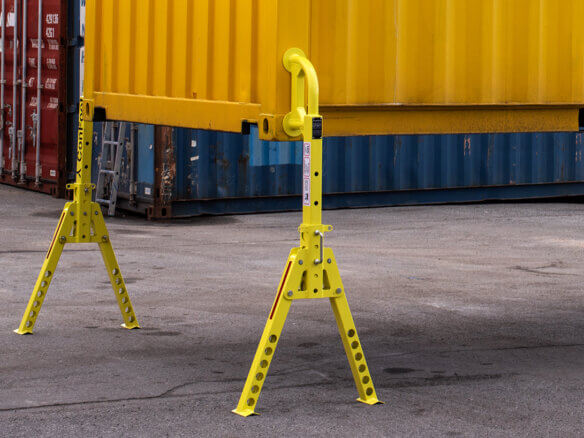
CFU30 is a height-adjustable container leg from the ConFoot product line, developed by the Finnish company Oy ConFoot Ltd and distributed in the Czech Republic and other EU countries by HZ KONTEJNERY s.r.o. The abbreviation CFU stands for “ConFoot Universal” — a universal lifting device — and the number 30 designates the maximum load capacity of 30 tons when using a set of four units.
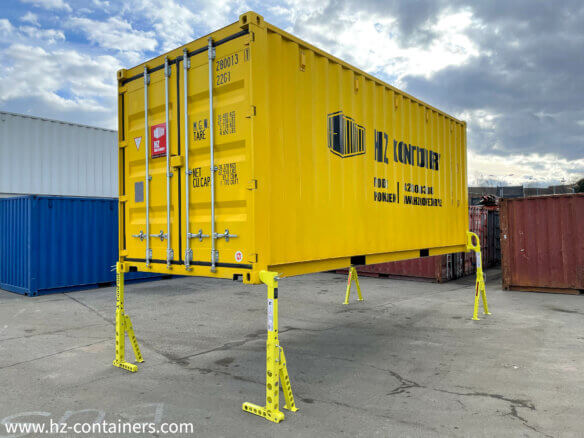
Key definition: CFU30 is a mechanical lifting device that clamps into the standard corner castings of a transport container and enables it to be lifted from a semi-trailer and lowered to the ground — or vice versa — without the need for a crane, forklift, or other heavy handling equipment.
What sets the CFU30 apart from the older CFU20 model as well as the fixed CF and CFP models is its telescopic design with a hydraulic jack, which allows smooth height adjustment in the range of 0 to 1,500 mm. This means that with the CFU30 you can not only take the container off the semi-trailer, but also lower it all the way to ground level — or conversely, raise it to a height that suits your loading ramp, with millimeter precision.

Who is the CFU30 designed for?
CFU30 finds application in a wide range of scenarios:
- Industrial operations — where there is a need to quickly and flexibly transfer containers without permanent crane infrastructure
- Military and emergency applications — CFU30 is certified for demanding conditions and enables field deployment of container units
- Construction — temporary storage and office containers on construction sites
- Agriculture and forestry — mobile warehouses in remote locations without access to heavy equipment
- Humanitarian operations — rapid establishment of container bases in the field
CFU30 is designed for professionals who need maximum flexibility — whether it concerns the placement height of the container, or the location where to place the container.
How does the CFU30 differ from other ConFoot models?
Comparison of the CFU model range
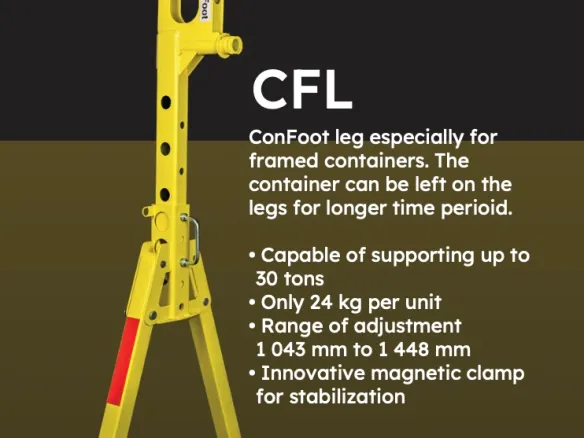
ConFoot offers three models in the universal CFU range, plus several models in the CF, CFP, and CFL ranges. Here is an overview of all key variants:
| Parameter | CFU20 | CFU30 | CFU45 | CF / CFL | CFP |
|---|---|---|---|---|---|
| Load capacity | 20 tons | 30 tons | 45 tons | 30–34 tons | 30 tons |
| Height range | 0–1,500 mm | 0–1,500 mm | 0–1,500 mm | 1,043–1,448 mm | Fixed (for ramp) |
| Weight of one leg | 46 kg (parts under 25 kg) | 46 kg (parts under 25 kg) | higher | 24 kg | 24 kg |
| Lifting principle | Hydraulic jack | Hydraulic jack | Hydraulic jack | Fixed structure | Fixed structure |
| Price (excl. VAT) | 162,500 CZK | 187,500 CZK | Individual | ~92,500 CZK | ~92,500 CZK |
| Typical use | Lighter containers, flexible height | Universal — the golden mean | Heavy industrial applications | Routine transshipment, tank containers | Loading ramps |
*Prices may vary according to the current price list. Current prices can be found directly on the ConFoot pages.
When to choose CFU30 instead of CF or CFP?
The answer is simple: whenever you need to lower a container to the ground or lift it to any height.
While the CF and CFP models are fixed supports with a fixed height range (1,043–1,448 mm), the CFU30 offers a continuous range of 0–1,500 mm. This is a fundamental difference in these situations:
- Accessibility without ramps — CFU30 lowers the container to ground level, so you can enter it without steps or ramps
- Uneven terrain — independent height adjustment of each leg compensates for unevenness of the surface
- Different semi-trailer heights — every truck has a slightly different loading surface height; CFU30 adapts to all
Practical example: Imagine a construction site where you need to place an office container. With CFU30, the driver takes it off the semi-trailer, lowers it to the ground, and levels it to a horizontal position — even when the terrain is slightly sloped. With CF, you would have to put the container on the ground in another way first and then deal with the support.
What are the technical specifications of the CFU30?
Construction and materials
CFU30 is made of high-quality Finnish steel with a durable surface finish that provides protection against corrosion even in demanding outdoor conditions. The construction consists of several modular parts, so no individual part exceeds a weight of 25 kg — a deliberate design choice with regard to manual handling limits.
Key design elements of the CFU30:
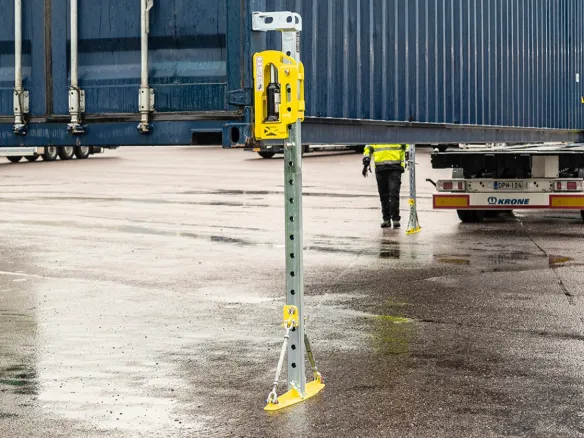
- Upper and lower main tube — a telescopic system enabling smooth height adjustment
- Climber unit — a mechanism that clamps into the corner casting of the container
- Hydraulic jack (bottle jack) — the heart of the lifting mechanism, operated by a crank
- Support leg assembly — ensures stability on the ground
- Patented locking mechanism — safely fixes the leg in the corner casting
- Safety pins with safety latches — prevent accidental release
Complete technical parameters
| Parameter | Value |
|---|---|
| Load capacity (set of 4 legs) | 30,000 kg |
| Load capacity (single leg) | 7,500 kg (nominal) |
| Height range | 0 to 1,500 mm |
| Weight of one leg (assembled) | 46 kg |
| Weight of heaviest part | < 25 kg |
| Material | High-quality steel with anti-corrosion treatment |
| Compatibility | Standard ISO corner castings, 10–45 ft containers |
| Operating temperature | −20 °C to +40 °C |
| Maximum wind speed | 12 m/s |
| Certification | CE, EN 283, Directive 2006/42/EC |
| Number of operators | 1 person |
Operating limits
CFU30 is designed for professional use, but has its operating limits that must be respected:
- Temperature: −20 °C to +40 °C. At extremely low temperatures, the viscosity of the hydraulic oil in the jack may be affected.
- Wind: Maximum 12 m/s (43 km/h). In stronger winds, there is a risk of instability of the raised container.
- Surface: Must be paved, level, and load-bearing. Ideal is concrete, compacted gravel, or asphalt. Soft surfaces (grass, sand) are unsuitable.
- Terrain slope: Although the CFU30 can compensate for slight unevenness thanks to the independent height adjustment, the manufacturer recommends the most level surface possible.
How does the CFU30 solve weight distribution and safety under load?
This is probably the most important question every technically thinking professional asks: What happens when a 30-ton container tilts and most of the weight rests on a single leg? The answer to this question reveals why the CFU30 is so robustly designed — and why this scenario is practically impossible in real-world operation.
Why the “30 tons on one leg” scenario is practically impossible
The answer begins with transport regulations. Every container that leaves a port or logistics depot and travels on European roads must be relatively centered by law. It is not possible for a 30-ton container to arrive at its destination with such a dramatically unbalanced load that one leg would carry significantly more than the others.
European regulations for road transport (including EU Directive 2015/719 and related standards for load securing according to ČSN EN 12195) require that the load on the vehicle be arranged so that the axle load does not exceed the permitted limits and the overall center of gravity of the load is within safe limits. In practice, this means that the maximum weight deviation between individual corners of the container is already limited at the input to single-digit percentages — not tens of percentages that would hypothetically endanger one leg.
Specifically: if a 30-ton container is on the road on a semi-trailer, the weight distribution must respect the maximum axle load of the tractor and semi-trailer. The driver, the carrier, and the sender are legally responsible for proper loading. Any significant deviation would be caught during a road inspection and would mean a fine and a ban on further travel.
Built-in safety buffer: individual structural assessment
And this is exactly what makes the CFU30 exceptional. Each CFU30 leg undergoes an individual structural assessment that includes a built-in safety buffer — safety buffer — designed precisely to absorb the weight deviation that is permitted under EU transport regulations.
What does this mean in practice? The ConFoot engineers, when designing the CFU30, assumed the following:
- The nominal load capacity per leg is 7,500 kg (30 tons ÷ 4)
- The actual structural strength of each leg is, however, significantly higher — precisely thanks to the safety buffer
- Testing according to EN 283 includes static and dynamic tests that verify that the leg can handle loads exceeding the nominal value
- Material certificates (SSAB, Welser Profile GmbH) guarantee consistent steel quality without hidden defects
In other words: even if — purely hypothetically — the maximum permitted weight deviation occurred during transport, the CFU30 has sufficient structural reserve to safely handle this situation. The leg will not break, bend, or lose stability.
Independent height adjustment as a safety feature
There is another factor that plays a fundamental role in the overall safety of the system: the independent height adjustment of each leg. Unlike fixed supports, where the height of all legs is the same, the CFU30 allows you to adjust each leg separately.
This has two safety implications:
- Perfectly horizontal position of the container: The operator can fine-tune each leg so that the container stands completely level. If the container is level, the weight is distributed evenly between all four legs — exactly as the design assumes.
- Compensation for uneven terrain: Even if the surface is slightly uneven, the CFU30 compensates for this. This eliminates the risk that one leg would bear a disproportionate part of the weight due to the container being tilted.
The combination of these factors — legal centering of the load, built-in safety buffer, material quality, and the ability to precisely level — means that the CFU30 is actually safer than it might seem at first glance at the numbers. The system is designed so that “30 tons on one leg” remains a scenario that exists only in theoretical safety analyses — not in real-world operation.
How to install and use the CFU30?
Installation procedure step by step
The installation of CFU30 is designed to be handled by one person in a few minutes. Here is the standard procedure:
Step 1: Preparation
- Park the semi-trailer on a paved, level surface.
- Raise the air suspension of the semi-trailer to maximum height. This gives you space to install the legs.
- Check the corner castings — they must be clean and undamaged.
Step 2: Attaching the climber unit
- Bring the support leg to the corner casting.
- Insert the climber unit horizontally into the oval opening of the corner casting.
- Turn the climber unit to a vertical position — this will lock it in the casting.
Step 3: Assembling the leg
- Pass the lower main tube through the climber unit into the support leg.
- Secure with the main safety pin.
- Insert the upper main tube into the lower one.
Step 4: Installation on all four corners
- Repeat steps 2–3 on all four corners of the container.
Step 5: Lifting the container
- Release the locking screws that hold the container on the semi-trailer.
- Insert the crank into the hydraulic jack and start lifting the container.
- Lift evenly — in small steps on all legs.
- Once the container is high enough, the semi-trailer can drive away.
Step 6: Height adjustment
- Use the crank to fine-tune the height of each leg.
- Use a spirit level to verify that the container is level.
- Check all safety pins and safety latches.
How many people are needed to operate it?
CFU30 was designed for one-person operation. This is one of the main selling points of the entire ConFoot range. However, it is important to understand several nuances:
- The weight of individual parts does not exceed 25 kg, which is deliberately just above the EU limit for manual handling (23 kg). For most physically fit persons, this is manageable, but ConFoot recommends that persons with lower upper body strength consider the assistance of a second person when lifting the heavier components.
- Ergonomic grips and a folding design minimize strain during handling.
- The entire process — from parking the semi-trailer to driving away with the empty semi-trailer — takes one person approximately 5–10 minutes depending on the operator’s experience.

What certifications and standards does the CFU30 meet?
CE certification and European legislation
CFU30 bears the CE marking, which is the manufacturer’s declaration that the product meets all relevant requirements of European directives. Specifically, these are:
- Directive 2006/42/EC (Machinery Directive) — key legislation regulating the safety of machinery in the EU
- Government Regulation 400/2008 (Finnish implementation of the Machinery Directive)
Testing according to EN 283 and other standards
CFU30 legs have undergone static and dynamic tests according to the specific test program CF EN 283. This standard defines the requirements for testing the strength of equipment for container handling. In addition, CFU30 meets:
| Standard | Meaning |
|---|---|
| SFS-EN 1494 +A1 | Mobile and portable jacks and associated lifting equipment |
| SFS-EN ISO 12100 | Safety of machinery — general principles of design |
| SFS-EN ISO 9001 | Quality management system of production |
| EN 473 / EN ISO 9712 | Qualification and certification of NDT weld inspectors |
These certifications are not just a formal stamp. They mean that every CFU30 leg has passed:
- Verification of material certificates (steel from SSAB and Welser Profile GmbH)
- Weld inspection by non-destructive methods
- Static load test
- Dynamic test simulating real transshipment conditions
What is the service life and maintenance of the CFU30?
Recommended inspection intervals
The service life of CFU30, with proper maintenance, is comparable to the service life of the transport containers themselves — that is, 10 to 25 years with regular maintenance, potentially more. ConFoot recommends the following maintenance plan:
| Interval | Action |
|---|---|
| Before each use | Visual inspection — cracks, deformations, corrosion |
| Before each use | Functional test — extension and retraction of the leg, smoothness of operation |
| Monthly | Check of safety pins — wear, corrosion, completeness |
| Quarterly | Lubrication of moving parts with a suitable lubricant |
| Annually | Professional inspection by a qualified technician |
Key maintenance points
- Lubrication: Apply an appropriate amount of lubricant to the moving parts. Do not over-lubricate — excess lubricant attracts dust and dirt.
- Safety pins: Any bent, corroded, or missing pin should be replaced immediately. Never use improvised replacements.
- Storage: Store the legs in a dry and clean place. The folding design of CFU30 allows compact storage.
- Damage: If you discover any crack, deformation, or structural change, take the leg out of service immediately and contact the supplier.
How much does the CFU30 cost and where to buy it?
Current price
As of June 2026, the recommended retail price of a CFU30 set is:
| Item | Price excl. VAT | Price incl. VAT |
|---|---|---|
| CFU30 — complete set of 4 legs | 187,500 CZK | 226,875 CZK |
For comparison: the CFU20 model costs 162,500 CZK excl. VAT (196,625 CZK incl. VAT) and the CF/CFP models cost around 92,500 CZK excl. VAT.
Rental options
For companies that do not need CFU30 on a daily basis, HZ CONTAINERS s.r.o. also offers short-term and long-term rental. This is an ideal solution for seasonal operations, one-off projects, or for testing the system before purchasing.
Distributor in the Czech Republic
The exclusive distributor of ConFoot CFU30 for the Czech Republic is:
HZ KONTEJNERY s.r.o.
Průmyslová 154, 674 01 Třebíč
E-mail: info (protected)
Mobile: +420 608 830 863
Web: http://www.confoot.cz
For bulk orders, individual discounts are available. Contact the distributor for a no-obligation consultation and a tailored offer.
Frequently asked questions
What is the difference between CFU30 and CFU20?
The main difference is in load capacity: CFU30 can carry 30 tons, while CFU20 can carry 20 tons. Both models share the same design principle (telescopic, hydraulic lift) and height range (0–1,500 mm). CFU30 is suitable for fully loaded 20-foot and 40-foot containers, while CFU20 is intended for lighter applications or partially loaded containers.
Can the CFU30 lift a 40-foot container as well?
Yes. CFU30 is compatible with standard ISO containers from 10 to 45 feet in length. A fully loaded 40-foot container weighing 30 tons can be safely lifted by CFU30.
Can one CFU30 leg really carry 30 tons?
The nominal load capacity of one leg is 7,500 kg (30 tons when using a set of four). The actual strength of each leg is, however, significantly higher due to the built-in safety buffer, which takes into account the permitted weight deviations under EU transport regulations. The scenario where all 30 tons would rest on a single leg is excluded in practice — the container must be centered by law already during transport.
Is CFU30 safe in wind?
The manufacturer specifies a maximum operating wind speed of 12 m/s (approximately 43 km/h). In stronger winds, it is not recommended to handle the container or leave it standing on the legs at maximum height. In practice, this means that CFU30 is safe in normal weather conditions, but during a gale or heavy storm, the container should be lowered to the ground.
Do I need any special training to operate CFU30?
ConFoot recommends that the operation be performed by trained personnel who are familiar with the operating manual. However, this is not a legal certification such as a crane operator’s license — the CFU30 manual (available in Czech) provides all the necessary information and can be studied by any technically skilled worker.
What surface is suitable for using CFU30?
Ideal is concrete, compacted gravel, or asphalt. The surface must be level, firm, and sufficiently load-bearing. Unsuitable are soft surfaces (grass, sand, mud), which could cause sinking or tilting of the leg. If you are not sure of the load-bearing capacity of the surface, use a load-distributing plate under each leg.
How long does the installation of CFU30 take?
An experienced operator can install all four legs and remove the container from the semi-trailer in 5 to 10 minutes. The time may be extended on uneven terrain or during first use.
Is it possible to use CFU30 in frost?
Yes, the operating range of CFU30 is −20 °C to +40 °C. At sub-zero temperatures, however, the viscosity of the hydraulic oil in the jack may be affected, which manifests as a slower and more difficult lift. In extreme frost, we recommend letting the legs acclimatize before use and checking the smoothness of the jack.
 Czech Republic
  WITHOUT SHIPPING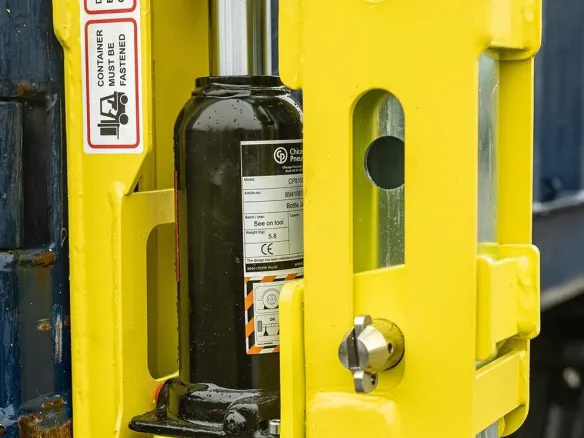


Other container news...

New shipping containers
If you are currently considering purchasing a new shipping container, you are not alone. While just twenty years ago containers were used almost exclusively for maritime transport, today they have found their way into construction, storage, business, and even housing. This growing popularity brings with it a host of questions: Which type should you choose? How much does it cost? How do you recognize quality? How can you avoid falling victim to scammers?

6m shipping container
Are you thinking about buying a 6-meter shipping container but aren’t sure what to look for? You are not alone—this 20-foot container is the best-selling size on the Czech market, and the differences between various types, conditions, and prices can be significant. In this guide, you will find everything you need to know: from exact dimensions and a comparison of categories (such as “one-way,” refurbished, and “Cargo Worthy”) to current prices and shipping advice.
Corner casting steel vs aluminum
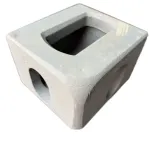
Every shipping container in the world — all 40 million of them — rests on eight critical components. Corner castings are the load-bearing blocks at each corner of an ISO shipping container, and they are the universal interface between the container and every crane, twistlock, spreader, and chassis on the planet. When you lift a container, stack it nine high on a ship, or lock it to a truck trailer, every ton of force flows through these fittings.

Construction cabin – selection, tips, dimensions and prices
Every construction project – whether a family house, a development project or a reconstruction – starts with the infrastructure. No construction manager, craftsman or investor who needs an on-site office, a changing room for workers or a safe storage for tools can do without a quality construction cell. But navigating the offer is not easy: residential containers, sanitary cells, storage modules, rental, purchase, refurbished pieces… This guide will give you answers to all the essential questions in one place.