
Shipping Containers – What is the Right Size?
Entering the world of logistics, international shipping or alternative construction can be overwhelming, especially when encountering specialized terminology. One of the most common questions is: What is the right size of a shipping container to choose? The answer depends on many factors, from volume and cargo type to final use. This comprehensive guide is designed to demystify the world of shipping containers, explain individual terms in detail, and help you make an informed decision. You will find everything about standard and special sizes, their uses, and technical parameters that are crucial for the correct selection.
Basic Terms and Definitions
Shipping Container
A shipping container, often also called an ISO container, intermodal container or Conex box, is a standardized, reusable steel box intended for cargo transport. Its main advantage is the ability to be easily moved across different transport modes (ship, train, truck) without handling the cargo inside – the so‑called intermodality.
Construction and Materials:
- The container body is mainly made of Corten steel, which is extremely resistant to weather and corrosion.
- The floor is usually layered hardwood (e.g., tropical wood) on a steel frame.
- Corner castings are designed for crane handling, stacking and securing during transport.
- Doors are equipped with lockable levers and seals against water and dust.
Main Uses:
- International transport and storage of goods
- Storage containers for companies, construction sites and private individuals
- Building blocks for modern modular shipping container homes, offices, cafés, showrooms and other structures
ISO Standard
ISO (International Organization for Standardization) defined the technical parameters of shipping containers in ISO 668:
- Exact external dimensions (length, width, height)
- Position and dimensions of corner castings
- Minimum structural strength and resistance to deformation
- Watertightness, dust protection and pest resistance
Because of this standardization, a 20‑foot container produced in Asia is fully compatible with European or American transport infrastructure.
TEU (Twenty‑foot Equivalent Unit)
TEU is the basic measurement unit in container transport. It represents the volume of one standard 20‑foot container. All ship, port and transport statistics are expressed in TEU. A 40‑foot container equals 2 TEU.
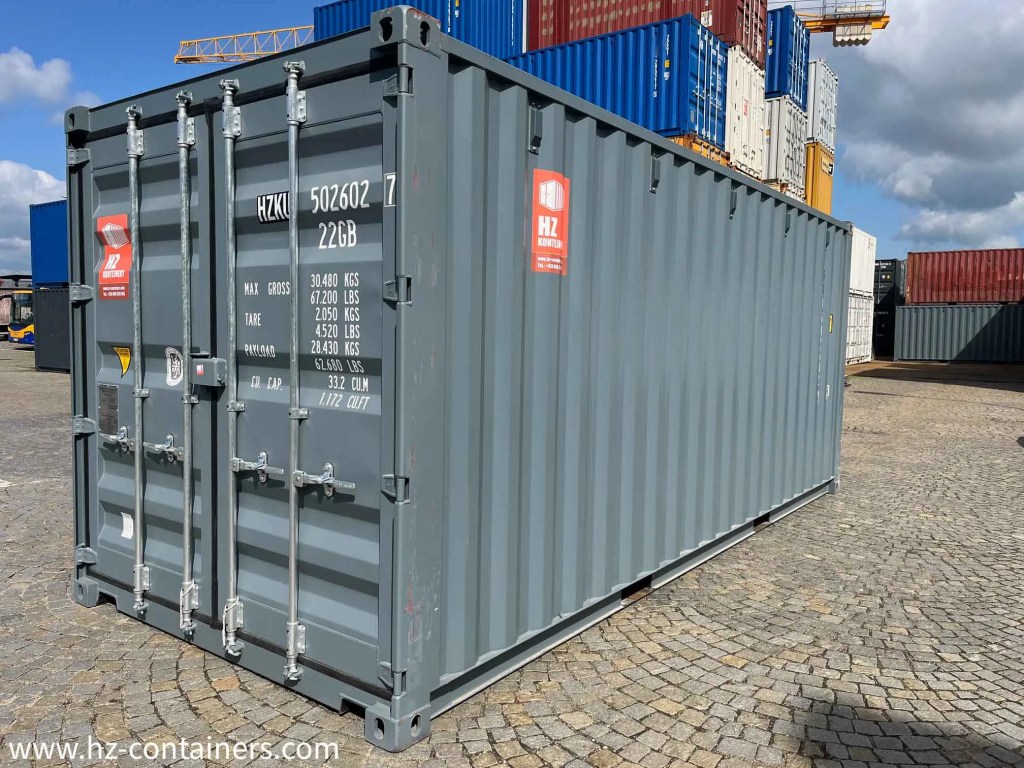
Standard Shipping Container Sizes
Standard containers are the basic building block of global logistics. They feature a standard width of 8 feet (2.44 m) and a height of 8 feet 6 inches (2.59 m).
Comparison Table of Common Sizes
| Container Type | External Dimensions (L × W × H) | Internal Dimensions (L × W × H) | Volume (m³) | Empty Weight (kg) | Max. Payload (kg) |
|---|---|---|---|---|---|
| 10 ft Standard | 2.99 × 2.44 × 2.59 | 2.84 × 2.35 × 2.39 | 15.9 | ~1 300 | ~8 000 |
| 20 ft Standard | 6.06 × 2.44 × 2.59 | 5.89 × 2.35 × 2.39 | 33.2 | 2 200–2 400 | 28 000–30 480 |
| 40 ft Standard | 12.19 × 2.44 × 2.59 | 12.03 × 2.35 × 2.39 | 67.7 | 3 600–3 900 | 28 800–30 480 |
| 40 ft High Cube (HC) | 12.19 × 2.44 × 2.89 | 12.03 × 2.35 × 2.69 | 76.4 | 3 900–4 200 | 28 560–29 600 |
| 45 ft High Cube (HC) | 13.72 × 2.44 × 2.89 | 13.56 × 2.35 × 2.69 | 86.0 | 4 820 | 27 860 |
Note: Dimensions and weights may vary by manufacturer and age of the container.
10 ft Container
- Smallest standard size
- Suitable for temporary storage, small‑business facilities, mobile stalls, small workshops, construction cells
- Advantages: easy handling, suitable for limited spaces, lower transport costs
20 ft Container (1 TEU)
- Most common type for export and storage
- Suitable for most standard goods, mobile warehouses, base for smaller constructions and modifications
- Strengths: simple handling, stackability, optimal volume‑to‑cost ratio
- Typical contents: 11 euro pallets, a midsize passenger car, a typical household move
40 ft Container (2 TEU)
- Economical choice for larger volume
- Popular for bulky or voluminous cargo, long‑term storage, structural base for larger projects
- Benefit: cost per volume is lower than two 20 ft containers
- Capacity: up to 25 euro pallets, several cars, equipment for a large company, etc.
High Cube Containers – Extra Height
What Is a High Cube Container?
A High Cube (HC) container has the same length and width as a standard container but is one foot (30 cm) taller. Standard external height is therefore 2.89 m (internal approx. 2.69 m), giving up to 12 % more volume.
Benefits and Uses of High Cube Containers
- Larger internal volume: ideal for bulky yet light goods that would not fit upright in a standard container (e.g., machinery, high racks, stacked pallets)
- Excellent for construction modifications: extra height allows comfortable living space (after insulation the clear ceiling height remains above 2.5 m)
- Optimal for multi‑layer pallet storage
Comparison Standard vs. High Cube
| Feature | Standard Container | High Cube Container |
|---|---|---|
| External Height | 2.59 m | 2.89 m |
| Internal Height | approx. 2.39 m | approx. 2.69 m |
| Internal Volume | see table above | +10–12 % |
| Surcharge | none/small | slightly higher price |
| Use | regular cargo | high/voluminous cargo, construction |
Special Sizes
- 20 ft High Cube: ideal when length is limited but height is needed
- 40 ft High Cube: most sold HC container, universal for transport, storage, construction and modifications
- 45 ft High Cube: extra long, mainly used on specific routes and in the USA; maximum capacity for light, voluminous cargo
- 53 ft High Cube: largest commonly produced size (mainly for inland transport in the USA/Canada)
Key Technical Specifications – Dimensions, Weights, Construction
External vs. Internal Dimensions
- External dimensions determine transport, storage and stacking possibilities – whether the container fits under bridges, in yards, etc.
- Internal dimensions are crucial for loading plans, storage and modifications – they define how much and what size cargo can be placed inside.
Weight Parameters
- Tare weight (empty weight): weight of an empty container (20 ft approx. 2.3 t, 40 ft approx. 3.8 t)
- Max. payload: maximum cargo weight that can be safely transported (20 ft approx. 28 t, 40 ft approx. 28–29 t)
- Max. gross weight: sum of tare weight and payload (typically 30.48 t for both 20 ft and 40 ft)
Doors and Access
- Standard doors: width approx. 2.34 m, height approx. 2.28 m (HC doors up to 2.58 m)
- Double Door: doors on both ends for easier loading/unloading
- Open Side: one entire long side opens, ideal for bulky goods and construction modifications
Practical Guide to Choosing the Right Size
Step 1: Define the Container’s Purpose
- International transport: focus on weight and volume. 20 ft for heavy/compact goods, 40 ft/HC for lighter, voluminous goods.
- Storage: measure the space and list what you will store. If you plan racks or high pallets, consider High Cube.
- Construction and modifications: for living modules, offices and retail spaces, 40 ft HC is almost always the best choice – ample space and comfortable height.
Step 2: Consider Cargo Characteristics
- Weight vs. volume: heavy cargo quickly reaches the weight limit of a 20 ft container. For bulky, light cargo, 40 ft/HC is better.
- Height of items: if any items exceed 2.3 m, you need a High Cube.
- Handling: need access from both sides? Consider Double Door. Very large dimensions? Open Side.
Step 3: Logistics and Availability
- Delivery to site: a 40 ft container requires more space for placement and handling – minimum road width 3 m, height clearance 4.5 m.
- Stacking: standard containers can be stacked up to 7 units high – important for efficient yard space use.
Step 4: Budget and Economics
- Cost per volume: a 40 ft container has almost double the volume of a 20 ft but often only 20–30 % higher price.
- New vs. used: new (one‑trip) containers are ideal for construction; used containers are cheaper but always check seal integrity and structural condition.
- Additional costs: transport, placement, possible modifications (doors, windows, insulation).
Frequently Asked Questions and Specific Examples
How many euro pallets fit into each container?
| Container Type | Number of Euro Pallets (floor) |
|---|---|
| 20 ft | 11 |
| 40 ft | 25 |
| 40 ft HC | 25 (with stacking possible) |
| 45 ft HC | 27–29 |
What is the service life of a shipping container?
- In international transport: 10–15 years (depending on usage intensity)
- For storage/construction: 25+ years (with proper maintenance and corrosion protection)
- Maintenance: regular repainting, seal checks, floor treatment
What is the difference between new, used and decommissioned containers?
- New container: no damage, ideal for construction and long‑term storage of sensitive items
- Used container: may have minor cosmetic defects, fully functional, suitable for warehouses, transport, simple constructions
- Decommissioned (as‑is): usually not watertight or significantly damaged, usable only as covered storage, cheap shelter, or structural base

 Czech Republic, Vysoké Mýto
  FREE SHIPPING


Other container news...

The Difference Between a Container Port, Terminal and Depot
Container port, terminal or depot. Are they the same thing? Many people think that they are the same, but they are not. Each of these places has its own specifics and primarily serves a different purpose. You will learn how to finally be clear about this in this article.

Shipping Containers Arquata Italy
Shipping containers are the backbone of modern global logistics. Arquata, Italy is home to one of Europe’s most important logistics centres, handling thousands of containers a year. This guide will tell you everything you need to know about Arquata Italy shipping containers — from their technical specifications to the practicalities of transport and storage.

Shipping Containers Ancona Italy
Shipping containers are the backbone of the modern global economy. Every day, millions of tons of goods are transported in these standardized metal boxes across the world’s oceans. The port of Ancona in Italy is one of the key hubs of European container logistics, strategically located on the shores of the Adriatic Sea. This guide will give you a complete overview of shipping containers, their types, specifications, purchasing and the role of the port of Ancona in modern freight transport.

Shipping Containers Barcelona Spain
Shipping containers are the backbone of modern global trade, and the Port of Barcelona is one of the most important nodes in this network. Understanding how containers work, what their standards are and how cargo is handled in the Port of Barcelona is essential for anyone involved in international commercial transport. The Port of Barcelona continues to invest in digitalisation, automation and environmental sustainability to maintain its position as one of the most important ports in Europe and the world.