
Price of CORNER CASTING
Corner casting (in English corner casting, in Czech also often called “corner block” or “container cube”) is a fundamental, highly technically sophisticated structural element of every standardized ISO shipping container. This robust casting made of cast steel is welded into each of the eight corners of a container – four on top and four on the bottom. These corner elements form universal connection points that allow containers to be safely lifted, stacked, anchored and transported across continents, by road, rail and sea transport.
Their precise dimensions, properties and load capacity are prescribed by the ISO 1161 standard, which guarantees compatibility and safety in global logistics. Corner castings are thus true “corners of the world” – key nodes that bear extreme loads and enable global transport without borders.
Essential importance of corner castings
Ensuring structural strength and load capacity
Corner castings are designed to carry extreme loads. When stacking containers – for example, on a ship’s deck in ten or more layers – the entire weight is concentrated precisely in these corners. The side walls and roof of the container are not designed to carry these vertical forces. Corner cubes transfer pressure directly to the container frame and further to the foundation.
Technical details:
- In a standard 20-foot container, there can be up to 200 tons in a column on one corner cube.
- Each casting is welded with a corner post, top and bottom frame and forms the load-bearing skeleton of the entire structure.
Enabling intermodal transport
Standardization of corner castings according to ISO 1161 means that every container can be handled using the same technique throughout the world. It doesn’t matter whether the crane is in Shanghai, the chassis in Rotterdam or the rail car in the Czech Republic – the same connection points are always used.
Benefits:
- Quick exchange between sea, rail and road transport without the need to unload cargo.
- Reduced risk of cargo damage and significantly shortened transport times.
Safety and stability in transport
During sea transport or in heavy-duty operations, containers are exposed to significant forces. Corner castings allow the use of twistlocks (rotating locks) and other connecting elements that securely fasten containers – both vertically and horizontally.
- Twistlocks: They are inserted into the upper or lower corner holes and, when rotated, firmly fix the containers to each other or to the transport platform.
- Bridge fittings: Used to connect containers side by side on a ship or in a depot.
Versatility beyond transport
Corner castings have found application beyond logistics – in modular architecture (container houses, offices, shops) or as anchor points for various structures.
Construction characteristics and materials
Material composition: Cast steel according to ISO
Corner castings are manufactured from high-strength cast steel, usually according to the specification CNS-SCW49/S-SCW480. This alloy has exceptional mechanical properties:
| Characteristic | Description |
|---|---|
| Tensile strength | > 490 MPa |
| Hardness | Resistant to repeated impacts and low temperatures |
| Weldability | Material designed for strong welding with frame |
| Corrosion resistance | Often surface-treated for increased durability (sometimes Corten steel) |
Lifespan: In normal conditions over 20 years, with proper maintenance even longer.
Dimensions and weight
According to ISO 1161:
| Dimension | Value |
|---|---|
| Length | 178 mm |
| Width | 162 mm |
| Height | 118 mm |
| Weight | approx. 10.9–12.5 kg |
Castings always have three holes – each serves a different purpose:
- Vertical hole (top/bottom): For twistlocks and stacking
- Side hole: For connecting side by side, anchoring
- Front hole: For guidance and quick attachment of spreader (crane hook)
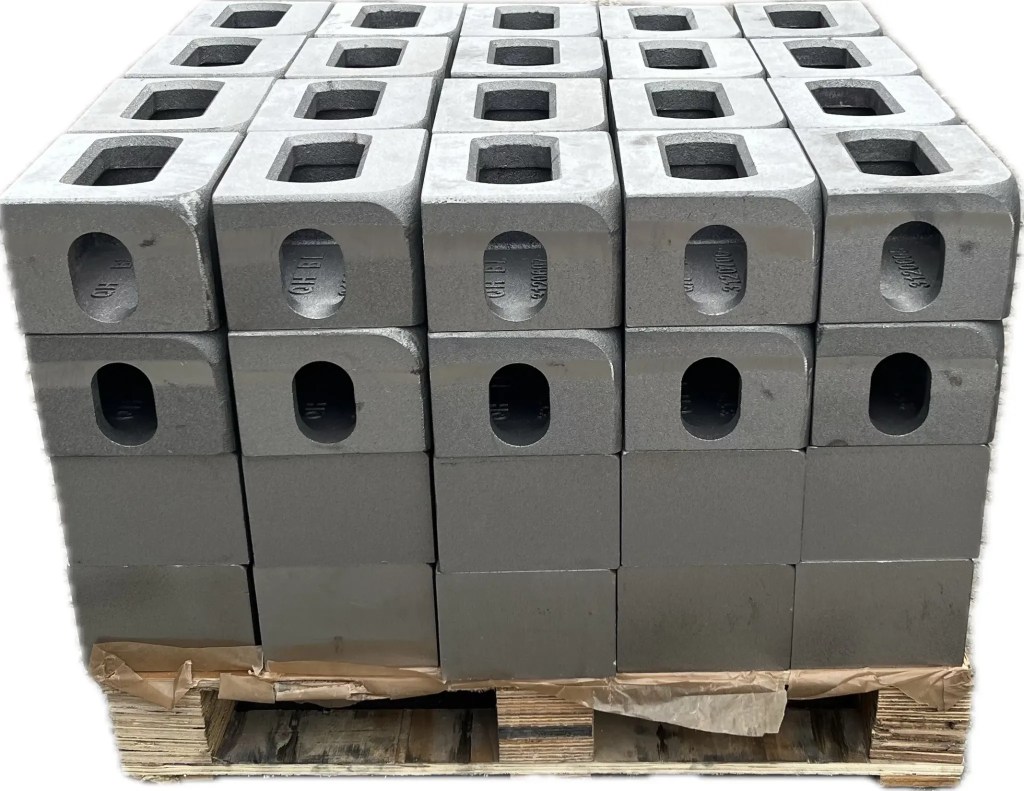
Types of corner castings and their designations
In fact, not all corner castings on a container are the same. We distinguish four basic types, always two at each position:
| Type | Location | Description |
|---|---|---|
| TL | upper left front / lower right rear | Hole for twistlock from above, plate hole on front side, “stadium” (oval) hole on side. |
| TR | upper right front / lower left rear | Mirror image of TL |
| BL | lower left front / upper right rear | Hole for twistlock from below, plate hole on front side, oval hole on side. |
| BR | lower right front / upper left rear | Mirror image of BL |
Each casting is marked with an embossed type designation (TL, TR, BL, BR) for clarity during assembly and repairs.
ISO 1161 Standard: Global standard
The ISO 1161:2016 standard “Freight containers – Corner and intermediate fittings – Specifications” is the foundation of worldwide compatibility.
What ISO 1161 standard prescribes:
- Precise dimensions, tolerances (mostly 0 to +1.5 mm)
- Shapes of holes and their placement
- Material properties (minimum strength, ductility, impact resistance)
- Functional tests (destructive tests, dimension control, material analysis)
- Requirement for certification of each production series
Without this standard, it would not be possible to globally standardize container handling.
Practical use of corner castings
Handling and lifting
- Spreader crane is equipped with four twistlocks, which are inserted into the upper corner holes.
- By rotating the twistlock, the container is secured and can be safely lifted.
Stacking (vertically)
- The lower castings of the upper container fit precisely onto the upper castings of the lower container.
- Twistlocks are inserted between the castings to prevent shifting.
Anchoring and connecting (horizontally)
- Bridge fittings (connecting brackets) are inserted into the oval holes of two adjacent containers and pull them firmly together.
- Another option is to use lashing rods and tensioners for securing to the ship’s structure or platform.
Special applications
- Manufacturing of container houses and building modules
- Anchor points for solar panels, railings, technical equipment
Manufacturing, quality control and maintenance
Manufacturing process
- Casting: High-strength steel is cast into precise molds according to the type of casting (TL, TR, BL, BR).
- Cooling and cleaning: After removal from the mold, the casting is cleaned (blasting, grinding).
- Machining: Critical surfaces and holes are precisely machined.
- Inspection: Each series is subject to measurement and destructive tests; only certified castings go to market.
Inspection and maintenance
Regular inspection of corner castings is essential (especially when selling used containers or as part of periodic maintenance):
- Cracks: Most often around welds.
- Deformation: Bends, dents, enlarged holes.
- Corrosion: Surface rust is common; deep corrosion is a reason for replacement.
- Wear: Excessive play in holes means risk of twistlock malfunction.
Repairs may only be performed by certified welders who comply with standards (e.g., IICL-5).
Price of corner castings in the Czech Republic (2024)
Price overview:
| Type | Price without VAT (1 pc) | Price with VAT | Sources |
|---|---|---|---|
| TL/TR (upper castings) | 1,300 CZK | 1,573 CZK | corner casting |
| BL/BR (lower castings) | similar price | similar price | same source |
- Price for set (8 pcs): approx. 10,000 – 12,000 CZK without VAT (depending on supplier, quantity and exchange rate).
- Availability: In stock, delivery usually within 1–2 days in the Czech Republic, or within a week within the EU.
- Material: CNS-SCW49/S-SCW480 (high-strength cast steel)
- Weight: 10.94 kg/pc
Note: Price may vary depending on current steel market, demand and USD/CZK exchange rate.
Frequently Asked Questions (FAQ)
Are all corner castings the same?
No, there are four types according to position (TL, TR, BL, BR), each with specific holes and orientation.
What material are corner castings made of?
From high-strength cast steel CNS-SCW49/S-SCW480, often with surface treatment against corrosion.
What weight can one corner casting support?
One cube must withstand loads of up to 200 tons (within a stack of containers).
Can corner castings be purchased separately?
Yes, they are available individually or in sets, commonly used outside of logistics as well.
How do I know if a casting complies with ISO 1161?
Dimensions 178x162x118 mm, weight approx. 11 kg, correct hole shapes, embossed type designation and certificate from the manufacturer.

 Czech Republic
  WITHOUT SHIPPING


Other container news...

What does ONE TRIP shipping container mean?
Welcome to our detailed article, where you will find the most detailed explanation of the term ONE TRIP shipping container – technical parameters, standards, life cycle, advantages, disadvantages and practical advice for purchasing.

What colors of shipping containers are the most used and most in demand?
The choice of shipping container color is a strategic issue of safety, durability, operational efficiency and corporate identity. The most popular shades (anthracite gray, gentian blue, light gray, pure white) are the result of long-term practice and reflect the requirements for durability, versatility and visual appeal. Modern coating systems meet strict standards (ISO, CSC) and, thanks to advanced pigments, offer better thermoregulation. When choosing, we recommend taking into account not only aesthetics, but also practical aspects – the type of cargo, environment, maintenance requirements and future use of the container.

Terminal Handling Charges (THC) in European and Czech Ports
Terminal charges (THC) are a complex and variable cost component in international transport. For Czech exporters and importers, understanding the structure, development and method of charging these charges is key to effective logistics cost management. Transparent communication with carriers and forwarders, the right choice of port and Incoterms and an emphasis on technological innovations in ports can fundamentally help optimize overall transport costs.

Salt Air and Shipping Containers
Salt air is a relentless and often underestimated enemy of steel shipping containers. Knowing how it works is key, but above all, a systematic approach to prevention, maintenance and repair is key. By following the recommended procedures, you can significantly extend the life of your container and protect your investment and the goods you are transporting.