
How to Use Bridge Fitting
In the rapidly evolving world of global logistics and maritime shipping, safety, stability and efficiency when handling shipping containers are top priorities. Securing the proper connection between containers is essential not only at sea but also during land transport, storage or in construction. One of the indispensable connecting components that often remains in the shadow of more familiar systems such as twist locks is Bridge Fitting.
This article gives you a detailed look at the technical parameters, construction, operating principle, applications and proper use of bridge fittings, including the latest insights and manufacturers’ experiences.
What Is a Bridge Fitting? Definition and Basic Purpose
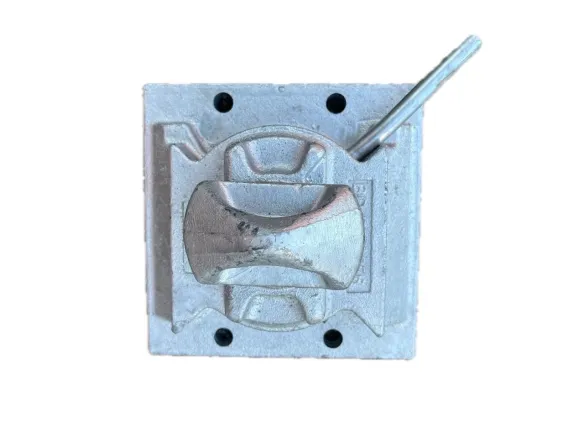
Bridge fitting is a robust, specialized connecting component designed for horizontal joining of shipping containers (side‑by‑side or end‑to‑end). It connects containers through their corner castings so that they are tightly clamped together, forming a stable unit that can resist movement, vibration and extreme forces during transport.
Key Functions and Benefits of a Bridge Fitting
| Function | Description and Benefit |
|---|---|
| Horizontal connection | Provides a firm link between containers side‑by‑side or end‑to‑end, increasing overall stability |
| Increased safety | Prevents shifting, overturning or separation of containers during transport or storage |
| Easy and quick installation | Allows simple installation and removal without welding |
| Compatibility with ISO containers | Universally usable with all standard ISO containers (20′, 40′, 45′, high‑cube) |
| Suitable for various applications | From maritime transport to rail, construction and modular architecture |
| Certified safety | Meets international standards (e.g., ISO 3874) and is tested for extreme loads |
Where Is a Bridge Fitting Used?
- On the decks of container ships to join rows of containers
- During rail or road transport to create monolithic blocks of containers
- In construction for walls, fences, modular buildings and temporary structures
- In warehouses and logistics centres for secure storage of multiple containers
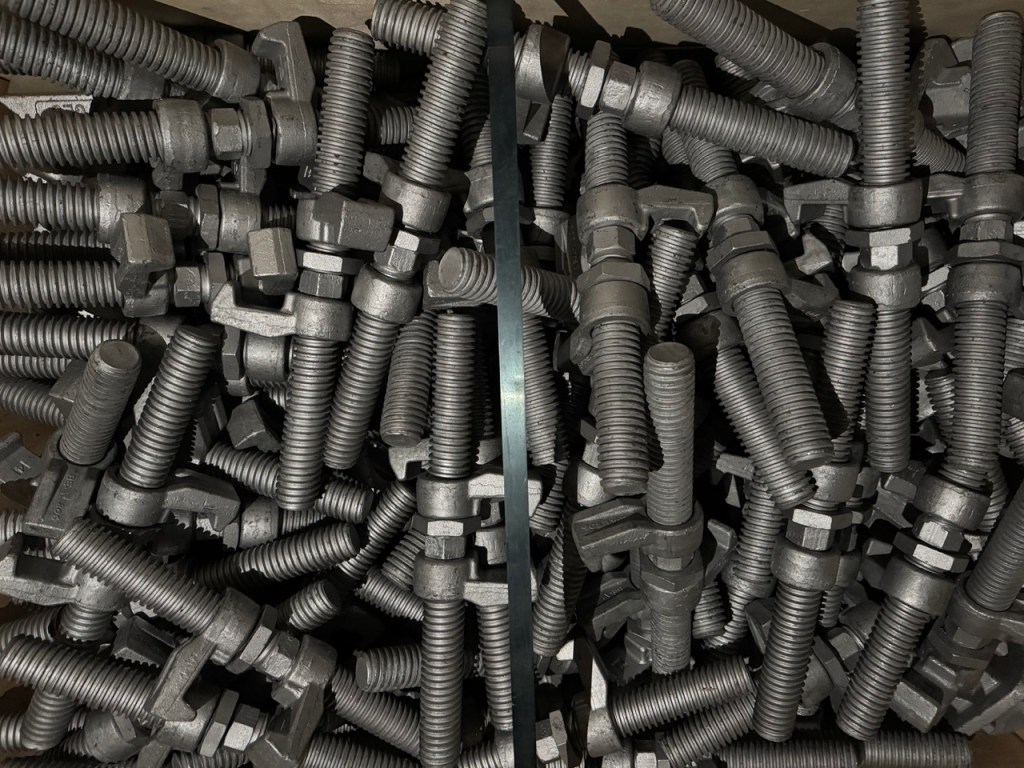
Anatomy and Technical Construction of a Bridge Fitting
For a bridge fitting to perform its function reliably, its construction must be perfectly engineered and made from the toughest materials.
Main Parts of a Bridge Fitting
| Part | Function |
|---|---|
| Two clamps (hooks) | Robust steel hooks that fit precisely into the corner castings of containers |
| Central threaded rod | Connects both clamps, carries the main tensile forces, has opposite threads on each side |
| Tightening nut | Allows mechanical pulling of the clamps together, thus clamping the containers |
| Safety nut | Locks the main nut against loosening caused by vibration |
Turnbuckle Principle
- Opposite threads on the ends of the rod allow the central nut to pull the clamps together or push them apart when turned.
- The generated force is evenly distributed between the two containers.
- After tightening, the safety nut is tightened against the main nut, preventing the joint from loosening even in highly vibratory environments.
Technical Specifications and Materials: Designed for Extreme Conditions
Bridge fittings are intended for the harshest environments – they must withstand aggressive seawater, mechanical stress and long‑term use.
Materials and Surface Treatment
| Parameter | Description |
|---|---|
| Material | High‑quality cast or forged steel, often alloyed for increased strength and toughness |
| Surface treatment | Hot‑dip galvanizing – a thick zinc layer that protects against corrosion in aggressive environments |
| Load capacity | Working load (SWL) typically 7.5–10 t (74–100 kN); ultimate (breaking) load at least 20–22 t (200–220 kN) |
| Dimensions | Standard length 260–280 mm (10–11.5 in), special versions up to 380 mm for larger container gaps |
| Weight | 3.5–5.0 kg each; some heavier models up to 3.0 kg depending on design and manufacturer |
| Compatibility | Suitable for all ISO container types (20′, 40′, 45′, high‑cube) |
Safety Factor
- Every bridge fitting is tested to withstand multiple times the normal working load.
- It complies with international standards ISO 3874 and container manufacturers’ recommendations.
- The surface treatment ensures durability even in high‑salinity and high‑humidity environments.
Practical Use and Applications of Bridge Fittings
Maritime and Rail Transport
- Side‑by‑side container connection: Prevents horizontal movement on ship decks or rail wagons.
- Stability of stacks: Combined with twist locks, creates extremely strong blocks that resist waves, wind and impact.
- Safety system: Bridge fitting is part of a comprehensive lashing system together with twist locks, lashing rods, chains and tensioners.
Construction and Modular Architecture
- Temporary or permanent container connections for offices, warehouses, residential and commercial buildings, fences, barriers.
- Fast and reversible assembly: Connections can be easily released for relocation or dismantling.
- Improved safety and sealing: Minimises gaps between containers, offering better protection against weather and unauthorized entry.
Additional Uses
- Storage (depots, terminals): Connecting containers into larger storage units.
- Temporary events and festivals: Quick container structures for booths, stages and backstage areas.
Guide: How to Use a Bridge Fitting (Step‑by‑Step)
Required Tools
- Large adjustable wrench (e.g., 46 mm French or ratchet wrench)
- Grease or thread lubricant (for easy tightening and corrosion prevention)
- Protective gloves (to avoid injury during handling)
Installation Procedure
- Inspection and preparation
- Examine the bridge fitting for cracks, deformation or corrosion.
- Check that the threads are clean and lubricated.
- Pre‑set length
- Rotate the central nut to set the fitting to approximately the distance between the corner castings.
- Insert clamps
- Place one clamp into the corner opening of the first container, the other into the adjacent container.
- Tightening
- Using the large wrench, turn the central nut until the containers are firmly drawn together.
- Tighten firmly but do not overtighten (respect the fitting’s working load).
- Secure with safety nut
- Tighten the safety nut against the main nut to lock the joint.
- Disassembly
- Loosen the safety nut, then the central nut, and remove the fitting.
Tip: For a pair of connected containers, use four bridge fittings – one at each corner – for maximum safety.
Bridge Fitting vs. Twist Lock: Key Differences
| Connecting element | Primary function | Location | Principle | Compatibility |
|---|---|---|---|---|
| Bridge Fitting | Horizontal connection | Between side corner castings | Threaded pull (turnbuckle) | ISO containers |
| Twist Lock | Vertical connection / stacking | Between top and bottom corner castings | Rotating lock mechanism | ISO containers, floor decks |
- Synergy in practice: Twist locks prevent vertical movement and partially limit horizontal shift of stacked containers, while bridge fittings join entire rows and stacks into a solid block for maximum stability and safety.
Maintenance, Service Life and Safety Recommendations
- Inspect regularly the condition of bridge fittings (damage, cracks, corrosion).
- Keep threads clean and lubricated for smoother operation and longer life.
- Use only original, certified products.
- Do not exceed the declared working load.
- Store fittings in a dry place away from direct seawater exposure when not in use.
Frequently Asked Questions (FAQ)
How many fittings are needed to connect two containers?
Four pieces – one at each corner – are required for a safe connection.
Can the fitting be reused?
Yes, provided it is not damaged or excessively corroded.
What size wrench should I use?
Typically a French or ratchet wrench with a 46 mm head (check the manufacturer’s specifications).
Can a bridge fitting be combined with twist locks?
Yes, combining both is recommended for maximum safety.
 Czech Republic
  WITHOUT SHIPPING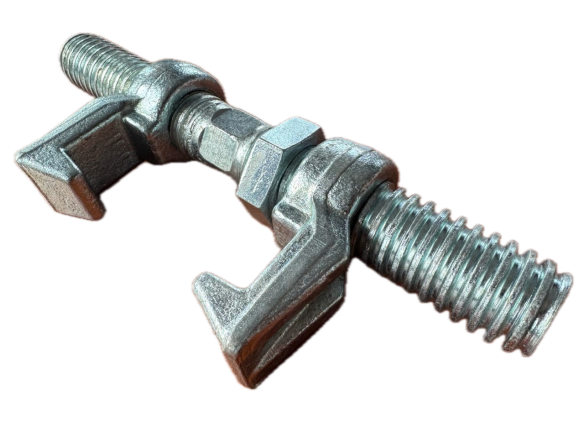
Other container news...

High Cube container specifications
A high cube container — also referred to as an HC container, HQ container, or high-cube — is an intermodal shipping container that stands one foot taller than the standard ISO container. While a standard general-purpose container measures 8 feet 6 inches (2.59 m) in external height, a high cube container extends to 9 feet 6 inches (2.89 m). This extra 12 inches of vertical clearance translates into approximately 10–15% more cubic capacity without altering the container’s footprint — the same length and width are maintained, meaning the container occupies the same floor space on a vessel, chassis, or storage yard.

Shipping container parts
A shipping container looks like a simple steel box from the outside, but it is an assembly of dozens of precisely engineered shipping container parts — each governed by international standards, each designed to survive decades of ocean transit, crane lifts, and stacking loads that would crush an ordinary structure. Whether you are buying a used container, planning a container home, troubleshooting a repair, or simply building your logistics vocabulary, understanding every individual component is the difference between making an informed decision and an expensive mistake.

40 Foot Container Dimensions
If you have ever booked ocean freight, planned a warehouse layout, or designed a modular building project, you have asked the same question: what are the exact 40 foot container dimensions — and what do they mean for what you can actually load? The numbers are standardized worldwide, but the practical implications of those numbers are surprisingly nuanced. A 40-foot container is not simply 40 feet of usable space, and its weight limits are not what most people assume. This guide covers every measurement, every weight rating, and every loading consideration you need to make informed decisions about the world’s most common shipping container.
Quick Answer: A standard ISO 40-foot shipping container measures 12.19 m (40 ft) long × 2.44 m (8 ft) wide × 2.59 m (8 ft 6 in) high externally and provides approximately 67.7 m³ (2,390 ft³) of usable internal volume. The maximum gross weight is 30,480 kg (67,200 lbs), with a typical payload capacity of approximately 26,700–26,800 kg (58,900–59,000 lbs).

Cargo worthy container
If you have ever shopped for a used shipping container, you have almost certainly encountered the term cargo worthy — often abbreviated as CW or CWO (Cargo Worthy Only). It is one of the most important classifications in the container industry, yet it is also one of the most misunderstood. A cargo worthy container is not a container that looks new. It is not necessarily a container that has a valid CSC plate. And it is definitely not the same as a wind and watertight container. This guide explains what cargo worthy really means — from its technical definition and historical origins to the precise structural criteria, inspection process, cost implications, and common misconceptions that trip up even experienced buyers.