
How to unload a shipping container? Using ConFoot legs
Unloading a shipping container using ConFoot legs introduces an innovative way to safely and efficiently unload a standard ISO container (10–45 ft) from a trailer or chassis without heavy handling equipment. Using a set of four special support legs (ConFoot), the container can be placed directly on the ground or at a ramp at the destination. The key principle is the use of the chassis air suspension and a patented leg system that installs into the container’s corner castings. After lowering the chassis, the container remains safely standing on the legs while the vehicle can immediately continue with the next transport. This process dramatically reduces non‑productive waiting time, eliminates the need for a crane, increases logistical flexibility, and cuts costs.
HZ CONTAINERS s.r.o. is the distributor of ConFoot legs in the following countries:
Czech Republic, Croatia, Italy, Hungary, Malta, Romania, Greece, Slovakia and Slovenia.
ConFoot legs are also available for rental, but only in the Czech Republic and Slovakia!
What are ConFoot legs? Technology, materials, certifications
Construction and material
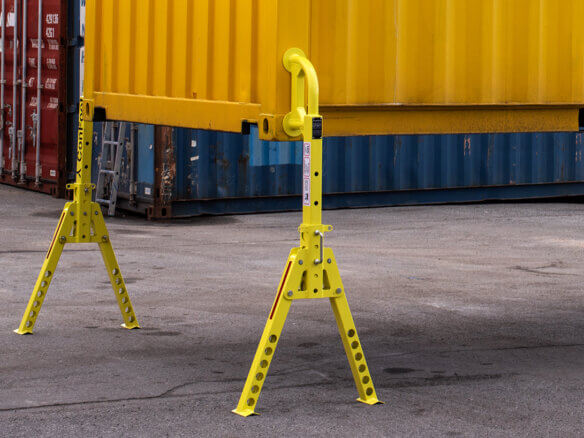
- High‑strength steel: The legs are made from a special alloy of Finnish high‑strength steel (six different grades), providing an optimal balance of low weight and high load capacity.
- Patented design: The unique folding construction is protected by a patent. In the folded state the arms form a compact shape; when extended they create an inverted “V” for maximum stability.
- Magnetic stabilization: A magnet at the top attaches the leg to the container wall, preventing unwanted movement during installation and handling.
- Weight and handling: A standard leg weighs only 24 kg (model CF), allowing easy handling by one person without a crane or pallet truck.
Safety and certifications
- Static and dynamic testing: Each model is certified according to the European standard EN 283, which verifies resistance to long‑term loads and dynamic shocks during handling.
- CE marking: The system complies with directive 2006/42/EC for machinery.
- Construction safety devices: Securing pins and telescopic mechanisms with safety locks minimise the risk of accidental collapse.
- Surface treatment: Anti‑corrosion coating for long service life in harsh weather conditions.
Compatibility
- Corner castings: Compatible with all standard ISO containers (10’, 20’, 30’, 40’, 45’), including tank, frame and special containers, provided they have ISO corner castings.
- Installation surface: Requires a solid, flat and load‑bearing surface (concrete, asphalt, compacted gravel).

ConFoot models and variants: Comparison overview
| Model | Load capacity (kg) | Weight per unit (kg) | Adjustable height (mm) | Usage specification |
|---|---|---|---|---|
| CF | 34 000 | 24 | 1 043 – 1 448 | Standard use, universal |
| CFP | 30 000 | 24 | 1 043 – 1 448 | For ramps, allows door opening |
| CFU 20 | 20 000 | 46 | up to 1 500 | Lifting (can be lowered to ground) |
| CFU 30 | 30 000 | 46 | up to 1 500 | Advanced height regulation |
| CFL | 34 000 | 24 | 1 043 – 1 448 | For frame containers (tank etc.) |
- CF (Standard) – for ordinary decommissioning on construction sites, in logistics, agriculture, or temporary warehouses.
- CFP (For ramps) – a special “L” shape allows doors to open up to 270°, suitable for direct unloading at a ramp in distribution centres.
- CFU (Lifting device) – includes a mechanism for active lifting and lowering of the container, ideal for locations without equipment or where the container floor must be level with the ground.
- CFL (For frame containers) – optimised for tank and special frame containers.
Price range (approx., excl. VAT)
- CF/CFP/CFL: about 3 500 EUR per set (4 pcs)
- CFU 20: about 6 300 EUR per set
- CFU 30: about 7 500 EUR per set
Prices may vary with exchange rates or market conditions.
Detailed procedure: How to unload a shipping container using ConFoot legs
Required equipment
- Set of 4 ConFoot legs (type depends on container)
- Vehicle with ISO chassis and air suspension
- Protective work gear (gloves, safety boots)
- Ideally 2 persons (1 experienced is sufficient)
Step‑by‑step instructions
- Prepare the site
- Check the load‑bearing capacity and evenness of the surface (ideally concrete, asphalt, compacted ground).
- Ensure there are no obstacles nearby.
- Secure the chassis
- Position the vehicle, apply the brakes and set wheel chocks.
- Raise the air suspension to its maximum (typically 10–15 cm above normal height).
- Unlock the twist‑locks on all four corners of the container.
- Install the legs
- Take a folded leg and insert the fixing pin into the corner casting (long side, according to type).
- Rotate the leg to a vertical position, spread the arms into a “V”, and secure the pins.
- Use the magnet to attach the upper part of the leg to the container wall.
- Extend the telescopic part until the leg sits firmly on the ground; lock it with the safety mechanism.
- Repeat for all four corners.
- Enable container access
- For the CFP model, set the legs so the doors can open to full angle.
- Transfer the load
- Slowly lower the vehicle’s air suspension. Observe the weight transferring smoothly onto the legs.
- Check stability and even loading of all legs.
- Vehicle departure
- Carefully drive the chassis out from under the container straight forward.
- The container remains stable on the legs, ready for unloading or storage.
Loading back onto the vehicle
- The process is exactly reversed: drive under the container, raise the suspension, remove the legs, lock the twist‑locks, and lower the suspension.
Comparison with alternative handling methods
| Method | Equipment needed | Number of people | Time | Cost | Safety | Flexibility | Comment |
|---|---|---|---|---|---|---|---|
| ConFoot | Minimal (legs only) | 1 | 5–10 min | Low | High | High | Ideal for sites without a crane |
| Mobile crane | Yes | 2+ | 30+ min | High | Medium | Low | Requires booking, waiting times |
| Side loader | Yes (special vehicle) | 1–2 | 15–30 min | High | High | Medium | Expensive, limited availability |
| Reach stacker | Yes (yard) | 2+ | 10–20 min | High | High | Low | Only in ports/warehouses |
| Forklift | Yes (large forklift) | 2+ | 15–30 min | High | Medium | Low | Limited load capacity, risk of damage |
ConFoot is the only system that enables unloading without heavy equipment, anywhere, quickly and safely.
Key advantages and benefits of the ConFoot system
- Significant time savings – the driver does not lose hours waiting for unloading and can continue with the next job immediately.
- Reduced operating costs – no need to pay for a crane, side loader or reach stacker.
- Increased safety – minimal injury risk, no heavy machinery in operation, certified to EN 283.
- Terrain flexibility – can be used in remote areas, on construction sites, in production yards or at festivals.
- Speed and simplicity – one person can complete the whole process in 5–10 minutes.
- Goods protection – a container standing on legs is ventilated, reducing moisture, rodent and flood risks.
- Product longevity – with proper maintenance and storage the product lasts for decades.
Practical use cases
- Logistics – efficient “drop & hook” operations where the vehicle simply unloads the container and drives on.
- Construction – temporary warehouses, changing rooms, offices directly on site – a container on legs is mobile and safe.
- Agriculture – storage of harvest, feed or seasonal equipment without building foundations.
- Humanitarian and military deployments – rapid setup of field hospitals, stores, accommodation units without reliance on infrastructure.
- Distribution centres – the CFP model allows the container to be positioned directly at a ramp for easy unloading.
- Special events – festivals, trade fairs, where mobile infrastructure is required.
Safety instructions and maintenance
Safety rules
- Use only on a load‑bearing, solid and level surface.
- Regularly inspect the legs – do not use damaged, deformed or heavily corroded parts.
- Distribute the load evenly – the container must not be overloaded on one side.
- Wind limit – do not use when wind speed exceeds 22.5 m/s.
- Establish a safety zone – unauthorized persons must stay away from under the container during handling.
Maintenance
- Cleaning – regularly remove dirt, mud, de‑icing salts.
- Lubrication – lubricate all moving parts with appropriate grease at least once per season.
- Storage – keep in a dry, covered and ventilated place, away from aggressive substances.
- Service life – with proper care the legs can exceed 10 years even in demanding operation.
Related terms and legislation
- ISO container – international standard for transport containers (ISO 668).
- Corner casting – attachment and handling element, per ISO 1161.
- Twist‑lock – securing mechanism for fixing the container to the chassis.
- EN 283 – European standard for testing container durability.
- CE marking – indicates conformity with EU safety and performance requirements.

 Czech Republic
  WITHOUT SHIPPING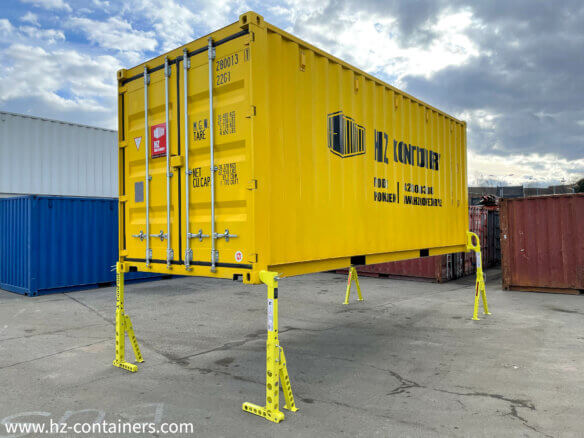

Other container news...
Buy shipping containers
Buying a shipping container means purchasing a standardized steel intermodal box — typically 10, 20, or 40 feet long — for use as ground-level storage, job site equipment housing, cargo transport, or architectural conversion. The right container can last decades. The wrong one can leak, rust through, or fail inspection the day it arrives. This guide covers every step of the process, from understanding what you’re actually buying to inspecting it in person and preparing your site for delivery.

20 Foot shipping container cost
If you are researching the cost of a 20 foot shipping container, you have likely already encountered wildly different prices — from $999 listings online to quotes exceeding $5,500. That range is not a sign of inconsistency. It reflects real differences in container condition, location, delivery logistics, and the seller you are dealing with.
Side Opening container
A side opening container is an ISO-compliant intermodal shipping container engineered with full-length bi-fold doors along one of its long side walls, in addition to the standard cargo doors at one end. Unlike conventional containers that restrict access to a single set of rear doors, a side opening container — also widely called an open side container, open-sided shipping container, or side door container — provides unobstructed lateral access across the entire 20-foot or 40-foot length of the unit. This design transforms the container from a narrow tunnel into a wide-open space that forklifts can enter from the side, multiple workers can load simultaneously, and oversized cargo that would never fit through standard end doors can be placed without struggle.
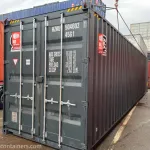
Can You Modify a 40ft High Cube Container?
The short answer is yes — you absolutely can modify a 40ft high cube container, and it is one of the most popular container types for modification projects worldwide. But the real question is not whether you can modify one; it is how to do it correctly, safely, legally, and within budget. This guide answers every dimension of that question, drawing on engineering principles, real-world pricing data, and the collective experience of thousands of modified container projects.
Key Takeaway: A 40ft high cube container offers 320 square feet of floor space with an extra foot of ceiling height compared to a standard container — making it the ideal canvas for offices, workshops, homes, retail spaces, and industrial applications. The extra height is particularly valuable when you add insulation and still want comfortable headroom.