
How to correctly choose a loading ramp for a shipping container?
A loading ramp for a shipping container (in English shipping container ramp or yard ramp) is a technically advanced accessory that significantly eases and increases the safety of handling goods between ground level and the container floor. It typically bridges a height difference of 15–20 cm – the standard container floor is always above the surrounding surface, which prevents barrier‑free access for handling equipment (such as forklifts, pallet trucks, hand trucks).
The ramp creates a safe, smooth and stable incline that enables:
- Efficient and fast loading/unloading of goods (stuffing and de‑stuffing)
- Access for various types of equipment including heavy forklifts and manual pallet trucks
- Reduction of physical effort and elimination of injury or product damage risk
Loading ramps are a key element in logistics, construction, manufacturing, the automotive industry, agriculture and anywhere containers are used as mobile warehouses, workshops, garages or even for residential purposes (such as shipping container homes and container houses).
Why is a ramp essential for efficient container operation?
- Standardized container floor height (approximately 17 cm for both 20 ft and 40 ft models) is not designed for direct equipment entry.
- The ramp eliminates the need for labor‑intensive manual handling of heavy loads or unsafe improvisations.
- Modern ramps allow quick installation, high load capacity and maximum safety even under intensive use.
Practical example:
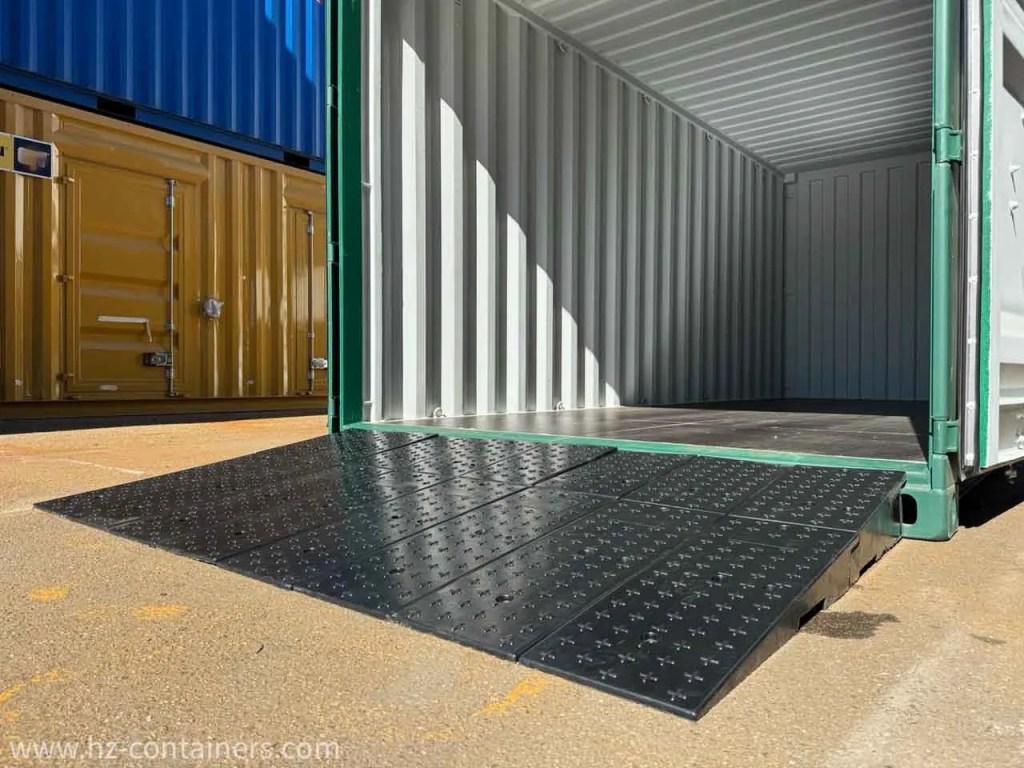
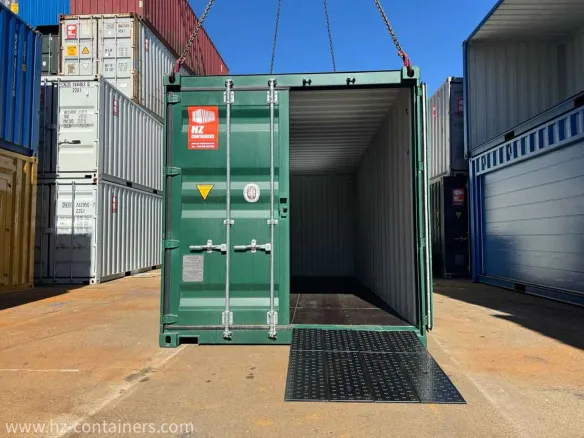
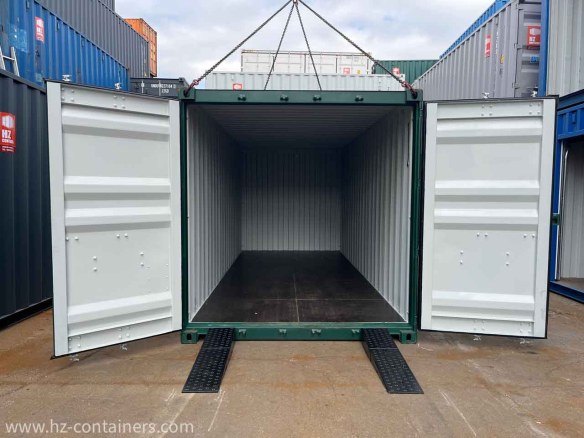
A ramp 1100 mm wide and 1445 mm long from HZ Containers is designed specifically for pallet and forklift trucks and, thanks to hot‑dip galvanized steel, can withstand extreme loads and operation in demanding outdoor conditions.

Why is selecting the right ramp critical?
Table: Risks and benefits of correct vs. incorrect ramp selection
| Criterion | Correct ramp | Incorrect ramp |
|---|---|---|
| Safety | Maximum protection of operators and equipment | High risk of injuries and damage |
| Productivity | Fast and smooth handling | Delays, downtime, complications |
| Asset protection | Protection of goods, forklift and container | Damage to floor, goods, ramp |
| Flexibility | Suitable for multiple types of equipment | Limited usage options |
| Ramp/equipment lifespan | Long, trouble‑free | Shortened lifespan, frequent repairs |
Reasons not to skimp on the ramp:
- Safety first: Handling heavy loads can cause falls, forklift overturns and floor damage. A quality ramp has anti‑slip features, raised edges and a secure attachment system.
- Efficiency: Every minute of downtime costs money. A ramp enables continuous workflow.
- Investment protection: Repairing container floors, forklifts or goods is often many times more expensive than a good ramp.
- Versatility: Today you may use manual trucks; tomorrow a heavy forklift. The right ramp handles both.
Standards and legislation:
In the Czech Republic, CSN EN ISO standards concerning handling safety and ramps apply. Quality manufacturers declare compliance with these regulations.
Key parameters for choosing a loading ramp
Load capacity – fundamental technical parameter
- Must exceed the maximum combined weight of equipment and load!
- For dynamic loading (entry, braking, acceleration) a safety margin of at least 20–30 % is recommended.
- Example: Forklift 4 t + load 1.5 t → recommended ramp capacity at least 6.6 t.
Ramp dimensions (Length and Width)
- Length: Determines the incline. The rule: the longer the ramp, the safer the slope. To overcome a 17 cm height difference, a 1.2–1.5 m ramp is sufficient; for manual trucks up to 2.5 m may be needed.
- Width: Must be at least 30 cm wider than the wheel track of the narrowest equipment. Standard width is 1.1–2.2 m. For two pallet trucks side‑by‑side, a width of at least 1.5 m is appropriate.
Special offer: HZ Containers offers ramps 1445 mm wide, suitable for larger loads and greater handling comfort.
Gradient (Slope)
- Manual trucks: max 10 % (≈ 6°) – steeper slopes risk load shift or inability to operate.
- Electric pallet trucks: up to 15 %.
- Forklifts: can manage up to 20 %, but a gentler slope is recommended for equipment longevity and safety.
Type of handling equipment
| Equipment | Recommended ramp type | Material | Gradient |
|---|---|---|---|
| Manual truck | Light mobile, foldable | Aluminum, steel | Up to 10 % |
| Electric pallet truck | Mobile, more robust | Steel, aluminum | Up to 15 % |
| Forklift | Heavy, stationary, with wheels | Steel, hot‑dip zinc | Up to 20 % |
Material
- Steel: For industrial use, outdoor operation, intense loads. Hot‑dip zinc coating ensures long life and corrosion resistance.
- Aluminum: Low weight, easy handling. Suitable for warehouse environments where the ramp is moved frequently.
Surface treatment and construction features
- Anti‑slip grids (wheel‑rims), slatted steel: Increase safety in rain, snow or ice.
- Raised side edges: Prevent wheels from rolling off the ramp.
- Fork pockets: Allow quick repositioning of the ramp.
- Safety chains, clamps: Secure the ramp to the container.
Types of container loading ramps
Mobile (portable) ramps
| Advantages | Disadvantages | Typical use |
|---|---|---|
| Easy to handle, storable | Lower load capacity, smaller dimensions | Temporary operations, small warehouses, construction sites |
| Aluminum or steel | – | – |
| Foldable construction | – | – |
Stationary (fixed) ramps
| Advantages | Disadvantages | Typical use |
|---|---|---|
| Maximum stability, long lifespan | Not mobile, higher cost | Logistics centers, production halls |
| High load capacity | Requires permanent installation | – |
One‑piece vs. foldable ramps
- One‑piece: Highest strength and durability, suitable for intensive use.
- Foldable (two‑piece): Easier storage, ideal where space is limited.
Material and construction elements: Pillars of safety and durability
Overview of most used materials
| Material | Advantages | Disadvantages | Typical application |
|---|---|---|---|
| Steel | Extreme strength, high load capacity, long life, hot‑dip zinc | Heavy, harder to handle | Heavy duty, outdoor |
| Aluminum | Low weight, corrosion resistance | Lower load capacity, higher cost | Mobile, light duty |
Construction and safety features
- Anti‑slip surface: Wheel‑rim grid or slatted steel – mandatory for safety.
- Side edges: Minimum 5–10 cm, prevent wheel fall‑off.
- Transition plate (lip): Provides smooth entry and protects the container floor edge.
- Attachment: Chains, clamps, pins – firm connection between ramp and container.
- Fork pockets: Enable quick and safe ramp handling.
Ramp in the context of container operations
Standardization and compatibility
- International standards (ISO, CSC): Container manufacturers and ramps follow the same dimensional norms, ensuring compatibility.
- 20 ft and 40 ft containers: Most common types; ramps are sized for their door height and width.
- Accessories from specialized suppliers: Companies such as HZ Containers and Ekovovyroba offer ramps optimized for specific container models, including those with swing doors.
Accessory ecosystem
- A reliable supplier will provide a ramp that fits your container and is ready for immediate use.
- Premium ramps typically include warranty, technical advice and often free delivery.
Comparison of specific market models
| Ramp model | Dimensions (L × W) | Load capacity | Material | Price (incl. VAT) | Intended use |
|---|---|---|---|---|---|
| HZ Containers (basic) | 1445 × 1100 mm | 2000 kg | Steel, zinc | 11 495 CZK | Pallet trucks / small forklifts |
| HZ Containers (wide) | 1445 × 2890 mm (2 pcs) | 4000 kg | Steel, zinc | 35 090 CZK (set) | Dual passage, larger forklifts |
| CEMO (Ekovovyroba.cz) | 1200 × 700 mm | 450 kg | Aluminum | 15 541 CZK | Manual trucks, hand trucks |
Most common mistakes when selecting a ramp
- Underestimating load capacity: Risks ramp failure, injury, equipment damage.
- Incorrect length/gradient: Not just height – a too steep ramp is dangerous.
- Unsuitable surface: Smooth steel is slippery, especially when wet.
- Missing anchoring: The ramp can shift under load.
Frequently Asked Questions (FAQ)
How to calculate ramp length?
- Formula: Ramp length (m) = Height to be overcome (m) × 6–8 (depending on equipment type)
- Practical example: Floor height 0.17 m → ideal length for a forklift is at least 1.0–1.5 m; for manual trucks up to 2.5 m.
Steel ramp or aluminum ramp – which is better?
- Steel: For intensive operation, heavy forklifts, outdoor use.
- Aluminum: For mobility, manual trucks, lower cost.
What load capacity is sufficient for a typical forklift?
- A standard forklift with load requires a ramp with at least 6–8 t capacity.
How is the ramp fixed to the container?
- Using safety chains with hooks, clamps or pins – these prevent ramp movement.
Can I use a car ramp?
- No. Car ramps are not designed for the point‑load and dynamic forces of forklifts and lack required safety features.

 Czech Republic
  WITHOUT SHIPPING


Other container news...
40 Foot High Cube container cost
A 40 foot high cube container — often abbreviated as 40ft HC, 40′ HC, or 40-foot high cube — is one of the most common shipping container sizes sold on the secondary market. But if you are researching what a 40 foot high cube container costs, you have almost certainly noticed that prices are all over the map. One seller quotes $1,500. Another quotes $7,000. Both could be legitimate.
20 Foot container cost
If you have ever searched for a shipping container, you have almost certainly asked one question first: how much does a 20 foot container cost? The answer is not a single number. It is a range that spans from under $1,000 for a weathered, as-is unit to over $5,000 for a pristine, one-trip container — and that is before delivery, site preparation, or modifications enter the picture.
Buy shipping containers
Buying a shipping container means purchasing a standardized steel intermodal box — typically 10, 20, or 40 feet long — for use as ground-level storage, job site equipment housing, cargo transport, or architectural conversion. The right container can last decades. The wrong one can leak, rust through, or fail inspection the day it arrives. This guide covers every step of the process, from understanding what you’re actually buying to inspecting it in person and preparing your site for delivery.

20 Foot shipping container cost
If you are researching the cost of a 20 foot shipping container, you have likely already encountered wildly different prices — from $999 listings online to quotes exceeding $5,500. That range is not a sign of inconsistency. It reflects real differences in container condition, location, delivery logistics, and the seller you are dealing with.