
Customs and Security Inspection
Every day, millions of shipping containers carrying goods worth billions of crowns are transported across the world’s oceans. To ensure security, environmental protection, and compliance with legal regulations, every container must undergo thorough customs and security inspection. This inspection is not merely a formality — it is a critical process that protects consumers, employees, states, and global trade itself.
If you are an importer, exporter, logistics professional, or business manager, understanding the procedures for customs and security inspection of shipping containers is key to smooth operations. This guide will walk you through each phase of inspection, explain the legal framework, international standards, and practical tips on how to prepare for inspection.
What is the basic definition of customs and security inspection of shipping containers?
Definition and main purpose of inspection
Container Inspection is a systematic, professional, and detailed control process aimed at verifying the condition, safety, and suitability of a shipping container for transporting goods. This activity is key to minimizing the risk of cargo damage, protecting the environment, ensuring worker safety when handling containers, and complying with applicable national and international regulations.
Customs and security inspection of shipping containers is a specific form of inspection conducted by customs authorities and security agencies. Its purpose is:
- Verification of identity and legality of goods — Checking whether the container’s contents match the customs declaration and commercial documents
- Prevention of smuggling and illegal trade — Detection of prohibited goods, counterfeits, drugs, weapons, and other banned items
- Protection of public health and safety — Inspection of food, medicines, chemicals, and hazardous materials
- Ensuring transport safety — Verification of the container’s technical condition, seal integrity, and proper cargo storage
- Collection of duties and taxes — Verification that all duties and taxes are correctly calculated and paid
Inspections take place at various stages of the logistics chain — from manufacturing facilities, through depots, transshipment points, to loading, unloading, and border crossing locations. They are conducted by certified inspectors, customs officers, State Agricultural and Food Inspection (SZPI) inspectors, or trained personnel.
| Type of Inspection | Conducted by | Focus | Frequency |
|---|---|---|---|
| Customs Inspection | Czech Customs Administration | Documents, contents, duties and taxes | Routine or targeted |
| Security Inspection | Customs Administration, GIBS | Security threats, smuggling | Random or risk-oriented |
| Food Inspection | SZPI | Food safety and quality | Targeted by commodity type |
| Technical Inspection | Authorized entities | Container condition, CSC certification | Periodic (every 2.5 years) |
| Security Seals | Customs Administration, carrier | Seal and closure integrity | Inspection at each transfer |
History and development of inspection standards
Shipping container inspections are not a modern invention — their roots go back to when containers began to be used on a larger scale in the 1960s and 1970s. As international trade expanded and the number of containers grew exponentially, it became clear that a standardized safety control system was needed.
A key milestone was the Convention for Safe Containers (CSC), signed in 1972 and entering into force in 1977. This convention, administered by the International Maritime Organization (IMO), established the first international standards for container safety. The Czech Republic is a signatory to the CSC and is committed to complying with these standards.
Over the decades, inspection procedures have continuously improved. In the 1990s, particularly after the terrorist attacks in the USA in 2001, security inspections became even stricter. A number of new technologies were introduced — from X-ray scanners to hazardous material detectors. In the EU, harmonized rules were introduced through the Union Customs Code and uniform standards for all member states.
Today, shipping container inspections are part of a complex global security system. International organizations such as ISO (International Organization for Standardization), IMO, and the World Customs Organization (WCO) continuously develop new standards and recommendations to keep inspections effective and secure.
Legal and regulatory framework in the Czech Republic
In the Czech Republic, the legal basis for customs and security inspection of shipping containers is established in several legal regulations:
Act No. 242/2016 Coll., Customs Act is the fundamental legal regulation governing customs control. This act defines the rights and obligations of customs authorities, the procedure for customs control, securing goods, and the application of sanctions. Specifically, Section 56 of this act deals with the movement and condition of containers used by maritime carriers. The act allows the customs authority to conduct physical, documentary, laboratory, and other inspections.
Act No. 17/2012 Coll., on the Customs Administration of the Czech Republic regulates the organization and scope of the Czech Customs Administration. The Czech Customs Administration is subordinate to the Ministry of Finance and has four regional customs offices (for the Central Bohemian Region, South Bohemian Region, Moravian-Silesian Region, and the City of Prague). Each customs office has its own inspection department.
Council Regulation (EC) No. 1255/96 and Commission Regulation (EC) No. 1496/98 establish technical standards for shipping containers in the EU. As an EU member, the Czech Republic must implement and comply with these standards.
Act No. 634/1992 Coll., on Consumer Protection regulates consumer protection in the import of goods. The Czech Trade Inspection Authority (ČOI) oversees compliance with this act and may initiate inspection of imported products that pose a risk to consumer safety.
Act No. 258/2000 Coll., on Public Health Protection regulates health protection in the import of food and medical devices. The State Agricultural and Food Inspection (SZPI) conducts inspection of food in imported containers.
In addition to Czech legal regulations, customs authorities must also comply with the Union Customs Code (UCC) and its implementing regulations, which harmonize customs procedures throughout the EU. This means that customs control procedures in the Czech Republic are coordinated with procedures in other EU member states.
How are shipping containers identified in the customs process?
ISO 6346 and BIC code — international standard
To track millions of containers circulating around the world, each container must be uniquely identified. This function is served by ISO 6346 Standard, which is the international standard for coding, identification, and marking of shipping containers.
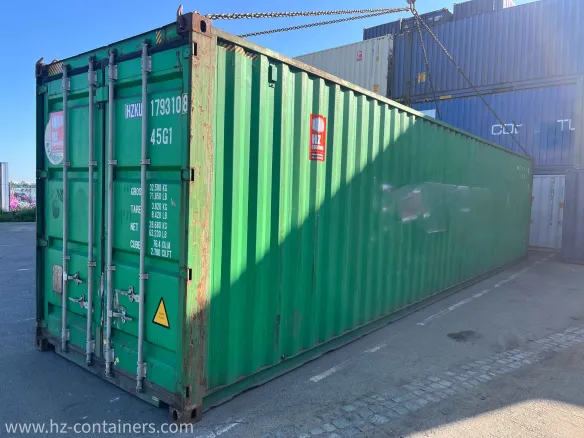
According to ISO 6346 standard, each container has an 11-character alphanumeric identification code, also known as the BIC code (Bureau International des Containers — International Container Bureau). This code consists of the following parts:
| Position | Number of Characters | Content | Example |
|---|---|---|---|
| 1–4 | 4 | Owner/operator (BIC code) | HZCU (HZ Containers) |
| 5–8 | 4 | Container type and size | 2000 (20′ GP container) |
| 9–11 | 3 | Check digit | 123 |
| Complete BIC Code | 11 characters | Example | HZCU2000123 |
|---|
First four characters (owner) — This is an identifier of the container owner or operator. Each company owning containers registers its unique BIC code with the International Container Bureau. HZ Containers, for example, has the code HZCU.
Characters 5–8 (type and size) — These characters define the type and size of the container. For example:
- 2000 = 20′ General Purpose (GP) — standard 20-foot container for general use
- 4000 = 40′ General Purpose — standard 40-foot container
- 2200 = 20′ High Cube — 20-foot container of increased height
- 4200 = 40′ High Cube — 40-foot container of increased height
Characters 9–11 (check digit) — This is a three-digit number calculated from the other eight characters using a mathematical algorithm. This number serves as a checksum, allowing automatic detection of errors in the BIC code.
Thanks to the BIC code, customs officers, logistics professionals, and carriers can immediately identify a container in the database, find its history, owner, and last known location. This code becomes part of all customs documents and is key to tracking the container in the global logistics chain.
Physical marking and labeling
In addition to the BIC code, each container must have a number of physical markings and labels that are visible on its surface and serve as identification and security elements.
CSC Label (Safety Plate) — This is a metal plate permanently attached to the outside of the container (usually on the left side near the top). The label contains:
- Name and address of the container owner
- BIC code
- Maximum gross weight (MGW)
- Tare (weight of empty container)
- Maximum payload
- Date of last inspection and CSC certificate
- Inspector’s signature and inspection organization’s stamp
This label proves that the container meets CSC technical standards and is safe for transport.
Safety Markings — Containers also have markings warning of hazards:
- Warning symbols (for example, for hazardous goods)
- Barcodes for automatic reading
- Manufacturer markings
- Information about year of manufacture
Tare and Weight Data — The label shows weight information:
- Tare (weight of empty container) — typically 2–4 tons
- Maximum payload (Max Load) — typically 20–28 tons
- Maximum gross weight (MGW) — sum of tare and maximum payload
These data are critical for customs officers, as they allow verification that the container is properly loaded and does not exceed the maximum permitted weight.
Registration and tracking in systems
Each container is registered in the Central Register of Shipping Containers, maintained by the International Container Bureau. The Czech Customs Administration has access to this register and can verify whether a container is registered, who owns it, and what its inspection history is.
In the Czech Republic, the key tool is the Central Customs System (CCS), a computer database into which all information about imported and exported containers is entered. Customs officers can search this system for:
- History of all customs inspections of a given container
- Previous violation findings
- Whether a container was ever detained
- Who is its owner and operator
- What goods were transported in the past
This system is part of the EU Single Window, which is a unified interface that allows information sharing between all EU member states. This allows customs officers in the Czech Republic to see what inspections a given container has undergone in Germany, Poland, or other countries.
What are the key steps in customs inspection of a shipping container?
Initial documentary inspection
Customs inspection of a container always begins with documentary inspection. Before the container is physically opened, customs officers inspect all documents accompanying the shipment.
Customs Declaration is the basic document that must be submitted by the importer or their representative (customs broker). This declaration contains:
- Identification of the importer (name and address)
- Description of goods (name, quantity, weight)
- Classification of goods according to the Customs Tariff (tariff number)
- Origin of goods (country of manufacture)
- Value of goods (for duty calculation)
- Invoice reference number
Bill of Lading (B/L) is a document issued by the carrier confirming that goods have been accepted for transport. It contains:
- Description of goods and number of packages
- Weight and dimensions
- Container number and its BIC code
- Name of ship and sailing date
- Port of loading and unloading
- Names of sender and recipient
Commercial Invoice issued by the seller contains:
- Detailed description of goods
- Unit price and total price
- Terms of sale (Incoterms)
- Terms of payment
Certificates of Origin — Some goods require a certificate of origin to verify that they come from a specific country. This is important for preferential customs regimes (for example, goods originating from the EU have lower duties).
The customs officer checks whether:
- All documents are present and correctly completed
- The description of goods in the declaration matches the description in the bill of lading and invoice
- Weight and dimensions are consistent
- Classification of goods is correct
- All special requirements are met (certificates, permits, etc.)
If the documents are in order, the inspection proceeds to physical inspection. If discrepancies are found, the container is detained and the importer is given time to clarify them.
Physical inspection and content inspection
If the documentary inspection passes without problems, it is time for physical inspection. This inspection takes place in several steps:
External Inspection — The inspector first examines the outside of the container:
- Verifies that the BIC code on the label matches the number in the documents
- Checks for physical damage (dents, cracks, rust spots)
- Verifies that security seals are intact
- Checks that the CSC label is present and legible
- Photographs the container and seals for documentation
Opening the Container — If everything is in order, the inspector opens the container doors. When opening, special attention is paid to:
- Integrity of seals (whether they are damaged or replaced)
- First impression of the contents
- Any signs of unauthorized entry
- Odor (indicator of biological hazard, mold, etc.)
Internal Inspection — The inspector enters the container and checks:
- Overall condition of the interior (cleanliness, dryness)
- Presence of foreign objects or signs of tampering
- Odor (indicator of biological hazard, decay, etc.)
- Condition of floor and walls
Physical Inspection of Contents — Depending on the type of goods and level of risk, the following is performed:
- Visual Inspection — The inspector examines packages and checks whether they match the description
- Sampling — For some goods (food, chemicals, textiles), samples are taken for laboratory analysis
- Counting — For expensive goods, individual items are counted and compliance with the declaration is verified
- Weighing — Selected packages are weighed on portable scales to verify declared weight
X-ray and Scanning Technology — In some cases, modern technology is used:
- X-ray Scanner — Allows viewing of package contents without opening them. Used to detect hidden goods, weapons, drugs, and other banned items.
- Hazardous Material Detector — Used to detect radioactive materials, explosives, and chemical weapons.
- Metal Detectors — Used to search for metal objects hidden in cargo.
These technologies are particularly valuable because they allow inspection without physically opening and handling cargo, saving time and minimizing risk of damage.
Special inspections by commodity type
Depending on the type of goods being transported, special inspections may be conducted:
Food Inspection (SZPI) — If the container contains food, an SZPI inspector must be present on behalf of the importer or in the importer’s name. Inspection includes:
- Inspection of hygiene documentation
- Sampling for laboratory testing (microbiology, pesticides, allergens)
- Verification that food is not prohibited (for example, certain types of game, dairy products from certain countries)
- Temperature control for chilled goods
- Verification that health requirements are met
Inspection of Hazardous Goods — If the container contains hazardous substances (chemicals, explosives, radioactive materials), inspection is conducted in accordance with the International Maritime Dangerous Goods Code (IMDG Code). Inspectors check:
- Proper labeling and packaging of hazardous goods
- Documentation on the type and quantity of hazardous substance
- Proper storage in the container (distance from other goods)
- Presence of safety data sheet (SDS)
Textile Inspection — Some textiles are subject to quotas and restrictions. Inspectors check:
- Proper labeling of country of origin
- Compliance with declared quantity
- Whether textiles are counterfeits or illegally imported
Electronics and ICT Inspection — Some electronic products are subject to restrictions:
- Inspection whether they are not subject to sanctions (e.g., electronics for Russia)
- Verification that they are not counterfeits
- Inspection of compliance with EU standards (ROHS, WEEE)
Final clearance and release
If the inspection passes without findings, it is time for customs clearance. This includes:
- Calculation of duties and taxes — The customs officer calculates:
- Duty (usually a percentage of the value of goods)
- VAT (value added tax)
- Special taxes (for alcohol, tobacco, etc.)
- Issuance of customs document — A Release of Goods Document is issued, confirming that duty and taxes have been paid and goods are released for removal from the customs area.
- Physical Release — The container is marked with a stamp or sticker confirming that it has passed customs inspection and is released.
- Handover to Importer — The importer is handed the Release of Goods Document and can collect their container.
The entire process from the container’s arrival at the port to its release typically takes 1–3 days, depending on the scope of inspection and availability of inspectors.
What are the safety standards and certifications for shipping containers?
CSC Certificate — Convention for Safe Containers
CSC (Convention for Safe Containers) is an international agreement on shipping container safety adopted in 1972 and entering into force in 1977. The purpose of CSC is to ensure that shipping containers are safe for transporting goods and do not fall off ships or collapse during loading and unloading.
The Czech Republic is a signatory to the CSC and is committed to complying with these standards. Every container used for international transport must have a valid CSC certificate, proving that it meets CSC technical standards.
CSC Technical Requirements include:
- Structural Integrity — The container must withstand loading without deformation
- Mechanical Strength — Doors, locks, and corner castings must be sufficiently strong
- Tightness — The container must be tight (important for refrigerated containers)
- Door Safety — Locks and hinges must be secure and must not open spontaneously
CSC Inspection Procedure — The CSC certificate is issued based on an inspection conducted by an authorized inspection organization. Inspections take place at the following intervals:
| Type of Inspection | Interval | Content |
|---|---|---|
| Initial Inspection | Upon commissioning | Complete technical inspection |
| Periodic Inspection | Every 2.5 years | Inspection of condition, repairs, safety |
| Extraordinary Inspection | After accident or damage | Verification of safety after incident |
| Inspection upon Decommissioning | Upon retirement from service | Verification that container is no longer usable |
CSC Label — If the container passes inspection and meets requirements, a CSC Label (Safety Plate) is attached to it. This metal label contains:
- Name and address of the inspection organization
- Date of inspection
- Inspector’s signature
- Inspection organization’s stamp
- Maximum weight (MGW)
- Tare and maximum payload
The label is permanently attached to the left side of the container and is visible. If the label is missing, damaged, or illegible, the container cannot be used for international transport.
ACEP (Approved Continuous Examination Programme)
In addition to periodic inspection, there is also ACEP (Approved Continuous Examination Programme), a continuous inspection program that can be conducted by the manufacturers or owners of containers themselves. Instead of waiting for periodic inspection every 2.5 years, containers can be subject to continuous inspection and maintenance.
The ACEP program allows:
- Container owners to conduct their own inspections and maintenance
- Shortening of intervals between inspection cycles
- Maintaining a higher level of safety
If the owner or manufacturer meets ACEP criteria, they can maintain their own inspection and maintenance records. These records are then verified by authorized inspection organizations.
Security Seals and Their Role
One of the most important elements of shipping container security is the security seal. A seal is a one-time lock attached to the container doors and prevents unauthorized opening.
ISO 17712 Standard regulates requirements for security seals. According to this standard, there are three categories of seals:
| Category | Description | Use |
|---|---|---|
| Mechanical Seals (High Security — HS) | Metal seals with high resistance to tampering | International transport, high risk |
| Indicative Seals (Indicative — IN) | Plastic seals that visibly show tampering | Domestic transport, lower risk |
| Cable Seals | Steel cable with lock | Transport within EU |
A security seal is applied to the container doors after the container is loaded and closed. The seal contains:
- Unique Serial Number — Each seal has its own number, recorded in customs documentation
- Manufacturer’s Name and Logo — Allows identification of who manufactured the seal
- Date of Manufacture — Helps identify counterfeits
During transport, the seal is inspected at each transfer (at border crossings, in ports, etc.). If the seal is damaged or missing, it is an indicator of suspected unauthorized opening.
Counterfeit Seals — Unfortunately, counterfeit seals exist that can be used to mask unauthorized opening. Customs officers are trained to detect counterfeits and check:
- Quality of material
- Accuracy of printing
- Consistency of serial number
- Presence of hologram or other security features
Technical Safety Requirements
In addition to the CSC certificate and seals, containers must meet a number of technical safety requirements:
Load Capacity — Each container has a maximum gross weight (MGW) that must not be exceeded. Exceeding MGW can lead to:
- Deformation of container floor
- Door failure
- Container falling during transport
- Ship damage
Construction and Materials — Containers are made of steel or aluminum materials. Steel containers are more durable but heavier. Aluminum containers are lighter but less durable.
Corner Castings — These are four metal pieces in the corners of the container that serve to:
- Secure the container on the ship using locks (lashing)
- Transfer weight to load-bearing elements
- Ensure mechanical strength
Floor — The container floor must be sufficiently strong to withstand even weight distribution. Some containers have special floors:
- Wooden Floors — Common in general containers
- Plastic Floors — Hygienic, used for food
- Special Floors — For example, for transporting automobiles
How is physical security inspection of a container conducted?
External Inspection — Visual Assessment
Physical security inspection always begins with external inspection. The inspector examines the outside of the container and checks:
Physical Damage:
- Dents and cracks in steel
- Rust spots or corrosion
- Cracks in welds
- Damaged or missing corner castings
Security Elements:
- Presence of CSC label
- Legibility of all data on the label
- Presence and integrity of security seal
- Visible signs of tampering
Markings and Labeling:
- Correct placement of BIC code
- Legibility of all safety markings
- Presence of warning symbols (if goods are hazardous)
The inspector also photographs the container from multiple angles, especially the seal and CSC label, for documentation.
Internal Inspection — Access to Container
If the external inspection passes without problems, the inspector enters the container. When entering, safety procedures must be followed:
Entry Safety:
- Inspection that the container is not sealed or dangerous
- Opening of ventilation openings (if they exist)
- Verification that no hazardous gas or toxic substances are present
- Presence of another inspector or safety worker
Interior Inspection:
- Overall condition of the interior (cleanliness, dryness, no mold)
- Presence of foreign objects or signs of tampering
- Odor (indicator of biological hazard, decay, etc.)
- Condition of floor and walls
Cargo Storage Inspection:
- The way cargo is secured (packages should be safely stored)
- Absence of cargo movement when opening doors
- Proper weight distribution
- Presence of appropriate supports and securing
Technical Testing and Measurement
In addition to visual inspection, technical tests are performed:
Pressure Test — For some types of containers (especially refrigerated or those intended for hazardous goods), a pressure test is performed. This test verifies that:
- The container is tight and no gas leaks from it
- Doors fit tightly
- No cracks or openings are present
Door Tightness Inspection — The inspector checks that:
- Doors open and close smoothly
- Locks are functional and secure
- Door seals are in good condition
- No play or gaps are present
Weight Inspection — Cargo is weighed on portable scales. The inspector checks that:
- Declared weight matches actual weight
- Weight does not exceed container MGW
- Weight is evenly distributed
X-ray and Scanning Technology
Modern inspection procedures use advanced technology:
X-ray Scanner — The X-ray scanner allows viewing of container contents without physically opening packages. The scanner emits X-rays through the cargo and creates an image. Inspectors can see:
- Shape and size of objects
- Presence of hidden objects
- Anomalies in contents (e.g., weapons, drugs, smuggled goods)
X-ray scanners are particularly valuable for detecting:
- Weapons and ammunition
- Drugs and psychotropic substances
- Counterfeits and illegal goods
- Radioactive materials (in combination with other detectors)
Hazardous Material Detector — Used to detect:
- Radioactive materials (Geiger-Müller counter)
- Explosives (chemical analysis or detectors)
- Chemical weapons (sensors)
Metal Detector — A portable metal detector is used to search for metal objects hidden in cargo or in the container itself (e.g., weapons, coins, jewelry).
Thermal Camera — A thermal camera detects heat differences and can reveal hidden spaces or people hidden in the container.
What are the timeframes and frequency of inspections?
Routine Inspections — When and How Often?
Every container crossing the border of the Czech Republic is subject to routine inspection. The frequency and scope of inspection depend on several factors:
Risk Management System — The Customs Administration uses a Risk Management System (RMS) that classifies containers into categories based on risk:
- Low Risk — Containers from known and trusted importers with proper documentation. These containers may be subject to only documentary inspection without physical inspection.
- Medium Risk — Containers where some indicators of suspicion exist. These containers are subject to documentary inspection and partial physical inspection (opening and viewing of contents).
- High Risk — Containers from unknown importers, with incomplete documentation, or from risk countries. These containers are subject to complete physical inspection, including X-ray scanning and sampling.
Typical Inspection Frequencies:
- Low risk: 1–5% of all containers
- Medium risk: 10–20% of all containers
- High risk: 50–100% of all containers
Random and Targeted Inspections
In addition to routine inspection, random and targeted inspections are also conducted:
Random Inspections — Some containers are selected completely randomly for inspection, regardless of risk. The purpose is to ensure that all importers know their container can be inspected at any time.
Targeted Inspections — Are focused on specific types of goods or importers:
- Inspection of all containers containing food
- Inspection of all containers from a specific importer who had problems in the past
- Inspection of all containers containing hazardous goods
- Inspection of all containers from a specific country (e.g., in case of sanctions)
Operations Focused on Specific Threats — In some cases, the Customs Administration conducts special operations focused on specific threats:
- Operations against counterfeits
- Operations against drug smuggling
- Operations against illegal wildlife trade
- Operations against illegal weapons trade
Duration of Inspection
The duration of inspection depends on its scope:
Documentary Inspection — 15–30 minutes
Visual Inspection (opening and viewing) — 30–60 minutes
Partial Physical Inspection (opening several packages) — 1–2 hours
Complete Physical Inspection (opening and inspecting all packages) — 4–8 hours
X-ray Scanning — 30–60 minutes (depending on size and density of cargo)
Special Inspection (food, hazardous goods) — 2–4 hours (depending on commodity type)
If the inspection is completed and no problems are found, the container is released the same day. If problems are found, it may take several days to resolve them and release the container.
What are violations, penalties, and consequences of non-compliance?
Most Common Violations and Their Causes
Various violations appear during customs inspection. The most common are:
Inaccurate or Incomplete Customs Declaration — The importer or customs broker incorrectly classifies goods, omits items, or states an incorrect value. This may be unintentional (error) or intentional (attempt to avoid higher duties).
Discrepancy Between Declaration and Actual Contents — The container contents do not match what is stated in the declaration. For example, the declaration states 100 kg of coffee, but in reality there is 50 kg of coffee and 50 kg of something else.
Damaged or Missing Security Seal — The seal is damaged, missing, or replaced with a counterfeit. This is an indicator that someone tried to open the container without authorization.
Counterfeits and Fakes — The container contains counterfeits (for example, counterfeit brands, electronics, medicines). This is a serious violation that endangers consumers and businesses.
Illegal Goods — The container contains goods that are prohibited in the Czech Republic (for example, certain types of weapons, drugs, or endangered species).
Violation of Safety Standards — The container does not contain a valid CSC certificate, or contains goods that are improperly packed and pose a safety risk (e.g., heavy objects are not properly secured).
Violation of Health and Food Standards — Food is moldy, contaminated, or comes from risk countries without appropriate certification.
Legal Consequences and Penalties
If a violation is found, legal consequences may follow:
Confiscation of Goods — If goods are illegal or counterfeit, they are confiscated by the state. The importer loses the investment.
Fine for Violation of Customs Regulations — According to Customs Act No. 242/2016 Coll., fines may be imposed in the range of:
- 10,000–100,000 CZK for violation of obligation to report goods
- 50,000–500,000 CZK for violation of customs obligation
- Up to 1,000,000 CZK for serious violations
Container Detention — The container is detained and cannot be released until all problems are resolved. This may take days or weeks.
Import Ban — An importer or carrier may be temporarily or permanently banned from importing certain goods.
Criminal Liability — In case of intentional violation (smuggling, counterfeiting), persons may be prosecuted criminally. The sentence may be up to 5 years imprisonment.
Practical Impact on Trade
Violations of customs regulations have serious practical consequences:
Financial Losses — The importer loses the investment in goods, pays fines, and additional costs for storage and legal representation.
Transport Delays — Container detention causes delays in delivery of goods to customers. This may lead to breach of contracts and claims for damages.
Increased Costs — If a container is detained, the importer must pay for storage, handling, and other logistics costs.
Reputational Damage — If an importer is known for having customs inspection problems, their business partners may be reluctant to trade with them.
Import Ban — In case of serious violation, an importer may be temporarily or permanently banned from importing certain goods, which can destroy their business.
Real Example: In 2015, the Customs Administration detained a container from China in the Czech Republic containing 22 tons of moldy cocoa beans. The shipment was intended for the food industry but was banned by SZPI. The importer lost the entire investment and was penalized. The case was publicized in the media, damaging their reputation.
What are international agreements and standards?
EU Customs Code and Harmonization
The Czech Republic is a member of the European Union and therefore must comply with the Union Customs Code (UCC), adopted in 2013 and entering into force in 2016. This code harmonizes customs procedures throughout the EU and ensures that:
- All member states use the same procedures for customs inspection
- Information about containers and goods is shared between member states
- Goods can be transported without obstacles between member states after passing customs inspection in one state
- Duty and tax rates are standardized
The Czech Customs Administration implements the UCC through the Central Customs System (CCS), which is connected to similar systems in other EU member states. This allows customs officers in the Czech Republic to see what inspections a given container has undergone in Germany, Poland, or other countries.
Incoterms and Responsibility for Inspection
Incoterms are international commercial terms that define the obligations of the seller and buyer during transport. Incoterms also determine who bears the costs of inspection and who is responsible for goods at various stages of transport.
The most commonly used Incoterms are:
| Incoterm | Seller | Buyer (Importer) | Inspection Costs |
|---|---|---|---|
| FOB (Free on Board) | Responsible for goods until loading on ship | Responsible for goods from loading on ship | Importer |
| CIF (Cost, Insurance, Freight) | Responsible for goods until unloading | Responsible for goods from unloading | Importer |
| DDP (Delivered Duty Paid) | Responsible for goods until delivery | Responsible for goods from delivery | Seller |
| EXW (Ex Works) | Responsible for goods at factory | Responsible for goods from factory | Buyer |
In practice, this means that if the Incoterm is FOB, the importer bears the costs of customs inspection and is responsible for resolving any customs inspection problems. If the Incoterm is DDP, the seller is responsible for all costs and problems until delivery.
Bilateral and Multilateral Agreements
The Czech Republic has bilateral and multilateral agreements with many countries that facilitate trade and harmonize customs procedures. The most important include:
Convention for Safe Containers (CSC) — As already mentioned, this agreement is an international standard for container safety.
Agreements on Recognition of Certificates — The Czech Republic has agreements with other countries that recognize certificates issued in the Czech Republic (e.g., CSC certificates) and vice versa.
Supply Chain Security Agreements — For example, CTPAT (Customs-Trade Partnership Against Terrorism) is a US program that harmonizes security procedures in the supply chain. The Czech Customs Administration cooperates with US customs authorities on the security of containers destined for the USA.
How to Prepare for Customs and Security Inspection?
Documentary Preparation
To ensure the inspection runs smoothly, it is important to prepare all necessary documents:
Document Checklist:
- Customs Declaration — Complete correctly and fully. All data must be consistent with the invoice and bill of lading.
- Bill of Lading (B/L) — Have a copy containing the container number and BIC code.
- Commercial Invoice — Containing detailed description of goods, unit prices, and total price.
- Certificate of Origin — If required (for example, for goods from the EU).
- Special Certificates — If it is food (health certificate), hazardous goods (safety data sheet), etc.
- Insurance Certificate — If goods are insured.
- Permits and Licenses — If goods are subject to special regimes (for example, weapons, medicines).
Common Errors:
- Incorrect classification of goods according to the Customs Tariff
- Incomplete description of goods
- Incorrect or missing value of goods
- Incorrect or missing information about origin of goods
- Incorrect or missing BIC codes of containers
Physical Preparation of Container
To ensure the inspection is as quick as possible, it is important to properly prepare the physical contents of the container:
Proper Packing:
- Goods should be securely fastened so they do not move when opening doors
- Heavy objects should be in the lower part of the container
- Light objects should be in the upper part
- Empty space should be minimized (to prevent cargo movement)
Proper Labeling:
- Each package should be labeled with a number or identifier
- Packages should be labeled according to the description in the declaration
- If goods are hazardous, warning symbols should be present
Container Cleanliness:
- The interior of the container should be clean and dry
- There should be no remnants from previous shipments
- There should be no odor
Security Seal:
- The seal should be applied after closing and securing the container
- The seal’s serial number should be recorded in the documentation
- The seal should be intact
Selection of Logistics Partner
To ensure the inspection runs smoothly, it is important to have an experienced logistics partner:
What to Look for in a Partner:
- Experience — The partner should have many years of experience with customs inspection
- License — The partner should be licensed as a customs broker
- Reputation — Should have a good reputation and positive reviews from clients
- Knowledge of Legislation — Should be up to date with the latest legal regulations
- Language Skills — Should speak Czech and possibly other languages
- Availability — Should be available in case of problems
Benefits of a Professional Partner:
- Reduction of risk of errors and violations
- Faster document processing
- Better communication with customs authorities
- Lower inspection costs (due to efficiency)
- Protection of importer’s legal rights
Frequently Asked Questions
What is shipping container inspection?
Shipping container inspection is a systematic control process that verifies the condition, safety, and suitability of a container for transporting goods. The purpose is to minimize risks associated with transport, protect public health and safety, and ensure compliance with legal regulations. Inspections include document inspection, physical inspection of contents, and technical testing.
What are the steps of customs inspection of a container?
Customs inspection proceeds in the following steps: (1) Documentary inspection — verification of customs declaration, bill of lading, and invoices; (2) External inspection — visual assessment of the outside of the container; (3) Opening — opening doors and verifying seal integrity; (4) Internal inspection — inspection of cleanliness and interior condition; (5) Physical inspection of contents — inspection of packages and possible sampling; (6) Special inspection — if required (food, hazardous goods); (7) Final clearance — calculation of duties and taxes and issuance of release document.
What are the safety standards for shipping containers?
The main safety standards are: (1) CSC (Convention for Safe Containers) — international agreement regulating technical requirements for container safety; (2) ISO 6346 — standard for container identification; (3) ISO 17712 — standard for security seals; (4) ACEP (Approved Continuous Examination Programme) — continuous inspection program. Every container must have a valid CSC certificate and be equipped with a security seal.
How are shipping containers identified?
Shipping containers are identified using the BIC code (Bureau International des Containers), an 11-character alphanumeric code standardized by ISO 6346. The code consists of: (1) Four characters identifying the owner (e.g., HZCU); (2) Four characters identifying the type and size (e.g., 2000 for 20′ GP); (3) Three check digit characters. The container also has physical marking — a CSC label containing information about the owner, maximum weight, and date of last inspection.
What is a CSC certificate and why is it important?
A CSC (Convention for Safe Containers) certificate is a document proving that a shipping container meets international technical safety standards. The certificate is issued by an authorized inspection organization after successful inspection. The CSC certificate is important because: (1) It guarantees container safety; (2) It is required for international transport; (3) It protects workers and the public from the risk of container falling; (4) It is recognized worldwide and facilitates trade. The certificate is valid for 2.5 years and must be periodically renewed.
What is the role of the customs authority in container inspection?
The customs authority plays a key role in container inspection. Its tasks include: (1) Verification of customs documentation; (2) Physical inspection of contents; (3) Detection of smuggled and illegal goods; (4) Collection of duties and taxes; (5) Protection of public health and safety; (6) Ensuring transport safety; (7) Enforcement of legal regulations. Customs authorities also cooperate with other agencies (SZPI, ČOI, security services) to ensure the security and legality of trade.
How does physical inspection of a container work?
Physical inspection of a container includes: (1) External inspection — visual assessment of the outside, inspection of seals and CSC label; (2) Opening — opening doors and verifying seal integrity; (3) Internal inspection — inspection of cleanliness and interior condition; (4) Content inspection — visual inspection of packages, possible opening and inspection; (5) Sampling — for some goods (food, chemicals); (6) Technical testing — inspection of tightness, weight, etc.; (7) X-ray scanning — if required. Physical inspection typically takes 30 minutes to 4 hours, depending on scope.
What are security seals and how are they used?
A security seal is a one-time lock attached to container doors and prevents unauthorized opening. The seal is standardized by ISO 17712 and contains: (1) Unique serial number; (2) Manufacturer’s name and logo; (3) Security features (hologram, etc.). The seal is applied after closing and securing the container. During transport, the seal is inspected at each transfer (borders, ports). If the seal is damaged or missing, it is an indicator of suspected unauthorized opening. The seal’s serial number is recorded in customs documentation and can be verified.

 Czech Republic, Třebíč
 FREE SHIPPING


Other container news...

Obligation to Check Tightness When Selling a Reefer Container
Who is responsible for the refrigerant leak check when selling a refrigerated container? Find out what obligations the seller has at the time of handover and why they must provide a PTI report along with the technical data plate. Learn which regulatory requirements and F-gas record-keeping duties become the sole responsibility of the new owner.

New shipping containers
If you are currently considering purchasing a new shipping container, you are not alone. While just twenty years ago containers were used almost exclusively for maritime transport, today they have found their way into construction, storage, business, and even housing. This growing popularity brings with it a host of questions: Which type should you choose? How much does it cost? How do you recognize quality? How can you avoid falling victim to scammers?
New sea shipping containers
If you are currently considering purchasing a new shipping container, you are not alone. While just twenty years ago containers were used almost exclusively for maritime transport, today they have found their way into construction, storage, business, and even housing. This growing popularity brings with it a host of questions: Which type should you choose? How much does it cost? How do you recognize quality? How can you avoid falling victim to scammers?

6m shipping container
Are you thinking about buying a 6-meter shipping container but aren’t sure what to look for? You are not alone—this 20-foot container is the best-selling size on the Czech market, and the differences between various types, conditions, and prices can be significant. In this guide, you will find everything you need to know: from exact dimensions and a comparison of categories (such as “one-way,” refurbished, and “Cargo Worthy”) to current prices and shipping advice.