
Corner Casting – Offset 28 mm or 55 mm
Corner casting of a container is a robust, standardized steel block with three holes that forms each of the eight corners of a standard ISO container. This component – often also referred to as “corner fitting” or “corner block” – is the most important structural element of the entire container from a construction perspective. Its main task is to enable safe lifting, stacking, securing and transporting of the container across all types of transport – by sea, rail and road.

Corner castings are absolutely crucial for the global intermodal transport system, because their standardization according to ISO 1161 ensures that any container complying with this standard can be safely handled by any equipment anywhere in the world.
Main functions:
- Serve as a universal connection point for lifting equipment, twist locks, stacking systems and other components.
- Carry all static and dynamic loads of the container (can exceed 30 tons!).
- Protect the container structure during impacts and handling.
Anatomy of corner casting
Material composition and properties
| Property | Specification |
|---|---|
| Material | Most often Corten (weather-resistant steel), CNS-SCW49, S-SCW480 or equivalent high-strength steels |
| Weight | 11–12.5 kg (depending on type and manufacturer) |
| Manufacturing | Casting (casting), followed by machining and surface treatment |
| Resistance | High tensile strength, pressure, shear and bending resistance |
| Weldability | Excellent – corner castings are firmly welded into the container frame |
| Corrosion resistance | High due to Corten or surface treatment |
| Fire resistance | Steel is resistant to high temperatures |
Corten is a special alloyed steel with additions of copper, chromium and nickel, which creates a protective patina and significantly slows down further corrosion – ideal for marine environments.
Detailed description of holes (apertures)
Each corner casting contains three precisely defined holes:
| Hole | Location | Shape | Function and use | Standard (dimension ± tolerance) |
|---|---|---|---|---|
| Stacking hole | Top surface of upper castings, bottom surface of lower castings | Oval (approx. 120 × 62 mm) | For twist locks and vertical stacking of containers | ISO 1161: 120 × 62 mm ±1 mm |
| Side hole (stadium) | Long side (side) of each casting | Stadium (elliptical) | Hook attachment, handling, securing, Domino Clamp | ISO 1161: 110 × 63 mm ±1 mm |
| Front hole (shield hole) | Short side (front) of the casting | Wide, often beveled | Enabling hook lifting, spreader guidance | ISO 1161: 110 × 63 mm ±1 mm (may vary slightly) |
Hole dimensions and their precise placement are specified with a tolerance of ±1–1.5 mm, which guarantees seamless compatibility with all equipment.
Standardization and ISO 1161 standard
The standard ISO 1161:2016 “Corner elements for Series 1 containers” is the basic standard for all containers used in international transport. It ensures:
- Precise dimensions of corner castings: 178 mm (length) × 162 mm (width) × 118 mm (height).
- Shape and dimensions of holes: Allow safe attachment of twist locks, spreaders, hooks, etc.
- Strength requirements: Each casting must withstand extreme loads in tension, pressure and shear (verified by testing).
- Placement and tolerance: Precision of hole placement and their offset is essential for stacking and handling.
ISO container identification: Each container has a unique code on the doors and sides (BIC code) and a label indicating compliance with ISO 1161 standard.
Types and placement of corner castings
A standard container uses four different types of castings depending on position:
| Designation | Container location | Description |
|---|---|---|
| TL | Top Left corner | Mirror-oriented |
| TR | Top Right corner | Mirror-oriented |
| BL | Bottom Left corner | Mirror-oriented |
| BR | Bottom Right corner | Mirror-oriented |
Each type is marked with an abbreviation (TL, TR, BL, BR) and placed precisely according to manufacturing documentation to ensure proper force distribution and maximum safety.
Key functions of corner castings
1. Lifting
- Via spreader (four twist locks to upper corners).
- Hooks to side/front holes for crane handling.
- High-lift trucks with adapters for lower castings.
2. Stacking
- Containers can be stacked up to 9 layers due to perfect casting compatibility.
- Twist locks connect the upper and lower casting of two containers.
3. Securing (lashing)
- On chassis and wagons, containers are secured with twist locks through lower castings.
- Ensures stability during transport.
4. Structural integrity
- Corner castings are nodes where all major structural elements of the container converge (frame, corners, floor).
- Transfer all forces from the structure and cargo.
5. Enabling modular modifications
- Standardized holes serve for secure attachment of accessories (Domino Clamp, shelves, lighting, canopies, cameras, supports for container buildings, etc.).
- Without the need for drilling/welding into the container shell.

Offset 28 mm and 55 mm (“offset from the outside”)
What is offset and why is it important?
Offset refers to the distance between the outer edge of the casting and the axis of the hole in the casting. Corner castings do not protrude exactly in the same plane as the walls or roof of the container – they protrude slightly and thus form a protective frame.
Functional significance of offset:
- Protection: Durable castings protect more sensitive container panels from impacts.
- Ensuring clearance: To ensure handling and stacking, there must be a gap between containers, which the offset ensures.
- Defining dimensions: The external dimensions of the container (e.g. 8′ × 8’6″) are determined precisely by the distance between the outer points of the castings.
Variants of 28mm and 55mm offset
In the ISO 1161 standard (which defines the geometry of container corner castings), the holes in the corner casting are not centered on the outer surface of the container – they are offset (recessed) by a fixed distance.
Here is the significance of individual values:
| Location | Offset from outside of container | Significance |
|---|---|---|
| Upper corner casting (vertical surface) | 28 mm | The hole for the twist lock is 28 mm from the outer edge of the front surface of the upper casting. |
| Lower corner casting (vertical surface) | 55 mm | The hole for the twist lock is 55 mm from the outer edge of the front surface of the lower casting. |
This dimension is, for example, crucial for determining the type of ConFoot CFL legs for cisterns.
Maintenance and most common corner casting defects
Despite high durability, corner castings require regular inspection:
Most common problems
| Problem | Description and recommendations |
|---|---|
| Corrosion | Corten protects with patina, but damaged areas must be cleaned and repainted with special anti-corrosion paint. |
| Cracks and deformations | After impacts or rough handling, cracking may occur – immediate replacement is necessary because it fundamentally compromises safety. |
| Clogged holes | Dirt, ice or deformation prevents proper use of twist locks – always check and clean before handling. |
Recommended maintenance procedure
- Regular visual inspection with each handling or container exchange.
- Repair or replacement exclusively according to standardized procedures (e.g. according to IICL-5).
- Documentation of each repair or intervention in accordance with shipping company requirements.
Overview of normative corner casting dimensions according to ISO 1161
| Parameter | Value |
|---|---|
| Length | 178 mm |
| Width | 162 mm |
| Height | 118 mm |
| Hole diameter | approx. 62–63 mm |
| Hole offset from edge | 28 mm (vertically), 55 mm (horizontally) |
| Weight | 11–12.5 kg |
| Material | Corten, CNS-SCW49, S-SCW480 (or equivalent) |

 Czech Republic
  WITHOUT SHIPPING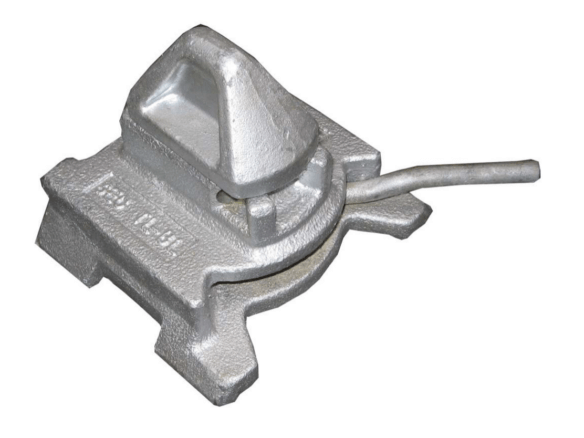
Other container news...

New shipping containers
If you are currently considering purchasing a new shipping container, you are not alone. While just twenty years ago containers were used almost exclusively for maritime transport, today they have found their way into construction, storage, business, and even housing. This growing popularity brings with it a host of questions: Which type should you choose? How much does it cost? How do you recognize quality? How can you avoid falling victim to scammers?
New sea shipping containers
If you are currently considering purchasing a new shipping container, you are not alone. While just twenty years ago containers were used almost exclusively for maritime transport, today they have found their way into construction, storage, business, and even housing. This growing popularity brings with it a host of questions: Which type should you choose? How much does it cost? How do you recognize quality? How can you avoid falling victim to scammers?

6m shipping container
Are you thinking about buying a 6-meter shipping container but aren’t sure what to look for? You are not alone—this 20-foot container is the best-selling size on the Czech market, and the differences between various types, conditions, and prices can be significant. In this guide, you will find everything you need to know: from exact dimensions and a comparison of categories (such as “one-way,” refurbished, and “Cargo Worthy”) to current prices and shipping advice.
Corner casting steel vs aluminum
Every shipping container in the world — all 40 million of them — rests on eight critical components. Corner castings are the load-bearing blocks at each corner of an ISO shipping container, and they are the universal interface between the container and every crane, twistlock, spreader, and chassis on the planet. When you lift a container, stack it nine high on a ship, or lock it to a truck trailer, every ton of force flows through these fittings.