
Construction containers
Construction container today no longer means just a metal box for tools. It is a fully functional mobile base that can serve as an office, changing room, sanitary cabin, warehouse, or even as a living space. Whether you are planning a renovation, building a family house, or expanding your company capacities, a properly chosen construction container will save you tens of thousands of crowns and a lot of worries. This guide will walk you through everything you need to know — from types and dimensions to prices and rental, all the way to legal requirements.
What is a construction container and how does it differ from a construction cabin
The terms construction container and construction cabin are often confused in practice, and no wonder — the line between them is thin. As a general rule, a construction container is a broader term encompassing any mobile modular units used on construction sites. A construction cabin is then a specific type — usually a lighter, insulated unit designed primarily for human occupancy.
To help you navigate the terminology, we have prepared a clear comparison:
| Criterion | Construction container (storage) | Construction cabin (residential/office) |
|---|---|---|
| Primary purpose | Storage of material and tools | Human occupancy — office, changing room, accommodation |
| Construction | Steel frame, non-insulated | Steel/sandwich frame, insulated |
| Weight | 2,000–4,000 kg (20′ container) | 1,500–3,000 kg (6 m cabin) |
| Equipment | Empty space, possibly shelves | Electrical installation, windows, doors |
| Price (new) | 40,000–80,000 CZK | 115,000–140,000 CZK |
| Rental/month | from 2,000 CZK | from 3,000 CZK |
Prices are indicative and may vary depending on the season and current pricing. For an accurate calculation, please contact us or view our current price list.
Key difference: If people will be working in the container for more than a few minutes a day, always opt for a construction cabin with insulation, electrical installation, and ventilation. A storage container is only for things.
Types of construction containers
Choosing the right type is the first and most important step. Each type of construction container is designed for a different purpose — and using the wrong type can mean not only discomfort but also a safety risk.
Storage container
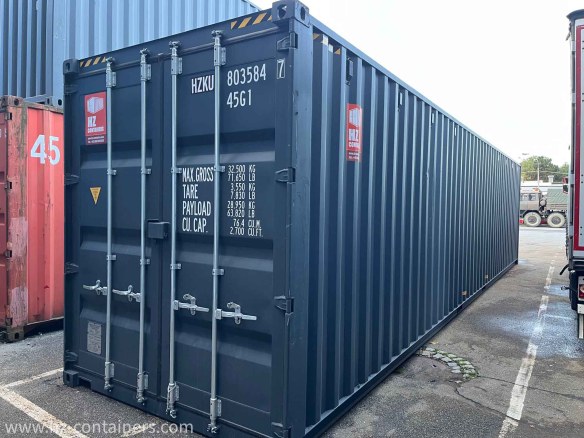
Most often, it is a modified shipping container (ISO container) with a length of 10, 20, or 40 feet. It is made of steel, is extremely durable and lockable — ideal for the safe storage of tools, machinery, and construction materials directly on the construction site. The advantage is the ability to stack up to 3 units on top of each other, saving space. The 20-foot storage container is the most widespread variant in the Czech Republic.
Residential container and construction cabin
A residential container is an insulated unit designed for human occupancy. It typically has a length of 6 meters, a width of 2.5 meters, and a height of around 2.8 meters. The internal dimensions provide approximately 14–15 m² of floor area. Standard equipment includes electrical installation (230 V sockets, lighting), windows, doors, and the option to connect heating. It is used as a changing room for workers, a temporary office for the site manager, or even as an accommodation unit.
Office container
This is an extension of a residential container — an office container usually has better interior equipment (floor covering, additional sockets, data cabling, air conditioning). It is also produced in versions with a partition wall or dividing panel.
Sanitary container
A sanitary container provides hygienic facilities on construction sites. It includes toilets, showers, washbasins, and possibly water heaters. It can be connected to the water main, sewage, and electricity. Sanitary cabins are subject to stricter hygienic standards — they must have ensured ventilation, washable surfaces, and drains.
Special containers
This category includes tipper containers, side-opening containers (side door), refrigerated containers (reefer), or containers modified as gatehouses, sales stands, and laboratories. Their price depends on the degree of individual modifications.
Dimensions of construction containers
Dimensions are a key parameter — they affect not only the usable space but also the price, transport, and placement options. Most construction containers are based on ISO standards for shipping containers, which ensures compatibility during transport and stacking.
Standard dimensions of shipping and storage containers
| Size | Length (m) | Width (m) | Height (m) | Internal volume | Use |
|---|---|---|---|---|---|
| 10′ (feet) | 3.0 | 2.44 | 2.59 | ~15 m³ | Small tools, small construction sites |
| 20′ (feet) | 6.06 | 2.44 | 2.59 | ~33 m³ | Most common — storage on construction site |
| 20′ HC | 6.06 | 2.44 | 2.90 | ~38 m³ | Higher variant for bulkier materials |
| 40′ (feet) | 12.19 | 2.44 | 2.59 | ~67 m³ | Large storage, workshop |
| 40′ HC | 12.19 | 2.44 | 2.90 | ~76 m³ | Maximum storage volume |
Dimensions of construction cabins (residential/office)
| Cabin type | Length (m) | Width (m) | Height (m) | Floor area |
|---|---|---|---|---|
| Small (3 m) | 3.0 | 2.5 | 2.6–2.8 | ~7.5 m² |
| Standard (6 m) | 6.0 | 2.5 | 2.6–2.8 | ~15 m² |
| Large (7.5 m) | 7.5 | 2.5 | 2.6–2.8 | ~18.75 m² |
A standard 6-meter cabin is the most widespread — it offers enough space for 4–6 people in changing room mode or a fully functional office for 2–3 people. When choosing a size, be guided not only by the interior space but also by the access road — a truck with a hydraulic arm needs at least 10 meters of free space for unloading a 20′ container.
Price of a construction container — purchase and rental
Indicative prices of construction containers in 2026 vary widely. It depends on the type, condition (new vs. used), equipment, and location. Below we provide an overview that will help you create a realistic budget.
Indicative price list — purchase (excluding VAT)
| Type | New | Used / refurbished |
|---|---|---|
| Storage container 10′ | 35,000–45,000 CZK | 25,000–35,000 CZK |
| Storage container 20′ | 55,000–80,000 CZK | 35,000–55,000 CZK |
| Storage container 40′ | 80,000–120,000 CZK | 55,000–80,000 CZK |
| Residential cabin (6 m, basic) | 80,000–120,000 CZK | 50,000–80,000 CZK |
| Office cabin (6 m, fully equipped) | 120,000–180,000 CZK | 80,000–120,000 CZK |
| Sanitary cabin (showers+WC) | 150,000–250,000 CZK | 90,000–150,000 CZK |
Prices are indicative and may vary depending on the season and current pricing. For an accurate calculation, please contact us or view our current price list.
Indicative price list — rental (monthly, excluding VAT)
| Type | Price per month |
|---|---|
| Storage container 20′ | 2,000–4,500 CZK |
| Residential cabin (6 m) | 3,000–6,500 CZK |
| Office cabin (6 m) | 4,000–8,000 CZK |
| Sanitary cabin | 5,000–10,000 CZK |
Rental prices for a construction container usually include basic service but do not include transport, installation, and any energy costs. Expect one-time transport costs depending on the distance.
What affects the price the most
- Condition — new vs. used: A used container can be up to 40% cheaper. For storage containers, used condition is a common choice; for residential cabins, we recommend considering refurbished units from established sellers.
- Equipment: Electrical installation, heating, air conditioning, floor covering, partitions — each item adds 5,000–20,000 CZK.
- Location: Prices in Prague and surroundings are usually 10–20% higher than in the regions.
- Transport and handling: Don’t forget the cost of delivery by crane (3,000–8,000 CZK) and removal.
How to choose a construction container: 7 steps to the right decision
Choosing a construction container doesn’t have to be complicated if you proceed systematically. The following framework will guide you through the key questions:
Step 1: Define the purpose
Before you start browsing offers, answer three essential questions:
- Who will use the container? People, or just material?
- For how long? A week, a month, or several years?
- In what conditions? Summer, or year-round operation?
If people will be working or resting in the container, you need an insulated residential cabin with electrical installation. If you are just storing tools, a storage container is sufficient.
Step 2: Choose the right type and size
According to the purpose, choose one of the types described above. For the size, a simple rule applies: rather 20% larger than 5% smaller. An overcrowded container is impractical and dangerous. For illustration:
- Changing room for 6 workers → at least 15 m² (standard 6 m cabin)
- Office for 2 people → 12–15 m²
- Tool storage for a family house → 10′ container (15 m³)
- Material storage for a larger construction → 20′ container (33 m³)
Step 3: Decide between purchase and rental
This decision affects the overall budget the most:
- Renting pays off if you need the container for a period shorter than 12–18 months. The advantage is flexibility, no worries about maintenance and service. The disadvantage is higher monthly costs in the long term.
- Buying pays off if you plan long-term use (2+ years) or repeated deployment on different projects. The purchased container also has residual value — a used storage container can be sold for 60–70% of the purchase price.
Step 4: Set a budget including hidden costs
Include in your budget:
- The price of the container itself (purchase or monthly rental)
- Transport and crane (2,000–8,000 CZK one-time)
- Possible occupation of public space (50–500 CZK/day depending on the municipality)
- Connection of utilities (electricity, water)
- Insurance (especially for rental — some companies require insurance against theft)
Step 5: Verify the supplier
Before signing the contract, check:
- References and reviews — Google, Firmy.cz, industry experience
- Availability of a replacement unit — in case of a breakdown, you need a quick replacement
- Transparency of the price list — request a complete calculation including transport
Established suppliers such as HZ Containers have branches throughout the Czech Republic and offer standardized services including maintenance.
Step 6: Check legal requirements
Before the container is delivered to your land, resolve these administrative issues:
- Placement on your own land: For a storage container up to 25 m², you generally do not need a building permit or notification — provided it is not used for living and is not permanently fixed to the ground. For residential cabins for human occupancy, the situation is stricter. Always consult the building authority.
- Occupation of public space: If the container extends onto the sidewalk or road, you must request permission for the occupation from the relevant authority. Processing takes 2–4 weeks and the fee ranges from 50 to 500 CZK per m² per day.
- Neighbor consent: It is not formally required, but we recommend informing neighbors in advance — you will avoid complaints.
Step 7: Prepare the site for placement
Before the carrier arrives, ensure:
- Reinforced, level base — concrete panels, compacted gravel, or asphalt. Soft soil can cause subsidence and damage to the container.
- Access road — at least 3.5 meters wide for a truck with a hydraulic arm to pass.
- Handling space — for unloading a 20′ container, a minimum of 10 meters of free space is needed in front of the placement site.
- Utility connections — if you plan a residential cabin, arrange for an electrical cable and possibly a water connection.
Legal and practical aspects of operating a construction container
Building permit — when is it needed?
This is one of the most common questions. The answer varies depending on the type of container and the way it is used:
- Storage container on your own land: If it is not permanently fixed to the ground (stands freely, without foundations), is not used for living, and its built-up area does not exceed 25 m², you do not need a building permit or notification. This also applies to stacking multiple containers — the sum of built-up areas is decisive.
- Residential cabin for human occupancy: Here the situation is more complicated. If people will be working in the cabin for more than 4 hours a day, hygienic regulations apply (lighting, ventilation, sanitary facilities). In some municipalities, a building notification may be required.
- Container on someone else’s land: You always need the consent of the land owner, ideally in written form.
Recommendation: Before placing a container, always contact the local building authority. Rules may differ from municipality to municipality and the official will provide you with a binding statement free of charge.
Transport and handling
The transport of a construction container itself requires specialized equipment. Most suppliers arrange transport with their own equipment, but it is good to know what to expect from the transport:
- A truck with a hydraulic arm (HR) can unload the container up to a distance of 6–8 meters from the road. For greater distances or difficult terrain, a crane is necessary.
- A truck equipped with twist lock locks requires a crane to be provided at the unloading site.
- Handling with a forklift is only possible for smaller units on a reinforced, flat surface.
- Stacking — most construction containers are designed for stacking up to 3 units on top of each other. However, this requires a solid base and proper securing of the corner locks (twist lock).
Insurance and liability
For a rented container, the tenant is responsible for damage. We recommend:
- Arranging liability insurance (specialized insurance companies)
- Documenting the condition of the container upon acceptance (photographs)
- For valuable equipment inside the container, consider separate insurance against theft
FAQ
What is the difference between a construction container and a shipping container?
A shipping container (ISO container) is a standardized steel transport unit designed primarily for maritime transport. A construction container is a broader term — it can be a modified shipping container used as storage, or a specially manufactured construction cabin for human occupancy. A shipping container is not insulated and has no electrical installation, so it is suitable exclusively for storage.
What are the dimensions of construction containers?
The most common dimensions of storage containers are 10′ (3 × 2.44 × 2.59 m), 20′ (6.06 × 2.44 × 2.59 m), and 40′ (12.19 × 2.44 × 2.59 m). Construction cabins usually have a length of 3, 6, or 7.5 meters, a width of 2.5 meters, and a height of 2.6–2.8 meters. The most used is the 6 × 2.5 meter cabin with a floor area of approximately 15 m².
How much does it cost to rent a construction container?
Monthly rental of a 20′ storage container ranges from 2,000 to 4,500 CZK. A residential cabin (6 m) costs 3,000–6,500 CZK per month, an office cabin 4,000–8,000 CZK. In addition to the rental price, transport (2,000–5,000 CZK) and any utilities must be added. Prices are excluding VAT.
Is it worth buying a used construction container?
Yes, a used construction container is often a very good choice. For storage containers, used condition is the standard — the steel construction has a lifespan of decades and the visual condition does not affect functionality. For residential cabins, we recommend choosing refurbished units from established sellers (e.g., HZ Containers) that have passed inspection. The price of a used container is 30–50% lower than a new one.
Do I need a building permit for a construction container?
For a storage container up to 25 m² placed on your own land, which is not permanently fixed to the ground and is not used for living, a building permit is generally not required. For residential cabins for human occupancy and for containers on public space, the situation is more complicated — always consult with the local building authority. For the occupation of public space, you need permission from the relevant authority.
What type of construction container should I choose for year-round operation?
For year-round operation with human occupancy, you need an insulated residential cabin with electrical installation. Look for units with insulation thickness of at least 60 mm in the walls and 80–100 mm in the ceiling. Quality windows with insulating double glazing and doors with sealing are also important. For the winter months, we recommend direct heating panels or oil radiators with an output of 2,000–3,000 W per cabin.

 Czech Republic, Pardubice
  WITHOUT SHIPPING

Other container news...

Obligation to Check Tightness When Selling a Reefer Container
Who is responsible for the refrigerant leak check when selling a refrigerated container? Find out what obligations the seller has at the time of handover and why they must provide a PTI report along with the technical data plate. Learn which regulatory requirements and F-gas record-keeping duties become the sole responsibility of the new owner.

New shipping containers
If you are currently considering purchasing a new shipping container, you are not alone. While just twenty years ago containers were used almost exclusively for maritime transport, today they have found their way into construction, storage, business, and even housing. This growing popularity brings with it a host of questions: Which type should you choose? How much does it cost? How do you recognize quality? How can you avoid falling victim to scammers?
New sea shipping containers
If you are currently considering purchasing a new shipping container, you are not alone. While just twenty years ago containers were used almost exclusively for maritime transport, today they have found their way into construction, storage, business, and even housing. This growing popularity brings with it a host of questions: Which type should you choose? How much does it cost? How do you recognize quality? How can you avoid falling victim to scammers?

6m shipping container
Are you thinking about buying a 6-meter shipping container but aren’t sure what to look for? You are not alone—this 20-foot container is the best-selling size on the Czech market, and the differences between various types, conditions, and prices can be significant. In this guide, you will find everything you need to know: from exact dimensions and a comparison of categories (such as “one-way,” refurbished, and “Cargo Worthy”) to current prices and shipping advice.