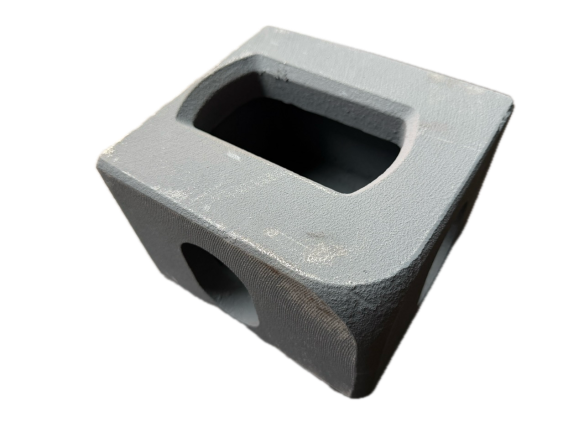
Corner Casting on a Shipping Container
If you have ever seen a crane lift a 30-ton shipping container and effortlessly transfer it to a waiting truck chassis, you have witnessed the effectiveness of the most important piece of container engineering. This lifting – and millions of others that take place every day in ports around the world – is made possible by eight inconspicuous steel blocks called corner castings. Without them, moving a modern intermodal shipping container would be, literally, impossible.
Corner castings (formally called corner fittings) are standardized three-aperture castings made of cast steel, installed at all eight corners of an ISO shipping container. They serve as a universal connection point for lifting, stacking, securing, and transporting containers on ships, trains, and trucks.
What is a corner casting on a shipping container?
A corner casting is much more than just “a piece of metal in the corner.” It is a precisely engineered structural node manufactured with tolerances measured in millimeters, designed to concentrate and transfer every force acting on a container – cargo weight, stacking pressure, dynamic impacts, crane lifting – through a single standardized interface that works with equipment anywhere in the world.
Each corner casting measures 178 mm × 162 mm × 118 mm and weighs approximately 11 kg (24 lbs). It is made of high-strength cast steel – typically ASTM A27 Grade 70-36 or JIS SCW480/SCW490 – and is machined on all six faces to precise specifications. The casting contains three distinct apertures, each with a specific shape and position: one on the top or bottom face for twist locks and stacking, one on the longer side face, and one on the shorter end face for lashing and horizontal connection.
How many corner castings does a shipping container have?
Every standard ISO Series 1 freight container uses eight corner castings, arranged in four pairs:
- 2 Top Left (TL) – top left corner at each end
- 2 Top Right (TR) – top right corner at each end
- 2 Bottom Left (BL) – bottom left corner at each end
- 2 Bottom Right (BR) – bottom right corner at each end

Each end of the container receives one complete set of four types. Left-hand castings are mirror images of their right-hand counterparts. Top and bottom castings have significantly different aperture shapes – this design solution is given by the fundamentally different load paths during lifting (top castings) versus stacking and resting (bottom castings).
Where did corner castings for shipping containers come from?
The birth of containerization
Before 1956, cargo was loaded and unloaded piece by piece – a laborious process called breakbulk, which could keep a ship in port for a whole week. That year, American trucking entrepreneur Malcolm McLean loaded 58 standardized metal containers onto a converted tanker Ideal X in Port Newark, New Jersey, and began the age of containerization.
In those early years, however, there was no universal corner design. Different shipping lines used different container corner configurations. Some used corner brackets, others used pin and clamp systems, and many containers simply could not be stacked or connected between competing fleets. The result was a fragmented system that undermined the efficiency containerization promised.
The emergence of ISO 1161 – the universal standard
The International Organization for Standardization (ISO) realized that without a universal corner interface, the container revolution would stall. After years of negotiations between shipping companies, port authorities, and manufacturers, ISO 1161 was first published in 1984. The standard established the basic dimensions, functional requirements, and strength requirements for corner fittings on Series 1 freight containers. It has been periodically revised, with the most current version being ISO 1161:2016.
The genius of ISO 1161 lies in its restraint. It does not dictate every dimension of the corner casting – for example, the thickness of solid walls (without apertures) is left to the manufacturer. Instead, it standardizes only what must be universal: the size, shape, and position of each aperture, the wall thickness at apertures, and functional strength requirements. This enables manufacturing innovation while guaranteeing that a container built in Shanghai will lock perfectly onto a chassis in Rotterdam.
What are the dimensions of corner castings for shipping containers?
Standard ISO 1161 dimensions
The basic external dimensions are universal for all standard dry container applications:
| Parameter | Standard Value | Tolerance | Function |
|---|---|---|---|
| External length (L) | 178 mm | ±1.5 mm | Fits twist locks, spreaders, and stacking pins |
| External width (W) | 162 mm | ±1.5 mm | Accommodates bridge clamps and lashing equipment |
| External height (H) | 118 mm | — | Vertical seating in corner post assembly |
| Internal length (l) | 113 mm | ±1.0 mm | Anchors lifting and securing equipment |
| Internal width (w) | 98 mm | ±1.0 mm | Prevents lateral shift of twist lock heads |
| Wall thickness (apertured walls) | ≥19 mm (¾ in) | — | Load distribution and structural integrity |
| Weight | ~11 kg (24 lbs) | — | Standard for cast steel |
| Top aperture (stacking aperture) | Ø ≈ 51 mm (oval) | — | Insertion of twist lock pin |
Two reference dimensions that govern container geometry worldwide are particularly critical:
- S (center-to-center lengthwise): Distance between the centers of the corner castings along the length of the container. For a 20ft container, S = 5,853 mm. For a 40ft container, S = 11,985 mm.
- P (center-to-center crosswise): Distance between the centers across the width of the container. P = 2,259 mm for all standard containers.
Why millimeter tolerances matter
A 2 mm deviation in internal width – from 98 mm to 96 mm – may sound trivial. In practice, it can jam a twist lock, delay a discharging operation by 30 minutes or more, and lead to missed vessel departures and thousands of dollars in demurrage charges. In 2023, a Brazilian port rejected 40 containers after automated scanning revealed worn internal apertures measuring 96 mm instead of the specified 98 mm. The resulting penalties exceeded USD 280,000.
Ports are increasingly using automated optical scanning systems that measure corner casting dimensions in real time. Non-compliant containers are flagged immediately. The cost of a single rejected container includes crane rehandling fees, inspection fees, CSC recertification, and – what hurts most – demurrage of USD 5,000 or more per day.
What are the different types of corner castings?
Top vs. bottom: Acorn and semi-circle aperture shape
This is the most visible difference between types of corner castings. Top corner castings have a side aperture in the shape of an acorn (shield) – wider at the top, narrowing downward – designed to guide lifting hooks and spreader pins into position while reducing localized stress during lifting. Bottom corner castings have an oval or semi-circular side aperture, of simpler shape, because they primarily experience compressive forces when the container rests on a surface or another container beneath it.
The top aperture (stacking aperture) is present on both, but on top castings it faces upward for insertion of the twist lock during lifting. On bottom castings, it faces downward, aligned with the twist locks or stacking cones of the container below.
Left vs. right: Mirror design
Top left (TL) and top right (TR) are mirror images. The same applies to bottom left (BL) and bottom right (BR). Each casting is typically marked inside one of its apertures – look for the letters TL, TR, BL, or BR cast or stamped into the steel. This marking system is standardized so that any technician anywhere can unambiguously identify the correct spare part.
The three apertures and their functions
Every corner casting, regardless of position, has three distinct apertures:
| Face | Aperture Shape | Primary Function |
|---|---|---|
| Top/bottom face | Oval stacking aperture (Ø ≈ 51 mm) | Twist lock insertion for vertical stacking and crane lifting |
| Side face (longer wall) | Oval / stadium-shaped (≈ 65 × 130 mm) | Bridge clamps, horizontal container-to-container connection, lashing bars |
| End face (shorter wall) | Oval (bottom castings) / acorn-shaped (top castings) | Spreader insertion, lashing hooks, end-to-end container connection |
The side and end apertures serve a critical secondary function: they are attachment points for lashing bars that secure container stacks to ship decks during sea transport. In heavy seas, these lashings absorb enormous dynamic forces that would otherwise topple unsecured stacks.
What materials are corner castings made from?
Cast steel – the industry standard
The vast majority of corner castings are made from low-alloy carbon-manganese cast steel – grades such as ASTM A27 Grade 70-36 (USA), JIS SCW480 or SCW490 (Japan), and equivalent European specifications. Cast steel is chosen for its specific combination of properties:
- High tensile strength: ≥400 MPa, capable of withstanding concentrated forces from container stacks nine and more layers high
- Excellent weldability: Essential for attaching castings to corner posts and frame rails during container assembly and for replacement procedures
- Ductility and toughness: The material absorbs impacts and vibrations without brittle fracture, even at temperatures down to -50 °C
- Machinability: Post-casting machining produces precise aperture dimensions that enable worldwide interoperability
After casting, the raw blocks undergo normalizing heat treatment at approximately 910 °C to achieve optimal grain size, strength, and toughness. They are then machined on all surfaces and shot-blasted to produce a clean, uniform surface ready for welding.
Comparison of alternative materials
Although cast steel dominates, other materials exist for special applications:
| Property | Cast Steel | Aluminum | Stainless Steel | Gray Cast Iron | Ductile Cast Iron |
|---|---|---|---|---|---|
| Tensile strength | High (≥400 MPa) | Medium (250–350 MPa) | High (≥515 MPa) | Low (150–250 MPa) | Medium-high (400–550 MPa) |
| Weldability | Excellent | Limited / specialized | Good | Poor | Limited |
| Corrosion resistance | Medium (requires coating) | Excellent | Excellent | Poor | Medium |
| Cost | Basic | 2–3× higher | 3–5× higher | Lower | 1.5× higher |
| Temperature range | -50 °C to +70 °C | -30 °C to +60 °C | -100 °C to +80 °C | -30 °C to +50 °C | -40 °C to +60 °C |
| Typical use | Standard ISO containers | Lightweight military containers | Food-grade / chemical containers | Cheap aftermarket (limited) | Heavy-duty / high-stress applications |
Why not all steel is the same
A common point of confusion: container corner posts are often made of Corten steel, but corner castings are not. Corten (weathering steel) forms a protective rust patina and is excellent for sheet and structural applications, but it is not a casting material. Corner castings require specific metallurgical properties – grain size, machinability, and welding compatibility – that only cast steel can provide.
Every legitimate corner casting should carry certification from at least one major classification society: Lloyd’s Register (LR), Bureau Veritas (BV), American Bureau of Shipping (ABS), DNV, CCS, or RINA. These certifications confirm that the casting has been manufactured, tested, and inspected in accordance with or exceeding ISO 1161 requirements.
How much weight can corner castings bear?
Corner castings are designed for loads that significantly exceed typical container weights. Understanding the numbers puts their importance into perspective.
Rated loads
- Top-corner lifting load: Each top corner casting must withstand at least 150 kN (33,700 lbf) in an ISO 1161 lifting configuration. With four top corners engaged during a typical lift, the combined rated capacity exceeds 600 kN.
- Dynamic vertical load: Each corner casting must bear dynamic vertical loads exceeding 40,000 lbs (approximately 18,000 kg) without permanent deformation.
- Corner post test strength: Individual corner posts (the vertical structural elements to which corner castings are welded) are rated for approximately 115,000 lbs (510 kN), with test strengths reaching 190,000 lbs.
- Stacking: Corner castings allow standard containers to be stacked 9 to 10 layers high on container ships, meaning the bottom corner castings in a stack bear the cumulative weight of every container above them.
Load path: How forces travel through the container frame
Understanding the load path reveals why corner castings are indispensable:
Cargo weight → Container floor → Bottom side rails and cross members → Corner posts → Corner castings → Twist locks → Next container (or chassis/ship deck)
When a crane lifts a container, the load path reverses: the crane spreader engages four top corner castings through twist locks, and the entire 30+ tons of container and cargo hangs from those four points. The full weight of a loaded 40ft container – up to 30,480 kg (67,200 lbs) gross – is suspended from the top apertures of four corner castings. That’s approximately 7,600 kg (16,800 lbs) per corner casting in pure tension.
How do corner castings work with twist locks and bridge fittings?
Twist locks – the universal connector
A twist lock is a mechanical device that mates with the top aperture of a corner casting. It consists of a T-shaped or cone-shaped head mounted on a shaft. During insertion, the head passes through the oval stacking aperture and is then rotated 90 degrees. The head is now wider in one dimension than the aperture, securely locking it inside the casting.
Twist locks come in three main variants:
- Manual twist locks: A worker physically inserts and rotates the lock using a lever. Common for securing containers to chassis.
- Semi-automatic twist locks (SATL): Installed in the bottom corner castings of the upper container before stacking. They automatically lock when the upper container is lowered onto the lower one, but require manual release.
- Fully automatic twist locks: Built into crane spreaders. Insertion and withdrawal are entirely hydraulically or electrically controlled without manual intervention.
Bridge clamps and lashing equipment
The side and end apertures of corner castings serve horizontal and securing functions. Bridge clamps (also called bridge fittings) connect adjacent containers side-by-side through their side apertures, creating rigid container blocks on ship decks. Lashing bars pass through the end and side apertures and are tensioned with turnbuckles to secure container stacks to deck lashing points, preventing movement in heavy seas.
Can corner castings be repaired, or must they be replaced?
The rule: Replace, never repair
This is one of the most important rules of container maintenance: a damaged or cracked corner casting must always be replaced – never repaired. The main standards for container inspection, including the IICL repair guidelines (Institute of International Container Lessors) and ISO requirements, expressly prohibit welding repairs to corner castings.
The reason is metallurgical. Corner castings derive their strength from the carefully controlled grain structure created during the casting and heat treatment process. Welding introduces localized heating and cooling that alters this grain structure and creates heat-affected zones with unpredictable strength, ductility, and fatigue resistance. A welded repair may look superficially correct while hiding a critical weakness that will fail under load – with potentially catastrophic consequences for anyone nearby.
When to inspect and replace
Corner castings should be thoroughly inspected at every container exchange and at regular maintenance intervals. Look for:
- Cracks: Any visible crack – hairline or otherwise – is grounds for immediate decommissioning and replacement.
- Deformation: Bent, dented, or distorted apertures indicate overloading. Even slight deformation can prevent twist lock insertion.
- Corrosion: Pitting corrosion deeper than 1 mm or any perforation of aperture walls requires replacement.
- Worn apertures: Internal dimensions outside ISO 1161 tolerances (e.g., internal width below 97 mm or above 99 mm).
- Weld failure at the interface: Cracking or separation between the casting and corner post or frame rail.
Replacement procedure overview
Replacing a corner casting is a certified procedure that should only be performed by qualified technicians:
- Carefully cut out and grind the damaged casting without damaging the adjacent corner post and rails.
- Precisely position the new certified casting using jigs and alignment tools to maintain the critical S and P reference dimensions.
- Weld using certified procedures compatible with both the cast steel casting and the adjacent structural steel.
- Conduct post-weld inspection – visual, dimensional verification, and often liquid penetrant or magnetic particle testing.
- Document the replacement and update the container repair records.
How are corner castings manufactured?
The sand casting process
Corner castings are manufactured by the sand casting method, a centuries-old technique refined for modern precision:
- Pattern making: A precision pattern – slightly enlarged to account for metal shrinkage during cooling – is created for each of the four casting types (TL, TR, BL, BR).
- Mold preparation: The pattern is pressed into specially formulated sand mixed with binders, creating a cavity in the exact negative shape of the casting.
- Pouring: Molten cast steel at approximately 1,500 °C (2,730 °F) is poured into the mold cavity.
- Cooling and shakeout: After controlled cooling, the sand mold is broken apart to reveal the raw casting.
- Heat treatment: Normalizing at ~910 °C to achieve specified grain size and mechanical properties.
- Machining: All six faces are machined to final dimensions. Apertures are precisely drilled to ISO 1161 specifications. Edge chamfering (typically R10 radius) reduces stress concentration.
- Shot blasting: Steel shot at high speed cleans and uniformly textures the surface.
- Inspection: Dimensional verification, visual inspection, and often X-ray or ultrasonic testing to detect internal voids or inclusions.
Quality control and certification
Before a corner casting leaves the factory, it goes through several verification steps:
- Dimensional checks using GO/NO-GO gauges – the GO gauge must pass freely through each aperture, while the NO-GO gauge must not fit.
- Load tests – casting samples from each batch are tested to destruction to verify strength exceeds ISO 1161 minimums.
- Classification society certification – independent inspectors from organizations such as ABS, BV, or Lloyd’s Register verify manufacturing quality and issue certificates for each production batch.
What are common corner casting problems and failures?
| Type of Failure | Common Causes | Symptoms | Required Procedure |
|---|---|---|---|
| Corrosion pitting | Salt water exposure, coating failure, standing water | Rust flakes, surface pitting >1 mm deep | Replace if aperture wall thickness is compromised; otherwise clean, treat, repaint |
| Impact deformation | Improper crane handling, container drops, collisions | Bent or distorted aperture edges, misaligned holes | Immediate replacement – dimensional integrity lost |
| Fatigue cracking | Repeated load cycles, manufacturing defect, overloading | Hairline cracks radiating from aperture corners | Immediate replacement – risk of crack propagation |
| Aperture wear | Friction wear from twist locks, lashings, frequent handling | Internal dimensions below ISO tolerance | Replace – worn apertures can cause twist lock disengagement |
| Weld separation | Poor original weld, corrosion at interface, overloading | Gap or crack between casting and corner post | Replace casting and reweld; inspect adjacent structure |
| Internal voids / casting defects | Manufacturing defect – sand inclusions, gas porosity | May only be visible by X-ray or when a crack develops | Replace if found – internal voids compromise strength |
Corrosion is the most insidious of these failures, because it develops gradually and can be hidden under paint or inside apertures. Regular inspection of all aperture interiors with a flashlight and mirror is the only reliable method of detection.
What to look for when purchasing
- ISO 1161 compliance explicitly stated – not just “ISO compatible” or “ISO standard”
- Material specification – cast steel, not unspecified cast iron
- Classification society marks – look for ABS, BV, LR, or equivalent stamps on the casting
- Dimensional guarantee – 178 × 162 × 118 mm with stated tolerances
- Machined surface finish – raw, unmachined castings will not fit properly
- Awareness of complete set – remember that a complete set requires 8 castings: 2 TL, 2 TR, 2 BL, 2 BR
Complete sets of eight corner castings typically range from USD 400 to 600 for standard cast steel. Individual castings (specific positions) range from USD 50 to 100 each. Stainless steel and aluminum castings cost significantly more and are generally made to special order.
What does the future hold for corner castings?
The corner casting design has remained essentially unchanged for decades – and for good reason. Any change to the interface would disrupt compatibility with millions of twist locks, spreaders, and handling systems worldwide. Innovation is therefore happening around the casting, not within it.
Smart castings – IoT and RFID integration
Leading manufacturers are beginning to embed RFID tags into recesses in the casting body, protected from impact and weather. These tags store the container’s unique identity, maintenance history, and certification status – readable by port scanners without human intervention. More advanced prototypes integrate strain gauges that monitor load distribution in real time via Bluetooth or cellular networks, alerting operators to overloading conditions before they cause structural failure.
Advanced manufacturing
3D-printed titanium corner castings are emerging for high-value specialized containers, achieving dimensional tolerances of ±0.05 mm – an order of magnitude better than traditional sand casting. Although currently cost-prohibitive for standard containers, this technology points toward a future where corner castings will be lighter, stronger, and manufactured on demand.
Sustainability
As the container industry focuses on the carbon footprint of the lifecycle, corner casting manufacturers are exploring electric arc furnace steel from recycled scrap, reducing the carbon intensity of each casting. Because corner castings can be recycled at end of life – simply melted down and recast – they already represent one of the more sustainable components of container construction.
Frequently asked questions
What are corner castings on a shipping container?
Corner castings are standardized three-aperture castings made of cast steel, mounted at all eight corners of an ISO shipping container. They are governed by the ISO 1161 standard and serve as a universal interface for crane lifting of containers, vertical stacking of containers, securing containers to ships and chassis using twist locks and lashing equipment, and horizontal joining of containers using bridge fittings.
How much weight can shipping container corner castings bear?
Each top corner casting must withstand a minimum lifting load of 150 kN (33,700 lbf) per ISO 1161 specification. In practice, each corner casting on a loaded container can bear a dynamic vertical load of up to approximately 40,000 lbs (18,000 kg). Individual corner posts with attached castings are rated for a test strength of approximately 115,000 lbs, enabling container stacks of nine to ten layers.
What is ISO 1161 and why is it important?
ISO 1161 is the international standard that establishes the basic dimensions, functional requirements, and strength requirements for corner fittings on Series 1 freight containers. First published in 1984 and most recently updated in 2016, it ensures that every compliant corner casting works with every compliant twist lock, spreader, and lashing equipment – anywhere in the world. Without ISO 1161, the global system of intermodal containers would not function.
How many corner castings does a shipping container have?
Every standard ISO shipping container uses eight corner castings: two top left (TL), two top right (TR), two bottom left (BL), and two bottom right (BR). Each end of the container receives a complete set of four (one of each type), with left and right castings being mirror images.
What are the differences between top and bottom corner castings?
Top corner castings have a side aperture in the shape of an acorn (shield) designed to guide lifting hooks and reduce stress during crane lifting. Bottom corner castings have an oval or semi-circular side aperture that primarily handles compressive forces when the container rests on a surface. Top castings are also oriented with the stacking aperture facing upward, while bottom castings have it facing downward.
Can corner castings be repaired instead of replaced?
No. Industry standards including the IICL repair guidelines and ISO requirements expressly prohibit welding repairs to corner castings. A damaged, cracked, or deformed corner casting must always be replaced with a new, certified casting. Welding a corner casting alters its carefully controlled grain structure and creates heat-affected zones with unpredictable strength, posing a serious safety risk.
What material are shipping container corner castings made from?
The standard material is low-alloy carbon-manganese cast steel, typically ASTM A27 Grade 70-36 or JIS SCW480/SCW490. Cast steel is chosen for its combination of high tensile strength (≥400 MPa), excellent weldability, ductility, and machinability. Alternative materials include aluminum (for lightweight military containers) and stainless steel (for food-grade and chemical containers), but cast steel remains the clear choice for standard ISO containers.
What are the dimensions of shipping container corner castings?
Standard corner castings measure 178 mm × 162 mm × 118 mm (approximately 7 in × 6.38 in × 4.64 in), weigh approximately 11 kg (24 lbs), and have a wall thickness of at least 19 mm (¾ in). Internal aperture dimensions are equally critical – especially the internal width of 98 mm (±1 mm), which must be maintained to ensure compatibility with twist locks.
Where can I buy replacement corner castings for a shipping container?
Replacement corner castings are available from specialized container parts suppliers including Chassis King, Mytee Products, Conexwest, Container Modification World, Container Nut, Sea Box, and Industrial Wheels. Complete sets of eight cast steel corner castings typically cost USD 400–600. Always verify ISO 1161 compliance and classification society certification before purchasing.
How long do corner castings last?
With proper maintenance – including regular coating, corrosion inspection, and avoiding impact damage – corner castings can last the entire 15–25 year service life of a shipping container. Castings on containers in heavy maritime service, however, particularly those frequently handled or exposed to aggressive saltwater environments, may require replacement sooner. Regular dimensional inspection is the best way to determine whether a corner casting has reached the end of its operational life.
 Czech Republic
  WITHOUT SHIPPING