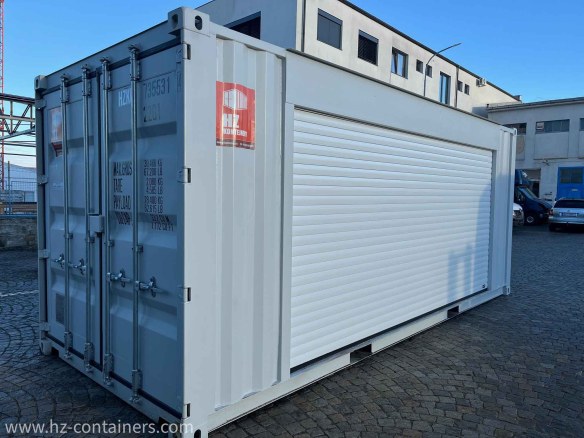
Container Survey Report
In a globalized world of logistics, where millions of cargo containers are transported daily, ensuring the safety, integrity, and suitability of each unit is an absolute necessity. A key tool for achieving these goals is the Container Survey Report – a technically precise document that is much more than mere formality. In this comprehensive glossary, you will learn everything about the significance, content, processes, responsibilities of inspectors, types of inspections, insurer requirements, and real technical procedures including recommended checklists.
What is a Container Survey Report?
A Container Survey Report is an official technical document that records in detail the current physical condition and functionality of a cargo container based on a thorough inspection conducted by a qualified inspector (container surveyor). The report contains not only a description of identified defects, deformations, corrosion, cleanliness, door functionality and sealing, but also photographic documentation and repair recommendations. Its significance lies in the fact that it provides objective, verifiable, and legally recognized evidence of the container’s condition at a specific point in time, which is essential for:
- protection of transported goods,
- minimizing risks throughout the supply chain,
- resolving disputes between parties (owner, carrier, lessee, insurer),
- compliance with international safety and technical standards (e.g., CSC – Convention for Safe Containers according to IMO, ISO standards).
Why is the report key?
According to HZ CONTAINERS, neglecting professional inspection and failing to obtain a report is a common cause of financial losses – for example, if old damage is not documented, it may be wrongly attributed to a new user/lessee. The report is also crucial for the possibility of claiming an insurance event, as insurers require detailed, independent, and time-specific evidence of the container’s condition before/during transport.
Who needs a Container Survey Report and why?
Shippers, importers, lessees, and owners
- Need to ensure that the container meets technical and hygiene requirements for the type of goods being transported (for example, food-grade standard, absence of contamination, tightness).
- The report is evidence to insurers and business partners that damage occurred/did not exist beforehand.
- Minimizes the risk of contamination or deterioration of goods – for example, from moisture, rust, mold, or pests.
Carriers, transporters, ship owners, and logistics companies
- Ensure the safety of crew, vessel, and other cargo – structural defects can cause collapse during stacking or handling.
- Reports facilitate repair and maintenance planning, extend container lifespan, and reduce emergency costs.
Leasing companies
- Work with so-called on-hire (upon receipt) and off-hire (upon return) inspections to precisely determine who bears responsibility for damage.
- Ensure transparency of transactions and trustworthiness between parties in the global market.
Insurers
- Without an inspection report, insurance benefits may not be recognized, or may be reduced due to insufficient proof of damage occurrence.
- The report is key for tracing causes and extent of damage and for legal disputes.
Customs and regulatory authorities
- Require valid inspections (particularly CSC inspections) to permit containers for international transport.
- Control compliance with international safety regulations and regular periodic inspections.
Inspection process and the role of container inspectors
Who is a container inspector?
- An expert with certification and experience in the field of construction, maintenance, and assessment of container condition according to standards ISO 6346, ISO 1496, CSC, and company standards.
- May be an employee of a transport company, specialized inspection agency, or independent expert.
- Must be able to identify both common and hidden defects, use measuring instruments (e.g., moisture meters, ultrasonic probes for sheet thickness), and properly document findings.
Inspector qualification requirements
- Completion of specialized courses (e.g., IICL – Institute of International Container Lessors, Bureau Veritas, etc.).
- Knowledge of various container types (standard, high-cube, open-top, flat rack, reefer).
- Knowledge of current legal and technical requirements for international transport.
Responsibilities of container inspectors
- Conduct thorough visual and technical inspection of both exterior and interior of the container.
- Prepare detailed written report containing a description of each identified defect, its location, extent, and impact on container usability.
- Take a set of numbered photographs that are an integral part of the report.
- Check the validity and condition of the CSC plate (for international use).
- Recommend appropriate measures – from minor repairs to decommissioning.
- Oversee proper loading, unloading, and sealing of the container, if required by the client.
Types of container inspections and their specifics
The main types of inspections are:
| Inspection Type | When Performed | Purpose and Focus |
|---|---|---|
| On-Hire Survey | Upon receipt of container for lease | Document original condition, protect lessee from third-party damage |
| Off-Hire Survey | Upon return of container after lease | Compare with on-hire report, determine new damage |
| Damage Survey | After damage is discovered/occurs | Determine extent and cause of damage, basis for insurance claim |
| CSC Inspection | Regularly (minimum every 30 months), or before export | Verify compliance with safety regulations, extend CSC plate validity |
| Condition Survey | Upon sale, purchase, long-term storage | Overall condition assessment, basis for pricing and decision-making |
| Pre-Trip Inspection (PTI) | Before trip for refrigerated containers | Test functionality of cooling unit, insulation, tightness, and sensors |
Note: Some types of inspections (particularly CSC and PTI) are governed by strict IMO, ISO standards and shipping company requirements.
Key components of a Container Survey Report
Every quality report should contain the following sections:
1. Basic information
- Identification data: container number (e.g., TCKU 123456-7), type, size (20′ DC, 40′ HC, 40′ RF, etc.), manufacturer, year of manufacture.
- Place and date of inspection, inspector’s name, company.
- Purpose of inspection (on-hire, off-hire, damage, condition, CSC).
2. Overall assessment
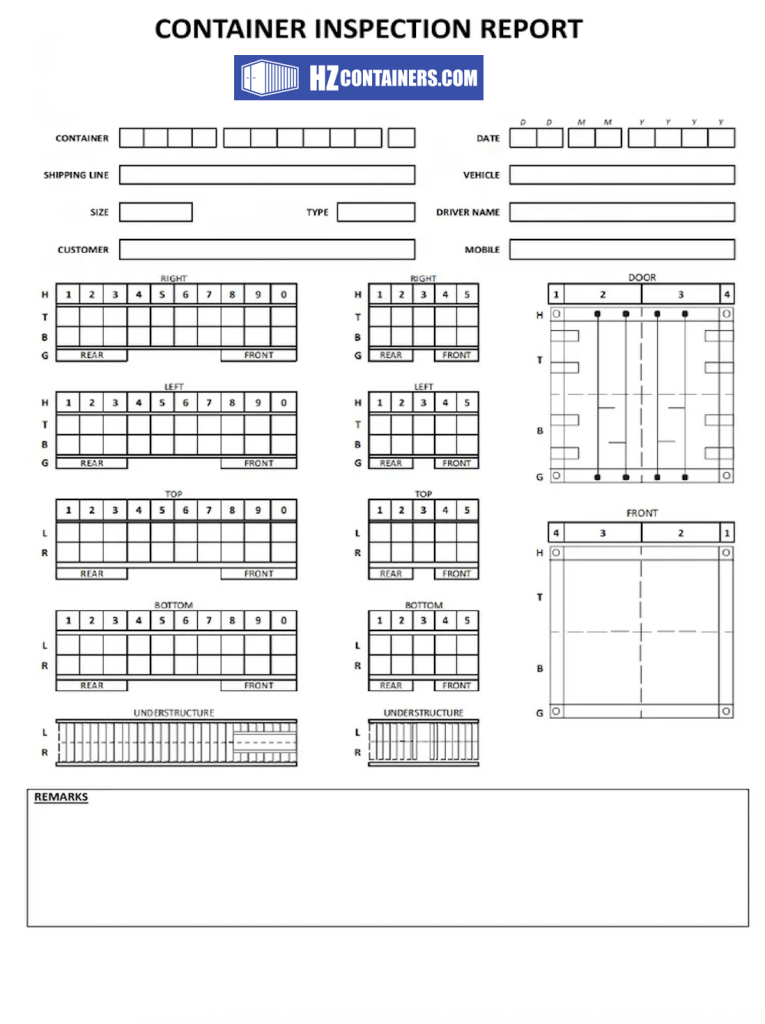
- Condition categorization: Cargo Worthy, Wind and Watertight (WWT), Food-grade, Requires repair.
- CSC plate validity (for export containers).
3. Detailed description of findings (according to checklist)
- Clear table or list describing the condition of all structural parts:
- Undercarriage, corner fittings, walls, roof, doors, floor, sealing.
- Location and extent of damage (e.g., “right wall – dent 20×10 cm, rust in surrounding 5 cm area”).
4. Photographic documentation
- Each significant defect or area of interest is carefully photographed, numbered, and described in the text.
- Overall photographs of exterior and interior.
5. Recommendations and cost estimate
- Proposed repair method according to IICL standard, or recommendation for container decommissioning.
- Approximate budget for materials and labor (if required by contract terms).
Detailed inspection checklist (ISO Container Inspection Checklist)
Example of systematic procedure:
| Inspection Point | What is Checked | Why It Matters |
|---|---|---|
| Exterior/Undercarriage | Frame condition, beams, corner fittings, welds, corrosion signs, deformations | Critical for structural strength, stacking, and handling |
| Walls (outer, inner) | Dents, cracks, holes, corrosion, repair marks | Affects cargo protection, tightness, water leakage/entry risk |
| Doors and sealing | Hinge functionality, locking, rubber seals, locks | Main entry point for water, dust, pests, and cargo security |
| Roof/Ceiling | Deformations, cracks, load marks, light test | Weather protection – water, snow, sun |
| Floor | Wooden/steel floor condition, delamination, holes, contamination | Load capacity, handling safety, contamination elimination |
| Ventilation openings | Functionality, absence of blockage, cleanliness | Condensation and mold prevention, proper ventilation |
| Interior cleanliness/odor | Chemical traces, mold, pests, odor | Essential for food, pharmaceutical, textile transport |
| CSC plate (for export) | Validity, readability, correct data | International transport requirement |
Common deficiencies and recommended repairs:
- Corrosion removal and application of new anti-corrosion protection.
- Repair/renewal of door sealing.
- Filling or replacement of floor boards.
- Repair of locks and hinges.
- Welding or replacement of damaged panels.
Real-world examples and frequently asked questions
What is the difference between “Cargo Worthy” and “wind and watertight”?
- Cargo Worthy means that the container meets all requirements for safe transport including structural strength and valid CSC inspection.
- Wind and watertight (WWT) indicates that the container does not leak water or wind, but may not be suitable for export.
When is CSC inspection necessary and what is checked during it?
- CSC (Convention for Safe Containers) inspection is mandatory for all containers intended for international maritime transport.
- It is performed at least every 30 months, checking the condition of construction, doors, floor, walls, roof, and plate validity/readability. Without a valid CSC plate, transport is not permitted.
How does an inspection report help with insurance claims?
- If a container is damaged during transport, the report provides key evidence of its previous condition, enabling quick and fair insurance settlement.
Where can an inspection be ordered and who can perform it?
- From specialized agencies, logistics companies, or through commercial platforms (e.g., Container xChange).
- It is always recommended to use an accredited inspector with documented certification.
A Container Survey Report is not a bureaucratic burden, but a key element for risk management, investment protection, and building trust in the global business environment. Regular, professionally conducted inspections and careful documentation help prevent financial losses, disputes, and cargo damage. Investment in a quality inspection report is negligible compared to potential costs of damage, insurance disputes, and penalties for non-compliance with legislation.

 Czech Republic, Třebíč
  WITHOUT SHIPPING