Static Calculation of Shipping Container
Static calculation of shipping container represents a key engineering discipline that enables verification of whether the container structure safely withstands all anticipated loads during its lifetime. Container statics is essential not only for transporting goods across oceans, but also for subsequent use in modular architecture and construction.
Importance of Static Calculation in Practice
- Safety and certification: Every container must undergo static assessment according to ISO 1496 standard and obtain certification according to CSC (Convention for Safe Containers).
- Construction optimization: Static calculations enable minimization of material weight while maintaining or increasing construction safety and rigidity.
- Adaptation for construction: For modular buildings, such as shipping container homes or container houses, new static calculations must be performed considering load changes and interaction with other load-bearing elements.
Key Principles of Shipping Container Statics
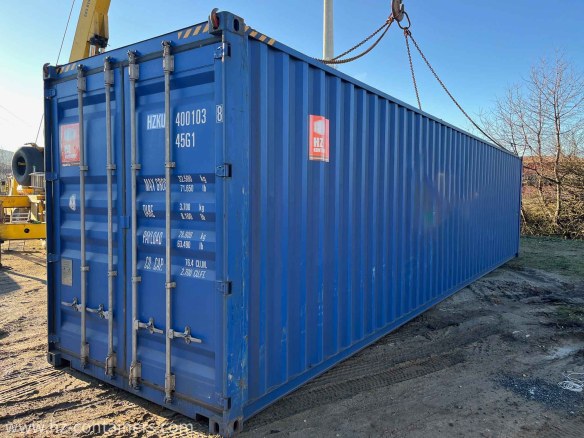
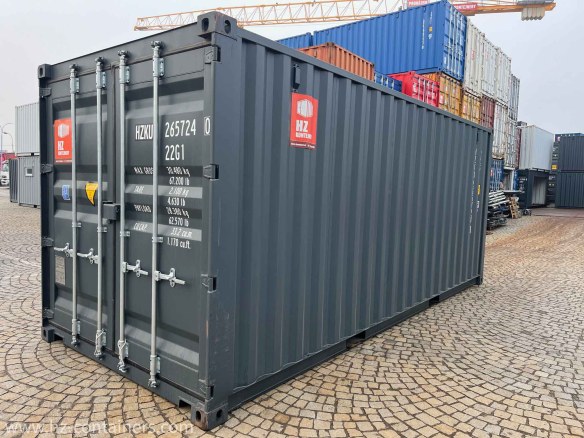
Shipping container is a self-supporting monocoque structure, where each part carries a share in force transmission. Static action is determined by how individual forces are transmitted between main elements.
Load Transfer
| Element | Transmitted Forces | Normative Requirements | Important Properties |
|---|---|---|---|
| Corner posts | Vertical (pressure from stacking) | ISO 1496: min. 850 kN per post | S355J2+N steel, seamless profiles |
| Corner castings | Vertical, tensile, shear | ISO 1161: precise shapes and dimensions, load capacity | High-strength steel |
| Walls | Horizontal (wind, impacts) | Profiling per ISO, buckling resistance | COR-TEN steel, thickness 1.6–2.0 mm |
| Roof | Area load, rigidity | Load capacity min. 200 kg/m², water resistance | Cross profiling, COR-TEN |
| Floor | Point and area loads | Load capacity min. 5,400 kg per point, EN 283 | Water-resistant plywood, steel cross-members |
Main Structural Elements and Their Role in Statics
Corner Posts and Corner Castings
- Corner posts form the vertical load-bearing axis. They enable stacking containers up to nine units high. Each post is dimensioned for pressure min. 850 kN and is often made from seamless profiles for higher safety.
- Corner castings are standardized castings made from high-strength steel (ISO 1161), which serve not only for handling and stacking, but also as anchor points during transport.
Walls and Roof

- Walls are made from profiled sheets (mostly COR-TEN steel, thickness 1.6–2.0 mm), which increase rigidity and distribute horizontal forces from wind or uneven loading.
- Roof serves a protective and rigidity function, but is not designed for high loads. It allows safe movement of persons, but area loads such as snow should always be assessed.
Floor
- Floor is formed by steel cross-members and a water-resistant plywood sheet (min. thickness 28 mm). It must withstand point loads (e.g., from forklift wheels) and simultaneously distribute cargo weight across the entire frame.
Types of Load Considered in Static Calculation
Static calculation includes various types of loads – from the container’s own weight, through direct cargo loading, to climatic and handling forces.
| Type of Load | Description | Normative Values |
|---|---|---|
| Own Weight (Tare Weight) | Weight of empty container (20′ approx. 2,200 kg, 40′ approx. 3,700 kg) | ISO 668 |
| Cargo Load (Payload) | Maximum permitted cargo weight (20′ approx. 28,000 kg, 40′ approx. 26,000 kg) | ISO 668, 1496 |
| Stacking Load | Forces acting when stacking up to 9 containers on top of each other | ISO 1496 (min. 850 kN/post) |
| Tensile and Shear Forces | Crane handling, twistlocks, transport | ISO 1161, EN 283 |
| Climatic Loads | Wind (up to 1.5 kN/m²), snow (depending on region), thermal expansion | EN 1991 |
| Dynamic Loads | Impacts, braking, acceleration during transport | Equivalent static forces with safety coefficient |
Example of Force Distribution in Container
            [STACKING]
               ↓
       ┌─────────────┐
       │             │
       │             │
       │             │
       └───┬─────┬───┘
           ▲     ▲
     [Corner Castings]
Forces from stacking and cargo are always directed through corner posts to corner castings and further to the foundation.
Methods of Static Calculation and Analysis
Quasi-Static Method
- Uses static models where dynamic effects are converted to equivalent forces.
- Enables quick and preliminary assessment, but does not capture local effects (e.g., wall buckling, stress peaks).
- Suitable for initial designs, less for final certification.
Finite Element Method (FEA)

- Most accurate and modern method: Models the entire container in CAD software, divides it into thousands of elements.
- FEA Advantages:
- Detailed stress and deformation distribution throughout the structure.
- Identification of critical points (e.g., weak spots after intervention in load-bearing structure).
- Enables optimization (e.g., weight reduction while maintaining load capacity).
- Practical Use:
- Essential for certification of atypical and modified containers.
- Standard requirement in modular building design (shipping container homes).
Other Methods
- Nonlinear Analysis (GMNIA): Considers imperfections, material nonlinearities and is recommended for multi-story and atypical buildings.
- Dynamic Simulations: For special containers (e.g., transport of hazardous materials), impact modeling and extreme situation modeling is also required.
Standards and Regulatory Framework
| Standard / Regulation | Area of Application | Key Requirements |
|---|---|---|
| ISO 1496 | Strength, testing, stacking, lifting | Functional and safety tests, load capacities |
| ISO 668 | Dimensions, types, classification | Precise dimensions, overall weight limits |
| ISO 1161 | Corner castings | Shape, dimensions, strength, material |
| CSC | Safety plate and regular inspections | Inspection records, periodic reviews |
| EN 1993 (Eurocode) | Steel structures (construction) | Design of reinforcements and modifications for construction use |
CSC Plate
Every container used in international transport must be marked with a CSC plate. This plate confirms that the container has passed type approval and regular inspections.
Practical Impacts and Factors Affecting Statics

Construction Modifications
- Any intervention (e.g., cutting holes for doors, connecting multiple containers) disrupts the original force flow – a new static calculation and reinforcement must be performed.
- For multi-story buildings (large container homes), proper load distribution between individual containers and their corner elements is critical.
Corrosion and Damage
- Corrosion (particularly of the frame and floor cross-members) reduces load capacity. Continuous visual and technical inspections are mandatory.
- Deformation of posts, bending of longitudinals or cracks in welds disqualify the container from service.
Improper Loading and Stacking
- Overloading, uneven load distribution or support outside corner elements causes stress concentration, leading to deformation or structural collapse.
Related Terms
| Term | Explanation |
|---|---|
| Tare Weight | Own weight of empty container |
| Payload | Maximum permitted cargo load |
| Gross Weight | Total permitted weight (tare + payload) |
| COR-TEN Steel | Steel with high resistance to atmospheric corrosion (patinating surface) |
| CSC Plate | Safety certification plate according to CSC convention |
| Monocoque | Self-supporting structure – most loads carried by shell and frame |
| Twistlock | Mechanism for connecting containers to each other or to a vehicle |
| GMNIA | Geometrically and materially nonlinear analysis with imperfections (advanced method for static calculations) |
| FEA | Finite Element Method (numerical analysis of stress and deformations) |
Static calculation of shipping container is a fundamental condition for its safe operation and further use. Modern containers represent the result of precise engineering work, where every structural detail is subject to strict standards and tests. The results of static calculations are key not only for obtaining certifications, but also for optimizing production and safe use in transport and construction.
Regular inspections, proper handling and expert assessment during modifications are the guarantee of long service life and safety of every container.

 Czech Republic, Třebíč
  FREE SHIPPING