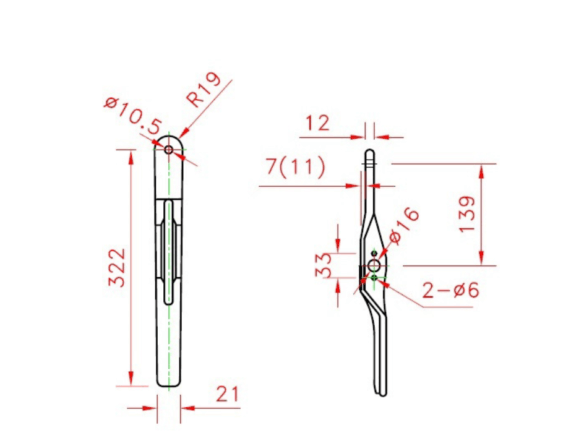
Retainer Plate
What is a Retainer Plate on a shipping container?
A Retainer Plate is a small, robust, but absolutely crucial steel element of the door locking mechanism of a shipping container. It is usually firmly welded or bolted to the outer side of the container’s swing doors. Its main task is to secure the door handle in a locked, vertical position. It works in tandem with a rotating component called a “retainer catch”. Once the door handle is folded into the retainer plate, the catch rotates over it and mechanically locks it in the closed position, preventing its spontaneous opening or unauthorized manipulation.
Although the retainer plate is a minor component compared to the massive structure of the container, it is an essential part of the shipping container door lock. It is responsible for ensuring that the strong locking bars remain in the secured position and the doors are safely closed.
Catalog Number:
Retainer Plate DH3 – HZ000081
Retainer Plate DH7 – HZ000082
Significance and role of the retainer plate in the door lock assembly
To understand the importance of the retainer plate, it is essential to know the entire construction of the container door locking system. Standard ISO container doors are not secured by a simple lock, but by a complex mechanical assembly designed for extreme strength and resistance to external influences.
Key components of a shipping container door lock:
| Component | Function and Significance |
|---|---|
| Locking Bars/Rods | Vertical steel bars on each door (usually 2 per door). When rotated, they engage with the top and bottom keepers, securing the doors. |
| Cams and Keepers | Hooks at the ends of the locking bars that engage with fixed keepers on the door frame when locked. |
| Door Handle | Lever used to rotate the locking bar and operate the cams. |
| Handle Hub Mount Brackets | Hold the locking bar against the door and allow its smooth rotation. |
| Handle Retainer Assembly | Consists of two main elements – the Retainer Plate and the rotating Retainer Catch, which covers the handle and prevents it from opening. |
Door locking procedure:
- The operator closes the doors and uses the handle to rotate the locking bar until the cams engage with the keepers.
- The handle is folded into the retainer plate (U-profile).
- The rotating retainer catch flips over the handle and mechanically locks it.
- For increased security, a padlock or seal can also be inserted.
Key functions and importance of the retainer plate
The retainer plate in the container door system fulfills three absolutely crucial roles:
1. Protection against unauthorized entry
The retainer plate with the rotating catch forms the last link in the mechanical locking chain. This is where the padlock or security seal is placed. Without a properly functioning retainer plate, the entire mechanism would be compromised – security against burglary, theft, or cargo manipulation would be lost.
2. Safety during transport
Shipping containers are exposed to extreme stress:
- Strong vibrations during transport by ship, train, and truck
- Rapid temperature changes (-40°C to +70°C)
- Great forces during stacking and handling
If the handle were not firmly secured, it could spontaneously release during transport, leading to the doors opening – with consequences such as cargo loss, endangering the safety of workers and the public, or disrupting the stability of the entire container stack.
3. Contribution to structural integrity
Properly locked doors, with their handle secured in the retainer plate, significantly increase the rigidity of the container’s rear frame. This is crucial when stacking containers (commonly up to 7 high on ships), where the entire structure must withstand great pressure and deformations.
Types and variants of retainer plates
Despite having the same function, several variants of retainer plates exist. They differ mainly in manufacturing technology, dimensions, and specific design details according to the manufacturer or the type of container used.
By manufacturing technology:
- Forged Retainer Plate:
- Produced by forging, i.e., heating and subsequent shaping of steel.
- The resulting product has higher density and resistance to material fatigue.
- Suitable for containers intended for the most demanding conditions.
- Pressed/Flat Lever Retainer Plate:
- The most common variant.
- Produced by pressing steel sheet into a U-profile.
- Despite lower density compared to forged plates, it fully meets the requirements of ISO containers.
By design:
- Basic U-profile: The most widespread form, often with pre-drilled holes for attaching the catch.
- Special dimensions: Different manufacturers may have varying tolerances, material thickness, or hole spacing; however, always within ISO standards (see below).
Compatibility
ISO standardization allows most retainer plates to be interchangeable across brands and manufacturing years. However, when replacing, it is always advisable to change the plate together with the corresponding catch as an assembly.
Materials, manufacturing, and technical specifications
Material:
- Most commonly high-strength low-alloy structural steel (e.g., S355), or cast steel.
- The material is identical to most frame elements of the container (corners, frame, locking bars).
Surface treatment:
- Hot-dip galvanization: Provides protection against corrosion in extremely aggressive environments (sea salt, humidity, temperature shocks).
- Alternatively, zinc primer with a final surface finish (polyurethane, epoxy).
Typical dimensions of a pressed retainer plate:
| Parameter | Value |
|---|---|
| Length | 130 mm |
| Width | 46 mm |
| Thickness | 5.5 mm |
| Weight | approx. 0.23 kg |
Standards and certifications:
- ISO 668, ISO 830, ISO 1161, ISO 1496-1, ISO 6346: Standards defining dimensions, strength, marking, and construction details of containers, including door mechanisms.
- CSC (Convention for Safe Containers): Requires regular safety inspections, which include the condition of retainer plates and catches.
- T.I.R. certification: Requires the container to be securely closable and sealed.
The Retainer Plate in the Global Container Industry
The retainer plate is a microscopic example of the principles that shape the entire container industry: standardization, durability, and global interchangeability.
Importance for operation and maintenance
- Thanks to standardization, a damaged component can be quickly replaced almost anywhere in the world – from a port in Shanghai to a service depot in Rotterdam.
- The retainer plate is also crucial for container modifications (e.g., container shops, offices, technological boxes), where the original door hardware ensures security even after a change of purpose.
Examples of use in container conversions
- Entrance doors for sales or storage containers: The original locking mechanism is often retained for maximum security.
- Container workshops or generator boxes: The retainer plate guarantees that the equipment inside remains protected from unauthorized access.
- Social and architectural projects: When converting containers into shipping container homes, container houses, emergency shelters, or commercial properties, secure locking is crucial for protecting property and occupants.
Common faults, maintenance, and replacement
Although the retainer plate is robust, it undergoes wear, damage, or corrosion during several years of operation. Regular inspection is therefore essential not only for safety but also for the validity of CSC certification.
Most common faults:
- Bending or deformation: Most often due to impact by handling equipment or an attempt at forced opening.
- Cracking or breaking: Fatigue cracks or breakage under extreme load.
- Corrosion: Damage to the zinc layer leads to rusting and weakening of the material.
- Loosening or loss: Welds may fail, the catch may loosen or be lost.
- Catch jamming: Corrosion of the catch pin causes it to snag.
Maintenance and repairs:
- Regular inspection: At least during every periodic inspection (according to CSC every 30 months), visually check the condition of the plate and catch, and test for smooth movement.
- Minor deformations: Can be temporarily repaired by hammering out, but complete replacement is recommended as soon as possible.
- Replacement: A damaged or corroded plate must be cut off, the surface cleaned, and a new plate welded on according to the manufacturer or ISO standards.
Glossary of related container parts
| Component | Description |
|---|---|
| Retainer Catch | A rotating element covering the handle and retainer plate. |
| Door Gasket | Rubber seal around the perimeter of the doors – ensures watertightness and dust-tightness. |
| Corner Castings | Eight standardized steel corners with holes for handling and stacking (according to ISO 1161). |
| Crossmembers | Steel beams under the container floor, to which the floor panel is attached. |
| CSC Plate | Mandatory mark according to the “Convention for Safe Containers” with information on the manufacturer, load capacity, last inspection, etc. |
Frequently Asked Questions (FAQ)
What is the difference between a retainer plate and a catch?
A retainer plate is a firmly welded U-profile into which the handle is inserted. A catch is a rotating element that folds the handle down and secures it against opening.
Are all retainer plates the same?
For ISO containers, dimensions and functions are largely standardized, but there are minor differences in design. For replacement, it is advisable to choose a complete plate + catch assembly.
Can I replace the retainer plate myself?
Replacement requires professional welding and surface preparation, so we recommend entrusting it to an experienced technician.
Why is galvanization important?
The zinc layer protects the steel from corrosion, which could reduce the strength and lifespan of the entire assembly.
When should I replace the retainer plate?
Upon any noticeable damage, corrosion, cracking, or when the catch does not operate smoothly.
Conclusion
The retainer plate is a perfect example of the precision engineering that goes into making shipping containers safe and reliable. Without this component, billions of tons of goods could not be transported safely across continents. Its design, material and surface finish comply with the strictest international standards (ISO, CSC, T.I.R.), allowing for quick replacement, global compatibility and long service life in the most demanding conditions.
Whether it is a brand new container or a ten-year-old refurbished one, the retainer plate remains a silent guardian of the valuables stored inside.
 Czech Republic
  WITHOUT SHIPPING