Door Locking Mechanism (Door Keeper, Cam Keeper)
What is a Container Door Keeper?
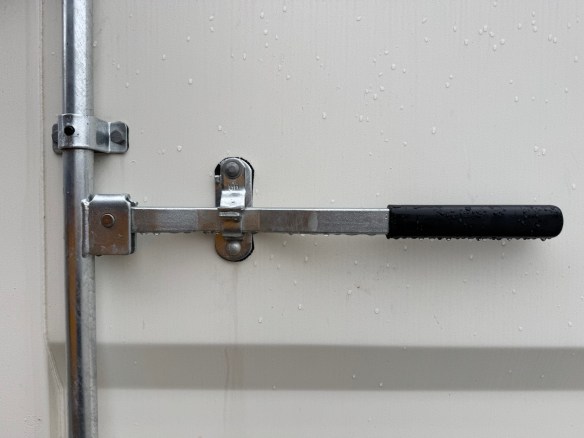
Container door locking mechanism keeper (door keeper, cam keeper) is a small but essential metal component of the door locking system of a shipping container. In English, it is most commonly referred to as “door keeper” or “cam keeper”. This component is usually firmly welded or bolted to the container door frame – specifically to the threshold sill and upper frame (header). Its main function is to receive and secure rotating cams that are attached to vertical locking rods.
When the door handle is turned to the locked position, the cam at the end of the rod rotates into the keeper. The keeper catches the cam, pulls the door tightly against the frame, and secures it against accidental opening. This simple but robust connection ensures that the container remains firmly sealed, secure, and resistant to weather conditions during transport and storage.
Detailed Analysis of Cam Keeper
Key Function and Operating Principle
The cam keeper is an integral part of the entire locking system, which also includes locking rods, handles, cams, and other hardware.
- Cooperation with the cam: The keeper is precisely shaped to safely catch the cam at the end of the locking rod. The cam has the shape of an eccentric “crescent” and when the handle is turned, it fits into the recess of the keeper. This creates a wedge effect that pulls the door inward and compresses the rubber door gasket, which is key to ensuring water-tightness and air-tightness.
- Securing locking rods: The keeper firmly fixes the cam, preventing unwanted rotation of the locking rod and thus opening of the door. A standard container has four locking rods (two on each door), each with a cam at the top and bottom – thus eight cams and eight keepers.
- Solid anchor point: The keeper is a stationary, extremely durable point – all the force of the locking mechanism is transmitted through the cams to the keepers and subsequently to the supporting structure of the container. For this reason, the quality and proper installation of the keeper is essential for safety and longevity.
Diagram of a typical container locking system:
| Component | Quantity per container (20’/40′) | Material |
|---|---|---|
| Cam keeper | 8 | Steel (cast/forged/galvanized) |
| Cam | 8 | Steel |
| Locking rod | 4 | Steel (Ø25-32mm, seamless tube) |
| Handle | 4 | Steel/cast iron |
Anatomy, Material, and Manufacturing
Physical Description and Dimensions
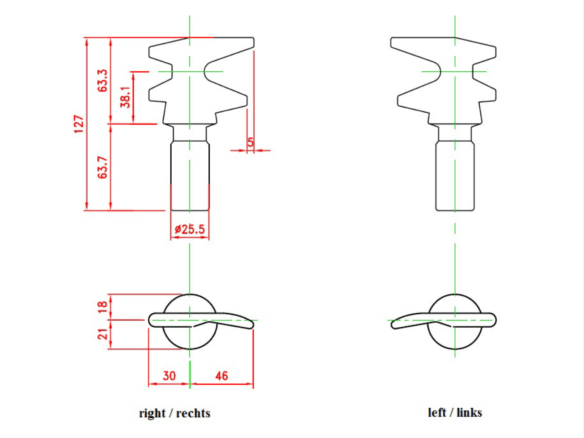
The cam keeper is a compact, solid metal block with a recess for the cam. Typical dimensions of quality keepers are approximately 76 × 41 × 47 mm, weight around 1 kg. The recess is designed to precisely match the shape of the cam without unnecessary clearance.
Material Specifications
- Cast or forged steel: The most commonly used material is high-strength steel, either cast (molded) or forged. Forged keepers have higher strength, fatigue resistance, and better structure (metal fibers are aligned), which increases longevity and resistance to cracking.
- Stainless steel (AISI 304/316): Used in highly durable or special containers, particularly where there is increased risk of corrosion (marine environment).
- Zinc coating/Galvanization: Surface protection with zinc (minimum layer thickness 50–70 μm) is standard for increased corrosion resistance and extended component life.
Manufacturing Technology
| Manufacturing Method | Advantages | Disadvantages | Application |
|---|---|---|---|
| Casting | Low cost, shape variability | Possible porosity, lower strength | Standard containers |
| Forging | High strength, no porosity | Higher cost, fewer shape variants | Safety and new hardware |
Placement of Keepers on Container
Keepers are distributed in the upper (header) and lower (sill) parts of the door frame. Each door has two rods, each rod has a cam at the top and bottom, thus four keepers on each side.
Distribution of keepers:
- Upper frame (header): 4 pcs
- Threshold sill: 4 pcs
This eight-point locking evenly distributes force around the entire door perimeter, ensures even pressure, and maximum safety.
Critical Importance of Door Keeper
Safety and Cargo Protection
The door keeper is a fundamental safety element – if even one fails, the container can be easily opened, leading to risk of theft, cargo damage, or even safety hazards during transport.
- Resistance to intrusion: The combination of cam and keeper forms an effective barrier against forced opening – it requires the use of heavy equipment or specialized tools.
- Prevention of accidental opening: The keeper ensures that the door remains securely closed even under extreme vibrations, impacts, or container tilting.
Tightness and Weather Protection
When the keeper and cam are properly adjusted, optimal compression of the rubber door gasket is achieved, preventing water, dust, and pests from entering the container.
- Water-tightness: Quality keeper and precise manufacturing ensure that the door with gasket forms a unified barrier against rain, splashing water, or sea salt.
- Air-tightness: Prevention of condensation and deterioration of sensitive cargo (textiles, electronics, paper).
Structural Integrity and Transport Safety
During transport or storage, the container is exposed to significant dynamic forces – rolling on ships, vibrations on railways, impacts in road transport. Door keepers absorb part of these forces and protect the doors from deformation or opening.
| Situation | Risk if keeper fails | Impact |
|---|---|---|
| Maritime transport | Water ingress, cargo damage | Cargo destruction |
| Road/rail transport | Door opening during transit | Safety incident |
| Storage | Theft, vandalism | Financial loss |
Use in Standard and Modified Containers
The reliability of cam keepers is key not only for classic shipping containers, but also for all types of container conversions:
- Chemical storage (COSHH): Require perfect security against hazardous substance leakage – keeper is the foundation of safety certification.
- Container power plants: Protection of expensive equipment; reinforced keepers as standard.
- Container offices, shops, museums: Securing property, electronics, exhibits, and personal items of users.
In modern architecture and social projects (e.g., container housing) door safety and tightness is absolutely essential for resident satisfaction and protection.
Manufacturing Methods: Forging vs. Casting
Casting:
- Molten metal is poured into a mold where it solidifies into the desired shape. The advantage is low cost and shape variability. The disadvantage is higher probability of micro-cracks, porosity, or weak points in the structure.
- Used primarily in standard, less exposed containers.
Forging:
- Metal is plastically shaped by blows and pressure, which aligns the material fibers and increases its strength, toughness, and fatigue resistance.
- Forged keepers have longer service life and are suitable for all types of containers where emphasis is placed on safety and long service life.
Surface Treatments:
- Galvanization (zinc coating): Essential for corrosion protection. Layer thickness typically ranges from 50–70 μm.
- Painting: Zinc paint or spray is used in areas after welding or repairs.
Maintenance, Repairs, and Replacement
Inspection Checklist for Cam Keepers
- Corrosion: Monitor rust appearance especially in cam pockets.
- Deformation: Check if the keeper is bent, bulged, or elongated (may be due to vandalism or improper handling).
- Cracks: Thoroughly visually inspect welds and keeper attachment area.
- Weld strength: Check that welds are solid and crack-free.
Cam Keeper Replacement
A damaged, corroded, or deformed keeper must be replaced immediately – it is an affordable and standardized spare part.
Replacement procedure:
- Cutting/removal of old keeper from door frame (using grinder or cutting torch).
- Surface preparation – cleaning and grinding smooth.
- Welding new keeper in correct position (precision required for proper cam engagement).
- Treatment of welds with zinc spray to restore anti-corrosion protection.
Related Terminology
| Term | Meaning |
|---|---|
| Door cam | Rotating segment of locking rod, fits into keeper |
| Locking rod | Vertical steel rod that locks the door |
| Door handle | Lever for operating locking rods |
| Handle keeper | Fixes handle in locked position |
| Door gasket | Rubber seal around door, ensures tightness |
| Corner castings | Enable handling, stacking of container |
Container door keeper (cam keeper) is a small but extremely important element on which the safety, tightness, and structural integrity of the entire container depends. Quality material, proper manufacturing, regular maintenance, and appropriate installation of keepers are the foundation not only for safe cargo transport, but also for all types of container conversions – from chemical storage to mobile offices to residential modules. Investment in a quality door keeper is an investment in safety and long-term container functionality.

 Czech Republic
  WITHOUT SHIPPING