Corner Castings – Technical Documentation
Container Corner Casting (also “container corner block” or “corner fitting”), is a highly standardized, robust, three-dimensional cast steel component that is welded to all eight corners of an ISO (International Organization for Standardization) maritime container. These castings are fundamental load-bearing elements that enable container handling with cranes, safe stacking of containers on top of each other, and secure fastening to various types of transport vehicles – ships, trains, and tractors. Corner castings thus form universal connection points and are the backbone of the global intermodal transport system.
Contents

- Introduction to container corner castings
- ISO 1161 Standard: Global standard for uniformity
- Technical documentation of corner casting
- Standard dimensions and tolerances
- Hole geometry
- Types of corner castings (TL, TR, BL, BR)
- Intermediate corner castings for extended containers
- Material science and manufacturing
- Primary role of cast steel
- Comparison: Steel vs. aluminum
- Manufacturing process and quality control
- Functions and interaction with accessories
- Lifting, stacking, securing
- Relationship with twist locks
- Modern fastening: Domino Clamps and other innovations
- Identification, certification and maintenance
- ISO container identification
- Certification and compliance
- Installation, repairs, maintenance
- Related terms
- Conclusion
Introduction to Container Corner Castings
Modern global logistics is built on the efficiency of standardized maritime containers. A key, yet often overlooked component of their construction is the corner casting. This “block” is the true pillar of modularity and interchangeability in logistics. Each ISO container is equipped with eight of these castings, which form the interface for handling, securing and connecting containers anywhere in the world. It is precisely because of them that a container can be loaded in a factory on one continent and transported without transshipment of contents across oceans and continents – all thanks to strict international standardization.
ISO 1161 Standard: Global Standard for Uniformity
The universal compatibility of corner castings is not accidental – it is the result of strict standard ISO 1161:2016 “Series 1 freight containers — Corner and intermediate fittings — Specifications”. This standard defines every essential aspect of corner casting design and functionality:
- Dimensional requirements: Precise external dimensions (length 178 mm, width 162 mm, height 118 mm), dimensions and position of three holes and permitted tolerances (often in the order of millimeters).
- Functional requirements: Ability to safely cooperate with standard handling equipment (cranes, spreaders, twist locks).
- Strength requirements: Minimum mechanical strength and material properties ensuring safe lifting of fully loaded containers (usually up to 30 tons) and stacking up to nine containers high on a ship.
Compliance with ISO 1161 is mandatory for all containers intended for international transport. The standard is also closely related to other key ISO standards, such as ISO 668 (container classification and dimensions) and ISO 1496 (testing procedures).
Important Points from ISO 1161
| Parameter | Value / Specification |
|---|---|
| Length (external) | 178 mm |
| Width (external) | 162 mm |
| Height (external) | 118 mm |
| Number of pieces per container | 8 |
| Material | Cast steel (special alloys) |
| Standard | ISO 1161 |
| Weight (1 casting) | approx. 10–11 kg |
| Weight of set (8 pcs) | 85–90 kg |
Technical Documentation of Corner Casting
Technical documentation, based on ISO 1161 standard, contains detailed specifications of physical and material properties of corner casting. It serves designers, manufacturers and logistics experts as a basic reference document.
Standard Dimensions and Tolerances
- External dimensions: 178 mm × 162 mm × 118 mm
- Tolerances: Manufacturing precision is extremely important – tolerances of holes and positioning are in the order of millimeters, so that all twist locks and spreaders can safely grip every container in the world.
Hole Geometry
Each corner casting has three functional holes on different surfaces:
- Side holes (stadium/discorectangle): Elliptical holes on the longer side and on the lower front side – designed for twist locks and lashing equipment.
- End hole (shield): On the upper corner castings is a front hole in the shape of a “shield”, which ensures safe catching and guiding of spreader hooks when lifting.
- Stacking hole: The largest hole is on the upper surface of upper and on the lower surface of lower castings. It is used for inserting a stacking pin or twist lock during vertical container connection.
| Hole Type | Location | Shape | Main Function |
|---|---|---|---|
| Side (stadium) | sides, bottom | oval | twist locks, lashing, lifting |
| End (shield) | front (top) | shield-shaped | guide for crane hooks |
| Stacking | upper/lower | circular | stacking, twist locks, container connection |
Types of Corner Castings (TL, TR, BL, BR)
One container uses eight castings divided into four types (two pieces of each type):
- Top Left (TL) – left upper corner
- Top Right (TR) – right upper corner
- Bottom Left (BL) – left lower corner
- Bottom Right (BR) – right lower corner
Upper and lower castings differ mainly in the shape of holes and orientation of the stacking hole. Type identification is important in manufacturing and repairs.
Intermediate Corner Castings for Extended Containers
Containers longer than 40 feet (e.g., 45′, 48′, 53′) are usually equipped with additional castings in a position corresponding to the 40′ dimension, to ensure compatibility with equipment on ships, railways and in container ports.
Material Science and Manufacturing
Primary Role of Cast Steel
Corner castings are manufactured almost exclusively from low-alloy cast steel (e.g., Corten, SCW480), which provides:
- High tensile strength: Each casting must withstand forces exceeding 500 kN (approx. 50 tons).
- Resistance to wear and impact: Daily handling in ports places high demands on service life.
- Weldability: Castings must be firmly connected to the container frame.
- Resistance to extreme temperatures: Functionality from arctic to tropical conditions.
- Machinability: For precise machining of dimensions and holes according to ISO 1161.
Comparison: Steel vs. Aluminum
| Property | Cast Steel (Corten, SCW480) | Aluminum |
|---|---|---|
| Tensile strength | very high | lower |
| Heat resistance | excellent | limited |
| Weight | higher | lower |
| Price | favorable | higher |
| Corrosion resistance | high (Corten) | very high |
| Weldability | excellent | limited |
Aluminum is used only for special containers (e.g., aircraft containers). For standard ISO containers, cast steel is irreplaceable due to its strength and service life.
Manufacturing Process and Quality Control
- Casting: Molten steel is poured into precise molds.
- Heat treatment: Optimization of mechanical properties.
- Machining: Finishing adjustments to meet ISO tolerances.
- Surface treatment: Application of basic anti-corrosion paint.
- Testing: Inspection of chemical composition and mechanical properties of each batch according to national and international standards (e.g., EN, CSN, ISO).
Functions and Interaction with Accessories
Lifting, Stacking, Securing
- Lifting: A crane spreader with four twist locks inserts heads into the upper corner castings, rotates 90° and safely lifts the container.
- Stacking: The lower casting of the upper container rests on the upper casting of the lower one. Twist locks are inserted between containers to ensure stack stability.
- Lashing: On ships, containers are further secured with lashing bars, tensioners and additional twist locks, which are always connected to corner castings.
Relationship with Twist Locks
Twist lock is a mechanical counter-part component that is inserted into a hole in the casting and secured after rotation. Twist locks exist in many variants (manual, semi-automatic, special for various applications).
Modern Fastening: Domino Clamps and Other Innovations
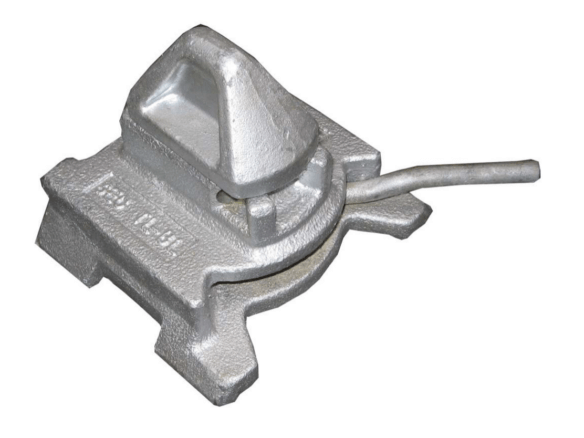
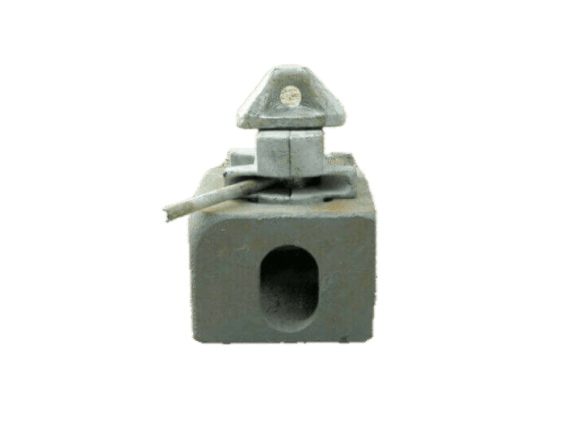
Standardized holes in corner castings allow the use of modern accessories, such as Domino Clamps – special clamps that without welding or drilling allow fastening of lights, cameras, advertising surfaces or temporary structures directly into the casting holes.
Identification, Certification and Maintenance
ISO Container Identification
Each ISO container has a unique identification code according to ISO 6346 (e.g., ABCU 123456-7), which is marked on the doors and sides of the container. The presence of these codes and the CSC (Container Safety Convention) label indicates that the container and its corner castings comply with all international standards.
Certification and Compliance
In addition to manufacturing compliance with ISO 1161, corner castings are usually certified by independent classification societies (Lloyd’s Register, Bureau Veritas, American Bureau of Shipping, etc.), which is essential especially in maritime transport.
Installation, Repairs, Maintenance
- Installation: Corner castings are welded to corner posts and lower/upper frame of the container.
- Maintenance: Regular inspection of condition (corrosion, cracks, deformation) is essential for safe operation.
- Repairs: Repairs may only be performed by certified technicians according to strict procedures (e.g., IICL) to maintain valid safety certification (CSC). Improper repairs can endanger the entire container structure.
Related Terms
- Twist lock: Mechanical device for connecting corner castings.
- ISO 1161: International standard for corner casting specifications.
- ISO 668: Standard specifying container dimensions and classification.
- Intermodal transport: Transport of goods in containers using multiple types of transport without transshipment of contents.
- Corten: Low-alloy, weather-resistant steel.
- Spreader: Crane handling frame with twist locks for lifting containers.
- Domino Clamps: Patented clamps allowing attachment of accessories to corner casting holes.
Conclusion
Container corner casting is a masterpiece of standardized engineering. Thanks to precise technical documentation and the ISO 1161 standard, it has become the universal key to efficient global transport. Its robust construction, uniform dimensions and wide applicability enable safe lifting of heavy loads, stable stacking and innovative attachment of accessories. Corner casting remains one of the most essential structural elements of world trade.
 Czech Republic
  WITHOUT SHIPPING