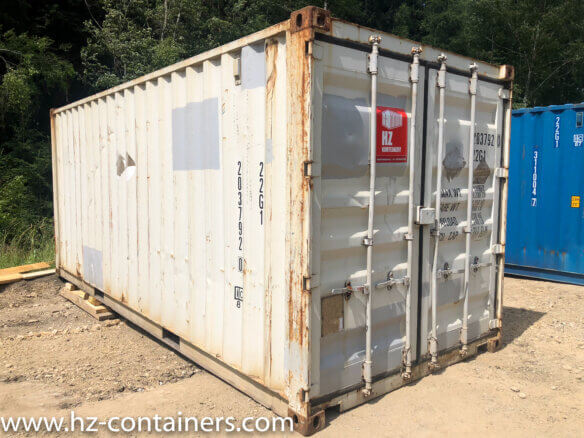
Spare part for the shipping container door No. 7 – door handle, HZ000252


 Czech Republic
  WITHOUT SHIPPING
 What is a Door Handle for a shipping container?
Door handle is a basic, extremely robust and ergonomic lever that is an integral part of the locking system of an ISO shipping container. It is designed to allow the operator to generate sufficient leverage to rotate the vertical locking rods that hermetically seal the heavy steel doors of the container and protect the cargo during global transport, storage or use of the container in construction. This component differs fundamentally from ordinary household door handles – it is much stronger, made of massive steel, often forged, and engineered for long‑term exposure to extreme conditions (sea water, temperature shocks, mechanical stress, vandalism).
Catalog number: HZ000252
The door handle is not only a lever for locking but also a key safety element – its failure can prevent the container from being closed, cause loss of watertightness, cargo leakage or endanger operator safety. For this reason handles are designed in accordance with strict ISO standards (especially ISO 1161 and ISO 1496), emphasizing durability, strength and easy maintenance.
Interesting fact:
The development of the shape, material and surface finish of the door handle reflects decades of experience in maritime and logistics practice. Every small design change results from optimisation for gloved handling, corrosion resistance and the possibility of rapid installation of security seals or locks.
Detailed anatomy and components of the locking mechanism
The door handle is the centre of a complex system in which every component influences the functionality and reliability of the whole container door. Understanding the individual parts is essential for effective maintenance and fault prevention.
Main components of the door mechanism
| Component | Function | Material / Surface treatment | Standards |
|---|---|---|---|
| Locking rods | By rotating they fix the doors in the frame, ensuring hermetic closure | Steel, galvanised or painted | ISO 1161, ISO 1496 |
| Cams and brackets | Eccentric cams engage the brackets, firmly pulling the doors to the frame | Steel, galvanised | ISO |
| Door handle | Control lever for rotating the locking rods | Forged or pressed steel | ISO |
| Handle hub | Rotating attachment of the handle to the locking rod | Steel, zinc‑plated | – |
| Latch | Secures the handle in the closed position | Steel, welded | – |
| Retaining plate | Prevents spontaneous opening of the handle, allows locking with a hanging lock | Steel, welded | – |
| Lever rivet | Joins the handle and hub, enables rotation | Steel, galvanised | – |
| Door gasket | Rubber profile around the perimeter, provides watertight and dust‑tight sealing | EPDM, rubber | ISO, EN |
| Hinges | Bearing points of the door, allow rotation | Steel, thick‑walled profile | ISO |
Types of door handles by manufacturing technology
| Handle type | Description | Advantages / Disadvantages |
|---|---|---|
| Forged handle | Massive, forged from a single piece of steel | Very high strength, long service life, higher price |
| Pressed handle | Pressed from a steel strip, often hollow | Lower price, lower strength, suitable for less exposed applications |
Note: Forged handles dominate maritime transport and new containers, while pressed handles are common on storage or refurbished containers.
Dimensions and specifications (according to ISO and practice)
- Handle length: 250–350 mm (most commonly 300 mm)
- Handle diameter: 25–35 mm
- Wall thickness: 3–5 mm
- Seal/lock opening: 10–14 mm
- Surface treatment: galvanised zinc (Zn), optionally powder‑coated for increased corrosion resistance
Construction and installation
- Handle hub – robust welded part forming the rotating point. Material: forged steel, zinc‑coated.
- Handle rivet – key joining element, allows free rotation of the handle while maintaining joint strength. Regular inspection of rivet play and condition is required due to frequent mechanical stress.
- Latch and retaining plate – prevent accidental release of the handle during transport. The latch is welded to the door panel; the retaining plate enables attachment of a hanging lock or security seal.
Door system types by number of handles
| Configuration | Description | Application |
|---|---|---|
| 4 handles | 2 handles on each leaf, maximum strength | Maritime transport, heavy cargo |
| 3 handles | 2 handles on the left, 1 on the right (longer lever on the right) | Warehouse, construction containers |
The handle in the context of the whole container door locking system
The function of the handle is closely linked to all other door components:
- Locking rods: Vertical steel rods, typically 32 mm outer diameter and 24–25 mm inner diameter, rotated by the handle. Their ends are equipped with cams.
- Cams: Eccentric steel parts that engage the brackets and secure the doors in the frame.
- Cam brackets: Counter‑pieces on the container frame for firm cam locking.
- Rod clamps/guides: Guide and secure the locking rod on its axis, preventing bending.
- Door gaskets: EPDM or rubber profiles around the door perimeter that ensure watertight and dust‑tight sealing when the door is closed and the handle is engaged.
- Hinges and pins: Allow smooth opening up to 270°, must withstand high loads and frequent use.
- Security box: Steel box protecting a hanging lock from mechanical attack.
Common problems, damage and maintenance of door handles
Typical faults and their causes
| Problem | Cause | Impact | Solution |
|---|---|---|---|
| Stiffness / Jamming | Corrosion of pins, insufficient lubrication, long‑term weather exposure | Increased effort to operate, risk of deformation | Regular lubrication, replace damaged parts |
| Bending / Deformation | Use of inappropriate levers, impact with a forklift | Locking failure, inability to close doors | Replace handle or entire locking rod |
| Cracking / Breaking | Material fatigue, extreme overload | Loss of function, safety risk | Immediate replacement with a new part |
| Play / Looseness | Worn rivet, damaged hub | Reduced force transmission efficiency | Replace rivet or hub, check fastening |
| Missing part | Vibration, previous improper repair | Inability to operate doors | Supply and install a new original part |
Recommended maintenance
- Regular lubrication – Apply a high‑quality water‑resistant lubricant (e.g., lithium‑based grease) to all moving joints, especially hinge pins, cams and contact surfaces of the handle.
- Visual inspection – Before each use verify the integrity of the handle, rivet, hub and latch. Look for corrosion, cracks or deformation.
- Proper handling – Avoid improvised levers (e.g., pipes) and excessive force. Use specialised container levers for stuck doors.
- Timely replacement – Replace damaged or worn parts promptly to prevent secondary damage or safety hazards.
- Use of original parts – Always prefer original or certified spare parts that match your container type and comply with ISO standards.
Logistics, selection and purchase of spare parts (handle)
Compatibility and identification
- Standardisation: Most containers built after 1980 have unified dimensions and handle types, but older or special containers require careful checking of dimensions and mounting.
- Part identification: Before ordering verify the catalog number (e.g., HZ000252), dimensions, surface finish, seal/lock opening position and mounting method.
Prices and packaging
- Price varies with manufacturing technology (forged vs. pressed), material and supplier. Roughly 200–600 Kč per piece.
- Individual pieces and discounted sets for larger repairs are available.
Shipping and logistics
- Shipping: Cost depends on quantity and carrier. Small items can be sent via standard parcel services (e.g., DPD); larger volumes on pallets.
- Availability: Specialized dealers keep spare parts in stock, enabling fast delivery (usually 1–3 days within the Czech Republic).
- Packaging: Handles are packed to minimise damage in transit and usually include a basic installation guide.
Safety recommendations and certifications
- The handle must allow the installation of a security seal or a hanging lock. For customs‑supervised transport, certified seals are mandatory.
- Regular inspection of the handle is part of the mandatory maintenance under the CSC (Convention for Safe Containers) regime.
- Installation of a security box (lock box) is recommended to increase resistance to theft.
Frequently asked questions (FAQ)
How can I tell if a door handle is damaged?
It will show increased play, stiffness or deformation. Visually inspect for cracks, corrosion and rivet wear.
Can I replace the handle myself?
Yes, the replacement is relatively simple but requires basic tools (hammer, rivet‑setting tool, possibly a welder for the hub). Professional installation is advised to ensure proper function and safety.
Where can I buy an original door handle?
From specialised container spare‑part distributors, such as HZ CONTAINERS, which offer individual parts and complete door mechanisms.
Conclusion
The door handle of a shipping container is a key safety and handling component whose quality and condition directly affect the safety, functionality and service life of the container. Investing in original, correctly dimensioned and professionally installed handles guarantees trouble‑free operation both in storage and in international transport. Consistent maintenance and timely replacement of damaged parts reduce the risk of accidents, cargo loss and extend the overall lifespan of the equipment.
Price and shipping
Price is quoted per unit, without shipping. Items can be sent via a parcel service or collected in person at our workshop in Třebíč, Czech Republic. Shipping cost depends on the ordered quantity and destination country. We ship only within Europe.
If you are interested, please send an inquiry including the required quantity through the form below. Always provide a phone number, country, city and ZIP code for accurate shipping cost calculation. We will send you a complete quotation including transport.
We offer all spare parts for shipping containers. Parts are in stock and can be dispatched immediately. Larger quantities are available on request.
All information, services and prices are subject to change. Prices are indicative; we always charge based on actual conditions.

 Czech Republic


Send inquiry
Shipping container colors
RAL 1001 RAL 1003 RAL 1014 RAL 1015 RAL 1018 RAL 1023 RAL 2001 RAL 2008 RAL 2011 RAL 3000 RAL 3001 RAL 3002 RAL 3009 RAL 3013 RAL 3020 RAL 4008 RAL 5003 RAL 5005 RAL 5010 RAL 5011 RAL 5013 RAL 5017 RAL 6005 RAL 6007 RAL 6018 RAL 6029 RAL 6031 RAL 6038 RAL 7000 RAL 7004 RAL 7005 RAL 7012 RAL 7015 RAL 7016 RAL 7021 RAL 7024 RAL 7031 RAL 7032 RAL 7035 RAL 7036 RAL 7037 RAL 7038 RAL 7040 RAL 7042 RAL 8004 RAL 8008 RAL 9003 RAL 9004 RAL 9005 RAL 9010 RAL 9016 CAMOUFLAGEQUESTIONS & ANSWERS TO THE MOST FREQUENTLY ASKED QUESTIONS:
We always guarantee the size, quality, and specific type of container including the pickup location of your choice.
Why is it not possible to access the depot to inspect the container? And for what reason is it not possible to take photos of the container from the depot?
How does the self-pickup of a container from the depot work?
What if the container we came to pick up at the depot does not match the condition and quality we ordered?
Afraid of being scammed and not receiving the container? Many questions are answered in our article container purchase scams.
You can find out how to arrange for the unloading of a shipping container here.
The information in the text may differ from the exact specification of a particular container, the image, price and description of the container are for guidance only, the specification of the container will therefore be specified by e-mail or telephone before the conclusion of the contract. The text provided on this page is therefore not a proposal to conclude a contract.