
Wide range of shipping containers at HZ CONTAINERS
Welcome to the comprehensive page dedicated to the world of shipping containers. This glossary is your guide to all aspects of the HZ CONTAINERS offer – from technical parameters, through types and specifications, to legislative requirements and modern use in architecture. I have drawn from the most up‑to‑date Czech professional sources, including Kuehne+Nagel, hz‑containers.com and legal advisors, to create the most comprehensive and current market overview.
Basics: What is an intermodal shipping container?
Definition and significance
Intermodal container is a large closed steel box, standardized for safe and efficient transport of goods across various transport modes – ship, train and truck – without the need to unload the cargo itself. Thanks to this standardization defined by the International Organization for Standardization (ISO), it is now possible to move goods from one continent to another without interfering with its contents.
Advantages of intermodal containers:
- Fast handling at all logistics nodes
- Minimisation of cargo damage and reduction of theft risk
- Easy stacking and storage
ISO standards and container dimensions
Key standards: ISO 668 and ISO 1496
Container standardisation is the foundation of global transport efficiency. Most often you will encounter the so‑called ISO 1 containers, which are further divided into types 1C (20‑foot), 1CC (20‑foot high cube), 1A (40‑foot), 1AA (40‑foot high cube), 1AAA (45‑foot high cube).
- ISO 668: Defines dimensions, classification and load capacity of individual container types.
- ISO 1496: Specifies construction requirements, internal/external dimensions and safety standards of containers.
Table of main ISO container dimensions:
| Container type | External length (mm) | External width (mm) | External height (mm) | Internal length (mm) | Internal width (mm) | Internal height (mm) | Volume (m³) |
|---|---|---|---|---|---|---|---|
| 20′ Standard | 6 058 | 2 438 | 2 591 | 5 900 | 2 350 | 2 390 | ~33 |
| 40′ Standard | 12 192 | 2 438 | 2 591 | 12 030 | 2 350 | 2 390 | ~67 |
| 40′ High Cube | 12 192 | 2 438 | 2 896 | 12 030 | 2 350 | 2 690 | ~76 |
| 45′ High Cube | 13 716 | 2 438 | 2 896 | 13 556 | 2 350 | 2 690 | ~86 |
Source: HZ CONTAINERS – ISO dimensions
All ISO containers have universal corner castings for easy lifting, securing and stacking.
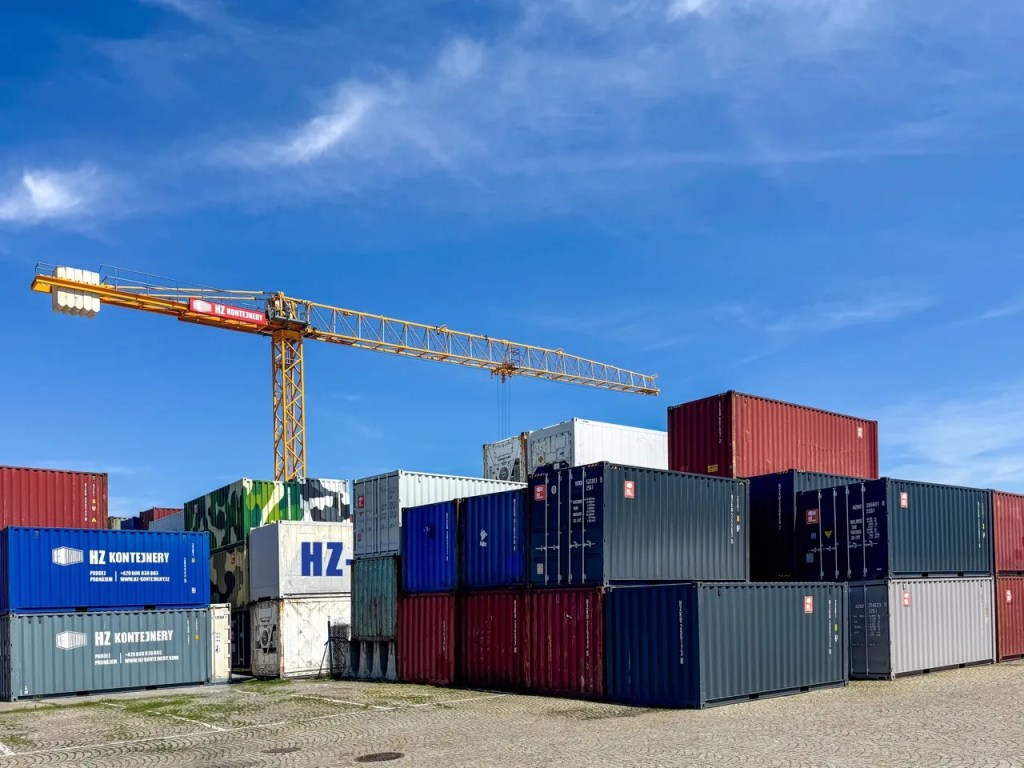
Types of shipping containers
Standard containers (General Purpose)
- 20′ (1C) and 40′ (1A) DC (Dry Cargo): Fully enclosed, watertight, ideal for ordinary palletised or boxed goods.
- High Cube (HC): About 30 cm taller than standard, suitable for lightweight, bulky cargo or residential conversions such as shipping container homes.
- Pallet Wide (PW): Wider internal dimension for optimal use of Euro‑pallets (two side by side without gaps).
- Double Door: Allows loading/unloading from both ends, useful for splitting cargo.
Special containers
| Type | Common dimensions | Specifics and uses |
|---|---|---|
| Open Top | 20′, 40′ | Top loading, heavy and oversized cargo (machinery, scrap) |
| Flat Rack | 20′, 40′ | Floor and end frames only, no walls/roof; machinery, vehicles |
| Platform | 20′, 40′ | Floor only, extremely heavy and oversized cargo |
| Refrigerated (Reefer) | 20′, 40′ HC | Cooled/temperature‑controlled, own refrigeration unit; food, pharmaceuticals |
| Insulated/Thermal | 20′, 40′ | Passive insulation, stable temperature without active cooling |
| Ventilated | 20′ | For goods requiring air circulation (coffee, cocoa) |
| Tank (Tanktainer) | 20′ | Liquids, gases, powders, food‑grade and chemical |
| Half‑Height | 20′ | Half height, heavy bulk materials, construction |
Detailed breakdown and technical parameters can be found at the container classification and dimensions sections of the HZ CONTAINERS website.
Container condition: New vs. used
New containers (“One‑Trip”)
- Produced mainly in Asia, only one journey to Europe.
- Minimal signs of wear, no corrosion, almost as‑new from manufacture.
- Suitable for long‑term storage, business modifications and demanding construction projects.
Used containers
Used containers are classified by condition:
| Abbreviation | Designation | Description |
|---|---|---|
| CW | Cargo Worthy | Structurally fit for transport, inspected |
| WWT | Wind and Watertight | Tight, no leaks, suitable for safe storage |
| ASIS | As Is | No guarantee, cheap, often needs repair |
Prices are significantly lower than for new containers.
Innovative uses: Housing, offices and construction cells
Container housing
Construction modifications and legislation are governed by Building Act No. 183/2006 Coll. An amendment from July 2024 permits building minor structures up to 40 m² without a building permit, which includes many residential containers and shipping container houses.
Key points:
- Larger projects or permanent housing require a building permit or notification.
- Local zoning, hygiene and fire regulations must be observed.
- Building a container house is fast, ecological and cost‑effective.
Advantages of container housing:
- Modularity and expandability
- Rapid implementation (weeks)
- Durability and long service life
- Sustainability (steel recycling)
Disadvantages:
- Need for insulation and interior finishing
- Building permit required for larger structures
- Zoning restrictions
Mobile offices, garages and technical facilities
- Offices: Insulation, electrical installation, air‑conditioning, windows and custom entrance doors.
- Garages and warehouses: Secure storage of vehicles, machinery or material; possibility to install doors, shelves, racks.
Key logistics terms
Intermodal transport
Transport of goods in a single container by multiple transport modes (ship, train, truck) without cargo handling. It ensures speed and minimises damage.
Loading and unloading (stuffing & stripping)
- Professional load distribution is essential for stability during transport.
- Use of securing devices, dunnage and anti‑movement measures.
- Handling with cranes, forklifts, portal cranes.
Freight forwarding
A forwarding company manages the complete transport process – space reservation, documentation, customs clearance, insurance, shipment tracking.
Frequently asked questions (FAQ)
Which container is suitable for building a house?
Ideally a new or lightly used 40′ HC container for interior height and flexibility.
Can I place a residential container without a permit?
If the shipping container house is up to 40 m² and meets other conditions, a simple notification is sufficient (no permit required from 2024). Larger structures always require consultation with the building authority.
What is the difference between CW and WWT?
*CW (Cargo Worthy): Suitable for transport, inspected.
WWT (Wind and Watertight): Suitable for storage, not certified for transport.
What is the service life of a shipping container?
With proper maintenance and corrosion protection, 30 years or more.
Can containers be stacked?
Yes, thanks to ISO corner castings, up to eight layers in ports.

 Czech Republic, Jesenice
  FREE SHIPPING


Other container news...

Shipping Containers Barcelona Spain
Shipping containers are the backbone of modern global trade, and the Port of Barcelona is one of the most important nodes in this network. Understanding how containers work, what their standards are and how cargo is handled in the Port of Barcelona is essential for anyone involved in international commercial transport. The Port of Barcelona continues to invest in digitalisation, automation and environmental sustainability to maintain its position as one of the most important ports in Europe and the world.

Spare Parts for Shipping Containers Spain
Spare parts for shipping containers are an essential part of the global maritime logistics system. Without them, the thousands of containers that travel the world’s oceans and roads every day would not be able to be maintained in working order. Whether you’re looking for a replacement door handle, a new lock, a gasket or a complete floor, this guide will provide you with all the information you need to find the right parts, install them and maintain them — with a special focus on availability and suppliers in Spain and surrounding countries.

Container Units 20′ – 6m (Construction Unit)
20′ (6 meter) construction cells are one of the most important elements of modern construction and temporary project solutions. These mobile units, created from the conversion of shipping containers, have become an indispensable tool for builders, designers and construction managers around the world.

Demurrage: Port Storage Fees
Demurrage is a time-based fee charged when loaded shipping containers remain in a port or terminal longer than the allotted free time. The term comes from the French word demeurer, meaning “to remain or linger”, and originally arose in the context of ship chartering in the maritime trade. In modern container shipping, demurrage serves as a financial penalty and incentive mechanism to ensure the efficient movement of containers through ports and prevent their indefinite storage at terminals.