
What is the difference between a 40ft High Cube and standard container?
If you work in international shipping, logistics, or freight procurement, you have almost certainly faced the decision: 40ft standard container or 40ft high cube? The two units look nearly identical from a distance — same length, same width, same corrugated steel walls. But that single extra foot of height on the high cube changes everything: how much cargo fits, what types of freight can be loaded, how the container travels through the supply chain, and what it ultimately costs you.
This guide gives you every dimension, every weight spec, every cost variable, and every operational consideration you need to choose with confidence. No other page combines the complete dimensional data, cost breakdown, historical context, loading best practices, and frank discussion of limitations in one place. Let’s start at the core question.
What Is a 40ft High Cube Container and How Does It Differ From a Standard Container?
A 40ft standard shipping container (also called a general-purpose or dry container, ISO type code 42G1) is the backbone of global trade. It measures 8 feet 6 inches (2.59 meters) tall externally. For decades, this height was the universal default — every container ship cell, every chassis, every rail car was designed around it.
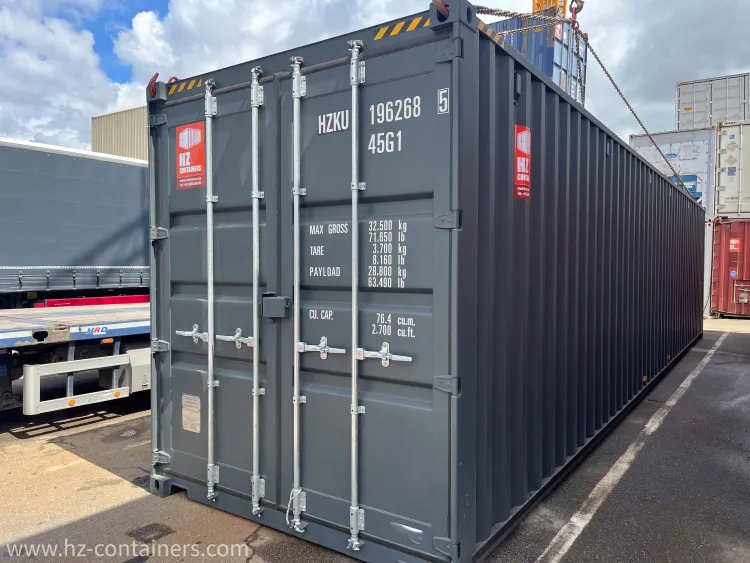
A 40ft high cube container (ISO type code 45G1) takes that same footprint and adds one extra foot of height, yielding an external height of 9 feet 6 inches (2.89 meters). That single foot translates into roughly 13% more internal cubic capacity. The external length and width remain identical between the two types: 40 feet long and 8 feet wide.
The core difference, put simply: A 40ft high cube container is exactly one foot taller than a 40ft standard container in every dimension that matters — external height, internal height, and door height. That extra foot is the difference between fitting 67.7 cubic meters of cargo and fitting 76.4 cubic meters.
The table below gives you the at-a-glance comparison:
| Specification | 40ft Standard Container | 40ft High Cube Container |
|---|---|---|
| External Height | 8’6″ (2.59 m) | 9’6″ (2.89 m) |
| Internal Height | 7’10” (2.39 m) | 8’10” (2.69 m) |
| Door Height | 7’5″ (2.28 m) | 8’5″ (2.58 m) |
| Internal Volume | 2,390 cu ft (67.7 m³) | 2,694 cu ft (76.4 m³) |
| Tare Weight | ~8,265 lbs (3,750 kg) | ~8,860 lbs (4,020 kg) |
| Typical Payload | ~58,900 lbs (26,730 kg) | ~58,330 lbs (26,460 kg) |
Both types share the same external length (40 feet / 12.19 meters) and the same external width (8 feet / 2.44 meters). This dimensional parity is what keeps both types compatible with the global intermodal infrastructure — ships, trains, and trucks can handle either type without physical modification to the transport equipment itself.
What Are the Exact Dimensions of a 40ft Standard vs. 40ft High Cube Container?
Dimensions matter in shipping down to the millimeter. A poorly understood dimension can mean the difference between cargo that loads and cargo that incurs dead freight — space you paid for but cannot use. Here are the precise numbers, sourced from ISO 668 standards and major shipping line specifications.
External Dimensions Compared
| External Dimension | 40ft Standard | 40ft High Cube |
|---|---|---|
| Length | 40’0″ / 12,192 mm | 40’0″ / 12,192 mm |
| Width | 8’0″ / 2,438 mm | 8’0″ / 2,438 mm |
| Height | 8’6″ / 2,591 mm | 9’6″ / 2,896 mm |
The length and width are universal constants. Every standard and high cube 40-footer fits the same corner casting spacing, which is why both types lock onto the same chassis and into the same vessel cell guides. The height is the only external variable — and it is what drives every operational difference that follows.
Internal Dimensions Compared
Internal dimensions are where the real-world loading decisions happen. The walls, floor, and roof of the container eat into the external box by about 4–6 inches in every direction.
| Internal Dimension | 40ft Standard | 40ft High Cube |
|---|---|---|
| Internal Length | 39’5″ / 12,032 mm | 39’5″ / 12,032 mm |
| Internal Width | 7’8″ / 2,352 mm | 7’8″ / 2,352 mm |
| Internal Height | 7’10” / 2,393 mm | 8’10” / 2,697 mm |
Door Opening Dimensions
The door opening dimensions matter enormously if you load cargo with a forklift or if your goods have any vertical clearance requirements at the point of entry.
| Door Dimension | 40ft Standard | 40ft High Cube |
|---|---|---|
| Door Width | 7’8″ / 2,340 mm | 7’8″ / 2,340 mm |
| Door Height | 7’5″ / 2,280 mm | 8’5″ / 2,585 mm |
Notice that the high cube’s door height is a full foot taller. If you are loading pre-assembled machinery, tall racking, or stacked pallets of lightweight goods, a standard container’s 7’5″ door may force you to tilt, disassemble, or reduce stack height — costing you time and cube utilization. The high cube door clears 8’5″, eliminating many of those constraints entirely.
What Is the Capacity Difference Between a 40ft High Cube and Standard Container?
Capacity is why people choose the high cube. The numbers are straightforward, but understanding what they mean operationally is where the real value lies.
Cubic Capacity (Volume) Comparison
| Capacity Metric | 40ft Standard | 40ft High Cube | Difference |
|---|---|---|---|
| Cubic Feet | 2,390 cu ft | 2,694 cu ft | +304 cu ft |
| Cubic Meters | 67.7 m³ | 76.4 m³ | +8.7 m³ |
| Percentage Gain | — | — | +12.9% |
That additional 304 cubic feet — or 8.7 cubic meters — is the equivalent of roughly one extra row of standard palletized goods stacked to full height. If you are shipping furniture, textiles, insulation, plastic goods, or any other low-density product that fills volume long before it hits weight limits, the high cube can eliminate the need for an entire second container in some multi-container shipments.
To put a practical number on it: if you are shipping goods at a density of roughly 8–10 lbs per cubic foot (lightweight manufactured goods), the high cube’s extra volume lets you load around 2,500–3,000 additional pounds of cargo without exceeding volume constraints — not because the container weighs more, but because you can use space that simply does not exist in a standard box.
Pallet Capacity Comparison
Pallet configurations vary by pallet type and loading pattern, but industry-standard estimates are as follows:
| Pallet Type | 40ft Standard | 40ft High Cube |
|---|---|---|
| Euro Pallets (1,200 × 800 mm) | 25 | 25 (potential for higher stacks) |
| US Standard Pallets (40″ × 48″) | 20–21 | 20–21 (potential for higher stacks) |
The floor footprint is identical — you cannot fit more pallets on the floor of a high cube. The advantage comes from stack height. If your cargo can be safely double-stacked or triple-stacked on pallets, the high cube’s extra 12 inches of internal clearance lets you build those stacks taller or use taller individual pallet loads.
For example, if each pallet load is 48 inches tall, you can only double-stack in a standard container (48″ × 2 = 96″, which fits under a 94″ internal ceiling, just barely). In a high cube, those same pallets clear with room to spare (106″ internal height), and you can add dunnage or airbags without worrying about roof contact.
What Are the Weight Specifications for Each Container Type?
Weight specs are frequently misunderstood. Many people assume a “bigger” container can carry more cargo. That assumption is wrong — and potentially expensive if it leads to overloading.
Tare Weight Comparison
Tare weight is the empty weight of the container itself. A high cube container, because it requires more steel in its taller corner posts and side panels, weighs more empty:
| Weight Metric | 40ft Standard | 40ft High Cube |
|---|---|---|
| Tare Weight | ~3,750 kg (8,265 lbs) | ~4,020 kg (8,860 lbs) |
| Difference | — | +270 kg (595 lbs) |
That ~600-pound tare weight difference directly reduces the net payload you can legally load. In other words, choosing a high cube costs you about half a ton of cargo capacity before you even start loading.
Maximum Gross Weight and Payload
Both container types share the same maximum gross weight under ISO standards: 30,480 kg (67,200 lbs). Gross weight is the combined weight of the container (tare) plus the cargo (payload). The formula is simple:
Available Payload = Max Gross Weight − Tare Weight
| Spec | 40ft Standard | 40ft High Cube |
|---|---|---|
| Max Gross Weight | 30,480 kg (67,200 lbs) | 30,480 kg (67,200 lbs) |
| Tare Weight | 3,750 kg (8,265 lbs) | 4,020 kg (8,860 lbs) |
| Available Payload | 26,730 kg (58,935 lbs) | 26,460 kg (58,340 lbs) |
A high cube container carries roughly 270 kg (595 lbs) less cargo than a standard container — even though it offers 13% more volume. This is the fundamental trade-off: you gain cubic space but lose a modest amount of weight capacity. For dense cargo like steel, stone, or liquids in intermediate bulk containers, a standard container is almost always the better choice. For voluminous, lightweight cargo — furniture, apparel, foam products, insulation — the high cube is the clear winner because you will cube out (fill all available volume) long before you weigh out (hit the weight limit).
Overloading Risks and Road Regulations
Beyond ISO limits, individual countries impose road weight restrictions that may be stricter than the container’s rated maximum. In the United States, for example, the federal interstate gross vehicle weight limit for a standard five-axle tractor-trailer is 80,000 lbs (36,287 kg). Subtract the tractor (~17,000–20,000 lbs), the chassis (~8,000 lbs), and the container tare (~8,860 lbs for a high cube), and your practical cargo limit may be closer to 44,000–47,000 lbs — well below the container’s ISO rating. Always check state-by-state and route-specific weight limits, particularly for bridge laws and axle weight distribution rules.
How Much More Does a 40ft High Cube Container Cost?
Cost is rarely a single number. It splits into purchase price, freight cost, and the softer operational costs that accumulate through the supply chain.
Purchase Price Comparison
A high cube container uses more steel — taller corner posts, taller door frames, more corrugated wall material — and is manufactured in lower volumes than the ubiquitous standard container. This translates into a consistent price premium:
| Condition | 40ft Standard (Approx.) | 40ft High Cube (Approx.) | Premium |
|---|---|---|---|
| New (One-Trip) | $3,800–$5,500 | $4,200–$6,200 | $200–$700 |
| Used (Cargo-Worthy) | $2,000–$3,500 | $2,300–$4,000 | $300–$500 |
| Used (Wind & Water Tight) | $1,500–$2,500 | $1,800–$3,000 | $300–$500 |
The general rule of thumb across the industry: expect to pay 10–15% more for a high cube container compared to a standard unit of the same age and condition. Regional availability heavily influences actual pricing. High cubes are more common near major port cities with high import volumes (Los Angeles/Long Beach, Rotterdam, Shanghai) and less common inland, where the premium can widen.
Ocean Freight Cost Comparison
On the ocean, the pricing story is different — and often surprisingly favorable to the high cube. Most shipping lines charge a flat rate per container regardless of whether it is a standard or high cube 40-foot unit. A 40-foot slot on a vessel costs the same base ocean freight whether the box is 8’6″ or 9’6″ tall.
Why? Because the container slot on a ship is priced by the twenty-foot equivalent unit (TEU) footprint, and a 40-foot container occupies exactly two TEU slots regardless of its height. The line does not charge more for the vertical space because that vertical space is already part of the vessel’s fixed cell guide structure.
Key takeaway: You often get 13% more cargo volume for the same ocean freight cost when choosing a high cube. For low-density shipments, this is one of the most straightforward cost-per-unit-volume wins in container shipping.
The caveat: if your high cube cargo makes the container too tall for under-deck stowage and forces a top-side stow, some carriers may apply a surcharge. This is rare for 40-foot units (more common with 45-foot high cubes) but worth confirming with your freight forwarder.
Transportation and Handling Costs
On land, the extra foot of height can introduce real costs. A high cube container on a standard chassis may exceed clearance heights on certain roads, under certain bridges, or through certain tunnels. This is rarely an issue on major interstate highways (which are designed for 13’6″ clearance as a federal standard), but it becomes relevant on local roads, older infrastructure, and in regions with lower clearance standards. Some trucking companies charge a modest premium for high cube moves to account for route planning and the marginally higher fuel consumption from increased wind resistance.
Where Did the High Cube Container Come From and Why Was It Invented?
Understanding why the high cube exists helps you understand when it makes strategic sense to use one.
The Birth of the Standard Container
The modern shipping container traces its origins to the 1950s, when American trucking entrepreneur Malcolm McLean pioneered the idea of moving truck trailers — and then standardized steel boxes — directly between ships, trucks, and trains without unloading the contents. By the mid-1960s, the need for global standardization was urgent. Different shipping lines and ports used incompatible container sizes, creating chaos at transfer points.
In 1968, the International Organization for Standardization published ISO 668, which established the external dimensions and load ratings for Series 1 freight containers. The standard 40-foot container was defined at 8 feet wide by 8 feet 6 inches tall. This height was chosen to fit within the road clearance standards of the era, particularly in Europe and North America. Every container ship, rail car, crane, and chassis was subsequently engineered around this 8’6″ height.
The 1970s and the Rise of the High Cube
By the 1970s, shipping lines faced a new economic reality. Container ships were growing larger, and vessel operators wanted to squeeze more cargo capacity out of every voyage. The container footprint on deck — 40 feet by 8 feet — was fixed by ISO standards and could not change without breaking global compatibility. But the vertical dimension had some flexibility.
The solution was elegantly simple: add one foot of height to the standard 40-foot box. The first high cube containers appeared in the 1970s, primarily on the transpacific trade lanes between Asia and North America, where high volumes of lightweight manufactured goods (apparel, electronics, furniture components) made volume — not weight — the binding constraint.
The Gooseneck Tunnel Innovation
One of the less-appreciated engineering details that made the high cube possible was the gooseneck tunnel recess — a notch carved into the front underside of the container floor. Standard-height container chassis already had a raised gooseneck section that the container sat on, which raised the front of the box slightly. By incorporating a matching recess into the container floor, engineers could lower the container’s overall ride height on the chassis by several inches. This kept the high cube’s total road height within legal limits (typically under 13’6″ in the US) even with the extra foot of container height. Without the gooseneck recess, the high cube would have been too tall for many road networks, and its adoption would have been severely limited.
Today, the high cube has evolved from a niche variant into a mainstream container type, accounting for a significant share of the global 40-foot container fleet. Its ISO 668 classification (type code 45G1) is a fully recognized standard, supported by every major shipping line, port, and intermodal rail operator.
When Should You Choose a 40ft High Cube Over a Standard Container?
The decision turns on three factors: the nature of your cargo, your volume requirements, and your logistics environment.
Cargo Types Ideally Suited for High Cube Containers
High cube containers shine when your cargo is lightweight relative to its volume. If your shipment would fill a standard container’s cubic capacity before hitting the weight limit, the high cube’s extra headroom either solves the problem outright or reduces the number of containers needed:
- Furniture and home goods: Assembled sofas, mattresses, wardrobes, and flat-pack furniture kits are bulky but relatively light. The high cube’s taller interior often allows an additional vertical layer of boxed furniture.
- Industrial machinery and equipment: Large, irregularly shaped machinery that cannot be broken down easily often needs the extra door height just to enter the container. Once inside, the additional internal height provides clearance for protruding components.
- Textiles, garments, and footwear: Baled or boxed apparel is among the lowest-density cargo types. You will cube out long before weighing out, making the high cube’s added volume pure economic gain.
- Plastic goods and packaging materials: Empty bottles, containers, foam products, and packaging materials are almost entirely air by volume. A high cube can be the difference between a single container and two containers.
- Automotive parts and bulky components: Bumpers, dashboards, seats, and body panels are awkwardly shaped and benefit from the extra maneuvering room inside a taller box.
- Oversized or overheight cargo: Any single piece exceeding 2.28 meters (the standard door height) will not physically enter a standard container. The high cube’s 2.58-meter door height clears many items that would otherwise require open-top or flat rack containers — which are significantly more expensive and harder to book.
Cargo Types Better Suited for Standard Containers
Standard containers remain the better choice when cargo is dense and heavy:
- Steel products: Coils, bars, plates, and structural steel will hit the weight limit in a fraction of the container’s volume.
- Stone, tile, and ceramics: Natural stone and ceramic tiles are extremely dense. A single layer of palletized stone can approach the payload limit.
- Liquids in IBC totes or drums: Liquid cargo is heavy (water weighs 1,000 kg per cubic meter). A standard container will weigh out at roughly 26 cubic meters of liquid cargo — well below its 67.7 m³ volume capacity.
- Canned goods and beverages: Canned food and bottled beverages are moderately dense and typically hit the weight limit before filling a standard container, let alone a high cube.
- Grain, cement, and bulk commodities: Even when bagged, these materials are heavy enough that a standard container provides more than enough volume.
The Volume Threshold — A Decision Rule of Thumb
A practical guideline used by freight forwarders and shipping managers:
- If your total shipment volume is below 58 cubic meters, a 40ft standard container is almost certainly sufficient.
- If your shipment is between 58 and 68 cubic meters, a standard container might work with careful loading, but a high cube removes the risk and gives loading flexibility.
- If your shipment is above 68 cubic meters, you need either a high cube container or a second container entirely.
Also consider your cargo density: if the shipment weighs less than approximately 22–24 metric tons, you are likely to cube out before weighing out, making the high cube the better value proposition on a cost-per-unit-volume basis.
What Are the Disadvantages and Limitations of High Cube Containers?
High cube containers are not universally superior. They carry real limitations that can make a standard container the smarter choice.
Higher Tare Weight — Less Net Payload
As detailed in the weight section above, the high cube’s additional ~270 kg (595 lbs) of steel subtracts directly from your available cargo capacity. For every high cube you load instead of a standard, you lose roughly a quarter-ton of legal payload.
Road and Rail Clearance Restrictions
While major highways and rail corridors accommodate high cube containers without issue, not every segment of the supply chain does:
- Local roads and older bridges: Rural roads, urban streets with low overpasses, and older infrastructure built before modern container heights may have clearances under 13’6″. A high cube on a standard chassis sits at approximately 13’6″ — exactly at the US federal limit — leaving zero margin for error.
- European road networks: In parts of Europe, road height limits are tighter. Some countries restrict total vehicle height to 4.0 meters (approximately 13’1″), which can make high cube movements require special routing.
- Rail double-stack restrictions: In North American double-stack rail corridors, high cubes can generally be stacked two-high because the well cars are designed for it. But on some legacy rail lines with lower tunnel clearances, a top-position high cube may be restricted.
Vessel Stowage Constraints
On container ships, not every slot accommodates a high cube. Under-deck stowage positions in older vessels were engineered for the standard 8’6″ height. Placing a 9’6″ high cube in a cell guide designed for an 8’6″ container is physically impossible. As a result, high cubes are frequently assigned to top-side (on-deck) stowage positions, which have open air above them. This is not a problem on modern post-Panamax vessels, where most slots are high-cube-compatible, but on older or smaller feeder vessels, it can restrict loading flexibility and occasionally delay sailing if too many high cubes compete for limited compatible slots.
Availability Challenges
Standard 40-foot containers are the most numerous container type in the world. High cubes, while increasingly common, still represent a smaller share of the global fleet. In some inland locations, during peak shipping seasons, or on less common trade lanes, high cube availability can be constrained. If your shipment timeline is tight and a standard container is available while a high cube requires a three-day wait, the standard may be the more practical choice.
Higher Handling and Depot Costs
Some container depots and terminals charge slightly higher handling fees for high cube containers due to the additional clearance requirements on stacking equipment and the marginally larger storage footprint in the yard. These fees are typically modest but accumulate across multiple moves in a complex supply chain.
How Do Loading and Weight Distribution Differ in High Cube Containers?
The extra vertical space in a high cube creates both opportunities and risks during loading.
Vertical Stacking Advantage
The most obvious loading difference is the ability to build taller stacks. Where a standard container might accommodate two layers of 48-inch-tall pallets with only inches to spare, a high cube handles three layers of 34-inch-tall palletized goods with room for dunnage between each layer. This is particularly valuable for boxed consumer goods, where the boxes themselves are relatively short and stacking them higher is the most efficient way to use the container volume.
Center of Gravity — The Hidden Risk
The extra stacking height raises the center of gravity of the loaded container. A high cube packed with lightweight goods stacked to the ceiling will have a higher center of gravity than those same goods in a standard container, simply because the stack is taller. This matters for:
- Road transport: A higher center of gravity increases rollover risk in emergency maneuvers or high crosswinds. This is usually manageable with proper load securing, but it is a real consideration.
- Vessel stowage: A top-heavy container on an upper deck of a ship experiences greater lateral forces during rolling. Proper securing and weight distribution planning are essential.
Best practice: place the heaviest items on the bottom layer and progressively lighter goods above. This applies to both container types, but the consequences of ignoring it are amplified in a high cube.
Securing Cargo in the Extra Vertical Space
Unused vertical space is not just wasted — it is a hazard. Loose cargo that does not reach the container ceiling can shift upward during transport, especially in rough sea conditions. In a standard container, the lower ceiling limits how far cargo can rise. In a high cube, there is an additional foot of vertical travel before cargo hits the roof. Use dunnage airbags, load bars, and strapping at multiple height levels to fill vertical voids. A common mistake is securing cargo only at the base and assuming it will not shift upward — it will.
Weight Distribution Best Practices
The “60/40 rule” applies to both container types but is worth reiterating: place approximately 60% of the cargo weight in the front half of the container (the end that faces the truck cab or the forward end on a rail car) and 40% in the rear half. This keeps the center of gravity forward, which improves towing stability on the road and reduces the risk of trailer sway. Within that distribution, keep heavier items centered between the side walls to avoid listing and ensure the weight rides evenly across all four corner castings.
What About Using These Containers for Storage, Conversions, and Construction?
A significant share of the container market exists outside the shipping industry — for on-site storage, modified structures, and architectural projects.
Storage Applications
For pure storage — whether at a construction site, retail location, or residential property — the high cube offers an unambiguous advantage: more storage volume for roughly the same footprint. If you are paying for the ground space to park a container, you may as well get the most cubic storage per square foot of land occupied. The only exception is if local zoning or HOA rules restrict structure height, in which case a standard container may be the only permitted option.
Container Homes, Offices, and Pop-Up Shops
High cube containers have become the preferred choice for most container conversion projects — tiny homes, site offices, retail pop-ups, and hospitality structures. The reason is ceiling height. A standard container’s internal height of about 7’10” (2.39 meters) becomes even lower after you add:
- Floor insulation and finished flooring: ~4–6 inches
- Ceiling insulation, electrical runs, and finished ceiling: ~4–8 inches
- Resulting finished ceiling height in a standard container: ~6’8″ to 7’0″ — technically habitable but claustrophobic for many people.
In a high cube, the same modifications leave a finished ceiling height of approximately 7’8″ to 8’2″, which feels much closer to a conventional room. For any application where people will spend extended time inside the container, the high cube is strongly preferred. Building codes in many jurisdictions also impose minimum ceiling heights for habitable spaces (often 7’0″ or 7’6″), which a modified standard container may struggle to meet.
Insulation and Mechanical Considerations
The extra height in a high cube also provides room for ductwork, split-system air conditioning units, and overhead storage without compromising headroom. In a standard container conversion, every inch of vertical space becomes a point of negotiation between insulation value, mechanical routing, and occupant comfort. High cubes reduce that trade-off substantially.
Frequently Asked Questions
What is the difference between a 40ft high cube and standard container?
The difference is exactly one foot of height. A 40ft standard container measures 8 feet 6 inches tall externally (7 feet 10 inches internally), while a 40ft high cube measures 9 feet 6 inches tall externally (8 feet 10 inches internally). This extra foot increases internal volume by approximately 13% — from 2,390 cubic feet (67.7 m³) to 2,694 cubic feet (76.4 m³). The high cube also has a taller door opening (8’5″ vs. 7’5″), a heavier tare weight (~8,860 lbs vs. ~8,265 lbs), and a slightly lower net payload capacity. Both types share the same length, width, and maximum gross weight rating.
How much taller is a 40ft high cube container?
A 40ft high cube container is exactly 12 inches (one foot, or 305 mm) taller than a standard 40ft container. The external height goes from 8’6″ (2,591 mm) to 9’6″ (2,896 mm). The internal height increases from 7’10” (2,393 mm) to 8’10” (2,697 mm). The door opening height grows from 7’5″ (2,280 mm) to 8’5″ (2,585 mm).
Can a high cube container hold more weight than a standard container?
No. A high cube container actually holds slightly less cargo weight than a standard container. Both types share the same maximum gross weight rating of 30,480 kg (67,200 lbs). However, the high cube’s heavier tare weight — approximately 4,020 kg vs. 3,750 kg — reduces the net payload by about 270 kg (595 lbs). The high cube provides more volume, not more weight capacity.
Do high cube containers cost more to ship by ocean freight?
In most cases, no. Ocean carriers typically charge the same base freight rate for a 40ft standard and a 40ft high cube because both occupy the same two-TEU slot footprint on the vessel. This means you often get 13% more cargo volume for the same shipping cost. Some carriers may apply surcharges if the high cube forces top-side stowage on a vessel with limited high-cube-compatible slots, but this is uncommon for 40-foot units on major trade lanes.
What types of cargo are best suited for high cube containers?
High cube containers are ideal for lightweight, voluminous cargo — goods that fill available space before reaching the weight limit. This includes furniture, mattresses, textiles, apparel, footwear, plastic products, foam and insulation materials, packaging materials, automotive body components, and large machinery that requires extra door clearance. Any cargo piece exceeding 2.28 meters (7’5″) in height cannot enter a standard container and requires a high cube, open-top, or flat rack.
Are high cube containers harder to transport?
On major highways and rail corridors, high cubes transport as easily as standard containers. However, they require attention to clearance heights: a high cube on a standard chassis sits at approximately 13’6″ — the US federal maximum — leaving no margin for low bridges, tunnels, or overhead obstructions on local roads. Some older rail tunnels and under-deck vessel positions cannot accommodate high cubes. Route planning should account for these constraints, but for the vast majority of container moves on major trade corridors, high cubes transit without issue.
How many pallets fit in a 40ft high cube vs standard container?
The floor-level pallet count is identical for both container types: approximately 25 Euro pallets (1,200 × 800 mm) or 20–21 US standard pallets (40″ × 48″). The high cube advantage comes from stack height — its taller interior lets you stack pallet loads higher. For example, if each pallet load is 48 inches high, a standard container barely fits two layers (96 inches under a 94-inch ceiling), while a high cube accommodates them comfortably with room for dunnage (96 inches under a 106-inch ceiling).
Why are they called “high cube” containers?
The term “high cube” is a straightforward description: higher cubic capacity. In shipping and logistics terminology, “cube” is shorthand for cubic volume (as in “cube out,” meaning to fill all available volume). A high cube container simply offers more cubic volume than its standard-height counterpart, achieved entirely through increased height. The term is used consistently across the industry, with variants including “HC,” “HQ” (high cube), and “hi-cube” appearing on shipping documents and container markings.
More container news...

40 High Cube Container vs Standard
If you have ever booked ocean freight, specified storage space, or planned a container conversion, you have almost certainly hit the same fork in the road: 40 high cube container vs standard — which one do you actually need? At a glance the two boxes look nearly identical. They share the same 40-foot length, the same 8-foot width, and the same corrugated steel walls that have defined global trade since the 1960s. But the single extra foot of height on a high cube changes almost everything downstream: how much cargo fits, what kind of freight you can load, how the unit travels through the supply chain, what it costs to buy and ship, and whether it will even clear the bridges and tunnels on the way to its destination.

Reefer container price
If you have ever looked into temperature-controlled storage or cold-chain logistics, one question has almost certainly dominated your research: how much does a reefer container cost? The answer is not a single number — and anyone who gives you one without asking follow-up questions is not being honest. A refrigerated shipping container can range from under $4,000 for a decommissioned shell with no working machinery to over $50,000 for a brand-new, 40-foot high-cube unit equipped with the latest Carrier or Thermo King refrigeration system. The gulf between those extremes is filled with variables — size, condition, cooling unit age, geographic location, and intended use — that together determine whether your investment will pay for itself in 18 months or bleed cash for a decade.

Open Side Container Rental
An open side container rental is an agreement that lets you lease a modified shipping container whose entire long wall opens up, rather than only the standard rear doors. Renting one gives you full-length side access for loading oversized, palletized, or irregular cargo without paying the full purchase price of a specialized unit.

Shipping container office
A shipping container office is a steel intermodal shipping container that has been repurposed or purpose-built into a functional, climate-controlled workspace. Rather than climbing steps into a raised trailer, most of these units sit directly on the ground, letting workers, visitors, and equipment move in and out without a ramp or staircase. They have grown into a mainstream option on construction sites, at events, in industrial parks, and increasingly in backyards and business districts — because they combine the portability of a trailer with a level of durability that lighter-built structures often cannot match.