
Sea Container 20′
Sea Container 20′ (twenty‑foot container, 20 ft container) is the basic building unit of global container transport. Its dimensions, construction and load capacity are defined by the international standard ISO 668, which ensures their interchangeability and usability worldwide – on ships, in ports, on railways and in road transport.
Its crucial importance lies in that it forms the basic measurement unit TEU (Twenty‑foot Equivalent Unit), according to which the transport capacities of ships, terminals and global trade are measured. Thanks to a robust construction (usually of Corten steel) and extreme durability, it can be reused repeatedly under the most demanding conditions.
Precise Technical Specifications of the 20′ Container
For successful planning of transport and storage it is essential to know the exact dimensions and parameters of the container, because even small differences can cause complications during stacking, handling and efficient use of interior space.
Table of Basic Parameters
| Parameter | Metric units (common) | Imperial units |
|---|---|---|
| External length | 6.058 m (often quoted as 6.06) | 19 ft 10.5 in |
| External width | 2.438 m | 8 ft 0 in |
| External height | 2.591 m | 8 ft 6 in |
| Internal length | 5.898 – 5.900 m | 19 ft 4.2 in |
| Internal width | 2.352 – 2.350 m | 7 ft 8.6 in |
| Internal height | 2.393 – 2.390 m | 7 ft 10.1 in |
| Door width | 2.340 m | 7 ft 8 in |
| Door height | 2.280 m | 7 ft 5.8 in |
| Tare (empty container) | 2 200 – 2 300 kg | 4 850 – 5 070 lb |
| Maximum payload | up to 28 200 kg | up to 62 170 lb |
| Maximum gross weight | 24 000 – 30 480 kg | 52 910 – 67 200 lb |
| Internal volume (capacity) | 32.6 – 33.2 m³ | 1 150 – 1 172 ft³ |
| Number of Euro pallets (1200 × 800 mm) | 11 pcs | – |
| Number of US pallets (40 × 48 in) | 10 pcs | – |
Note: Dimensions and parameters may vary slightly by manufacturer and series. For technically sensitive projects it is advisable to request a drawing or certificate of the specific container.

Weight Limits and Safety
Tare (empty weight): on average 2 200 – 2 300 kg. Tare includes the steel frame, wooden floor and locking mechanisms.
Maximum payload: typically 21 700 – 28 200 kg. The limit is set not only by the container’s structural strength but also by road and railway regulations in the countries of transport.
Maximum gross weight (MGW): standard 24 000 kg for older types, up to 30 480 kg for modern containers. Exceeding this limit can result in heavy fines and safety hazards during handling (tipping, crane damage, crew risk).
Volume Capacity and Space Utilisation
- Internal volume: approx. 33 m³ (1 172 ft³)
- Floor area: approx. 13.8 m²
- Pallet capacity: 11 Euro pallets (1200 × 800 mm) or 10 US pallets (1016 × 1219 mm, 40 × 48 in).
Practical usable volume is slightly lower due to the need to leave space for handling, safe cargo distribution and possible packaging.
TEU: The Twenty‑Foot Container as a Global Measurement Unit
- TEU (Twenty‑foot Equivalent Unit) is the standard unit in container transport. 1 TEU corresponds to one 20′ container.
- FEU (Forty‑foot Equivalent Unit): 1 FEU = 2 TEU (equivalent to a 40′ container).
- Ship capacity: the largest container ships transport over 23 000 TEU.
- Ports: hundreds of millions of TEU are handled annually (e.g., Shanghai over 47 million TEU per year).
- Statistics: all global transport volume, port performance and trade growth figures are expressed in TEU.
Typical Uses and Suitable Cargo
The 20′ container is versatile, and because of its load‑bearing capacity it is widely used for heavy and dense goods, where the weight limit is reached before the volume is fully filled.
Typical cargo examples
- Heavy machinery parts: engines, gearboxes, industrial equipment
- Metal coils, steel products
- Bulk materials in bags: cement, grain, coffee, sugar
- Construction materials: tiles, bricks, adhesives
- Small consumer goods shipments: electronics, footwear, clothing, home appliances
- Moving and personal belongings: equipment for a 1–2‑room apartment
- High‑value goods transport where security is critical
Types and Variants of 20′ Containers
Standard Dry Van has several specialised variants that enable transport of specific or non‑standard cargo:
| Container type | Description / use | Internal dimensions / capacity |
|---|---|---|
| Dry Van (DV, GP) | Basic type for dry goods | 5.90 × 2.35 × 2.39 m / 33 m³ / 11 pallets |
| High Cube (HC) | 30 cm higher, for bulkier or taller cargo | 2.69 m height / up to 37.4 m³ |
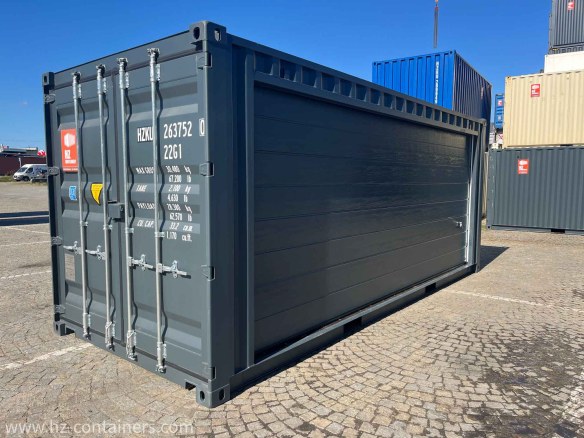
| Open Top (OT) | Open roof with tarpaulin, crane loading | 2.35 m height / 32 m³ |
| Flat Rack (FR) | No side walls or roof, for oversize cargo | 5.70 × 2.36 m floor area |
| Reefer (RF) | Refrigerated/frozen, with own unit | 5.45 × 2.29 × 2.25 m / 28 m³ |
| Tank‑tainer | For liquids, gases, powders | Internal tank + ISO frame |
| Double Door | Doors on both ends, easy loading/unloading | Same as DV |
| Open Top(description) | Suitable for heavy machines that cannot be loaded through doors, or for oversize parts. | |
| Flat Rack(description) | Ideal for transporting vessels, military equipment, pipes, large machines. | |
| Reefer(description) | Maintains constant temperature – chilled meat, dairy, pharmaceuticals. |
Construction and Materials
- Material: Mostly Corten steel – corrosion‑resistant, self‑healing oxide coating, service life at sea 10–15 years (often decades on land).
- Frame: Welded steel profiles, corrugated walls for added rigidity.
- Floor: Multi‑layer plywood (28 mm), impregnated against mold and pests, load capacity up to 2 000 kg/m², with lashing rings.
- Corner castings: Eight standardized reinforced corners for crane handling, stacking (up to nine containers high), and twist‑lock attachment.
- Doors: Double, robust, with four locking bars and massive seals for watertightness (WWT – wind & water tight).
- Protective coatings: Anti‑corrosion primer, paint layer, often with owner identification marks.
Comparison 20′ vs 40′ Containers
| Parameter | 20′ Container | 40′ Container |
|---|---|---|
| External length | 6.06 m | 12.19 m |
| Internal volume | 33 m³ | 67 m³ |
| Max. payload | 21 700 – 28 200 kg | up to 26 700 kg |
| Max. number of Euro pallets | 11 | 25 |
| Transport cost (absolute) | lower | higher |
| Cost per m³ | higher | lower |
| Ideal cargo | heavy, dense | light, volumetric |
Rule: For heavy goods the 20′ container is more efficient (weight limit reached sooner). For bulky, light goods the 40′ container offers a lower cost per cubic meter.
Sea Container 20′ in International Transport (FCL/LCL)
- FCL (Full Container Load): You rent the whole container – ideal for larger shipments, higher security and speed.
- LCL (Less than Container Load): Share a container with others, pay by volume/weight, suitable for smaller shipments.
- Intermodal transport: No cargo handling during the journey (ship, train, truck), significantly reducing damage risk and costs.
Alternative Uses After End of Service Life
After 10–15 years in maritime service, containers are often repurposed:
- Storage containers: Mobile warehouses on construction sites, in companies, for seasonal stock.
- Container architecture: Modular housing, shipping container homes, container houses, offices, shops, cafés, schools, festival structures.
- Workshops, technical facilities: Mobile workshops, generators, fuel stations, server rooms.
Facts and Trends
- Recycling: More containers are recycled for construction, eco‑projects, green roofs.
- Safety: Modern containers are equipped with GPS and IoT sensors for tracking location, temperature, humidity.
- Standards: ISO 668 (dimensions), ISO 6346 (marking), CSC (safety certification).
Related Terms
- TEU, FEU: Capacity measurement units
- ISO 668: Standard for dimensions and classification
- Corten steel: Weather‑resistant steel
- Intermodal transport: Combination of transport modes without cargo handling
- FCL/LCL: Types of shipments based on container occupancy
- High Cube, Dry Van, Open Top, Flat Rack, Reefer: Container types

 Czech Republic, Třebíč
  WITHOUT SHIPPING

Other container news...
Shipping container 12m (40 ft)
A 12m shipping container is an investment that, if properly selected and cared for, will pay off in decades of trouble-free use. Whether you plan to use it as a warehouse, workshop, garage or the basis for a residential module — the key is careful selection of the condition, a thorough inspection before purchase and high-quality preparation of the base for placement. Take the time to compare offers, check the seller’s references and do not hesitate to personally inspect the container before buying. A properly selected 40-foot container will serve you reliably for many years.
Construction container
A construction container is an investment in safety, order and comfort — whether it is protecting tools from thieves or providing a dignified environment for workers. There are three key decisions: type (storage, residential, sanitary, rubble), form of acquisition (rent vs. purchase) and legislative provision (occupation, building code).

Construction cabin – selection, tips, dimensions and prices
Every construction project – whether a family house, a development project or a reconstruction – starts with the infrastructure. No construction manager, craftsman or investor who needs an on-site office, a changing room for workers or a safe storage for tools can do without a quality construction cell. But navigating the offer is not easy: residential containers, sanitary cells, storage modules, rental, purchase, refurbished pieces… This guide will give you answers to all the essential questions in one place.
Storage container
A storage container is a lockable steel box designed for the safe and dry storage of materials, tools, goods or equipment. Originally created as a shipping container for maritime transport, its durability and versatility have found their way onto construction sites, corporate premises and private land.