
Repositioning a Shipping Container with ConFoot Legs
Repositioning a Shipping Container with ConFoot Legs introduces an innovative logistics process that allows a shipping container to be safely lifted, lowered, or temporarily set down without the use of heavy handling equipment (crane, reach stacker, forklift). The system uses a set of four lightweight, patented support legs that attach directly to the corner castings of an ISO container.
Thanks to this technology, the container can be independently set down at the destination and the truck driver can immediately continue with the next transport – without waiting for unloading or loading. This brings a substantial increase in efficiency, fleet optimisation and reduced operating costs. The ConFoot system is currently considered a revolutionary solution for handling containers, especially in locations with limited infrastructure.
Related terms
- Container handling without a crane
- Portable container lifts
- Container set‑down system
- ConFoot container legs
- Decoupling delivery and unloading
- ISO corner casting
- Mobile container storage
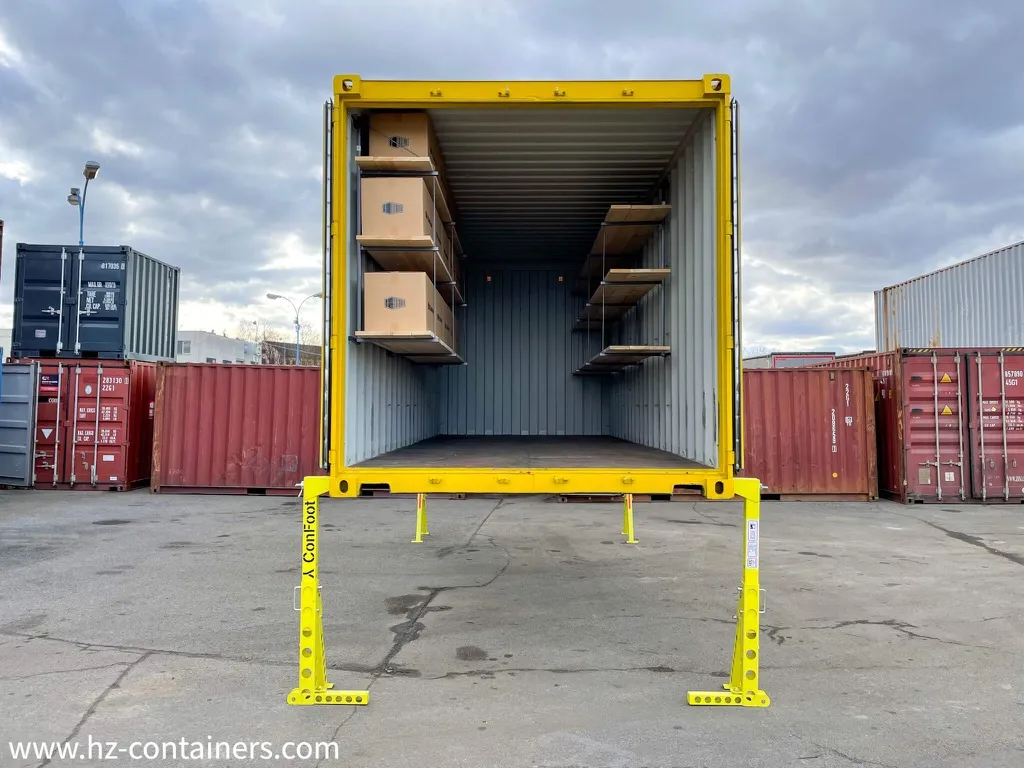
How it works – detailed process description
How does the manipulation process with ConFoot legs work?
- Arrival and preparation: The truck driver with an air‑suspended trailer arrives at the destination and raises the trailer to its maximum height.
- Leg installation: The four ConFoot legs are manually placed into the lower corner castings (ISO corner castings). Because each leg weighs 24 kg (CF/CFP) or 46 kg (CFU), one person can perform the installation.
- Container release: After the legs are secured, the twist‑locks that hold the container to the trailer are released.
- Trailer lowering: The trailer is lowered using its air suspension, allowing the container to settle safely on the ConFoot legs.
- Trailer departure: The truck can drive away while the container remains ready for gradual unloading or loading.
Reverse process – When the container needs to be loaded back, the driver drives the trailer under the container, raises the load platform, secures the twist‑locks, removes the legs and can depart.
Comparison with traditional methods
| Method | Need for equipment | Number of operators | Cost per handling | Time required | Flexibility |
|---|---|---|---|---|---|
| Mobile crane | Yes | 2–3 | High | 30–90 min | Low |
| Reach stacker | Yes | 1–2 | High | 20–60 min | Low |
| Gantry (portal) | Yes | 2–3 | Very high | 30–120 min | Low |
| ConFoot legs | No | 1 | Low (acquisition) | 5–10 min | High |
Models and variants of ConFoot legs
ConFoot offers several specialised models for different logistics scenarios. All models are tested according to EN 283 and carry CE certification.
| Model | Load capacity (per set) | Weight per leg | Adjustable height | Special features | Typical use |
|---|---|---|---|---|---|
| CF | 30–34 t | 24 kg | 1043–1448 mm | Magnetic lock, folding construction | Standard applications |
| CFP | 30 t | 24 kg | 1043–1448 mm | L‑shaped side for door, full door opening | Loading ramps |
| CFU 20 / CFU 30 | 20 t / 30 t | 46 kg | Up to 1.5 m | Hydraulic or mechanical lift, no air | Active lifting / lowering |
| CFL | 30 t | 24 kg | 1043–1448 mm | For “framed” containers (tank, silo, etc.) | Special storage |
Technological innovations
- Patented magnetic positioning system for easy mounting
- Compatible with ISO 10–45 ft containers
- Folding design for transport and storage of the legs directly in the cab or on the trailer
Technical parameters and certifications
| Parameter | Value / Standard |
|---|---|
| Material | High‑strength Finnish steel |
| Surface treatment | Powder coating, anti‑corrosion protection |
| Certifications | CE, EN 283, Directive 2006/42/EC |
| Static and dynamic tests | Yes, according to EN 283 |
| Safety margin | 1.5–2 × maximum declared load |
| Operated by | 1 person |
| Attachment system | Standard ISO corner casting |
| Service life | 10 + years (with basic maintenance) |
| Storage | Foldable, transportable in cab or on trailer |
Safety aspects and operating recommendations
Key safety principles
- Base surface: Always install the legs on a firm, level, load‑bearing surface (asphalt, concrete, compacted gravel).
- Correct use: Observe the maximum load for the selected model and never exceed the set’s capacity.
- Securing: After installation, visually verify proper insertion into the corner castings.
- Maintenance: Regularly inspect welds, pins and surface coating; clean off debris and corrosion.
- Training: Basic operator training is recommended, especially regarding occupational safety.
Certifications and legislation
ConFoot legs are approved for use in the EU (CE mark) and comply with:
- EN 283 – Testing of containers for road and rail transport
- Directive 2006/42/EC on machinery
- ISO 1161 – Dimensions and properties of ISO corner castings
Main benefits of the ConFoot system
Efficiency and cost savings
- Eliminates waiting: Drivers do not have to wait for unloading/loading; the fleet stays fully utilised.
- Low operating costs: No need to rent cranes or expensive handling equipment.
- Higher turnover: More trips per day increase carrier profitability.
Safety and simplicity
- One‑person operation: Full handling without additional labour.
- Stability: Robust construction tested for static and dynamic loads.
- Speed: Installation and removal in 5–10 minutes.
Flexibility and universality
- Applicable everywhere: Construction sites, warehouses, festivals, fields, military missions.
- Mobility: Legs can be carried directly in the cab or on the trailer – no special vehicle required.
- Compatibility: Suitable for all standard ISO containers (10–45 ft).
Environmental impact
- Reduced emissions: Less heavy‑equipment operation and shorter idle times for trucks.
- Sustainability: Long service life and recyclable steel materials.
Practical applications and field experience
Typical uses
- Logistics and transport: Optimised “last‑mile” delivery, efficient fleet use.
- Construction: Temporary storage, on‑site offices, modular buildings.
- Agriculture: Protection of crops, feed and equipment from moisture and pests.
- Retail: Continuous shop replenishment without blocking ramps.
- Military and humanitarian aid: Rapid establishment of stores and shelters in the field.
- Events and festivals: Mobile warehouses, ticket booths, support infrastructure.
Real‑world user feedback
- German logistics operator: “With ConFoot legs we reduced average truck waiting time to one‑third and increased daily orders by 20 %. Installation takes 7 minutes and any driver can do it after brief training.”
- Czech construction firm: “We use the legs as a mobile store right at the site. No earthworks, no cranes, maximum flexibility.”
- Agricultural enterprise: “Significant reduction in crop damage thanks to the ability to store containers above ground.”
Maintenance, storage and service life
Recommended maintenance
- Regular visual checks of welds and surface coating.
- Clean off mud, dust and salt after winter operation.
- Store in a dry place, preferably inside the cab or in a storage box.
- Lubricate moving parts according to the manufacturer’s instructions.
Service life
- With normal use and basic upkeep, the declared service life is 10 + years.
- Spare parts (pins, locks) are available through authorised distributors.
Comparison with alternative handling methods
| Method | Advantages | Disadvantages |
|---|---|---|
| Crane | High load capacity, versatility | Expensive, slow, requires operator |
| Reach stacker | Fast, easy handling of multiple containers | High acquisition/operating costs |
| Gantry (portal) | Efficient for large depots | Not mobile, high purchase price |
| ConFoot legs | Mobility, low cost, fast operation | Requires a firm surface, limited height |
Frequently Asked Questions (FAQ)
Can the ConFoot legs really be operated by a single person?
Yes, a standard leg weighs 24 kg, meeting European manual‑handling limits. Installation can be performed by any driver after minimal training.
Is the system safe for a fully loaded container?
Yes, the legs are tested up to 30–34 t (depending on model), covering the maximum container weight defined by ISO. They must be used on a solid, level base.
Can the legs be used on unpaved ground?
They are recommended only for paved or compacted surfaces (concrete, asphalt, compacted gravel). Soft ground (mud, sand) can cause sinking and loss of stability.
How are the legs transported?
The folding design allows transport in a storage box on the trailer, in the cab, or in a dedicated holder.
What is the maintenance schedule and expected lifespan?
Basic maintenance (visual inspection, cleaning) ensures a service life of over 10 years. The manufacturer offers service kits and spare parts.
Can the legs be used with non‑standard containers?
Yes, the CFL model is designed for “framed” containers such as tanks or silos.
Environmental impact and sustainability
- Lower carbon footprint: Fewer crane operations, reduced fuel consumption during truck idle periods, fewer heavy‑equipment movements.
- Recyclable materials: High‑strength steel can be fully recycled at end‑of‑life.
- Long service life: Reduces the need for new production of handling equipment.
HZ CONTAINERS s.r.o. is the distributor of ConFoot legs in the following countries:
Czech Republic, Croatia, Italy, Hungary, Malta, Romania, Greece, Slovakia and Slovenia.
ConFoot legs are also available for rental, but only in the Czech Republic and Slovakia.

 Czech Republic
  WITHOUT SHIPPING


Other container news...

How Many Pallets Fit in a Pallet Wide Container
Pallet Wide container is a technologically and logistically advanced type of shipping container that brings significant savings and higher efficiency in European and global logistics. It allows you to optimize the transport of palletized goods, reduces costs, speeds up handling and, last but not least, contributes to the greening of logistics chains. For companies that regularly transport goods on pallets, its use is a logical step towards increasing competitiveness and sustainability.

Sectional doors Hörmann for shipping containers
Hörmann sectional doors for shipping containers represent a high-quality, safe and comfortable solution for transforming shipping containers into full-fledged utility spaces. Thanks to their robust design, top-notch thermal and sound insulation, automation options and high variability, they are the ideal choice for garages, warehouses, workshops and commercial use. The modern design, long service life and environmental responsibility of the manufacturer Hörmann guarantee maximum satisfaction and return on investment.


SOC – shipping container
SOC (short for “Shipper Owned Container”) is a standard shipping container that is not owned or managed by a carrier (shipping line or logistics company), but directly by the customer, recipient, or freight forwarder.