
Open Top Container Rental
Open Top container rental from HZ KONTEJNERY s.r.o. represents a highly specialized service for the transport and temporary storage of items that exceed the capabilities of standard closed containers in terms of size, shape, or weight. Open Top is a variant of a transport container with an open upper part protected by a robust tarp, which allows vertical loading and unloading with a crane as well as handling of bulky or heavy loads that cannot be loaded through doors.
HZ KONTEJNERY s.r.o. provides not only the container itself, but also comprehensive logistical support: consulting, transport to the site, possible ConFoot leg rental, removal after the rental period ends, and technical assistance. The service is ideal for short-term projects, construction, industrial orders, as well as for private customers with one-time needs.
In-Depth Technical Analysis of Open Top Containers
Construction, Materials, and Key Elements
Material:
Open Top containers are manufactured from special CORTEN steel with additions of copper, nickel, chromium, and phosphorus. This alloy excels in high resistance to weather influences, corrosive environments, and mechanical stress. CORTEN creates a protective patina on the surface that prevents further rusting.
Reinforced Construction:
The missing solid roof is compensated by significantly reinforced upper and lower longitudinal members, corner posts, and massive cross members. This ensures sufficient rigidity for stacking and transport of heavy loads.
Removable Tarp:
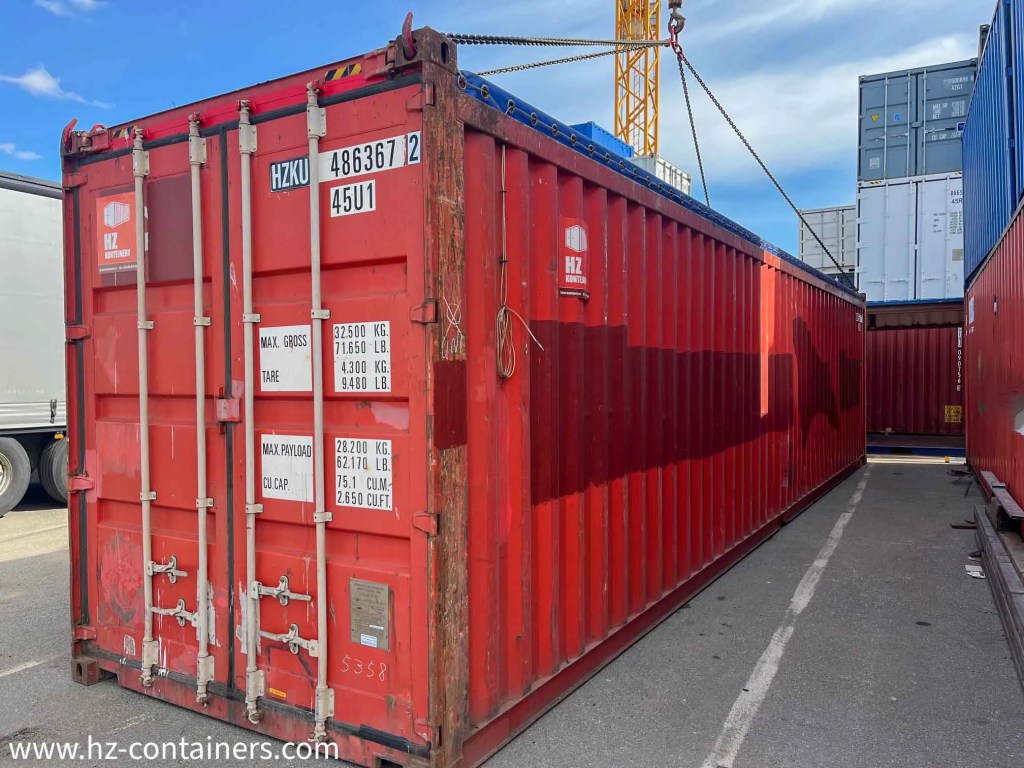
The roof is formed by a strong PVC or PE tarp (often 650–900 g/m² in weight) with high UV and water resistance, secured to robust aluminum or steel frames and ropes around the perimeter. The tarp can be easily rolled up or removed for quick access from above.
Roof Bows:
Removable steel cross members serve to prevent the tarp from sagging. These cross members can be removed during loading, allowing full use of the roof opening width and length.
Rotating Roof Header Bar:
A rotating or hinged upper beam is located at the doors, which can be removed before loading to ensure passage of items taller than the door frame.
Standard Front Doors:
The doors are double-leaf, equipped with lockable handles and sealing, allowing standard horizontal loading and cargo securing.
Lashing Rings:
Fixed lashing eyes are distributed across the floor and walls (minimum load capacity 1,000–2,000 kg per eye) for secure cargo securing with straps or chains according to EN 12195-2 standard.
ISO and CSC Certification:
Open Top containers are subject to ISO 668, ISO 6346 standards and the CSC (Container Safety Convention) safety certificate, which allows their use in international transport and stacking up to six layers.
Specifications and Dimensions (20′ and 40′ OT)
Specifications may vary slightly depending on the manufacturer, age, or specific series, but must always comply with strict standards:
| Parameter | 20′ Open Top (OT) | 40′ Open Top (OT) |
|---|---|---|
| External Length | 6,058 mm | 12,192 mm |
| External Width | 2,438 mm | 2,438 mm |
| External Height | 2,591 mm | 2,591 mm |
| Internal Length | 5,900 mm | 12,030 mm |
| Internal Width | 2,350 mm | 2,350 mm |
| Internal Height | 2,350 mm | 2,350 mm |
| Door Width | 2,340 mm | 2,340 mm |
| Door Height | 2,280 mm | 2,280 mm |
| Weight of Empty Container | approx. 2,350 kg | approx. 3,850 kg |
| Maximum Load Capacity | approx. 28,130 kg | approx. 26,630 kg |
| Internal Volume | approx. 32.5 m³ | approx. 66.4 m³ |
| Roof Opening Dimensions (L×W) | 5.44 × 2.23 m | 11.57 × 2.23 m |
Notes:
- The roof opening is bounded by a reinforced frame; the actual usable area is smaller than the total container length/width.
- On some containers, part of the cross members can be left in place to secure the tarp during transport.
Primary Purpose and Practical Use
Why and When to Choose Open Top?
- Oversized Height Cargo: Items exceeding the internal height of standard containers (e.g., machinery, turbines, sculptures).
- Heavy and Bulky Cargo: Crane handling is safer than using a forklift when moving heavy blocks, machinery, prefabricated elements.
- Vertical Loading: Bulk materials (gravel, sand, scrap), long pipes, wood, or scaffolding can be loaded from a hopper or lifted from above.
- Special Projects: Construction, renovation, cultural or artistic installations requiring non-standard logistics.
Typical Cargo and Industrial Sectors
Construction:
- Steel beams, concrete prefabricated elements, scaffolding, construction machinery, generators, long pipes, cable bundles.

Heavy Industry:
- Industrial equipment, parts of production lines, heavy motors, turbines, gearboxes, and industrial molds.
Mining and Raw Materials Sector:
- Large-volume big bags, raw wood, stone blocks, metal scrap (can be dumped from outside).
Agriculture and Forestry:
- Mature trees, large hay bales, specialized machinery, nursery plants.
Art, Exhibitions, Cultural Projects:
- Sculptures, monumental artifacts, stage sets, stage parts.
Practical Examples:
- Transport of wind turbine sections and ship engines.
- Transport of glass or concrete elements that must not be tilted.
Rental Process at HZ KONTEJNERY s.r.o.
Advantages of Rental Over Purchase
- Investment Savings: Purchasing an open top container is significantly more expensive than short-term rental, which is key for projects lasting weeks to months.
- Flexibility: Possibility to extend/terminate the rental according to project development, selection of specific dimensions and accessories.
- No Maintenance and Repairs: All service, inspections, and any repairs are handled by the provider.
- Immediate Availability: Containers in stock, possibility of quick delivery throughout the Czech Republic.
- Complete Logistics: Including transport, loading/unloading, possible provision of handling equipment and consulting.
Rental Process Step by Step
- Submit Inquiry: By phone, email, or online form, specify the dimensions, type, rental duration, and delivery location.
- Calculation and Offer: You receive a clear price quote, including detailed breakdown of items.
- Contract and Payment: After agreeing to the terms, a contract is concluded, followed by payment of deposit/rental and any handling fees.
- Transport and Unloading: As agreed. The container is delivered to the site, unloaded from the vehicle with a hydraulic arm (for 20′) or with crane assistance (for 40′) or using ConFoot leg rental.
- Use: The customer uses the container for the agreed period with the possibility of flexible extension.
- Termination and Removal: After the rental period ends, HZ KONTEJNERY arranges the return transport to the depot.
Detailed Cost Structure
- Monthly Rental: Depends on size, type, and rental duration. The longer the period, the more favorable the rate.
- Handling Fees: Loading and unloading of the container, or assistance with placement.
- Transport: Price according to distance from depot to client and back.
- Final Cleaning: Flat fee for sanitation and inspection after return.
- Possible Insurance: The customer must arrange insurance coverage against damage themselves.
Comparison with Other Container Types
| Container Type | Main Advantages | Limitations/Disadvantages | Typical Use |
|---|---|---|---|
| Open Top | Vertical loading, variable height, easy access | Higher price, need to maintain tarp | Oversized/bulky cargo, machinery |
| Standard (Dry Van) | Low price, standard goods, tightness | Cannot load from above, limited height | Palletized goods, boxes |
| Hard Top | Solid removable roof, higher protection | Higher weight, limited handling | Heavy, sensitive cargo |
| Side Opening | Side loading, quick access | Higher price, less common | Long pallets, building materials |
| Flat Rack | No roof or sides, extreme dimensions | No weather protection | Construction machinery, vehicles |
Placement, Handling, and Safety Accessories
Installation Requirements and Stability
- Surface: Level, compacted surface (concrete, asphalt, compacted gravel, panels). It is not recommended to place on uncompacted surfaces due to the risk of tilting or structural deformation.
- Access: Sufficient space for truck/trailer access, possibly crane access.
- Stacking: Open Top containers can be stacked, but only up to the height specified by the manufacturer (typically maximum 6 layers).
Certified Leveling Legs
- Purpose: Leveling legs allow container installation even on slightly uneven surfaces, protect the structure from twisting, and ensure proper door closure.
- Technical Parameters: Steel, height-adjustable, with load capacity up to 20 tons per leg; must be certified according to applicable standards.
- Advantages: Quick assembly and disassembly, without need for construction work. They extend container lifespan and increase safety.
Safety Accessories and Recommendations
- Locks and Security Seals: Use of certified container locks and seals reduces theft risk.
- Additional Weather Protection: For long-term outdoor storage, we recommend regular inspection of the tarp and cross members.
- Signaling Devices: GPS trackers can be used for monitoring container movement and location.
Technology, Communication, and Data Protection at HZ KONTEJNERY
- Digital Ordering System: Inquiries and communication take place electronically, ensuring fast processing and clear documentation.
- Technical Data Storage and Cookies: HZ KONTEJNERY website uses technology for storing user preferences, website optimization, and anonymous traffic analytics, always in accordance with applicable legislation (GDPR).
- Data Transparency: All personal and business information is protected and processed only to the necessary extent.
Frequently Asked Questions (FAQ)
Is the tarp on an Open Top container waterproof?
Yes, it is designed with maximum water resistance in mind (PVC, 650–900 g/m² weight), but in case of mechanical damage, it must be repaired/replaced immediately.
How does transport and unloading of a 40′ Open Top container work?
Standard transport is on a container trailer; unloading must be arranged with a crane with minimum load capacity of 7–10 tons and reach according to the situation. HZ KONTEJNERY s.r.o. will coordinate, or the customer at their own expense. Alternatively, unloading using ConFoot legs.
What is the minimum rental period?
Usually 1 month; shorter periods are uneconomical due to fixed costs.
What if the container gets damaged?
The customer is responsible for damage beyond normal wear and tear; the scope of coverage is described in the contract. Insurance is recommended.

 Czech Republic, Třebíč
  FREE SHIPPING
 Other container news...

Obligation to Check Tightness When Selling a Reefer Container
Who is responsible for the refrigerant leak check when selling a refrigerated container? Find out what obligations the seller has at the time of handover and why they must provide a PTI report along with the technical data plate. Learn which regulatory requirements and F-gas record-keeping duties become the sole responsibility of the new owner.

New shipping containers
If you are currently considering purchasing a new shipping container, you are not alone. While just twenty years ago containers were used almost exclusively for maritime transport, today they have found their way into construction, storage, business, and even housing. This growing popularity brings with it a host of questions: Which type should you choose? How much does it cost? How do you recognize quality? How can you avoid falling victim to scammers?
New sea shipping containers
If you are currently considering purchasing a new shipping container, you are not alone. While just twenty years ago containers were used almost exclusively for maritime transport, today they have found their way into construction, storage, business, and even housing. This growing popularity brings with it a host of questions: Which type should you choose? How much does it cost? How do you recognize quality? How can you avoid falling victim to scammers?

6m shipping container
Are you thinking about buying a 6-meter shipping container but aren’t sure what to look for? You are not alone—this 20-foot container is the best-selling size on the Czech market, and the differences between various types, conditions, and prices can be significant. In this guide, you will find everything you need to know: from exact dimensions and a comparison of categories (such as “one-way,” refurbished, and “Cargo Worthy”) to current prices and shipping advice.