
Corner Casting – Repair or Replacement?
Corner Casting (in Czech most often “corner casting of the container” or “corner element of the container”) designates a standardized high‑strength steel casting that is an indispensable part of all eight corners of a standardized ISO container. Corner castings are essential structural nodes of the container – they connect the frame and walls, transmit all loads and enable safe lifting, stacking and securing of the container in a multimodal transport chain.
Function and Importance of Corner Castings:
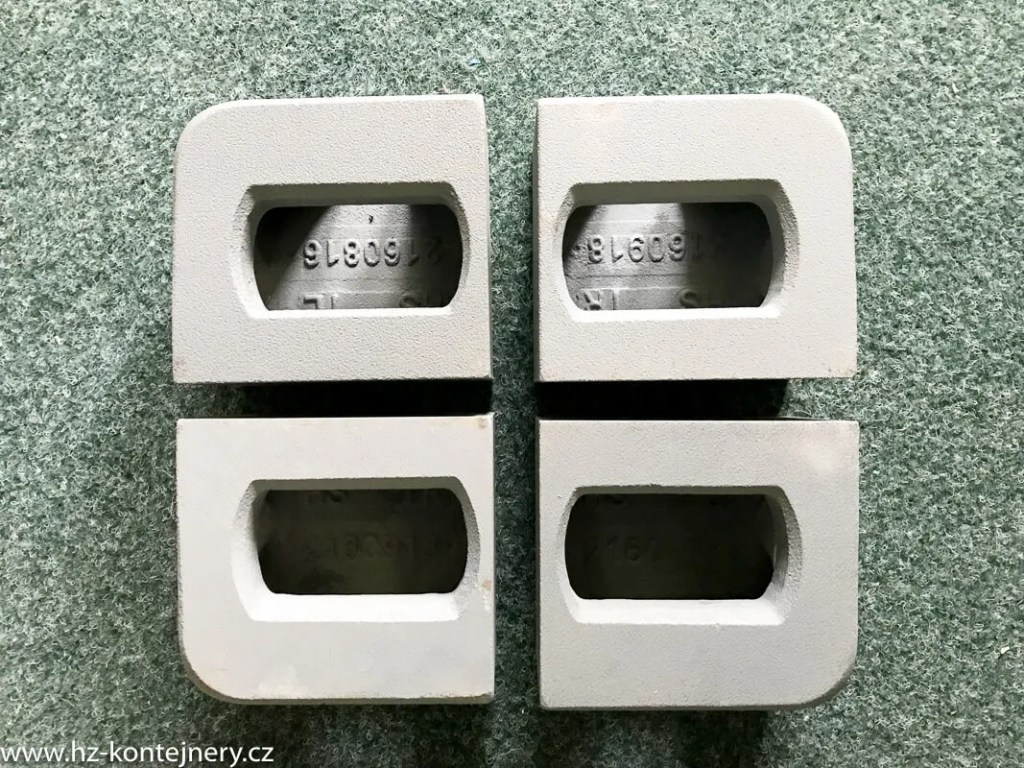
- Load‑bearing node of the container – transfers all forces between the container and handling equipment (cranes, spreaders, stacking devices).
- Standardized connection point – allows interchangeability and compatibility within the global container infrastructure thanks to standard ISO 1161.
- Key safety function – failure of a corner casting can have catastrophic consequences (collapse, stack failure, cargo damage and risk to life).
Alternative Names:
- Container Corner Fittings
- Shipping Container Corner Castings
- Container Corner Blocks
- ISO Corner Castings
- Corner Connectors
- Container Corners
- CEDEX code: CFG
Anatomy and Technical Specification of the Corner Element
Placement and Types of Corner Castings
Each ISO container contains eight corner castings:
- 4 upper corner elements (Top Left – TL, Top Right – TR)
- 4 lower corner elements (Bottom Left – BL, Bottom Right – BR)
Specifics:
- Upper and lower corner castings have different hole shapes – the upper often has an “acorn” (shield‑shaped) side hole, the lower typically oval (stadium).
- Each container corner has a unique (mirrored) part, marked on the casting.
Material and Production
- Material: Special low‑alloy carbon‑manganese cast steel (e.g., SCW490), designed for extreme mechanical stress and operation down to –40 °C.
- Manufacturing process: Usually precise casting into sand molds, followed by normalizing heat treatment (910 °C) to achieve optimal strength, ductility and toughness (see classification societies’ requirements – GL, BV, CCS, ABS, RINA, etc.).
- Alternative materials: Occasionally stainless steel (304, 316) or aluminium (for special applications), but cast steel is by far the most common and complies with ISO 1161.
Dimensions and Weight
| Parameter | Value | Standard |
|---|---|---|
| Length | 178 mm | ISO 1161 |
| Width | 162 mm | ISO 1161 |
| Height | 118 mm | ISO 1161 |
| Weight of element | approx. 11 kg | ISO 1161 |
| Wall thickness | min. 3/4″ (≈ 19 mm) | manufacturers |
| Openings | 3 (each different shape and location) | ISO 1161 |
All dimensions and tolerances are precisely defined by the ISO 1161 standard – tolerances are on the order of millimetres!
What Are the Openings in a Corner Casting For?
- Side opening (longer side) – handling, securing.
- Front opening (shorter side) – handling, securing.
- Top/bottom opening – for twist‑locks during stacking and securing.
Key Functions of Corner Castings
Function Overview
| Function | Description and Significance |
|---|---|
| Lifting | Enables safe gripping by cranes, spreaders and other equipment; transmits load up to 30 t. |
| Stacking | Aligns precisely with the next container; twist‑locks provide stack stability and safety. |
| Securing | Allows fixation to ship, rail wagon, truck chassis (twist‑locks, binding rods, chains). |
| Structural integrity | Transfers all static and dynamic forces to the container frame |
Corner castings are the backbone of safety and efficiency in container transport.
ISO 1161 Standard – Global Standard
ISO 1161:2016 is an international standard specifying:
- Exact dimensions and tolerances of all openings, shapes, positions and other details.
- Strength requirements: Must withstand forces during stacking up to 954 kN and lifting up to 300 kN.
- Functional compatibility: Twist‑locks, spreaders, chassis and securing devices must be interchangeable for all certified containers.
- Material requirements: Cast steel that undergoes normalizing heat treatment and meets required mechanical properties.
Thanks to this standard, containers can be transported safely and efficiently worldwide.
Damage, Inspection and the Untouchable Repair Rule
Most Common Types of Damage
| Damage type | Description | Critical limit |
|---|---|---|
| Cracks/fissures | Even a hairline crack, risk of propagation and failure | ZERO tolerance |
| Deformation | Bending > 5 mm from original plane | max. 5 mm |
| Enlarged openings | Wear, enlargement of twist‑lock openings | max. 66/127 mm |
| Reduced wall thickness | Corrosion, wear | per manufacturer/standard |
| Missing/broken parts | Mechanical damage | ZERO tolerance |
Inspection Limits (BIC, IICL)
| Item | Acceptable limit | Action if exceeded |
|---|---|---|
| Opening width | ≤ 66 mm | Immediate replacement |
| Opening length | ≤ 127 mm | Immediate replacement |
| Deformation | ≤ 5 mm | Immediate replacement |
| Cracks/fissures | 0 | Immediate replacement |
| Deformation preventing twist‑lock | 0 | Immediate replacement |
Even minor damage means the corner casting is taken out of service!
Why Welding Repair Is Prohibited
Repair by welding or any “filling” of a corner casting is prohibited worldwide. The only permitted method is replacement of the entire casting with a new, certified part. The reasons are purely technical and safety‑related:
Technical Reasons for the Welding Ban
- Metallurgical degradation: Cast steel is homogeneous and has undergone heat treatment for an optimal strength‑toughness balance. Welding creates a “heat‑affected zone” (HAZ) that is prone to brittleness and cracking.
- Internal stresses: Every weld introduces internal stresses into the casting, which combined with operational loads raises the risk of further failure.
- Disruption of force transmission: The corner casting is designed for smooth transfer of large forces; a weld becomes a stress concentration point (weakness).
- Quality control impossibility: In operational conditions it is impossible to guarantee weld quality and properties matching the original casting and heat treatment.
- Catastrophic failure consequences: Failure of a corner casting can cause container collapse, stack failure, million‑dollar damages and loss of life.
All leading organisations (IICL, BIC, CSC) require: The corner casting MUST NOT be repaired, only replaced!
Corner Casting Replacement Procedure
Step‑by‑Step
- Cutting out the damaged part: Careful removal of the damaged casting (plasma cutter, oxy‑fuel).
- Preparing surfaces: Grinding the weld surfaces to base metal, beveling surrounding frame parts for a quality weld.
- Fitting the new part: Precise alignment, geometry and gaps according to ISO 1161 (max. 2 mm).
- Welding: Use approved consumables (e.g., E7016/E7018 low‑hydrogen electrodes), full penetration, defect‑free. Only the joint to the frame is welded, never the casting itself!
- Final finishing: Clean welds, apply anti‑corrosion coating, verify dimensions and functionality.
This procedure fully restores the structural integrity of the container.

 Czech Republic
  WITHOUT SHIPPING


Other container news...

Side opening container for rent
A side-opening container for rent from HZ KONTEJNERY s.r.o. is a technically advanced, versatile and highly accessible storage space, available without the need for ownership and with complete service. It is the ideal choice for companies and individuals who need to quickly and flexibly solve storage, transportation or special projects without investment costs and maintenance worries.

Advantages of 4 Fold Shipping Containers
The advantage of 4 Fold shipping containers lies in their ability to fundamentally streamline the transport and management of empty containers. This concept is no longer just a theoretical innovation, but a fully certified and field-proven solution that delivers measurable savings, reduces environmental burdens and increases operational flexibility in the modern supply chain. In an era of increasing pressure for efficiency and sustainability, foldable containers like the 4 Fold are a key innovation that is changing the face of container transport.

What is IICL (Institute of International Container Lessors)
IICL is a cornerstone of the modern container industry. Its standards ensure safety, efficiency, cargo protection and long-term durability of containers. For anyone involved in logistics, knowledge and respect of IICL standards is a crucial competitive advantage.

Refrigerated Container for Rent
Renting a freezer container from HZ KONTEJNERY s.r.o. is a modern, effective and safe solution for anyone who needs reliable temperature-controlled storage. Thanks to innovations, professional service and high quality technology, it is an ideal choice for food companies, pharmaceutical operations, gastronomy, logistics and emergency situations.